
As filed with the Securities and Exchange Commission on April 24, 2026
UNITED STATES
SECURITIES AND EXCHANGE COMMISSION
Washington, D.C. 20549
FORM 20-F
ANNUAL REPORT PURSUANT TO SECTION 13 OR 15(d)
OF THE SECURITIES EXCHANGE ACT OF 1934
For the fiscal year ended December 31 , 2025
Commission file number 001-35934
Fomento Económico Mexicano, S.A.B. de C.V.
(Exact name of registrant as specified in its charter)
(Translation of registrant’s name into English)
(Jurisdiction of incorporation or organization)
(Address of principal executive offices)
(Name, telephone, email and/or facsimile number and address of company contact person)
Securities registered or to be registered pursuant to Section 12(b) of the Act:
Title of each class: | Trading Symbols: | Name of each exchange on which registered: | ||||||||||||
Securities registered or to be registered pursuant to Section 12(g) of the Act: None
Securities for which there is a reporting obligation pursuant to Section 15(d) of the Act: None
Indicate the number of outstanding shares of each of the issuer’s classes of capital or common stock as of the close of the period covered by the annual report:
BD Units, each consisting of one Series B Share, two Series D-B Shares and two Series D-L Shares, without par value. The BD Units represent a total of 2,015,185,015 Series B Shares, 4,030,370,030 Series D-B Shares and 4,030,370,030 Series D-L Shares. | ||||||||
B Units, each consisting of five Series B Shares without par value. The B Units represent a total of 7,085,242,500 Series B Shares. | ||||||||
Indicate by check mark if the registrant is a well-known seasoned issuer, as defined in Rule 405 of the Securities Act.
☒ | ☐ No | ||||
If this report is an annual or transition report, indicate by check mark if the registrant is not required to file reports pursuant to Section 13 or 15(d) of the Securities Exchange Act of 1934.
☐ Yes | ☒ | ||||
Indicate by check mark whether the registrant: (1) has filed all reports required to be filed by Section 13 or 15(d) of the Securities Exchange Act of 1934 during the preceding 12 months (or for such shorter period that the registrant was required to file such reports) and (2) has been subject to such filing requirements for the past 90 days.
☒ | ☐ No | ||||
Indicate by check mark whether the registrant has submitted electronically every Interactive Data File required to be submitted pursuant to Rule 405 of Regulation S-T (§232.405 of this chapter) during the preceding 12 months (or for such shorter period that the registrant was required to submit such files).
☒ | ☐ No | ||||
Indicate by check mark whether the registrant is a large accelerated filer, an accelerated filer, a non-accelerated filer or an emerging growth company. See the definitions of “large accelerated filer,” “accelerated filer” and “emerging growth company” in Rule 12b-2 of the Exchange Act.
Accelerated Filer ☐ | |||||
Non-accelerated Filer ☐ | |||||
If an emerging growth company that prepares its financial statements in accordance with U.S. GAAP, indicate by check mark if the registrant has elected not to use the extended transition period for complying with any new or revised financial accounting standards† provided pursuant to Section 13(a) of the Exchange Act. ☐
Indicate by check mark whether the registrant has filed a report on and attestation to its management’s assessment of the effectiveness of its internal control over financial reporting under Section 404(b) of the Sarbanes-Oxley Act (15 U.S.C. 7262(b)) by the registered public accounting firm that prepared or issued its audit report.
☒ | ☐ No | ||||
If securities are registered pursuant to Section 12(b) of the Act, indicate by check mark whether the financial statements of the registrant included in the filing reflect the correction of an error to previously issued financial statements. ☐
Indicate by check mark whether any of those error corrections are restatements that required a recovery analysis of incentive-based compensation received by any of the registrant's executive officers during the relevant recovery period pursuant to §240.10D-1(b). ☐
Indicate by check mark which basis of accounting the registrant has used to prepare the financial statements included in this filing:
U.S. GAAP ☐ | Other ☐ | |||||||
If “Other” has been checked in response to the previous question, indicate by check mark which financial statement item the registrant has elected to follow.
☐ Item 17 | ☐ Item 18 | ||||
If this is an annual report, indicate by check mark whether the registrant is a shell company (as defined in Rule 12b-2 of the Exchange Act).
☐ Yes | ☒ | ||||
TABLE OF CONTENTS
i
Share Ownership | |||||||||||
ii
iii
INTRODUCTION
References
The terms “FEMSA,” “our company,” “the Group,” “we,” “us” and “our” are used in this annual report to refer to Fomento Económico Mexicano, S.A.B. de C.V. and, except where the context otherwise requires, its subsidiaries on a consolidated basis.
The term “S.A.B.” stands for sociedad anónima bursátil, which is the term used in the United Mexican States
(“Mexico”) to denominate a publicly traded company under the Mexican Exchange Market Law (Ley del Mercado de
Valores or “Mexican Exchange Market Law”).
“IFRS” refers to International Financial Reporting Standards (Accounting Standards), as issued by the International Accounting Standards Board, unless otherwise stated.
“U.S.” or “United States” refers to United States of America; “U.S. dollars,” “US$,” “dollars” or “$” refer to the lawful currency of the U.S.; “Mexican pesos,” “pesos” or “Ps.” refer to the lawful currency of Mexico; and “Euros” or “€” refer to the lawful currency of the European Economic and Monetary Union (the “Euro Zone”).
Currency Translations and Estimates
This annual report contains translations of certain Mexican peso amounts into U.S. dollars at specified rates solely for the convenience of the reader. These translations should not be construed as representations that the Mexican peso amounts actually represent such U.S. dollar amounts or could be converted into U.S. dollars at the rate indicated. Unless otherwise indicated, such U.S. dollar amounts have been translated from Mexican pesos at an exchange rate of Ps. 18.0057 to US$ 1.00, the noon buying rate for Mexican pesos on December 31, 2025, as published by the U.S. Federal Reserve Board in its H.10 Weekly Release of Foreign Exchange Rates. On April 17, 2026, this exchange rate was Ps. 17.2380 to US$1.00.
To the extent estimates are contained in this annual report, we believe that such estimates, which are based on internal data, are reliable. Amounts in this annual report are rounded, and the totals may therefore not precisely equal the sum of the numbers presented.
Per capita growth rates, consumer price indexes, and population data have been taken from statistics prepared by the National Institute of Statistics, Geography and Information of Mexico (Instituto Nacional de Estadística, Geografía e Informática or “INEGI”), the U.S. Federal Reserve Board and the Mexican Central Bank (Banco de México), local entities in each country where we have operations and upon our estimates.
Sources
Certain information contained in this annual report has been computed based upon statistics prepared by the local entities such as INEGI and agencies in each country where we operate, the Federal Reserve Bank of New York, the U.S. Federal Reserve Board, Banco de México, the Comisión Nacional Bancaria y de Valores (Mexican National Banking and Securities Commission or “CNBV”) and upon our estimates.
Forward-Looking Information
This annual report contains words such as “believe,” “expect,” “anticipate” and similar expressions that identify forward-looking statements. Use of these words reflects our views about future events and financial performance. Actual results could differ materially from those projected in these forward-looking statements as a result of various factors that may be beyond our control including, but not limited to, effects on our company from changes in our relationship with or among our affiliated companies, fluctuation in the prices of raw materials, effects on our company’s points of sale performances from changes in economic conditions, changes or interruptions in our information technology systems, effects on our company from changes to our various suppliers’ business and demands, competition, significant developments in the countries where we operate, our ability to successfully complete or integrate mergers and acquisitions, including those we have completed in recent years and any current or future strategic projects (including the divestment of certain of our subsidiaries), our ability to fund our capital expenditures, international economic, social, political or environmental conditions, health epidemics, pandemics and similar outbreaks including future outbreak of diseases and their effect on customer behavior and on economic, political, social and other conditions globally, and in the countries where we have operations, as well as other facts described in “Item 3. Key Information—Risk Factors.” Accordingly, we caution readers not to place undue reliance on these forward-looking statements, which involve inherent risks and uncertainties. See “Item 3. Risk Factors.” In any event, these statements speak only as of their respective dates, and we undertake no obligation to update or revise any of them, whether as a result of new information, future events or otherwise.
1
ITEMS 1-2. NOT APPLICABLE
ITEM 3. KEY INFORMATION
The selected financial information should be read in conjunction with, and is qualified in its entirety by reference to, the consolidated financial statements, including the notes thereto appearing elsewhere in this annual report. The selected financial information as of December 31, 2025 and 2024 and for the years ended December 31, 2025, 2024 and 2023 is derived from the consolidated statements of financial position, consolidated income statements and other comprehensive income, included in the consolidated financial statements appearing elsewhere in this Annual Report. See “Item 5. Operating and Financial Review Prospectus.”
This annual report includes (under Item 18) our audited consolidated statements of financial position as of December 31, 2025 and 2024, and the related consolidated income statements, consolidated statements of comprehensive income, changes in equity and cash flows for the years ended December 31, 2025, 2024 and 2023. Our audited consolidated financial statements are prepared in accordance with IFRS.
This annual report presents financial information for 2025, 2024 and 2023 in nominal terms in Mexican pesos, taking into account local inflation of any hyperinflationary economic environment pursuant to IFRS. Our non-Mexican subsidiaries maintain their accounting records in their local currency and in accordance with accounting principles generally accepted in the country where they are located. For presentation in our consolidated financial statements, we adjust these accounting records into IFRS and report in Mexican pesos under these standards.
In the case of Argentina, the economy meets the criteria under IFRS to be treated as a hyperinflationary economy based on various economic factors, including that Argentina’s cumulative inflation over the three-year period prior to December 31, 2025 exceeded 100%, according to available indexes in the country. We recognized inflationary effects of our Argentine operations in our financial information. Our functional currency in Argentina was converted to Mexican pesos for the periods ended December 31, 2025, 2024 and 2023 using the exchange rates at the end of such periods. See Note 3.4 to our audited consolidated financial statements.
In February 2023, we discontinued the use of the equity method of accounting for Heineken N.V. and Heineken Holding N.V. (collectively, "Heineken"), and, in accordance with IFRS 5, Heineken’s operations were classified as discontinued operations for all years presented in the consolidated financial information included in this report. In May 2025, as part of our FEMSA Forward strategy, we completed the sale of our remaining equity stake in Heineken. See “Item 4. Information on the Company—Corporate History.”
In October 2023, as part of our FEMSA Forward strategy, we merged Envoy Solutions, LLC (“Envoy Solutions”) with IFS Topco, LLC (“Brady”) and obtained an ownership stake of 37.08% in the combined entity, currently doing business as BradyPLUS. On March 12, 2026, we closed the BradyPLUS and Imperial Dade all-equity merger. FEMSA remains invested in the combined entity with approximately 18.75% ownership and representation on its board of managers. See “Item 4. Information on the Company—Corporate History.” We account for our interest in BradyPLUS using the equity method. For periods prior to October 2023, in accordance with IFRS 5, Envoy Solutions’ operations are classified as discontinued operations. See Note 4.3 to our audited consolidated financial statements.
In November 2024, as part of our FEMSA Forward strategy, we divested our refrigeration and foodservice equipment business, and, in January 2025, we divested our plastic solutions operations. See “Item 4. Information on the Company—Recent Developments.” In July 2025, we completed the divestment of certain of our logistics operations doing business as Solistica. See “Item 4. Information on the Company—Recent Developments.” Additionally, our less-than-truckload operations in Brazil were held for sale until January 1, 2025, at which point it was reclassified as continuing operations. In accordance with IFRS 5, these operations (other than our less-than-truckload operations in Brazil since January 1, 2025) were classified as discontinued operations for all years presented in the consolidated financial information included in this report. See Note 4.3 to our audited consolidated financial statements.
Except when specifically indicated, information in this annual report is presented as of December 31, 2025 and does not give effect to any transaction, financial or otherwise, subsequent to that date.
Dividends
We have historically declared annual dividends in respect each Series of Shares (including in the form of American Depositary Shares, or “ADSs”), subject to changes in our results of operation and financial position, including due to extraordinary economic events, transactions, and the factors described in “Item 3. Key Information—Risk
2
Factors” that affect our financial condition and liquidity. These factors may affect whether or not dividends are declared and the amount of such dividends. We do not expect to be subject to any contractual restrictions on our ability to pay dividends, although our subsidiaries may be subject to such restrictions. Because we are a holding company with no significant operations of our own, we will have distributable profits and cash to pay dividends only to the extent that we receive dividends from our subsidiaries. Accordingly, we cannot assure you that we will pay dividends or as to the amount of any dividends.
The table below sets forth the nominal amount of dividends declared per share in Mexican pesos and translated into U.S. dollars, and their respective payment dates for the 2023 to 2025 fiscal years. All dividends were rounded up to the nearest whole number of ordinary shares.
| Fiscal Year | Aggregate | ||||||||||||||||||||||||||||||||||||||||||||||||||||
| with Respect to | Amount | ||||||||||||||||||||||||||||||||||||||||||||||||||||
| which Dividend | of Dividend | Per Series B Share | Per Series B Share | Per Series D Share | Per Series D Share | ||||||||||||||||||||||||||||||||||||||||||||||||
| Date Dividend Paid | was Declared | Declared | Dividend | Dividend(1) | Dividend | Dividend(1) | |||||||||||||||||||||||||||||||||||||||||||||||
May 8, 2023 and November 7, 2023 | 2022 | Ps. | 12,246,519,120 | Ps. | 0.6107 | $ | 0.0347 | Ps. | 0.7634 | $ | 0.0433 | ||||||||||||||||||||||||||||||||||||||||||
May 8, 2023 | Ps. | 0.3054 | $ | 0.0172 | Ps. | 0.3817 | $ | 0.0215 | |||||||||||||||||||||||||||||||||||||||||||||
November 7, 2023 | Ps. | 0.3054 | $ | 0.0175 | Ps. | 0.3817 | $ | 0.0218 | |||||||||||||||||||||||||||||||||||||||||||||
| April 18, 2024, July 18, 2024, October 17, 2024 and January 16, 2025 | 2023 | Ps. | 24,990,902,326 (2) | Ps. | 1.2463 | $ | 0.0669 | Ps. | 1.5578 | $ | 0.0836 | ||||||||||||||||||||||||||||||||||||||||||
| April 18, 2024 | Ps. | 0.3116 | $ | 0.0183 | Ps. | 0.3895 | $ | 0.0228 | |||||||||||||||||||||||||||||||||||||||||||||
| July 18, 2024 | Ps. | 0.3116 | $ | 0.0173 | Ps. | 0.3895 | $ | 0.0217 | |||||||||||||||||||||||||||||||||||||||||||||
| October 17, 2024 | Ps. | 0.3116 | $ | 0.0161 | Ps. | 0.3895 | $ | 0.0201 | |||||||||||||||||||||||||||||||||||||||||||||
| January 16, 2025 | Ps. | 0.3116 | $ | 0.0152 | Ps. | 0.3895 | $ | 0.0190 | |||||||||||||||||||||||||||||||||||||||||||||
April 25, 2025, July 18, 2025, October 17, 2025 and January 16, 2026 | 2024 | Ps. | 47,501,042,093 (3) | Ps. | 2.4486 | $ | 0.13177 | Ps. | 3.0606 | $ | 0.163 | ||||||||||||||||||||||||||||||||||||||||||
April 25, 2025 | Ps. | 0.61215 | $ | 0.03125 | Ps. | 0.76515 | $ | 0.0433 | |||||||||||||||||||||||||||||||||||||||||||||
July 18, 2025 | Ps. | 0.61215 | $ | 0.03262 | Ps. | 0.76515 | $ | 0.04077 | |||||||||||||||||||||||||||||||||||||||||||||
October 17, 2025 | Ps. | 0.61215 | $ | 0.03326 | Ps. | 0.76515 | $ | 0.04157 | |||||||||||||||||||||||||||||||||||||||||||||
January 16, 2026 | Ps. | 0.61215 | $ | 0.03464 | Ps. | 0.76515 | $ | 0.0374 | |||||||||||||||||||||||||||||||||||||||||||||
(1)Translations to U.S. dollars are based on the exchange rates on the dates the payments were made.
(2)Includes ordinary and extraordinary dividends. The total paid dividend reflecting the outstanding shares amounted to Ps. 14,404,167,269 of ordinary dividends and Ps. 10,090,865,110 of extraordinary dividends, reflecting the impact of share repurchases made throughout the year. See “Item 16.E. Purchases of Equity Securities by the Issuer and Affiliates Purchasers.” As of December 31, 2024, 511,006,615 shares were held in treasury, corresponding to 102,201,323 FEMSA UBD units.
(3)Includes ordinary and extraordinary dividends. The total dividend paid amounted to Ps. 14,728,723,836 million of ordinary dividends and Ps. 32,488,894,791 of extraordinary dividends, reflecting the impact of share repurchases made throughout the year. See “Item 16.E. Purchases of Equity Securities by the Issuer and Affiliates Purchasers.” As of December 31, 2025, 186,180,060 shares were held in our treasury, corresponding to 37,236,012 FEMSA UBD units.
On March 27, 2026, at our annual ordinary general shareholders meeting ("AGM") for 2026, our shareholders approved a cash dividend to be paid in four installments on April 23, 2026, July 16, 2026, October 15, 2026 and January 14, 2027, each consisting of Ps. 0.1980 per each Series B Share outstanding on the corresponding payment date and Ps. 0.2475 per each Series D Share outstanding on the corresponding payment date, corresponding to Ps. 0.9900 per each FEMSA “B” unit outstanding on the corresponding payment date and Ps. 1.1880 per each FEMSA “BD” unit outstanding on the corresponding payment date. Additionally, at such AGM on March 27, 2026, our shareholders approved an extraordinary cash dividend to be paid in four installments on April 23, 2026, July 16, 2026, October 15, 2026 and January 14, 2027, each consisting of Ps. 0.335825 per each Series B Share outstanding on the corresponding payment date and Ps. 0.419775 per each Series D Share outstanding on the corresponding payment date, corresponding to Ps. 1.679125 per each FEMSA “B” unit outstanding on the corresponding payment date and Ps. 2.014925 per each FEMSA “BD” unit outstanding on the corresponding payment date.
Annually, during each AGM, our shareholders approve our audited consolidated financial statements, together with a report by the Board of Directors, for the previous fiscal year at the AGM. Once the holders of Series B Shares have approved the audited consolidated financial statements, they determine the allocation of our net profits for the preceding year. Mexican law requires the allocation of at least 5% of net profits to a legal reserve, which is not subsequently available for distribution, until the amount of the legal reserve equals 20% of our paid in capital stock. As of the date of this annual report, the legal reserve of our company is fully constituted. Thereafter, the holders of Series B
3
Shares may determine and allocate a certain percentage of net profits to any general or special reserve, including allocations for open-market purchases of our shares. On March 27, 2026, at the AGM, our shareholders approved an amount of Ps. 34,000 million that may only be used for share repurchases. The remainder of net profits is available for distribution in the form of dividends to our shareholders. Dividends may only be paid if net profits are enough to offset losses from prior fiscal years.
Our bylaws provide that dividends will be allocated among the outstanding and fully paid shares at the time a dividend is declared in such manner that each Series D Share receives 125% of the dividend distributed in respect of each Series B Share. Holders of Series D Shares are entitled to this dividend premium in connection with all dividends paid by us. See “Item 10. Additional Information—Bylaws—Dividend Rights.”
Subject to certain exceptions contained in the deposit agreement dated May 11, 2007, as amended, among FEMSA, The Bank of New York Mellon, as ADS depositary and holders and beneficial owners from time to time of our ADSs, evidenced by American Depositary Receipts (“ADRs”), any dividends distributed to holders of our ADSs will be paid to the ADS depositary in Mexican pesos and will be converted by the ADS depositary into U.S. dollars based on the conversion rate as of the date of payment, net of any applicable fees. As a result, restrictions on the conversion of Mexican pesos into foreign currencies may affect the ability of holders of our ADSs to receive U.S. dollars, and exchange rate fluctuations may affect the U.S. dollar amount received by holders of our ADSs. See “Item 10. Additional Information—Taxation—Mexican Taxation” for a description of taxation related to dividends.
Risk Factors
Risks Related to Our Company
Coca-Cola FEMSA’s business depends on its relationship with The Coca-Cola Company, and changes in this relationship may adversely affect Coca-Cola FEMSA’s business, financial condition and results of operations.
Substantially all of Coca-Cola FEMSA, S.A.B. de C.V.’s (“Coca-Cola FEMSA”) sales are derived from sales of beverages that are sold under trademarks owned by The Coca-Cola Company, which we refer to as "Coca-Cola trademark beverages." Coca-Cola FEMSA produces, markets, sells and distributes Coca-Cola trademark beverages through standard bottler agreements in the territories where it operates, which we refer to as “Coca-Cola FEMSA’s territories.” Coca-Cola FEMSA is required to purchase concentrate for all Coca-Cola trademark beverages from affiliates of The Coca-Cola Company (“TCCC”), which price may be determined from time to time by TCCC in all such territories. Coca-Cola FEMSA is also required to purchase sweeteners and other raw materials only from companies authorized by TCCC. Increases in the cost, disruption of supply or shortage of ingredients for concentrate could have an adverse effect on Coca-Cola FEMSA’s business. See “Item 4. Information on the Company—Coca-Cola FEMSA—Coca-Cola FEMSA’s Territories.”
In addition, under Coca-Cola FEMSA’s bottler agreements, it is prohibited from bottling or distributing any other beverages without TCCC’s authorization or consent, and it may not transfer control of the bottler rights of any of its territories without prior consent from TCCC.
TCCC makes significant contributions to Coca-Cola FEMSA’s marketing expenses, although it is not required to contribute a particular amount. Accordingly, TCCC may discontinue or reduce such contributions at any time.
Coca-Cola FEMSA depends on TCCC to continue with its bottler agreements. Coca-Cola FEMSA’s bottler agreements are automatically renewable for ten-year terms, subject to the right of either party to give prior notice that it does not wish to renew the applicable agreement. In addition, these agreements generally may be terminated in the case of material breach. See “Item 10. Additional Information—Material Contracts—Material Contracts Relating to Coca-Cola FEMSA—Bottler Agreements.” Termination of any such bottler agreement would prevent Coca-Cola FEMSA from selling Coca-Cola trademark beverages in the affected territory. The foregoing and any other adverse changes in Coca-Cola FEMSA’s relationship with TCCC would have an adverse effect on its business, financial condition and results of operations.
The Coca-Cola Company has substantial influence on the conduct of Coca-Cola FEMSA’s business, which may result in Coca-Cola FEMSA taking actions contrary to the interests of Coca-Cola FEMSA’s shareholders other than The Coca-Cola Company.
TCCC has substantial influence on the conduct of Coca-Cola FEMSA’s business. As of the date of this report, TCCC indirectly owned 27.8% of Coca-Cola FEMSA’s outstanding capital stock, representing 32.9% of Coca-Cola FEMSA’s capital stock with full voting rights. TCCC is entitled to appoint up to five of Coca-Cola FEMSA’s maximum of 21 directors and the vote of at least two of them is required to approve certain actions by Coca-Cola FEMSA’s board of directors. As of the date of this annual report, we indirectly owned 47.2% of Coca-Cola FEMSA’s outstanding capital
4
stock, representing 56.0% of Coca-Cola FEMSA’s capital stock with full voting rights. We are entitled to appoint up to 13 of Coca-Cola FEMSA’s 21 directors and all of Coca-Cola FEMSA’s executive officers. TCCC and us, or only us in certain circumstances, have the power to determine the outcome of all actions requiring approval by Coca-Cola FEMSA’s board of directors, and TCCC and us, or only us in certain circumstances, have the power to determine the outcome of all actions requiring approval of our shareholders. See “Item 10. Additional Information—Material Contracts—Material Contracts Relating to Coca-Cola FEMSA—Shareholders Agreements.” The interests of TCCC may be different from the interests of Coca-Cola FEMSA’s other shareholders, which may result in Coca-Cola FEMSA taking actions contrary to the interests of such other shareholders.
Proximity Americas Division may not be able to maintain its historic growth rate.
Proximity Americas Division increased the number of OXXO stores at a compound annual growth rate of 5.8% from 2023 to 2025. The growth in the number of OXXO stores has driven growth in total revenue and results of operations at Proximity Americas Division over the same period. As the overall number of stores increases, percentage growth in the number of OXXO stores is likely to slow. In addition, as small-format store penetration in Mexico grows, the number of viable new store locations may decrease, and new store locations may be less favorable in terms of same-store sales, average ticket, and store traffic. As a result, our future results and financial condition may not be consistent with prior periods and may be characterized by lower growth rates in terms of total revenue and results of operations. We cannot assure that the revenues and cash flow of Proximity Americas Division that come from future retail stores will be comparable with those generated by existing retail stores. See “Item 4. Information on the Company—Proximity Americas Division —Store Locations.”
The Health Division’s sales and performance may be affected by a material change in institutional sale trends and payment by governmental entities in some of the markets where it has operations, as well as by contractual conditions with its suppliers.
In some of the markets where we have operations, the sales of the Health Division are highly dependent on institutional sales, as well as traditional, open-market sales. The institutional market involves public and private health care providers, and the performance of the Health Division could be affected by its ability to maintain and grow its client base. We and our institutional clients also depend on payments from governmental entities, which may be subject to changes in governmental policies and other constraints. We can not assure that said changes may adversely impact our business, financial condition and results of operations.
Additionally, the Health Division acquires the majority of its inventory and healthcare products from a limited number of suppliers. Its ability to maintain favorable conditions in its current commercial agreements could potentially affect the Health Division’s operating and financial performance.
The performance of the Fuel Division and our gas station operations in the U.S. may be affected by changes in commercial terms with suppliers, or disruptions to the industry supply chain, and the nature of such operations exposes the Fuel Division and our gas station operations in the U.S., and the communities in which we operate, to a range of health, safety, security and environmental risk.
The Fuel Division mainly purchases gasoline and diesel for its operations in Mexico. The fuel market in Mexico has experienced structural changes that could gradually decrease the number of suppliers. In the event of global changes in the industry, commercial terms could deteriorate in the future, adversely impacting the financial performance of the Fuel Division and that of our gas station operations in the U.S.
The nature of the operations of the Fuel Division and of our gas station operations in the U.S. creates exposure to certain risks, particularly at fuel stations. These risks include equipment failure, work accidents, fires, explosions, vapor emissions, spills and leaks at its facilities, service stations or other sites. These types of hazards and accidents may cause personal injuries or the loss of life, business interruptions and damage or contamination to the environment and to our property, equipment or reputation. Further, we may be subject to litigation, compensation claims, governmental fines or penalties or other liabilities or losses in relation to such incidents and accidents and may incur significant costs as a result. Such incidents and accidents may also affect our reputation or our brands, leading to a decline in sales of our products and services, and may adversely impact our business, financial condition and results of operations.
Our business expansion strategy may not be successful and may lead to decreased profit margins.
In recent periods, we have divested certain lines of business and entered new markets and new lines of business through the acquisition of other businesses, and we continue to seek investment opportunities in our core businesses, including as part of our FEMSA Forward strategy, which we announced on February 2023 to focus on our core business units of retail, Coca-Cola FEMSA and Spin. See “Item 4. Information on the Company—Corporate History.” These new businesses or investments may not result in the same growth rates that we have historically experienced, may experience
5
long lead times before returns on our investment materialize or may be less profitable than our more established businesses.
Key elements to achieving the benefits and expected synergies of these acquisitions are the ability to implement our strategies for these acquisitions, the effectiveness of those strategies, the integration of acquired businesses’ operations into ours in a timely and effective manner, the funding of capital expenditures and the retention of qualified and experienced key personnel. We may incur unforeseen liabilities in connection with acquiring, taking control of, or managing businesses and may encounter difficulties and unforeseen or additional costs in restructuring and integrating them into our operating structure.
Our long-term growth strategy includes expanding our store network organically, entering new geographic regions, and pursuing selective acquisitions and partnerships. These initiatives involve investments in capital, management resources, and operational capabilities, and may not generate the expected returns. Expansion into new markets may expose us to unfamiliar consumer preferences, competitive dynamics, and regulatory environments, which could limit our ability to replicate the success of our existing operations. In addition, newly opened stores or acquired operations may take longer than expected to reach targeted sales or profitability levels, and we may incur higher operating costs during the ramp-up period.
Furthermore, acquisitions and partnerships involve risks related to integration, execution, and the realization of anticipated synergies. If we are unable to successfully integrate acquired businesses, achieve the expected operational efficiencies, or adapt our value proposition to local market conditions, our expansion efforts may not deliver the anticipated profitability. As a result, these initiatives could put pressure on operating margins and returns on invested capital.
An erosion of our business reputation could have a material adverse effect on our brand, our ability to secure new resources and our business, financial condition, and results of operations.
Our reputation, trademarks and other proprietary rights are important to our competitive position. Coca-Cola FEMSA, OXXO and Spin, in particular, benefit from well-recognized brands. If we are unsuccessful in protecting our intellectual property rights, or if another party prevails in litigation claiming any rights thereto, the value of the brands could be diminished, causing customer confusion and materially adversely impacting our business and financial results. Failure to maintain product safety and quality could materially adversely affect our brand image and reputation and lead to potential product liability claims, governmental agency investigations and damages claims.
Substantially all of Coca-Cola FEMSA’s sales are derived from sales of Coca-Cola trademark beverages owned by TCCC. Maintenance of the reputation and intellectual property rights of these trademarks is essential to Coca-Cola FEMSA’s ability to attract and retain retailers and consumers and is a key driver for its success. Failure to maintain the reputation of Coca-Cola trademarks and/or to effectively protect these trademarks could have a material adverse effect on its business, financial condition and results of operations.
Societal expectations of businesses are also increasing; in recent years, we have seen a focus on business ethics, contribution to society, safety, and minimizing damage to the environment, among others. Also, there has been increased focus on the role of oil and gas and large retail businesses in the context of climate change and energy transition. These trends are subject to change and may be moderated or even reversed in certain geographies or constituencies within society. If we are unable to meet society demands in this regard, our brands, reputation and price of securities could be negatively affected, thus limiting our ability to deliver our strategy, reducing consumer demand for our products, harming our ability to secure new resources and contracts and restricting its ability to access capital markets or attract employees. Many other factors, including the materialization of the risks discussed in several of the other risk factors herein, could negatively affect our reputation and could have a material adverse effect on our business, financial condition and results of operations.
Our businesses highly depend on information technology and a failure, interruption or breach of our IT systems could adversely affect them.
Our businesses rely heavily on advanced IT systems to effectively manage our data, communications, connectivity and other business processes. We invest aggressively in IT to maximize its value generation potential. The development of IT systems, hardware and software needs to keep pace with the businesses’ growth due to the high speed at which the divisions add new services and products to their commercial offerings. If these systems become obsolete or if the planning for future IT investments is inadequate, our businesses could be adversely affected, so we constantly strive to improve and protect our IT systems with advanced security measures.
6
Cybersecurity incidents, system disruptions and other breaches of network or information technology security could have an adverse effect on our business and our reputation.
We use networks and information systems to operate our business, to process financial information and results of operations for internal reporting purposes and to comply with regulatory financial reporting, legal and tax requirements. Some of these information systems include the Internet and third-party hosted platforms and services used for procurement, supply chain, manufacturing, invoicing and storing client and employee personal data. Because information systems are critical to many of our operating activities, our business and new acquisitions may be impacted by system shutdowns, service disruptions or security breaches, such as failures during routine operations, network or hardware failures, malicious or disruptive software, unintentional or malicious actions of employees or contractors, cyber-attacks by hackers, criminal groups or nation-state organizations or social-activist (hacktivist) organizations, natural disasters, failures or impairments of telecommunication networks or other catastrophic events. Such incidents could result in unauthorized disclosure of material confidential information, and we could experience delays in reporting our financial results. In addition, misuse, leakage or falsification of information could result in violations of data privacy laws and regulations, damage to our reputation and credibility, loss of customers, and, therefore, could have a material adverse effect on our financial condition and results, or may require us to spend significant financial and other resources to prevent future attacks, remedy the damage caused by a security breach or to repair or replace networks and information systems.
We have adopted comprehensive policies and procedures related to our information security and privacy controls that assess compliance on these matters, including the sufficiency of the controls and procedures related to cybersecurity disclosure, through our Chief Information Security Officer, who advises the Audit Committee and Board of Directors on these matters.
Proximity Americas Division and Spin offer several financial and payments services for their customers. Cyber-security events such as the ones described above could result in unauthorized disclosure of customers’ confidential information, violations of data privacy laws and regulations, or in the total or partial loss of our customers funds, that could therefore require us to spend significant financial and other resources to prevent future attacks, remedy the damage caused by a security breach or to repair or replace networks and information systems. As we grow our digital business, we expect to hold more personal information of our customers, and, therefore, we expect these risks to increase.
We make investments in technologies, cyber insurance and training of our personnel. We also maintain an information security program that is presented to and supervised by the Audit Committee and by the Information Security Committee on a quarterly basis. As part of this information security program based on a risk approach, we have a cybersecurity framework, internal policies and cross-functional surveillance. Despite of our investments, our efforts to protect our IT systems, and the focus on risk management programs, we cannot assure that our systems will not be compromised or interrupted, or that increasing threats will not surpass our existing security measures. We may be subject to unexpected security breaches, and there is no assurance that the measures we implement will be sufficient to prevent such breaches.
If we fail to comply with privacy and data protection laws, we could be subject to adverse publicity, business disruption, data loss, government enforcement actions and/or private litigation, any of which could negatively affect our business and operating results.
In the ordinary course of our business, we receive, process, transmit and store information relating to identifiable individuals (“personal data”), including employees, former employees, vendors, third-party personnel, customers, and consumers with whom we interact. As a result, we are subject to a variety of continuously evolving and developing laws and regulations in numerous jurisdictions regarding privacy and data protection, which may include different standards and obligations or may be interpreted and applied differently from jurisdiction to jurisdiction and may create inconsistent or conflicting requirements. Our security controls over personal data and the policies, procedures and practices we have implemented or may implement in the future may not prevent the improper disclosure of personal data by us or the third-party service providers and vendors whose technology, systems and services we use in connection with the receipt, storage and transmission of personal data.
Our distributors, partners and suppliers have privacy and security controls and policies over personal data that differ in scope and complexity from our policies, procedures and practices, and we may also experience secondary contractual, regulatory, financial and reputational harm as a result of improper disclosure of personal data. Unauthorized access to or improper disclosure of personal data in violation of privacy and data protection laws could harm our reputation, cause loss of consumer confidence, subject us to regulatory enforcement actions (including penalties, fines and investigations), and result in private litigation against us, which could result in loss of revenue, increased costs, liability for monetary damages and/or fines, all of which could negatively affect our business and operating results. New and increased laws and regulations in this area, including self-regulation and industry standards, increased enforcement activity, and changes in interpretation of laws and regulations, could increase our cost of compliance and operation or otherwise harm our business.
7
Negative publicity, inaccurate information and ideological activism could adversely affect our reputation.
In recent years, there has been a considerable increase in the use of social media and similar platforms, including weblogs (blogs), social media websites, and other forms of Internet-based communications that allow individual access to a broad audience of consumers and other interested persons. Consumers value readily available information concerning retailers, manufacturers and their goods and services, and often act on such information without further investigation, authentication and without regard to its accuracy. The availability of information on social media platforms and devices is virtually immediate as is its impact. Social media platforms and devices immediately publish the content their subscribers and participants post, often without filters or checks on accuracy of the content posted. The opportunity for dissemination of information, including inaccurate information, is virtually limitless.
Negative publicity or inaccurate information concerning or affecting us, or our brands’ trademarks may be posted at any time on traditional media outlets, social media and similar platforms, including weblogs (blogs), social media websites, and other forms of Internet-based communications which allow individual access to a broad audience of consumers and other interested persons. We may experience additional risks as we grow FEMSA’s businesses. This information may harm our reputation without affording us an opportunity for redress or correction, which could in turn have a material adverse effect on its business, financial condition and results of operations. Likewise, campaigns by activists or others connecting us or our supply chain with certain political events or ideology, whether actual or perceived, could adversely impact our corporate image and reputation.
Regulatory developments in the countries where we have operations may adversely affect our business, financial condition and results of operations.
The principal areas in which we are subject to laws and regulations are labor, zoning, operations, environmental and related local permits, health and safety, anti-bribery, energy, taxation, antitrust, anti-money laundering, cybersecurity, among others. In connection with Spin, we are also subject to additional regulations applicable to payment providers and fintechs in the markets where we conduct those operations. See “Item 4. Information on the Company—Regulatory Matters—Fintech Regulations.” Changes in existing laws and regulations, the adoption of new laws or regulations, or stricter interpretation or enforcement thereof in the countries where we have operations may increase our operating and compliance costs or impose restrictions on our operations which, in turn, may adversely affect our business, financial condition and results of operations. We may also be subject to overlapping and potentially conflicting regulations in multiple jurisdictions. In addition, changes in current laws and regulations may negatively impact customer traffic, revenues, operational costs and commercial practices, which may have an adverse effect on results of our operations and financial condition.
Our business could be affected by new safety and environmental regulations enforced by governments, global environmental regulations and new energy technologies. Federal, state, and municipal laws and regulations for the installation and operation of service stations are becoming more stringent. Compliance with these laws and regulations is often difficult and costly. Global trends to reduce the consumption of fossil fuels through incentives and taxes could push sales of these fuels at service stations to slow or decrease in the future and automotive technologies, including efficiency gains in fossil fuel vehicles and increased popularity of alternative fuel vehicles, such as electric and liquefied petroleum gas (“LPG”) vehicles, have caused a reduction in fuel consumption globally. Other new technologies could further reduce the sale of fossil fuels, all of which could adversely affect results of operations and financial condition of the Fuel Division. See “Item 4. Information on the Company—Regulatory Matters—Environmental Regulations.”
Consumers’ increased concerns and changing attitudes about solid waste management and environmental responsibility and the related publicity could result in the adoption of such legislation or regulations. If these types of requirements are adopted and implemented on a large scale in any of our territories, they could affect our costs or require changes in our distribution model and packaging, which could reduce net operating revenues and profitability. For example, certain legislative and regulatory reforms have been enacted in some of the territories where Coca-Cola FEMSA operates, including in Colombia, to restrict the sale of single-use plastics and similar legislation or regulations may be proposed or enacted in the future, which may affect Coca-Cola FEMSA’s use of non-refillable and refillable containers. See “Item 4. Information on the Company—Regulatory Matters.”
Energy regulatory changes, in addition to other global events, such as the outbreak or escalation of military hostilities, may impact fuel prices and therefore adversely affect our business. The Fuel Division and our gas station operations in the U.S. mainly sell gasoline and diesel through owned or leased retail service stations. See "Item 3. Risk Factors—Global economic conditions have and may continue to cause an increase in the prices of raw materials, supply chain disruptions or shortages of raw materials and thus increase our cost of goods sold, therefore adversely affecting our business, financial conditions and results of operations." As of the date of this report, the prices of gasoline and diesel are regulated in Mexico by the National Energy Commission (Comisión Nacional de Energía, or “CNE”). See “Item 4. Information on the Company—Regulatory Matters—Energy Regulations.” Additionally, recent changes in energy regulations and regulatory agencies in Mexico may have an impact on the process for obtaining permits required for the expansion of the Fuel Division.
8
We are required to comply with anti-money laundering laws and regulations in the jurisdictions in which we have operations, which are particularly applicable to our retail and fintech businesses. Such laws and regulations require FEMSA to adopt and implement policies, procedures and controls designed to detect and prevent transactions with third parties involved in money laundering. Although we have such policies, procedures and controls in place, given the number of transactions made in its stores, we may be subject to the risk that our clients or third parties may misuse our services and engage in money laundering or other related illegal activities. There can be no assurance that FEMSA’s internal policies, procedures and controls will be sufficient to detect or prevent all inappropriate practices, including money laundering, fraud or other violations of law or that any person will not take actions in violation of FEMSA's policies, procedures and controls. As we expand and grow our retail and fintech businesses, including Spin, we will be subject to additional regulations applicable to financial technology companies in various jurisdictions. See “Item 4. Information on the Company—Regulatory Matters—Fintech Regulations.”
Price controls or voluntary price restraints in the countries where we operate may limit our ability to set prices for our products and could adversely affect our business, financial condition, and results of operations.
We operate in multiple territories and are subject to complex regulatory frameworks with increased enforcement activities with respect to anti-corruption, anti-bribery, anti-money laundering, water, environment, energy, labor, criminal, taxation, health and antitrust. In addition, on February 20, 2025, the U.S. government designated certain international cartels and transnational criminal organizations as Foreign Terrorist Organizations (“FTOs”), several of which are known to be present in jurisdictions where we have operations. These designations expand the tools available for U.S. authorities to prosecute members of FTOs or individuals or entities alleged to have provided them “material support” and increase the risk of potential criminal and civil liability against such entities or individuals. We maintain a Global Integrity Compliance Program that is supervised by our senior management, and employ a Legal Compliance Officer in each of our business units. Reports on such compliance program are presented to the Audit Committee of our Board of Directors on an annual basis. Despite our internal governance and compliance processes, including due diligence processes of third parties, we may be subject to breaches by our employees, contractors or other agents of our code of ethics, anti-corruption and anti-money laundering policies, other internal policies, or applicable laws or regulations, including instances of fraudulent behavior, corrupt practices, improper payments and dishonesty by any of them. In particular, the activities of criminal organizations, including international cartels and transnational criminal organizations, present in territories in which we operate have resulted in, and in the future may result in, impacts on our business, financial condition and results of operations, including through sustained interruption of our business, decreased revenues and higher expenses. In the past, we have decided to temporarily close stores in certain territories as a precautionary measure to ensure the safety of our employees, and we could also be required to do so in the future or to cease operations in certain territories. This could cause us to experience material income losses, increase in safety-related and insurance expenses, loss of product and revenue, or health and safety risks to our employees. See "Item 4. Information on the Company—Proximity Americas Division—Store Locations."
While we cooperate with law enforcement authorities in these territories, and despite government efforts to combat public corruption, these efforts may not be sufficient to prevent or avoid local, state and federal authorities and our employees being subject to corrupt practices or threats of violence which could lead to potential disruptions of our operations. We also cannot foreclose the possibility of criminal organizations affecting our operations by attempting to control the sale, distribution, and pricing of certain goods.
Our failure to comply with applicable laws and other standards could harm our reputation, subject us to substantial fines, sanctions or penalties and adversely affect our business. There is no assurance that we will be able to comply with changes in any laws and regulations within the timelines established by the relevant regulatory authorities.
Unfavorable outcome of legal proceedings could have an adverse effect on our business, financial condition, and results of operations.
Our operations and the operations of our business units have from time to time been and may continue to be subject to investigations and proceedings on antitrust, tax, consumer protection, environmental, labor and commercial matters. We cannot assure you that these investigations and proceedings will not have an adverse effect on our business units’ business, financial condition, and results of operations. See “Item 8. Financial Information—Legal Proceedings.”
Certain taxes could adversely affect our business, financial condition and results of operations.
The countries where we operate may adopt new tax laws or modify existing tax laws to increase taxes applicable to our business or products. Our products are subject to certain taxes in many of the countries where we operate. See “Item 4. Information on the Company—Regulatory Matters—Tax Reforms.” The imposition of new taxes, increases in existing taxes or changes in the interpretation of tax laws and regulation by tax authorities may have a material adverse effect on our business, financial condition and results of operations.
9
Changes in consumer preferences, as well as public concern about health-related and environmental issues, could reduce demand for some of Coca-Cola FEMSA’s products.
The beverage industry is evolving as a result of changing consumer preferences. If Coca-Cola FEMSA is unable to successfully introduce new products, digitize its operations or adapt to the rapidly changing retail landscape, including the rise of digital commerce, demand for its products may decrease and its overall financial results could be negatively affected.
Further, public concern over health-related issues has affected the beverage industry. Governmental authorities in some of the countries where Coca-Cola FEMSA operates have adopted various related plans and actions in recent years, including increases in tax rates and new taxes on the sale of certain beverages, as well as restrictions on using certain ingredients and additives in Coca-Cola FEMSA's beverages and packaging, and on the advertising, labeling and sale of some of its products. Moreover, researchers, health advocates and dietary guidelines encourage consumers to reduce their consumption of certain types of beverages sweetened with sugar, artificial sweeteners, High Fructose Corn Syrup (“HFCS”) and genetically modified foods, which may adversely affect Coca-Cola FEMSA's business.
In addition, concerns over the actual or perceived environmental impact of plastic may reduce the consumption of Coca-Cola FEMSA's products sold in plastic bottles or result in additional taxes that could adversely affect consumer demand. Increasing public concern about these issues, new or increased taxes, other regulatory measures, Coca-Cola FEMSA's failure to meet consumer preferences, changes in consumption patterns, including as a result of the effects or perceived effects of the use of weight-loss drugs, could reduce demand for some of its products, which would adversely affect Coca-Cola FEMSA's business, financial condition and results of operations. See “Item 4. Information on the Company—Coca-Cola FEMSA—Business Strategy.”
Competition in the markets where we have operations could adversely affect our business, financial condition and results of operations.
We face strong competition across industries in the countries where we have operations and may face competition from new market participants. The increase in competition may limit the number of new locations available or result in a reduction in revenues. Consequently, future competition may affect our results of operations and financial condition. See “Item 4. Information on the Company.” We expect the competitive environment will continue to evolve as new technologies are developed based on changing consumer trends and behavior. Lower pricing and activities by FEMSA’s competitors may affect our business. The continuing migration and evolution of the retail sector and financial services to online and mobile-based platforms for consumers may increase competition that could adversely affect our business, results of operations and financial condition.
FEMSA competes mainly in terms of price, packaging, effective promotional activities, access to retail outlets and sufficient shelf space, customer service, product innovation and product alternatives and the ability to identify and satisfy consumer preferences. See “Item 4. Information on the Company”
Global economic conditions have and may continue to cause an increase in the prices of raw materials, supply chain disruptions or shortages of raw materials and thus increase our cost of goods sold, therefore adversely affecting our business, financial conditions and results of operations.
Our sales volumes and revenues may be affected by economic conditions in the various countries where we operate. The prices for our raw materials are driven by market prices and local availability, the imposition of import duties and restrictions and fluctuations in exchange rates. Following a period of inflationary pressure on global markets, global economic growth was steady, though moderate, from 2023 through 2025, with varying degrees of recovery across different regions. Inflation has led to further increases in the costs of labor, raw materials, utilities and services that we use to produce our products and provide services, which would adversely affect our business if we are not able to pass on the increased costs to our customers or successfully implement mitigating actions.
The effects of inflation impact each of our businesses differently. For example, in addition to water, Coca-Cola FEMSA’s most significant raw materials are concentrate, which Coca-Cola FEMSA acquires from affiliates of TCCC, sweeteners, and packaging materials. Prices for Coca-Cola trademark beverages concentrate are determined with TCCC. Coca-Cola FEMSA is also required to meet all of its supply needs (including sweeteners and packaging materials) from suppliers approved by TCCC. Coca-Cola FEMSA’s most significant packaging raw material costs arise from the purchase of PET resin, the price of which is related to crude oil prices and global supply of virgin and recycled PET resin. Crude oil prices and related market dynamics have a cyclical behavior and are determined with reference to the U.S. dollar; therefore, high currency volatility and inflation may affect the average price for virgin and recycled PET resin in local currencies. Coca-Cola FEMSA cannot anticipate whether the U.S. dollar will appreciate or depreciate with respect to such local currencies in the future, and we cannot assure you that Coca-Cola FEMSA will be successful in mitigating any such fluctuations through derivative instruments or otherwise. See “Item 4. Information on the Company—Coca-Cola FEMSA—Raw Materials.”
10
For Proximity Americas Division and Proximity Europe Division, price variations of raw materials and supply chain disruptions caused by inflation may increase the cost of the goods sold.
Instability in the global trade landscape could affect our financial results and operations. The U.S. administration has implemented certain policies, including the imposition of increased tariffs at various levels on imports from several countries, including Mexico, Canada and China, which may lead to economic slowdown, supply chain constraints, currency volatility and additional inflation, further increasing our operational costs and potentially affecting demand for our products. The imposition of new import tariffs and similar actions by the U.S., as well as retaliatory tariffs by Mexico or other countries, could have a general impact on geopolitical conditions and, in turn, negatively affect our business, financial condition and results of operations.
In addition, geopolitical conflicts, including the ongoing military conflict involving Russia and Ukraine and the resulting economic sanctions imposed on Russia and certain Russian citizens and enterprises, as well as the ongoing military conflict in the Middle East involving the U.S., Israel and Iran, have resulted, and could continue to result, in volatile commodity markets, supply chain disruptions and greater risk of cyber incidents across the world. Volatility in commodity markets and supply chain disruptions have increased and may continue to increase the cost of some of our raw materials and therefore have an adverse effect on our business, financial condition and results of operations.
Water shortages or any failure to maintain existing concessions or contracts could adversely affect Coca-Cola FEMSA’s business, financial condition, and results of operations.
Water is an essential component of all of Coca-Cola FEMSA’s products. Coca-Cola FEMSA obtains water from various sources in its territories, including springs, wells, rivers and municipal and state water companies pursuant to either concessions granted by governments in its various territories (including governments at the federal, state or municipal level) or pursuant to contracts.
Coca-Cola FEMSA obtains the vast majority of the water used in its production from municipal utility companies and pursuant to concessions to use wells, which are generally granted based on studies of the existing and projected groundwater supply. Coca-Cola FEMSA’s existing water concessions or contracts to obtain water may be terminated by governmental authorities under certain circumstances and their renewal depends on several factors, including having paid all fees in full, having complied with applicable laws and obligations and receiving approval for renewal from local and/or federal water authorities. Climate change is causing a rise in temperatures in diverse territories and, as a result, is exacerbating water scarcity, droughts and flooding. This may cause a further deterioration of water quality in affected regions, which in turn could limit water availability for our bottling operations. In some of Coca-Cola FEMSA’s territories, its existing water supply may not be sufficient to meet its future production needs, and the available water supply may be adversely affected by shortages or changes in governmental regulations and environmental changes.
We cannot assure that water will be available in sufficient quantities to meet Coca-Cola FEMSA’s future production needs or will prove sufficient to meet its water supply needs. Continued water scarcity in the regions where Coca-Cola FEMSA operates may adversely affect its business, financial condition and results of operations.
Increases in the cost, disruption of supply or shortage of energy or fuel could adversely affect our business and results of operations.
Our business depends heavily on energy and fuel to maintain operations across segments.
An increase in the price, disruption of supply or shortage of fuel and other energy sources in the countries where we have operations, which may be caused by increased demand, natural disasters, power outages or government regulations, taxes, policies or programs, including programs designed to reduce greenhouse gas emissions to address climate change, could increase our operating costs and negatively impact our business and results of operations. Changes in government regulations in the countries where we have operations, including amendments related to transmission, sanctions, distribution, and other costs, could lead to a substantial increase in our electricity cost. See “Item 4. Information on the Company—Regulatory Matters.” The price of fuel has also increased in recent periods not only as a result of inflation and increases in energy demand, but also as a result of the conflict in Ukraine and Russia and subsequent economic sanctions imposed on Russia, particularly in Europe, as well as a result of the conflict in the Middle East involving the U.S., Israel and Iran. Further, military actions globally have affected fuel supply chains and increased the price of fuel. These and related events could adversely affect our costs and results of operations as a result of a reduction in output of petroleum, voluntary or otherwise, by oil-producing countries, sustained damage to oil-producing infrastructure, or prolonged interruptions to fuel supply chains. Moreover, a further escalation in international hostilities or instability in the region could have a destabilizing effect on global energy markets, which may impact us in the future. See "Item 3. Risk Factors—The performance of the Fuel Division and our gas station operations in the U.S. may be affected by changes in commercial terms with suppliers, or disruptions to the industry supply chain, and the
11
nature of such operations exposes the Fuel Division and our gas station operations in the U.S., and the communities in which we operate, to a range of health, safety, security and environmental risk."
Coca-Cola FEMSA’s operations deploy large fleets of trucks and other motor vehicles to distribute and deliver beverage products to its business partners and customers. In addition, Coca-Cola FEMSA uses a significant amount of electricity, natural gas and other energy sources to operate its bottling plants and distribution facilities. An increase in the price, disruption of supply or shortage of fuel and other energy sources in the countries where Coca-Cola FEMSA operates, which may be caused by increased demand, trade embargoes, natural disasters, power outages or government regulations, taxes, policies or programs, including programs designed to reduce greenhouse gas emissions to address climate change, could increase our operating costs and negatively impact Coca-Cola FEMSA’s business and results of operations.
The performance of FEMSA’s points of sale would be adversely affected by increases in the price of utilities on which the stores and stations depend, such as electricity. Electricity prices could potentially increase further as a result of inflation, shortages, interruptions in supply, changes in the regulatory framework and its interpretation or other reasons, and such an increase could adversely affect the results of operations and financial condition of our business.
We are subject to risks related to pandemics and public health crises that may materially and adversely affect our business.
Public health crises such as pandemics, tainted food, food-borne illnesses, food tampering, tampering with or failure of water supply may negatively affect our business, and demand for our products and services. We cannot predict whether there will be future pandemic outbreaks in any of the markets where we operate. A global pandemic could also impact our non-consolidated entities and cause significant volatility in financial markets, undermining investors’ confidence in the growth of countries and businesses. In addition, the longer-term economic effects of a global pandemic may include increased inflation rates, supply-chain disruptions, exchange rates volatility in the countries where we have operations and reduced demand for the products we sell or a shift to lower margin products. These lingering effects could be exacerbated by any additional pandemics or health crises.
Climate change and legal or regulatory responses thereto may have an adverse impact on our business.
There is increasing concern that a gradual rise of global average temperatures due to increased concentration of carbon dioxide and other greenhouse gases in the atmosphere will cause significant changes in weather patterns around the globe and an increase in the frequency and severity of natural disasters. Decreased agricultural productivity in certain regions of the world as a result of changing weather patterns may limit the availability or increase the cost of key agricultural commodities, such as sugarcane, corn and sugar beets, which are important sources of ingredients for Coca-Cola FEMSA’s products. Increasing concern over climate change also may result in additional legal or regulatory requirements designed to reduce or mitigate the effects of carbon dioxide and other greenhouse gas emissions on the environment. Increased energy or compliance costs and expenses due to increased legal or regulatory requirements may cause disruptions in, or an increase in the costs associated with, the manufacturing and distribution of Coca-Cola FEMSA’s beverage products. Initiatives to address climate change may be aimed at discouraging the use of traditional fuels, which could materially impact the Fuel Division’s business, financial conditions, and results of operations.
We expect increasing levels of regulation, disclosure-related and otherwise, with respect to environmental, social and governance (“ESG”) matters in Mexico and other countries where we have operations. On June 26, 2023, the IFRS Foundation’s International Sustainability Standards Board (“ISSB”) issued two sustainability standards, IFRS S1 and IFRS S2, requiring entities to disclose information about risks and opportunities related to sustainability and climate, respectively. In Mexico, the CNBV proposed significant modifications to domestic ESG-related regulations, particularly through amendments to the Disposiciones de Carácter General Aplicables a las Emisoras de Valores y a Otros Participantes del Mercado de Valores, known as the Circular Única De Emisoras (“CUE”) now requires issuers to prepare a sustainability report in accordance with such ISSB standards. The CUE amendments became effective on January 29, 2025 and provide a phase-in period requiring issuers to adopt IFRS S1 and IFRS S2 starting with their 2026 filings for fiscal year 2025. While external auditor assurance will not be required for reports filed in 2026 for fiscal year 2025, limited external auditor assurance will be required for filings made in 2027 for fiscal year 2026, and reasonable external auditor assurance will be required for filings made in 2028 for fiscal year 2027.
Compliance with these new rules, or similar rules or requirements imposed in other countries where we operate, may require us to incur significant additional costs to comply, including the implementation of significant additional internal controls, processes and procedures regarding matters that have not been subject to in the past, and impose increased oversight obligations on our management and Board of Directors. We may also be subject to overlapping and potentially conflicting ESG disclosure requirements in multiple jurisdictions. Our ability to comply with ESG regulations may be affected by factors outside our control, including access to water supply and fluctuations in the cost and availability of raw materials. Additionally, many of our suppliers, business partners and others in our value chain may be subject to similar expectations, which may increase or create additional risks, including risks that may not be
12
known to us. For these reasons, increased levels of ESG disclosure requirements could increase our operating costs and negatively impact our business and results of operations.
If Coca-Cola FEMSA fails to achieve its sustainability targets due to restrictions to access or short supply of energy from clean or renewable sources, technology or market conditions, or geopolitical developments, or if Coca-Cola FEMSA improperly reports on its progress toward achieving its emission reduction targets, or if Coca-Cola FEMSA or The Coca-Cola Company, as a partner in certain of these efforts, discontinue their sustainability initiatives to reduce the carbon footprint, the resulting negative publicity could adversely affect Coca-Cola FEMSA's business.
Weather conditions and natural disasters may adversely affect our business, financial condition and results of operations.
Lower or higher temperatures, higher rainfall, droughts and other adverse weather conditions such as hurricanes, natural disasters such as earthquakes, torrential rains, hurricanes and floods in the countries in which we operate may negatively impact consumer patterns, which may result in reduced sales of our products and at points of sale. Additionally, such adverse weather conditions and natural disasters may affect plant installed capacity, road infrastructure, personnel, assets and points of sale in the territories where we operate. Such events, or the containment measures to prevent or control them could also trigger increases in costs, disruption of supply, shortages of products, or consumer behavior changes including a decrease in an overall consumer mobility, thus affecting our business, financial condition, and results of operations. If any of these events becomes significant in duration, severity and frequency, our financial condition and results of operation could be materially adversely affected. FEMSA’s points of sales and facilities have been affected by hurricanes and other weather events in the past, which have resulted in increased insurance premiums, temporary closures and losses. Also, any of these events could force us to increase our capital expenditures to put our assets back in operation. See “Item 4. Information on the Company—Insurance.”
The management of one of our subsidiaries identified a material weakness in its information technology general controls (“ITGCs”) over financial accounting.
Coca-Cola FEMSA’s management has identified a material weakness related to ineffective ITGCs over systems that support its financial accounting. Due to such material weakness, our management has concluded that our internal control over financial reporting was not effective as of December 31, 2025. Despite such identified material weakness, no material errors were identified in our consolidated financial statements as of that date. For further details, please refer to “Item 15. Disclosure Controls and Procedures—(b) Annual Report of Management on Internal Control over Financial Reporting.”
Risks Related to Mexico and the Other Countries Where We Have Operations
Adverse economic conditions in Mexico may adversely affect our financial position and results of operation.
We are a Mexican corporation, and our Mexican operations are our single most important geographic territory. For the year ended December 31, 2025, 64% of our consolidated total revenues were attributable to Mexico. During 2025 and 2024, Mexican gross domestic product or GDP increased by approximately 0.7% and 1.3%, respectively, on an annualized basis compared to the previous year as published by the INEGI. We cannot assure that such conditions will be maintained or continue to increase in the future or will not have a material effect on our business, results of operations and financial condition going forward. The Mexican economy continues to be heavily influenced by the U.S. economy, and therefore, deterioration in economic conditions in, or delays in the recovery of, the U.S. economy may hinder any recovery. In the past, Mexico has experienced both prolonged periods of weak economic conditions and deterioration in economic conditions that have had a negative impact on our results.
Our business may be significantly affected by the general condition of the Mexican economy, or by the rate of inflation in Mexico, interest rates in Mexico and exchange rates for, or exchange controls affecting, the Mexican peso. Decreases in the growth rate of the Mexican economy, periods of negative growth and/or increases in inflation or interest rates may result in lower demand for the products we carry in our stores, lower real pricing of products, a shift to lower margin products or decrease in store traffic. Because a large percentage of our costs and expenses are fixed, we may not be able to reduce costs and expenses upon the occurrence of any of these events and our profit margins may suffer as a result.
In addition, an increase in interest rates in Mexico would increase the cost of our debt and would cause an adverse effect on our financial position and results of operation. Mexican peso-denominated debt (including currency hedges) represented 53.4% of our total debt as of December 31, 2025. See “Item 11. Quantitative and Qualitative Disclosures about Market Risk.”
13
Geopolitical conditions could negatively impact our financial results.
Financial uncertainties in our major markets and unstable geopolitical conditions or events in certain markets, including civil unrest, acts of war, terrorism or governmental changes could undermine global consumer confidence and reduce consumers’ purchasing power, thereby reducing demand for our products. Geopolitical conflicts, including the escalation of ongoing conflicts, such as the ongoing military conflict involving Russia and Ukraine and the resulting economic sanctions imposed on Russia and certain Russian citizens and enterprises, as well as other ongoing military conflicts globally, could also cause volatility in commodity markets and significant disruptions in supply chains across the world, which may increase the cost of some of our raw materials and therefore have an adverse effect on our business, financial condition and results of operations. Our presence in Europe through Valora A.G. ("Valora") positions FEMSA in closer proximity to the conflict in Russia and Ukraine and thus our European operations may be more significantly affected. Volatility in other regions in which we have operations may also impact our financial results and operations. There can be no assurance that future developments in emerging market countries and in the U.S., over which we have no control, will not have a material adverse effect on our financial condition and results.
Foreign exchange rate volatility of the Mexican peso and of our other local currencies could adversely affect our financial position and results of operation.
Foreign exchange rate volatility of the Mexican peso and of our other local currencies increases the cost of a portion of the raw materials we acquire, the price of which is paid in or determined with reference to U.S. dollars, and of our debt obligations denominated in U.S. dollars, and thereby negatively affects our financial position and results of operation. A severe devaluation or depreciation of the Mexican peso, which is our main operating currency, may result in disruption of the international foreign exchange markets and may limit our ability to transfer or to convert Mexican pesos into U.S. dollars and other currencies for the purpose of making timely payments of interest and principal on our U.S. dollar-denominated debt or obligations in other currencies. The Mexican peso is a free-floating currency and, as such, it experiences exchange rate fluctuations relative to the U.S. dollar over time. As of December 31, 2025, the Mexican peso appreciated relative to the U.S. dollar by approximately 13.7% compared to 2024. As of December 31, 2024, the Mexican peso depreciated relative to the U.S. dollar by approximately 23.4% and appreciated 13.3% in 2023, compared to the prior year. Through April 17, 2026, the Mexican peso has appreciated by approximately 4.3% since December 31, 2025. While the Mexican government does not currently restrict, and since 1982 has not restricted, the right or ability of Mexican or foreign persons or entities to convert Mexican pesos into U.S. dollars or to transfer other currencies out of Mexico, the Mexican government could impose restrictive exchange rate policies in the future, as it has done in the past. Currency fluctuations may have an adverse effect on our financial position, results of operation and cash flows in future periods.
When the financial markets are volatile, as they have been in recent periods, our results may be substantially affected by variations in exchange rates and commodity prices, and to a lesser degree, interest rates. These effects include foreign exchange gain and loss on assets and liabilities denominated in U.S. dollars, fair value gain and loss on derivative financial instruments, commodities prices and changes in interest income and interest expense. These effects can be much more volatile than our operating performance and our operating cash flows. See “Item 11. Quantitative and Qualitative Disclosures about Market Risk—Foreign Currency Exchange Rate Risk.”
The devaluation of the local currencies against the U.S. dollar can increase the operating costs for Coca-Cola FEMSA and other business units of FEMSA, and variations of the local currencies or the U.S. dollar can negatively affect the translation of Coca-Cola FEMSA’s and FEMSA’s results into Mexican pesos. Future currency devaluation or the imposition of exchange controls in Mexico or any of the countries in which we have operations would have an adverse effect on our financial position and results of operation.
Generally, future currency devaluations or the imposition of exchange controls in any of the countries where we have operations may potentially increase our operating costs, which could have an adverse effect on our results of operations and financial condition. See “Item 11. Quantitative and Qualitative Disclosures about Market Risk—Foreign Currency Exchange Rate Risk.”
Political, social and security events and conditions in Mexico and other countries in which we have operations could adversely affect our operations.
Mexican political events may significantly affect our operations. We cannot predict whether potential changes in Mexican governmental and economic policy could adversely affect economic conditions in Mexico or the sector in which we operate. The Mexican president and Congress have a strong influence over new policies and governmental actions regarding the Mexican economy, and the current federal administration could implement substantial changes in law, policy and regulations in Mexico, including reforms to the Constitution, which could negatively affect our business, results of operations and financial condition. In response to these actions, opponents of the administration could react with, among other things, riots, protests and looting that could negatively affect our operations.
14
On June 2, 2024, the presidential, state and local elections were held in Mexico, which were some of the largest elections in Mexico’s history given the number of elected being contested. Effective October 1, 2024, Claudia Sheinbaum won the presidential election and replaced Andres Manuel Lopez Obrador, both from the Morena political party, as President of Mexico for a six-year term. As of the date of this annual report, the Morena political party, together with its allied political parties, holds an absolute majority in the Chamber of Deputies, the Mexican equivalent of the House of Representatives, and a simple majority in the Senate, as well as a strong influence in numerous local legislatures.
Constitutional, legal and regulatory reforms in Mexico, particularly those affecting the judicial branch, regulatory frameworks and public and judicial entities, such as the constitutional reform of the judicial system in 2024, and the election reform currently being pursued by the Mexican administration, could introduce significant changes or uncertainties in the market that may impact our operations. Such reforms may affect our ability to conduct business, seek judicial review, alter regulatory compliance requirements, or create additional costs or operational risks, particularly in sectors subject to government oversight. We cannot provide any assurances that political developments in Mexico, such as changes in laws, public policy or regulations, judicial reforms, regulatory reforms, political disagreements or civil disturbances, over which we have no control, will not have an adverse effect on our business, results of operations and financial condition.
Furthermore, national presidential, state government and/or legislative elections took place in 2025 or are scheduled to take place in 2026 in several of the countries where we operate, including Argentina, Brazil, Costa Rica, Colombia, Mexico, Peru, Uruguay and the United States. These countries are or may be facing changes of government, which could introduce potential risks associated with shifts in political leadership and changes in public policies. Uncertainty surrounding the new administration’s agenda, regulatory reforms, and economic policies could impact our operations and financial performance.
Mexico has experienced periods of increasing criminal activity and particularly homicide rates, primarily due to organized crime. This poses a risk to our business and might negatively impact business continuity. An increase in crime rates could negatively affect our sales and customer traffic, increase our security expenses, affect our hours of operation and result in higher turnover of personnel or damage to the perception of our brands. Furthermore, this could adversely impact our business and financial results because consumer habits and patterns adjust to the increased perceived and real security risks, as people refrain from going out as much and gradually shift some on-premises consumption to off-premises consumption of food and beverages on certain occasions. Certain of our operations involve the transportation, storage and distribution of goods and materials. In certain regions, public security conditions may give rise to risks such as theft, vandalism or disruptions to logistics. While we maintain security measures and insurance coverage, such risks could result in operational delays, increased costs or losses, which may adversely affect our business, financial condition or results of operations. Further, actions by the Mexican government targeting organized crime have previously resulted in increased criminal activity in certain areas of Mexico, which has led to widespread retaliatory violence, road closures and, in some cases, temporary closures or damage to one or more of our points of sale.
Other countries in which we have operations have also experienced periods of increased criminal activity and other security incidents. We cannot assure you that political or social developments in the countries where we have operations or elsewhere, such as the election of new administrations, changes in laws, public policy or regulations, political disagreements, civil disturbances and the rise in violence and perception of such, over which we have no control, will not have a corresponding adverse effect on the local or global markets or on our business, financial condition and results of operations.
Adverse economic or political conditions in the U.S., or other related events, could have an adverse effect on the Mexican economy. Although economic conditions in other emerging market countries and in the U.S. may differ significantly from economic conditions in Mexico, investors’ reactions to developments in other countries may have an adverse effect on the market value of securities of Mexican issuers, the Mexican currency, or of Mexican assets. There can be no assurance that future developments in other emerging market countries and in the U.S., over which we have no control, will not have a material adverse effect on our financial situation and results.
There can be no assurance as to whether and to what extent new laws or regulations will be adopted, or the effect that any such measures or any others adopted by the U.S. administration and other governments will have on our operations.
Economic conditions in Mexico and other countries in which we have operations and raise capital could adversely affect our operations.
The markets in which we have operations are highly sensitive to economic conditions because a decline in consumer purchasing power is often a consequence of an economic slowdown which, in turn, results in a decline in the overall consumption of main product categories. During periods of economic slowdown, our points of sale may experience a decline in same-store traffic and average ticket per customer, which may result in a decline in overall
15
performance. See “Item 5. Operating and Financial Review and Prospects—Overview of Events, Trends and Uncertainties.”
Many countries worldwide, including Mexico, have suffered significant economic volatility in recent years, and this may occur again in the future. Global instability has been caused by many different factors, including substantial fluctuations in economic growth, high levels of inflation, changes in currency values, changes in governmental economic or tax policies and regulations and overall political, social, and economic instability. We cannot assure you that such conditions will not return or that such conditions will not have a material adverse effect on our financial condition and results.
The Mexican economy and currency and the market value of securities issued by Mexican issuers may be, to varying degrees, affected by economic and market conditions in other emerging market countries and in the U.S. In particular, economic conditions in Mexico have historically been correlated with economic conditions in the U.S. partially as a result of the U.S.-Mexico-Canada Agreement (“USMCA”), which came into force on July 1, 2020. A renegotiation of the USMCA, which is expected to occur by the mandatory review deadline of July 2026, if not sooner, an early withdrawal from the USMCA by any of the countries party to the agreement, or other related events, could have an adverse effect on the Mexican economy. Any adverse event affecting the relationship between any of the countries where we have operations and the U.S., including changes or the termination of any free trade agreement, may have a significant adverse effect on the economy of such countries.
Adverse economic conditions in the U.S. or other related events could have an adverse effect on the Mexican economy. Although economic conditions in other emerging market countries and in the U.S. may differ significantly from economic conditions in Mexico, investors’ reactions to developments in other countries may have an adverse effect on the Mexican currency or the market value of securities of Mexican issuers or of Mexican assets.
Risks Related to Our Principal Shareholders and Capital Structure
A majority of our voting shares are held by a voting trust, which effectively controls the management of our company, and the interests of which may differ from those of other shareholders.
As of April 1, 2026 the voting trust owned 40.6370% of our capital stock and 76.2768% of our capital stock with full voting rights, consisting of Series B Shares. Consequently, the voting trust has the power to elect a majority of the members of our board of directors and to play a significant or controlling role in the outcome of substantially all matters to be decided by our Board of Directors or our shareholders. The interests of the voting trust may differ from those of our other shareholders. See “Item 7. Major Shareholders and Related-Party Transactions” and “Item 10. Additional Information— Bylaws—Voting Rights and Certain Minority Rights.”
Holders of Series D-B and D-L Shares have limited voting rights.
Holders of Series D-B and D-L Shares have limited voting rights and are only entitled to vote on specific matters, such as certain changes in the form of our corporate organization, dissolution or liquidation, a merger with a company with a distinct corporate purpose, a merger in which we are not the surviving entity, a change of our jurisdiction of incorporation, the cancellation of the registration of the Series D-B and D-L Shares and any other matters that expressly require approval from such holders under the Mexican Securities Market Law. As a result of these limited voting rights, Series D-B and D-L holders will not be able to influence our business or operations. See “Item 7. Major Shareholders and Related-Party Transactions—Major Shareholders” and “Item 10. Additional Information—Bylaws—Voting Rights and Certain Minority Rights.”
Holders of ADSs may not be able to vote at our shareholder meetings.
Our shares are traded on the New York Stock Exchange (“NYSE”) in the form of ADSs. We cannot assure that holders of our shares in the form of ADSs will receive notice of shareholders’ meetings from our ADS depositary in sufficient time to enable such holders to return voting instructions to the ADS depositary in a timely manner. If instructions are not received with respect to any shares underlying ADSs, the ADS depositary will, subject to certain limitations, grant a proxy to a person designated by us in respect of these shares. If this proxy is not granted, the ADS depositary will vote these shares in the same manner as the majority of the shares of each class for which voting instructions are received.
Holders of BD Units in the U.S. and holders of ADSs may not be able to participate in any future preemptive rights offering and as a result may be subject to dilution of their equity interests.
Under applicable Mexican law, if we issue new shares for cash as a part of a capital increase, other than in connection with a public offering of newly issued shares or treasury stock, we are generally required to grant our shareholders the right to purchase enough shares to maintain their existing ownership percentage. Rights to purchase
16
shares in these circumstances are known as preemptive rights. By law, we may not allow holders of our shares or ADSs who are in the U.S. to exercise any preemptive rights in any future capital increases unless (1) we file a registration statement with the SEC with respect to that future issuance of shares or (2) the offering qualifies for an exemption from the registration requirements of the U.S. Securities Act of 1933, as amended. At the time of any future capital increase, we will evaluate the costs and potential liabilities associated with filing a registration statement with the SEC, as well as the benefits of preemptive rights to holders of our shares in the form of ADSs in the U.S. and any other factors that we consider important in determining whether to file a registration statement.
We may decide not to file a registration statement with the SEC to allow holders of our shares or ADSs who are located in the U.S. to participate in a preemptive right offering. In addition, under current Mexican law, the sale by the ADS depositary of preemptive rights and the distribution of the proceeds from such sales to the holders of our shares in the form of ADSs is not possible. As a result, the equity interest of holders of our shares in the form of ADSs would be diluted proportionately. See “Item 10. Additional Information—Bylaws—Preemptive Rights.”
The protections afforded to non-controlling shareholders in Mexico are different from those afforded to non-controlling shareholders in the U.S.
Under Mexican law, the protections afforded to non-controlling shareholders are different from, and may be less than, those afforded to non-controlling shareholders in the U.S. Mexican laws do not provide a remedy to shareholders relating to violations of fiduciary duties. There is no procedure for class actions as such actions are conducted in the U.S. and there are different procedural requirements for bringing shareholder lawsuits against directors for the benefit of companies. Therefore, it may be more difficult for non-controlling shareholders to enforce their rights against us, our directors or our controlling shareholders than it would be for non-controlling shareholders of a U.S. company.
Investors may experience difficulties in enforcing civil liabilities against us or our directors, officers and controlling persons.
FEMSA is organized under the laws of Mexico, and most of our directors, officers and controlling persons reside outside the U.S. In addition, nearly all or a substantial portion of our assets and the assets of our subsidiaries are located outside the U.S. As a result, it may be difficult for investors to effect service of process within the U.S. on such persons or to enforce judgments against them, including any action based on civil liabilities under the U.S. federal securities laws. There is doubt as to the enforceability against such persons in Mexico, whether in original actions or in actions to enforce judgments of U.S. courts, of liabilities based solely on the U.S. federal securities laws.
The failure or inability of our subsidiaries to pay dividends or other distributions to us may adversely affect us and our ability to pay dividends to holders of ADSs.
We are a holding company. Accordingly, our cash flow is principally derived from dividends, interest and other distributions made to us by our subsidiaries. Currently, our subsidiaries do not have contractual obligations that require them to pay dividends to us. In addition, debt and other contractual obligations of our subsidiaries may in the future impose restrictions on our subsidiaries’ ability to make dividend or other payments to us, which in turn may adversely affect our ability to pay dividends to shareholders and meet our debt and other obligations. As of April 1, 2026, we had no restrictions on our ability to pay dividends.
ITEM 4. INFORMATION ON THE COMPANY
Corporate Information
Our company was incorporated under the laws of Mexico on May 30, 1936 for a duration of 99 years. The duration can be extended indefinitely by resolution of our shareholders. We are organized as a sociedad anónima bursátil de capital variable under the laws of Mexico. Our legal name is Fomento Económico Mexicano, S.A.B. de C.V., and in commercial and business contexts we frequently refer to ourselves as “FEMSA.” Our principal headquarters are located at General Anaya No. 601 Pte., Colonia Bella Vista, Monterrey, Nuevo León 64410, Mexico. Our telephone number at this location is (+52-81) 8328-6000.
Any filings we make electronically are available to the public over the internet at our website www.femsa.com. This URL is intended to be an inactive textual reference only. It is not intended to be an active hyperlink to our website. The information on our website, which might be accessible through a hyperlink resulting from this URL, is not and shall not be deemed to be incorporated into this annual report. The SEC maintains an internet site that contains reports and other information regarding issuers that file electronically with the SEC at www.sec.gov. See “Item 10. Additional Information—Documents on Display.”
17
Corporate History
FEMSA traces its origins to the establishment of Mexico’s first brewery, Cervecería Cuauhtémoc, S.A. (“Cervecería Cuauhtémoc”), which was established in 1890. Descendants of certain of the founders of Cervecería Cuauhtémoc are participants of the voting trust that controls our company.
The following paragraphs describe certain key transactions and developments of FEMSA in the past three years.
In February 2023, we announced the FEMSA Forward strategy, which was the result of a thorough strategic review of our business platform, including the bottom-up definition of long-range plans for each business unit, as well as the top-down analysis of FEMSA’s corporate and capital structure. Consistent with this vision, we have determined that the best way to maximize long-term value creation is to focus on our core business verticals with the highest strategic relevance, growth potential, and financial and competitive strengths: our retail businesses, Coca-Cola FEMSA, and our digital solutions business.
In March 2023, we acquired the remaining 85.18% shares of Net Pay, S.A.P.I. de C.V., a merchant aggregator that offers several payment services and solutions to micro, small and medium-sized businesses in Mexico.
In June 2023, we successfully finalized the divestment of our interest in Jetro Restaurant Depot. As a result of this transaction, we received a total cash consideration of US$1.4 billion, of which approximately US$467 million was received in June 2023 and the remaining balance of approximately US$945 million was received in July 2024.
In October 2023, we created a new platform within the facility care, foodservice disposables and packaging distribution industries in the U.S., merging Envoy Solutions with Brady in a highly complementary combination, positioned to serve and provide value to its customers and suppliers effectively and efficiently across the country. Following the completion of this transaction, we received approximately US$1.5 billion in cash and retained economic interest of 37.08% in the combined entity.
In August 2024, we entered into definitive agreements with Delek US Holdings, Inc. (“Delek”) to acquire Delek’s retail operations, consisting of 249 convenience stores located mainly in Texas, in the United States, for a total of US$385 million on a cash-free, debt-free basis, including the purchase of inventories. In September 2024, we successfully closed such acquisition. This acquisition represented an important milestone for FEMSA as it strategically expands its retail footprint into the U.S. market.
In September 2024, we acquired from Grupo Conektame, S.A. de C.V.’s (“Conekta”) its cash business, which supports our OXXO Pay services. For Spin, this acquisition involved integrating various technological and operational elements from Conekta that supported OXXO Pay, a digital solution that allows businesses to increase their sales by accepting cash payments at OXXO stores for products and services sold online.
In November 2024, we finalized the divestment of our refrigeration and foodservice equipment operations, Imbera and Torrey, to Mill Point Capital LLC, a U.S.-based private equity firm, for a total amount of approximately Ps. 8,000 million, on a cash-free, debt-free basis.
In January 2025, we finalized the divestment of our plastics solutions operations to AMMI, a leading diversified corporation focused on the production of non-GMO corn and sustainable plastic packaging, and an affiliate of Milenio Capital. The transaction amount was Ps. 3,165 million, on a cash-free, debt-free basis.
In May 2025, we completed the sale of our equity interests in Heineken in an amount of approximately €359 million. This transaction marked the final step in a series of related transactions. In February 2023, we completed a sale of equity interests in Heineken in an amount of approximately €3.2 billion and completed an offering of senior unsecured exchangeable bonds for a principal amount of €500 million, which has since been paid, through a wholly owned subsidiary, exchangeable into existing issued ordinary shares of Heineken Holding N.V. As a result, FEMSA’s appointed directors resigned from Heineken’s Board of Directors and, at that point, we lost significant influence over Heineken. In May 2023, we completed an additional sale of equity interests in Heineken in an amount of approximately €3.3 billion, at which point we reduced our combined economic interest in Heineken from 14.76% to 0.91%. With the sale of our final equity interests in Heineken in May 2025, we completed our divestment of our Heineken investment.
In July 2025, we finalized the divestment of our transportation management operations in Mexico, as well as our contract logistics operations in Mexico, Brazil and Colombia doing business as Solistica (the “Solistica Logistics Transaction”), to Grupo Traxión, S.A.B. de C.V. (“Traxión”), a leading transportation and logistics company based in Mexico. The transaction did not include less-than-truckload operations in Brazil. The total consideration for this transaction was Ps. 4,100 million, on a cash-free, debt-free basis.
18
In September 2025, we announced the appointment of Jose Antonio Fernández Garza Lagüera as FEMSA's chief executive officer (“CEO”). On November 1, 2025, Mr. Fernández Garza Lagüera, former CEO of FEMSA Proximity & Health, succeeded José Antonio Fernández Carbajal, who held the position of acting CEO on an interim basis and currently holds the position of Chairman of the Board of Directors.
Recent Developments
In February 2026, we completed the separation of our joint venture with Raízen, S.A. (“Raízen”) in Brazil known as “Grupo Nós”, a transaction that was announced in September 2025. As a result of this transaction, we retained the OXXO stores in Brazil, which as of December 31, 2025 were 607, as well as the distribution center located in Cajamar, São Paulo, while Raízen retained all the Shell Select convenience stores. The remaining assets and liabilities of Grupo Nós were allocated between FEMSA and Raízen in accordance with their respective businesses.
In February 2026, we settled and repaid the outstanding principal of our €500 million exchangeable bonds. As mentioned above, these bonds, originally issued in February 2023 as part of the FEMSA Forward strategy, were exchangeable into ordinary shares of Heineken Holding N.V. At maturity, the outstanding principal amount was repaid; this transaction marks the conclusion of the specific exchangeable debt instrument linked to the divestment process initiated in 2023. We paid a total of approximately €513.1 million over the life of the bond, including interest and principal.
On March 12, 2026, BradyPLUS, in which we owned a non-controlling interest, completed an all equity merger transaction to combine with Imperial Dade, following a definitive agreement entered into in August 2025. BradyPLUS is a provider of janitorial and sanitation, foodservice, and industrial packaging products and solutions in the United States. Imperial Dade is a distributor of foodservice packaging, commercial cleaning supplies, janitorial equipment, and industrial packaging in the United States. FEMSA maintains an investment in the combined company with approximately 18.75% and will have representation on its board.
On March 12, 2026, BradyPLUS, in which we owned a non-controlling interest, completed an all equity merger transaction to combine with Imperial Dade, following a definitive agreement entered into in August 2025. BradyPLUS is a provider of janitorial and sanitation, foodservice, and industrial packaging products and solutions in the United States. Imperial Dade is a distributor of foodservice packaging, commercial cleaning supplies, janitorial equipment, and industrial packaging in the United States. FEMSA maintains an investment in the combined company with approximately 18.75% and will have representation on its board.
For more information, see “Item 4. Information on the Company.”
C. Ownership Structure
We conduct our business through our principal subsidiary companies as shown in the following diagram and table:
Ownership Structure of Significant Subsidiaries as of December 31, 2025
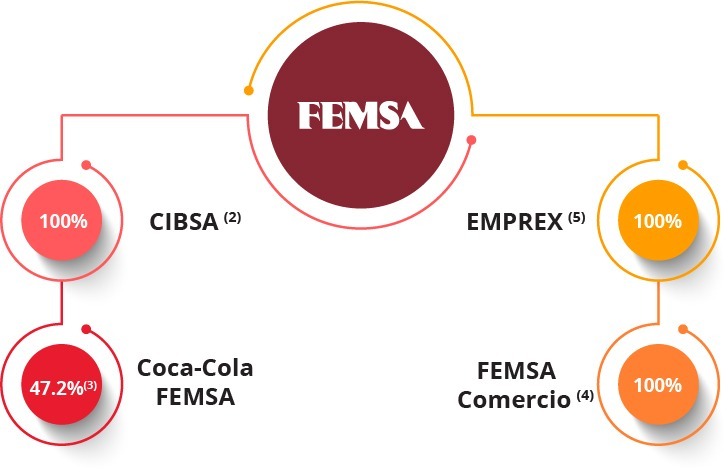
(1)Includes Proximity Europe Division. See “Item 4. Information on the Company.”
(2)Compañía Internacional de Bebidas, S.A. de C.V., which we refer to as “CIBSA.”
(3)Percentage of issued and outstanding capital stock owned by CIBSA (56% of Coca-Cola FEMSA’s capital stock with full voting rights). See “Item 4. Information on the Company—Coca-Cola FEMSA—Capital Stock.”
19
(4)Includes Proximity Americas Division, the Health Division and the Fuel Division. See “Item 4. Information on the Company.”
(5)Grupo Industrial Emprex, S. de R.L. de C.V., which we refer to as “Emprex.”
Significant Subsidiaries
The following table sets forth our significant subsidiaries as of December 31, 2025:
| Name of Company | Jurisdiction of Establishment | Percentage Owned | |||||||||||||||
| CIBSA: | Mexico | 100.0 | % | ||||||||||||||
| Coca-Cola FEMSA | Mexico | 47.2 | % | ||||||||||||||
| Emprex: | Mexico | 100.0 | % | ||||||||||||||
| FEMSA Comercio | Mexico | 100.0 | % | ||||||||||||||
The following table presents an overview of our operations by relevant reportable segment and by geographic area:
Operations by Reporting Segment—Overview
Year Ended December 31, 2025 and % of growth (decrease) vs. previous year
| Coca-Cola FEMSA | Proximity Americas Division | Proximity Europe Division | Fuel Division | Health Division | Others & Consolidation Adjustments | ||||||||||||||||||||||||||||||||||||||||||||||||
| (in millions of Mexican pesos, except for employees and percentages) | |||||||||||||||||||||||||||||||||||||||||||||||||||||
| Total revenues | Ps. | 291,746 | 4 | % | Ps. | 328,839 | 7 | % | Ps. | 57,028 | 15 | % | Ps. | 67,195 | 3 | % | Ps. | 88,129 | 10 | % | Ps. | 8,017 | 2,963 | % | |||||||||||||||||||||||||||||
| Gross profit | 133,176 | 3 | % | 148,495 | 8 | % | 23,250 | 9 | % | 8,191 | 3 | % | 23,854 | (1) | % | 4,610 | 87 | % | |||||||||||||||||||||||||||||||||||
| Total assets | 314,539 | 2 | % | 239,785 | — | % | 44,539 | (2) | % | 25,867 | 2 | % | 74,516 | 2 | % | 96,631 | (33) | % | |||||||||||||||||||||||||||||||||||
Employees (1) | 108,840 | (7) | % | 203,536 | 6 | % | 6,552 | (39) | % | 6,039 | (3) | % | 33,657 | (2) | % | 10,152 | (14) | % | |||||||||||||||||||||||||||||||||||
(1)Includes non-employee workers in this headcount.
Total Revenues Summary by Reporting Segment
| Year Ended December 31, | |||||||||||||||||||||||||||||
| 2025 | 2024 | 2023 | |||||||||||||||||||||||||||
| (in millions of Mexican pesos) | |||||||||||||||||||||||||||||
| Coca-Cola FEMSA | Ps. | 291,746 | Ps. | 279,793 | Ps. | 245,088 | |||||||||||||||||||||||
| Proximity Americas Division | 328,839 | 307,197 | 278,520 | ||||||||||||||||||||||||||
Proximity Europe Division | 57,028 | 49,755 | 43,552 | ||||||||||||||||||||||||||
| Health Division | 88,129 | 79,755 | 75,358 | ||||||||||||||||||||||||||
| Fuel Division | 67,195 | 65,365 | 58,499 | ||||||||||||||||||||||||||
Other (1) | 29,128 | 20,209 | 29,652 | ||||||||||||||||||||||||||
Consolidation adjustments | (21,111) | (20,489) | (27,977) | ||||||||||||||||||||||||||
| Consolidated total revenues | Ps. | 840,954 | Ps. | 781,585 | Ps. | 702,692 | |||||||||||||||||||||||
(1)Until January 1, 2025, our less-than-truckload operations in Brazil were held for sale, at which point it was reclassified as continuing operations.
Business Strategy
Our objective is to generate economic and social value through our business units. We generate economic value by designing, building and scaling mass business models, which enables us to meet our customers’ daily needs in a distinguished and efficient manner. We generate social value by contributing to the improvement of the communities we
20
serve through our actions, the comprehensive development of our employees, and the value proposals that generate well-being.
Everything we do across our three core businesses — retail, beverages and digital — is motivated and inspired by our commitments to our people, our community and our planet, underscored by strong governance practices. Our strategic framework is comprised of six priorities:
•Continued growth: We work to achieve balanced and sustainable growth by capitalizing on new and existing opportunities to create value within our core businesses. We have also increased our capabilities to operate and succeed in other geographic regions by improving management skills to obtain a precise understanding of local consumer needs. Going forward, we intend to use those capabilities to accelerate our expansion and maximize our value creation potential, focusing on our core businesses: retail, beverages and digital.
•Going digital: We are harnessing the power of technology to increase our businesses’ efficiency while also exploring new business opportunities through Spin. We are leveraging the competitive advantages and strong market position of our businesses to build innovative digital businesses in the financial services industry to address the financial needs of our customers and business partners, with an efficient and comprehensive value proposition closely aligned with OXXO Mexico. Additionally, we are developing and growing digitally-enabled loyalty initiatives leveraged on strategic partnerships and our businesses.
•Think Global: Our mindset is global. We believe that the competencies that our businesses have developed can be replicated in other geographic regions. This underlying principle guides our consolidation and growth efforts, which have led to our current footprint. We currently have operations in Mexico, Central America, South America, Europe and in the U.S., including some of the most populous metropolitan areas in Latin America. Our global presence provides us with opportunities to create value through an improved ability to execute our strategies.
•Rooted Sustainability: Sustainability is embedded in everything we do and it is central to the way we do business. Our strategic sustainability framework is composed of three pillars, supported by corporate governance best practices:
◦Our People: Our people’s well-being, dignified work and professional growth;
◦Our Community: Development and well-being within the communities where we have operations; and
◦Our Planet: Harmony with the environment and sustainable use of natural resources.
•Talent & Culture: Our people are integral to our business and their well-being is our highest priority. Our organizational culture is evolving, and we are finding new ways of working together collaboratively. We are committed to abiding by the law in all jurisdictions in which we have operations.
•Proactive Engagement with our Audiences: We aim to facilitate open, clear, proactive, transparent and tailored dialogues with all of our stakeholders, using accessible tools and mediums of engagement. This is essential to understanding internal and external expectations and concerns so we can respond accordingly, and, in turn, strengthen our levels of credibility and trust, more easily navigate challenges, identify new opportunities, and ultimately drive continuous improvement across our business.
Moreover, we are convinced that a robust corporate governance is vital to the responsible management and operation of our business, ensuring the accountability and alignment with our stakeholders to create long-term value through strong economic and social performance. Our governance structure is the foundation for our value creation. We aim to have the right leaders, teams, tools, policies and feedback mechanisms in place across the organization, with tiered levels of accountability. Our Board of Directors is responsible for defining the company’s corporate strategy, and is supported by three committees with distinct areas of responsibility and oversight, all focused on driving sustainable value creation to all stakeholders.
Business Units
FEMSA is a leading company that participates in the following businesses:
•In the beverage industry, through Coca-Cola FEMSA, the largest franchise bottler of Coca-Cola trademark products in the world by sales volume, based on publicly available filings and information of its main competitors;
21
•In the retail industry, through the following divisions: (1) Proximity Americas Division, operating the OXXO small-format store chain in Mexico, Latin America, the U.S., and gas stations in the U.S. (2) Proximity Europe Division, operating small-format retail and foodvenience chains in Europe, (3) the Fuel Division, operating the OXXO Gas chain of retail service stations, and (4) the Health Division, which includes pharmacy services locations and related operations.
•In Spin, leveraging the competitive advantages and strong market position of our businesses to build innovative digital solutions to address the financial needs of our customers and business partners. We have redefined our ecosystem as a model centered on OXXO Mexico, strengthening the alignment between Spin and our store network. This increased alignment will integrate digital and physical capabilities, combining payments, loyalty, data, services, consumer lending opportunities and talent into a more aligned value proposition.
•For information on our businesses classified as assets held for sale and discontinued operations, see “Item 3. Key Information.”
Coca-Cola FEMSA
Overview
Coca-Cola FEMSA is leader in the beverage market in most of the countries where it operates, being the largest franchise bottler of Coca-Cola trademark products in the world by sales volume, based on publicly available filings and information of its main competitors. In 2025, its sales volume represented approximately 12.3% of the total sales volume of the Coca-Cola system in the world. Coca-Cola FEMSA produces and distributes Coca-Cola trademark beverages, offering a wide portfolio of brands to approximately 268 million consumers each day. With more than 90,200 employees, it markets and sells approximately 4.2 billion unit cases per year through approximately 2.1 million points of sale. Coca-Cola FEMSA operates 55 bottling plants and 256 distribution centers. It is committed to generating economic, social and environmental value for all of its stakeholders throughout the value chain. Coca-Cola FEMSA is a member of various sustainability indexes, including the Dow Jones Sustainability MILA Pacific Alliance Index and FTSE4Good Emerging Index.
Coca-Cola FEMSA operates in territories in the following countries:
•Mexico—a substantial portion of central Mexico, the southeast and northeast of Mexico;
•Guatemala;
•Nicaragua;
•Costa Rica;
•Panama;
•Colombia—most of the country;
•Brazil—a major part of the states of São Paulo and Minas Gerais, the states of Parana, Santa Catarina, Mato Grosso do Sul and Rio Grande do Sul and part of the states of Rio de Janeiro and Goias;
•Argentina—Buenos Aires and surrounding areas; and
•Uruguay.
Coca-Cola FEMSA also operates in Venezuela through its investment in Coca-Cola FEMSA de Venezuela, S.A., or KOF Venezuela.
Coca-Cola FEMSA was organized on October 30, 1991 as a stock corporation with variable capital (sociedad anónima de capital variable) under the laws of Mexico for a term of 99 years. On December 5, 2006, as required by amendments to the Mexican Exchange Market Law, Coca-Cola FEMSA became a publicly traded stock corporation with variable capital (sociedad anónima bursátil de capital variable). Coca-Cola FEMSA’s legal name is Coca-Cola FEMSA, S.A.B. de C.V. Coca-Cola FEMSA’s principal executive offices are located at Calle Mario Pani No. 100, Colonia Santa Fe Cuajimalpa, Alcaldía Cuajimalpa de Morelos, 05348, Mexico City, Mexico. Coca-Cola FEMSA’s telephone number at this location is (52-55) 1519-5000 and Coca-Cola FEMSA’s website is www.coca-colafemsa.com.
References
As used in this annual report in connection with Coca-Cola FEMSA:
"Central America" refers to Guatemala, Nicaragua, Costa Rica and Panama;
22
"Central America South" refers to Nicaragua, Costa Rica and Panama;
"Coca-Cola trademark beverages" refers to beverages that are sold under trademarks owned by The Coca-Cola
Company; and
"South America" refers to Argentina, Brazil, Colombia and Uruguay.
The following is an overview of Coca-Cola FEMSA’s operations by reporting segment in 2025.
Operations by Reporting Segment—Overview Year Ended December 31, 2025
| Total Revenues | Gross Profit | ||||||||||||||||||||||||||||||||||
| (in millions of Mexican pesos) | |||||||||||||||||||||||||||||||||||
Mexico and Central America (1) | Ps. | 169,641 | 58.1 | % | Ps. | 81,234 | 61.0 | % | |||||||||||||||||||||||||||
South America (2) | 122,105 | 41.9 | % | 51,942 | 39.0 | % | |||||||||||||||||||||||||||||
| Consolidated | 291,746 | 100.0 | % | 133,176 | 100.0 | % | |||||||||||||||||||||||||||||
(1)Includes Mexico, Guatemala, Nicaragua, Costa Rica and Panama.
(2)Includes Colombia, Brazil, Argentina and Uruguay.
Capital Stock
As of the date of this annual report, (1) FEMSA indirectly owned Series A shares equal to 47.2% of Coca-Cola FEMSA’s capital stock (56.0% of Coca-Cola FEMSA’s capital stock with full voting rights), and (2) TCCC indirectly owned Series D shares equal to 27.8% of Coca-Cola FEMSA’s capital stock (32.9% of Coca-Cola FEMSA’s capital stock with full voting rights). Series L shares with limited voting rights constituted 15.6% of Coca-Cola FEMSA’s
23
capital stock, and Series B shares constituted the remaining 9.4% of Coca-Cola FEMSA’s capital stock (the remaining 11.1% of Coca-Cola FEMSA’s capital stock with full voting rights).
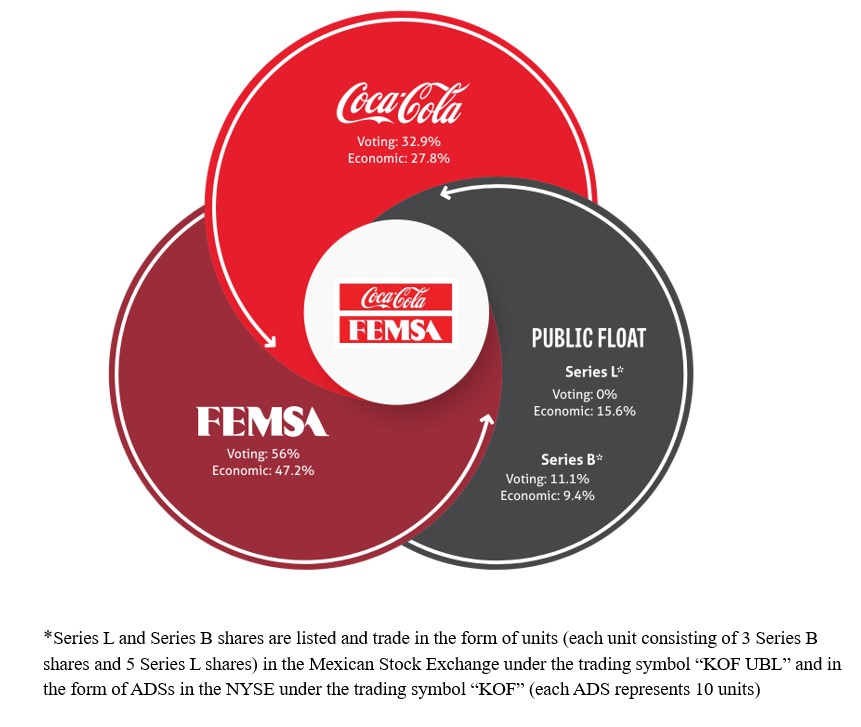
Business Strategy
Coca-Cola FEMSA is focused on growing the company by implementing a long-term sustainable growth model. Coca-Cola FEMSA’s purpose is to refresh the world anytime, anywhere. Coca-Cola FEMSA’s vision evolved during 2023 to emphasize their commitment to their customers, and sustainable development. To this end, Coca-Cola FEMSA’s refreshed vision is to be the customers’ and partners’ preferred commercial platform and ally for growth, fostering a sustainable future.
Coca-Cola FEMSA has strengthened their longstanding relationship with TCCC by together updating and enhancing the following main objectives: (i) growth principles, (ii) relationship economics, (iii) potential new businesses and ventures and (iv) digital strategy.
To consolidate Coca-Cola FEMSA’s position as a global leader in the industry and strengthen their value proposition for their retail clients and end consumers, Coca-Cola FEMSA is leveraging their strengths, their rights-to-win, and working on the following six strategic priorities as their guiding principles: (i) grow the core, (ii) be the preferred commercial platform, (iii) strategic M&A (iv) de-bottleneck our infrastructure and digitize the enterprise, (v) strengthen their customer-centric culture and (vi) foster a sustainable future.
24
(i)Grow the core. More runway to grow Coca-Cola FEMSA’s core business by a focus on capturing growth opportunities for the Coca-Cola portfolio across markets and channels; accelerating the growth of Coca-Cola Zero across its territories; improving its competitive position in flavors; developing growth opportunities in low per-capita markets; and accelerating growth of profitable non-carbonated beverage categories.
(ii)Be the preferred commercial platform. Aim to capitalize on the AI capabilities of Juntos+, Coca-Cola FEMSA's omnichannel commercial platform, and continue to roll out and leverage Juntos+ Advisor, its sales force tool, across its markets, leveraging a curated portfolio of brands together with The Coca-Cola Company and a multi-category portfolio.
(iii)Strategic M&A. Pursue value-enhancing acquisitions, leveraging a disciplined approach.
(iv)De-bottleneck its infrastructure and digitize the enterprise. Aim to increase manufacturing and distribution capacity, while implementing best-in-class logistics and distribution enablers.
(v)Strengthen its customer-centric culture. Aim to promote a growth mindset, fostering a customer-centric and psychologically safe culture, building a multiplier leadership style and empowering leaders to develop Coca-Cola FEMSA's people.
(vi)Foster a sustainable future. By integrating a robust governance framework with social development and environmental stewardship, Coca-Cola FEMSA creates lasting value for its business, people and communities across its value chain. Coca-Cola FEMSA's view on sustainable development is a comprehensive part of its business strategy.
25
Coca-Cola FEMSA’s Territories
The following map shows Coca-Cola FEMSA’s territories, giving estimates in each case of the population to which Coca-Cola FEMSA offers products and the number of retailers carrying its beverages as of December 31, 2025:
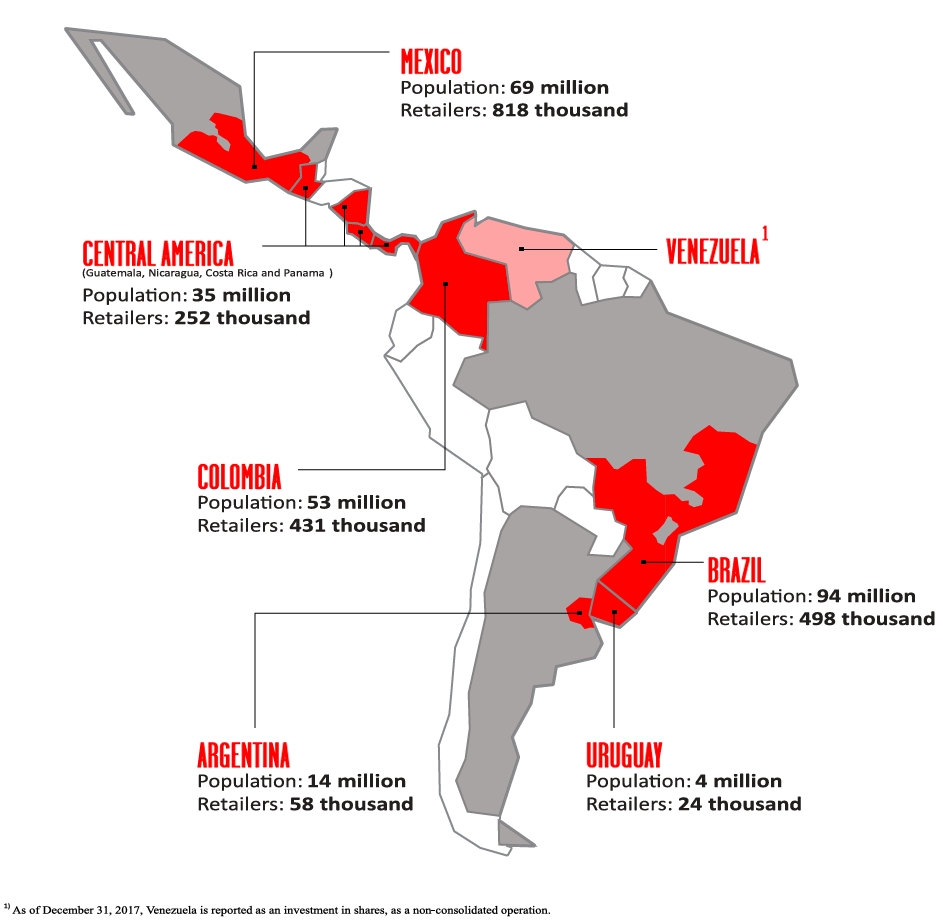
Coca-Cola FEMSA’s Products
Coca-Cola FEMSA produces, markets, sells and distributes mainly The Coca-Cola Company trademark beverage portfolio. These include sparkling beverages (colas and other non-alcoholic carbonated beverages), waters (flavored and non-flavored waters, whether or not carbonated) and other non-carbonated beverages (including tea, sports drinks, energy drinks, fruit-based beverages, juice, coffee, milk, value-added dairy, plant-based drinks) and certain alcoholic ready-to-drink beverages, such as Bacardí Coca-Cola and Topo Chico hard seltzer. “Sparkling beverages” refers to non-alcoholic carbonated beverages, “still beverages” refers to non-alcoholic non-carbonated beverages, and “waters” refers to flavored and non-flavored waters, whether or not carbonated.
26
In addition, through certain distribution agreements, Coca-Cola FEMSA distributes and sells certain consumer products and alcoholic beverages in most of its territories, including Monster products in all the countries where it operates, Heineken-owned brand beer products in certain markets, Estrella Galicia and Therezópolis beer products in its Brazilian territories, and ABI beer products in Costa Rica. This multicategory strategy aims to enhance Coca-Cola FEMSA's value proposition for retailers and consumers in the market, leveraging a curated portfolio that allows it to increase sales of its core portfolio and complement its reach, generating network effects that further strengthen its platform.
The following table sets forth the trademarks of the main products Coca-Cola FEMSA distributed in 2025:
| Colas: | ||
| Coca-Cola | ||
Coca-Cola Zero | ||
| Coca-Cola Light | ||
| Flavored Sparkling Beverages: | |||||||||||||||||
Ameyal | Fanta | Mundet | Sprite | ||||||||||||||
Crush | Fresca | QuAtro | Yoli | ||||||||||||||
Escuis | Kuat | Schweppes | |||||||||||||||
| Still Beverages: | |||||||||||
| AdeS | Del Valle | Hi-C | Powerade | ||||||||
| Cepita | Fury | Leão | Santa Clara | ||||||||
Delaware | Fuze Tea | Monster | Valle Frut | ||||||||
| Water: | |||||||||||
| Alpina | Brisa | Dasani | Smartwater | ||||||||
| Aquarius | Ciel | Manantial | Topo Chico | ||||||||
Benedictino | Crystal | Seagram's | Vitale | ||||||||
Packaging
Coca-Cola FEMSA produces, markets, sells and distributes Coca-Cola trademark beverages in each of its territories in containers authorized by TCCC, which consist primarily of a variety of returnable and non-returnable presentations in the form of glass bottles, cans and plastic bottles mainly made of PET resin. Coca-Cola FEMSA uses the term presentation to refer to the packaging unit in which Coca-Cola FEMSA sells its products. Presentation sizes for Coca-Cola FEMSA’s Coca-Cola trademark beverages range from a 192.0-milliliter personal size to a 20.0-liter bulk serving size. For all of Coca-Cola FEMSA’s products excluding water, Coca-Cola FEMSA considers a multiple serving size as equal to, or larger than, 1.0-liter. In general, personal sizes have a higher price per unit case as compared to multiple serving sizes. Coca-Cola FEMSA offers both returnable and non-returnable presentations, which allow it to offer portfolio alternatives based on convenience and affordability to implement sales strategies and to target specific distribution channels and population segments in its territories. In addition, Coca-Cola FEMSA sells some Coca-Cola trademark beverage syrups in containers designed for soda fountain use, which Coca-Cola FEMSA refers to as fountain.
In addition, Coca-Cola FEMSA informs their consumers through front labeling on the nutrient composition and caloric content of their beverages in accordance with local laws and regulations. Coca-Cola FEMSA adheres to national and international codes of conduct in advertising and marketing, including communications targeted to minors which are developed based on the Responsible Marketing policies and Global School Beverage Guidelines of The Coca-Cola Company.
27
Sales Volume and Transactions Overview
Coca-Cola FEMSA measures total sales volume in terms of unit cases and number of Transactions. “Unit Case” refers to 192 ounces of finished beverage product (24 eight-ounce servings) and, when applied to soda fountains, refers to the volume of syrup, powders and concentrate that is required to produce 192 ounces of finished beverage product. “Transactions” refers to the number of single units (e.g., a can or a bottle) sold, regardless of their size or volume or whether they are sold individually or in multipacks, except for fountain which represents multiple transactions based on a standard 12 ounce serving.
Except when specifically indicated, “sales volume” in this annual report refers to sales volume in terms of unit cases.
Coca-Cola FEMSA’s most important brand, Coca-Cola, together with its line of reduced- or no-sugar products, accounted for 60.3%, 60.7% and 60.2% of Coca-Cola FEMSA’s total sales volume in 2025, 2024 and 2023, respectively.
The following table illustrates historical sales volume and number of Transactions for each of Coca-Cola FEMSA’s reporting segments, as well as its Unit Case and Transaction mix by category.
Sales Volume (2) | Transactions (2) | ||||||||||||||||||||||||||||
| 2025 | 2024 | 2025 | 2024 | ||||||||||||||||||||||||||
| (Millions of unit cases or millions of single units, except percentages) | |||||||||||||||||||||||||||||
| Mexico | 2,013.6 | 2,124.3 | 9,553.8 | 10,131.9 | |||||||||||||||||||||||||
Guatemala (4) | 197.8 | 195.9 | 1,498.5 | 1,459.5 | |||||||||||||||||||||||||
Central America South (1) (4) | 180.3 | 173.9 | 1,359.0 | 1,335.2 | |||||||||||||||||||||||||
| Mexico & Central America | 2,391.7 | 2,494.1 | 12,411.4 | 12,926.6 | |||||||||||||||||||||||||
| Growth | (4.1) | % | 4.1 | % | (4.0) | % | 4.7 | % | |||||||||||||||||||||
| Colombia | 349.4 | 352.3 | 2,574.7 | 2,592.8 | |||||||||||||||||||||||||
Brazil | 1,178.0 | 1,159.3 | 8,616.8 | 8,286.2 | |||||||||||||||||||||||||
| Argentina | 178.8 | 168.3 | 951.7 | 877.4 | |||||||||||||||||||||||||
| Uruguay | 52.3 | 50.7 | 258.4 | 246.2 | |||||||||||||||||||||||||
| South America | 1,758.7 | 1,730.6 | 12,401.5 | 12,002.6 | |||||||||||||||||||||||||
| Growth | 1.6 | % | 4.7 | % | 3.3 | % | 5.3 | % | |||||||||||||||||||||
| Total | 4,150.4 | 4,224.6 | 24,812.9 | 24,929.2 | |||||||||||||||||||||||||
| Growth | (1.8) | % | 4.4 | % | (0.5) | % | 5.0 | % | |||||||||||||||||||||
The following table illustrates the multiple serving presentations and returnable packaging mix for sparkling beverages sales volume:
| Multiple Serving Presentations | Returnable packaging | ||||||||||||||||||||||||||||
| 2025 | 2024 | 2025 | 2024 | ||||||||||||||||||||||||||
| Mexico | 69.4 | % | 69.2 | % | 33.8 | % | 37.0 | % | |||||||||||||||||||||
| Guatemala | 60.6 | % | 60.4 | % | 33.8 | % | 35.0 | % | |||||||||||||||||||||
Central America South (1) | 63.1 | % | 62.8 | % | 33.5 | % | 35.3 | % | |||||||||||||||||||||
| Colombia | 69.6 | % | 70.5 | % | 23.5 | % | 25.8 | % | |||||||||||||||||||||
Brazil | 73.7 | % | 74.6 | % | 16.9 | % | 17.2 | % | |||||||||||||||||||||
| Argentina | 79.1 | % | 81.5 | % | 20.5 | % | 24.1 | % | |||||||||||||||||||||
| Uruguay | 79.9 | % | 80.5 | % | 17.7 | % | 18.5 | % | |||||||||||||||||||||
| Total | 70.5 | % | 70.8 | % | 26.8 | % | 29.1 | % | |||||||||||||||||||||
28
The following table illustrates Coca-Cola FEMSA’s historical sales volume and number of Transactions performance by category for each of its operations and its reporting segments for 2025 as compared to 2024:
| Year Ended December 31, 2025 | |||||||||||||||||||||||||||||||||||
| Sparkling | Stills | Water | Bulk Water | Total | |||||||||||||||||||||||||||||||
| Sales Volume Growth | |||||||||||||||||||||||||||||||||||
| Mexico | (6.6) | % | 2.2 | % | (5.1) | % | (3.1) | % | (5.2) | % | |||||||||||||||||||||||||
Guatemala (4) | 2.3 | % | (13.2) | % | (6.3) | % | (7.1) | % | 1.0 | % | |||||||||||||||||||||||||
Central America South (1)(4) | 1.7 | % | 7.0 | % | 39.6 | % | (4.0) | % | 3.7 | % | |||||||||||||||||||||||||
| Mexico and Central America | (5.0) | % | 1.9 | % | (3.3) | % | (3.1) | % | (4.1) | % | |||||||||||||||||||||||||
| Colombia | — | % | (8.5) | % | 1.4 | % | (7.2) | % | (0.8) | % | |||||||||||||||||||||||||
Brazil | 1.1 | % | 4.9 | % | 4.8 | % | (3.5) | % | 1.6 | % | |||||||||||||||||||||||||
| Argentina | 3.1 | % | 33.9 | % | 13.3 | % | (9.7) | % | 6.3 | % | |||||||||||||||||||||||||
| Uruguay | 1.2 | % | 13.3 | % | 10.4 | % | — | 3.2 | % | ||||||||||||||||||||||||||
South America | 1.1 | % | 5.1 | % | 5.4 | % | (6.6) | % | 1.6 | % | |||||||||||||||||||||||||
| Total | (2.3) | % | 3.3 | % | 1.0 | % | (3.4) | % | (1.8) | % | |||||||||||||||||||||||||
| Year Ended December 31, 2025 | |||||||||||||||||||||||||||||||||||
| Sparkling | Stills | Water | Bulk | Total | |||||||||||||||||||||||||||||||
| Number of Transactions Growth | |||||||||||||||||||||||||||||||||||
| Mexico | (7.1) | % | 1.4 | % | (2.2) | % | — | (5.7) | % | ||||||||||||||||||||||||||
Guatemala | 2.1 | % | (3.9) | % | 24.1 | % | — | 2.7 | % | ||||||||||||||||||||||||||
Central America South (1) | 1.8 | % | 1.8 | % | 1.4 | % | — | 1.8 | % | ||||||||||||||||||||||||||
| Mexico and Central America | (5.0) | % | 1.1 | % | (0.4) | % | — | (4.0) | % | ||||||||||||||||||||||||||
| Colombia | 0.8 | % | (13.5) | % | (0.7) | % | — | (0.7) | % | ||||||||||||||||||||||||||
Brazil | 3.7 | % | 5.3 | % | 4.1 | % | — | 4.0 | % | ||||||||||||||||||||||||||
| Argentina | 4.6 | % | 31.7 | % | 7.0 | % | — | 8.5 | % | ||||||||||||||||||||||||||
| Uruguay | 3.4 | % | 12.4 | % | 9.2 | % | — | 4.9 | % | ||||||||||||||||||||||||||
South America | 3.2 | % | 4.5 | % | 3.0 | % | — | 3.3 | % | ||||||||||||||||||||||||||
| Total | (1.2) | % | 2.9 | % | 1.5 | % | — | (0.5) | % | ||||||||||||||||||||||||||
The following table illustrates Coca-Cola FEMSA’s unit case mix by category for each of its operations and its reporting segments for 2025 as compared to 2024:
| Sparkling Beverages | Stills | Water(3) | |||||||||||||||||||||||||||||||||||||||
| Years Ended December 31, | |||||||||||||||||||||||||||||||||||||||||
| 2025 | 2024 | 2025 | 2024 | 2025 | 2024 | ||||||||||||||||||||||||||||||||||||
| Unit Case Mix by Category | |||||||||||||||||||||||||||||||||||||||||
| Mexico | 67.5 | % | 68.5 | % | 8.0 | % | 7.4 | % | 24.5 | % | 24.1 | % | |||||||||||||||||||||||||||||
Guatemala (4) | 90.0 | % | 88.8 | % | 4.3 | % | 5.1 | % | 5.7 | % | 6.2 | % | |||||||||||||||||||||||||||||
Central America South (1) (4) | 82.1 | % | 83.7 | % | 12.6 | % | 12.3 | % | 5.3 | % | 4 | % | |||||||||||||||||||||||||||||
| Mexico and Central America | 70.5 | % | 71.1 | % | 8.1 | % | 7.6 | % | 21.5 | % | 21.3 | % | |||||||||||||||||||||||||||||
| Colombia | 76.7 | % | 76.0 | % | 7.4 | % | 8.1 | % | 15.9 | % | 15.9 | % | |||||||||||||||||||||||||||||
Brazil | 82.9 | % | 83.3 | % | 8.9 | % | 8.6 | % | 8.2 | % | 8.1 | % | |||||||||||||||||||||||||||||
| Argentina | 72.8 | % | 75.1 | % | 10.0 | % | 8.0 | % | 17.1 | % | 16.9 | % | |||||||||||||||||||||||||||||
| Uruguay | 78.5 | % | 80.1 | % | 6.9 | % | 6.3 | % | 14.6 | % | 13.6 | % | |||||||||||||||||||||||||||||
South America | 80.5 | % | 81.0 | % | 8.6 | % | 8.4 | % | 10.9 | % | 10.7 | % | |||||||||||||||||||||||||||||
| Total | 74.7 | % | 75.2 | % | 8.3 | % | 7.9 | % | 17.0 | % | 16.9 | % | |||||||||||||||||||||||||||||
(1)Includes sales volume and transactions from Nicaragua, Costa Rica and Panama.
(2)Excludes beer and spirit sales volume and transactions.
(3)Includes bulk water volume and transactions.
(4)2024 volume figures adjusted to reflect real data for total and bulk volumes.
29
Seasonality
Sales of Coca-Cola FEMSA’s products are seasonal in all the countries where it operates, as Coca-Cola FEMSA’s sales volumes generally increase during the summer months of each country and during the year-end holiday season. In Mexico, Central America and Colombia, Coca-Cola FEMSA typically achieves its highest sales during the months of April through August as well as during the year-end holidays in December. In Brazil, Uruguay and Argentina, Coca-Cola FEMSA’s highest sales levels occur during the summer months of October through March, including the year-end holidays in December.
Marketing
Coca-Cola FEMSA, in conjunction with TCCC, has developed a marketing strategy to promote the sale and consumption of Coca-Cola FEMSA’s products. Coca-Cola FEMSA relies extensively on advertising, sales promotions and retailer support programs to target the particular preferences of its consumers. Coca-Cola FEMSA’s consolidated marketing expenses in 2025 were Ps. 5,372 million.
Retailer Support Programs. Support programs include providing retailers with point-of-sale display materials and consumer sales promotions, such as contests, sweepstakes and the giveaway of product samples.
Coolers. Coolers play an integral role in Coca-Cola FEMSA’s clients’ plans for success. Increasing both cooler coverage and the number of cooler doors among Coca-Cola FEMSA’s retailers is important to ensure that its wide variety of products are properly displayed, while strengthening its merchandising capacity in its distribution channels to significantly improve its point-of-sale execution.
Advertising. Coca-Cola FEMSA advertises in all major communications media. Coca-Cola FEMSA focuses its advertising efforts on increasing brand recognition by consumers and improving its customer relations. National advertising campaigns are designed and proposed by TCCC’s local affiliates in the countries where Coca-Cola FEMSA operates, with its input at the local or regional level. Point-of-sale merchandising and advertising efforts are proposed and implemented by Coca-Cola FEMSA, with a focus on increasing its connection with customers and consumers.
Marketing in Coca-Cola FEMSA’s Distribution Channels. In order to provide more dynamic and specialized marketing of its products, Coca-Cola FEMSA’s strategy is to classify its markets and develop targeted efforts for each consumer segment or distribution channel. Coca-Cola FEMSA’s principal channels are small retailers, “on-premise” accounts, such as restaurants and bars, supermarkets and third-party distributors. Presence in these channels entails a comprehensive and detailed analysis of the purchasing patterns and preferences of various groups of beverage consumers in each of the different types of locations or distribution channels. In response to this analysis, Coca-Cola FEMSA tailors its product, price, packaging and distribution strategies to meet the particular needs of and exploit the potential of each channel.
Multi-Segmentation. Coca-Cola FEMSA has implemented a multi-segmentation strategy in all of its markets. These strategies consist of the definition of a strategic market cluster or group and the implementation and assignment of different product/price/package portfolios and service models to such market cluster or group. These clusters are defined based on consumption occasion, competitive environment, income level, and types of distribution channels.
Product Sales and Distribution
The following table provides an overview of Coca-Cola FEMSA’s distribution centers, retailers and direct-to-consumer ("DTC") channels to which Coca-Cola FEMSA sold its products:
| As of December 31, 2025 | ||||||||||||||
| Mexico and | ||||||||||||||
Central America(1)(3) | South America(2) | |||||||||||||
| Distribution centers | 174 | 82 | ||||||||||||
Retailers(4) | 1,069,744 | 1,011,318 | ||||||||||||
DTC(5) | 474,436 | 5,614 | ||||||||||||
(1)Includes Mexico, Guatemala, Nicaragua, Costa Rica and Panama.
(2)Includes Colombia, Brazil, Argentina and Uruguay.
(3)For purposes of this table, Coca-Cola FEMSA has considered owned and third-party distribution centers managed by Coca-Cola FEMSA.
(4) Active customers with direct support from Coca-Cola FEMSA, including traditional channels, modern channels and indirect customers.
(5) Reflects purchasing households as of December 31, 2025.
30
Coca-Cola FEMSA continuously evaluates its distribution model in order to fit with the local dynamics of the marketplace and analyze the way it goes to market, recognizing different service needs from its customers, while looking for more efficient distribution models. As part of this strategy, Coca-Cola FEMSA is rolling out a variety of new distribution models throughout its territories looking for improvements in its distribution network.
Coca-Cola FEMSA uses several sales and distribution models depending on market, geographic conditions and the customer’s profile: (i) the pre-sale system, which separates the sales and delivery functions, permitting trucks to be loaded with the mix of products that retailers have previously ordered, thereby increasing both sales and distribution efficiency; (ii) the conventional truck route system, in which the person in charge of the delivery makes immediate sales from inventory available on the truck; (iii) sales through digital platforms to access technologically enabled customers; (iv) the telemarketing system, which could be combined with pre-sales visits; and (v) sales through third-party wholesalers and other distributors of Coca-Cola FEMSA’s products.
As part of the pre-sale system, sales personnel also provide merchandising services during retailer visits, which Coca-Cola FEMSA believes enhance the shopper experience at the point-of-sale. Coca-Cola FEMSA believes that an adequate number of service visits to retailers and frequency of deliveries are essential elements in an effective selling and distribution system of its products.
Coca-Cola FEMSA continues to reinforce its presence in its digital sales channels, such as food aggregators, digital platforms, e-commerce websites and mobile device applications, in an effort to address the growing demand from its business partners through such sales channels. This reinforcement is aligned with Coca-Cola FEMSA’s overall digitization and omnichannel strategies.
In 2025, no single customer accounted for more than 10.0% of Coca-Cola FEMSA’s consolidated total sales.
Coca-Cola FEMSA’s distribution centers range from large warehousing facilities to small cross-docking facilities. In addition to its fleet of trucks, Coca-Cola FEMSA distributes its products in certain locations through electric carts and hand-trucks. In some of its territories, Coca-Cola FEMSA relies on third parties to transport its finished products from its bottling plants to its distribution centers and, in some cases, directly to its customers.
Mexico. From the distribution centers, Coca-Cola FEMSA distributes its finished products to retailers mainly through its own fleet of trucks. In designated areas in Mexico, third-party distributors deliver Coca-Cola FEMSA’s products to retailers and consumers, allowing Coca-Cola FEMSA to access these areas on a cost-effective basis.
In Mexico, Coca-Cola FEMSA sells a majority of its beverages through its traditional distribution channel, which consists of sales at small retail stores to consumers who may take the beverages for consumption at home or elsewhere. Coca-Cola FEMSA also sells products through modern distribution channels, the “on-premise” consumption segment, home delivery routes, supermarkets and other locations. Modern distribution channels include large and organized chain retail outlets such as wholesale supermarkets, discount stores and convenience stores that sell fast-moving consumer goods, where retailers can buy large volumes of products from various producers. The “on-premise” consumption segment consists of sales through points-of-sale where products are consumed at the establishment from which they were purchased. This includes retailers such as restaurants and bars as well as stadiums, auditoriums and theaters.
Brazil. In Brazil, Coca-Cola FEMSA distributes its finished products to retailers through a combination of its own fleet of trucks and third-party distributors, while maintaining control over the selling activities. In designated zones in Brazil, third-party distributors purchase Coca-Cola FEMSA’s products and resell them to retailers. In Brazil, Coca-Cola FEMSA sells a majority of its beverages at small retail stores. Coca-Cola FEMSA also sells products through modern distribution channels and “on-premise” consumption. Modern distribution channels in Brazil include large and organized chain retail outlets such as wholesale supermarkets and discount stores that sell fast-moving consumer goods.
Territories other than Mexico and Brazil. Coca-Cola FEMSA distributes its finished products to retailers through a combination of its own fleet of trucks and third-party distributors. In most of Coca-Cola FEMSA’s territories, an important part of its total sales volume is sold through small retailers.
Principal Competitors
Coca-Cola FEMSA’s principal competitors are local Pepsi bottlers and other bottlers and distributors of local beverage brands. Coca-Cola FEMSA also faces competition in many of its territories from producers of low-price beverages, commonly referred to as “B brands.” A number of Coca-Cola FEMSA’s competitors in Central America, Brazil, Argentina and Colombia offer beer in addition to sparkling beverages, still beverages and water, which may enable them to achieve distribution efficiencies that other competitors who do not offer an integrated portfolio may not achieve.
31
While competitive conditions are different in each of its territories, Coca-Cola FEMSA competes mainly in terms of price, packaging, effective promotional activities, access to retail outlets and sufficient shelf space, customer service, product innovation and product alternatives and the ability to identify and satisfy consumer preferences. Coca-Cola FEMSA competes by seeking to offer products at an attractive price in the different segments in its markets and by building on the value of its brands. Coca-Cola FEMSA believes that the introduction of new products and new presentations has been a significant competitive advantage that allows Coca-Cola FEMSA to increase demand for its products, provide different options to consumers and increase new consumption opportunities. See “Item 4. Information on the Company—Coca-Cola FEMSA—Coca-Cola FEMSA’s Products” and “Item 4. Information on the Company—Coca-Cola FEMSA—Packaging.”
Mexico and Central America. Coca-Cola FEMSA’s principal competitor in Mexico is Grupo GEPP, S.A.P.I. de C.V., the exclusive bottler of Pepsi beverage products and subsidiary of Organización Cultiba, S.A.B. de C.V., a joint venture formed by Grupo Embotelladoras Unidas, S.A.B. de C.V., the former Pepsi bottler in central and southeast Mexico, a subsidiary of PepsiCo and Empresas Polar, S.A., a beer distributor and Pepsi bottler. Its main competition in the juice category in Mexico is Grupo Jumex. In the water category, its main competitor is Bonafont, a water brand owned by Danone. In addition, it competes with Keurig Dr Pepper in sparkling beverages and with other local brands in its Mexican territories, as well as B brand producers, such as Embotelladora Aga de Mexico, S.A. de C.V. (Red Cola bottler), that offer various presentations of sparkling and still beverages.
In the countries that comprise its Central America region, Coca-Cola FEMSA's main competitors are Pepsi and Big Cola bottlers. In Guatemala, Coca-Cola FEMSA competes with The Central American Bottler Corporation (“CBC”), who also has a regional joint venture with AmBev to produce, distribute and sell beer; Cervecería Centroamericana S.A. (“CCA”), who is focused in the beer and stills categories; and AJE Group. In Nicaragua, its principal competitor is AJE Group. Coca-Cola FEMSA also competes with the joint venture between CBC and AmBev. In Costa Rica, its principal competitor is Florida Bebidas S.A., a subsidiary of Florida Ice and Farm Co. and Cooperativa de Productores de Leche Dos Pinos R.L. in juices. In Panama, Coca-Cola FEMSA’s main competitor is Cervecería Nacional, S.A., followed by AJE Group and Petite Bottling Company, Inc ("Unicola"). Coca-Cola FEMSA also faces competition from B brands offering multiple serving size presentations in certain Central American countries.
South America. Coca-Cola FEMSA’s principal competitor in Colombia is Postobón, a local bottler that sells and distributes sparkling beverages (Manzana Postobón, Uva Postobón and Colombiana), still beverages (Hit Juice) and water (Cristal). Postobón also distributes Pepsi products and is a vertically integrated producer, the owners of which hold other significant commercial and industrial interests in Colombia. Coca-Cola FEMSA also competes with low-price producers, such as Aje Colombia S.A., the producers of Big Cola, which principally offer multiple serving size presentations in the value segment of the sparkling and still beverage industry.
In Brazil, Coca-Cola FEMSA competes against AmBev, a company that distributes Pepsi brands, local brands with flavors such as guarana, and proprietary beer brands. It also competes against B brands or “Tubainas”, which are small, local producers of low-cost sparkling beverages that represent a significant portion of the sparkling beverage market. In the water segment, Coca-Cola FEMSA’s main competitors include Minalba, owned by Grupo Edson Queiroz, Água da Pedra, owned by Fruki Bebidas, as well as several smaller regional brands. In the energy category, Coca-Cola FEMSA’s principal competitors are Red Bull, which has a distribution agreement with AmBev, and Bally, owned by Bebidas Grassi do Brasil Ltda., a brand positioned in the low‑price segment and offering multiple serving‑size formats.
In Argentina, Coca-Cola FEMSA’s main competitor is Buenos Aires Embotellador S.A., a Pepsi bottler owned by Argentina’s principal brewery, Quilmes Industrial S.A., and indirectly controlled by AmBev, and Manaos and Cunnington, B-brands owned by Refres Now S.A., low-price sparkling beverages which are gaining relevance in the market.. In the water category, Coca-Cola FEMSA competes directly with Levité, Villavicencio and Villa del Sur, owned by Danone, which is controlled by Compañía Cervecerías Unidas.
In Uruguay, Coca-Cola FEMSA’s main competitor is Salus, a water brand owned by Danone. It also competes against Fábricas Nacionales de Cerveza S.A. (“FNC”), a Pepsi bottler and distributor controlled by AmBev S.A. In addition, it competes with CCU Inversiones II Ltda., a water, soft drinks and brewing company, and finally with some low-priced regional producers.
Raw Materials
Pursuant to Coca-Cola FEMSA’s bottler agreements, Coca-Cola FEMSA is authorized to manufacture, sell and distribute Coca-Cola trademark beverages within specific geographic areas, and Coca-Cola FEMSA is required to purchase concentrate for all Coca-Cola trademark beverages in all of its territories from affiliates of TCCC and sweeteners and other raw materials from companies authorized by TCCC. Concentrate prices for Coca-Cola trademark beverages are determined as a percentage of the weighted average retail price in local currency net of applicable taxes.
32
In the past, concentrate prices for Coca-Cola trademark beverages have been increased in some of the countries where we operate. These prices may increase concentrate prices in the future and we may not be successful in negotiating or implementing measures to mitigate the negative effect this may have on the prices of our products or our results. See “Item 10. Additional Information—Material Contracts—Material Contracts Relating to Coca-Cola FEMSA—Cooperation Framework with The Coca-Cola Company.”
In addition to concentrate, Coca-Cola FEMSA purchases sweeteners, carbon dioxide, virgin and recycled PET resin and preforms to make plastic bottles, finished plastic and glass bottles, cans, caps and fountain containers, as well as other packaging materials and raw materials. Coca-Cola FEMSA’s bottler agreements provide that these materials may be purchased only from suppliers approved by TCCC. Prices for certain raw materials, including those used in the bottling of Coca-Cola FEMSA’s products, mainly PET resin, finished plastic bottles, aluminum cans, HFCS and certain sweeteners, are paid in or determined with reference to the U.S. dollar, and therefore local prices in a particular country may increase based on changes in the applicable exchange rates. Coca-Cola FEMSA’s most significant packaging raw material costs arise from the purchase of PET resin, the price of which is related to crude oil prices and global PET resin supply. The average price that Coca-Cola FEMSA paid for PET resin in U.S. dollars in 2025 increased 2.4% as compared to 2024 in all Coca-Cola FEMSA’s territories. In addition, given that high currency volatility has affected and continues to affect most of Coca-Cola FEMSA’s territories, the average price for PET resin in local currencies was higher in all of its territories. In addition, given that high currency volatility has affected and continues to affect most of its territories, the average price for PET resin in local currencies was higher in all of its territories. In 2024, Coca-Cola FEMSA purchased certain raw materials in advance, negotiated and locked-in prices in advance and entered into certain derivative transactions which helped them capture opportunities with respect to raw material costs and currency exchange rates.
Under its agreements with TCCC, Coca-Cola FEMSA may use raw or refined sugar, artificial sweeteners and HFCS in its products. Sugar prices in all of the countries where Coca-Cola FEMSA operates, other than Brazil and Uruguay, are subject to local regulations and other barriers to market entry that, in certain countries, often cause Coca-Cola FEMSA to pay for sugar in excess of international market prices. In recent years, international sugar prices experienced significant volatility. Across Coca-Cola FEMSA’s territories, its average price for sugar in U.S. dollars, taking into account its financial hedging activities, decreased by approximately 10.7% in 2025 as compared to 2024.
Coca-Cola FEMSA considers water as a raw material in its business. Coca-Cola FEMSA obtains water for the production of some of its natural spring water products, such as Manantial in Colombia and Crystal in Brazil, from spring water pursuant to concessions granted.
None of the materials or supplies that Coca-Cola FEMSA uses is presently in short supply, although the supply of specific materials could be adversely affected by strikes, market and economic conditions, weather conditions, governmental controls, national emergency situations, water shortages or the failure to maintain Coca-Cola FEMSA’s existing water concessions.
Mexico and Central America. In Mexico, Coca-Cola FEMSA purchases PET resin mainly from Indorama Ventures Polymers México, S. de R.L. de C.V. and DAK Resinas Americas Mexico, S.A. de C.V., which Alpla México, S.A. de C.V. (“Alpla”), and Envases Universales de México, S.A.P.I. de C.V. manufacture into non-returnable plastic bottles for them. Coca-Cola FEMSA has also diversified their import suppliers from China to Vietnam and Taiwan to mitigate the effects of tariffs and support its PET resin strategy.
Coca-Cola FEMSA purchases all of its cans from Crown Envases México, S.A. de C.V., formerly known as Fábricas de Monterrey, S.A. de C.V., and Envases Universales de México, S.A.P.I. de C.V. Coca-Cola FEMSA mainly purchases its glass bottles from Owens America, S. de R.L. de C.V., and Sílices de Veracruz, S.A. de C.V., known as SIVESA.
Coca-Cola FEMSA purchases sugar from, among other suppliers, PIASA, Beta San Miguel, S.A. de C.V. or Beta San Miguel and Ingenio La Gloria, S.A., all of them sugar cane producers. As of the date of this annual report, Coca-Cola FEMSA held a 36.4% and 2.7% equity interest in PIASA and Beta San Miguel, respectively. Coca-Cola FEMSA purchases HFCS from Ingredion México, S.A. de C.V., Cargill de Mexico S.A. de C.V. and Almidones Mexicanos, S.A. de C.V., known as Almex.
Sugar prices in Mexico are subject to local regulations and other barriers to market entry that often cause Coca-Cola FEMSA to pay higher prices than those paid in the international market. As a result, prices in Mexico have no correlation to international market prices. In 2025, sugar prices in local currency in Mexico decreased approximately 20.8% as compared to 2024.
In Central America, the majority of Coca-Cola FEMSA’s raw materials such as glass and non-returnable plastic bottles are purchased from several local suppliers. Coca-Cola FEMSA purchases its cans from Envases Universales Ball de Centroamérica, S.A. and Envases Universales de México, S.A.P.I. de C.V. Sugar is available from suppliers that
33
represent several local producers. In Costa Rica, Coca-Cola FEMSA acquires plastic non-returnable bottles from Alpla C.R. S.A., and in Nicaragua Coca-Cola FEMSA acquires such plastic bottles from Alpla Nicaragua, S.A. Coca-Cola FEMSA mainly purchases glass bottles from Vidriera Guatemalteca S. A., known as VIGUA, and Vidriera Centroamericana, S.A., known as VICAL.
South America. In Colombia, Coca-Cola FEMSA uses sugar as a sweetener in all its caloric beverages, which Coca-Cola FEMSA buys from several sources. Sugar prices in Colombia decreased by 4.1% in U.S. dollars and decreased 4.6% in local currency, as compared to 2024. Coca-Cola FEMSA purchases non-returnable plastic bottles from Amcor Rigid Plastics de Colombia, S.A. and Envases de Tocancipa S.A.S. (affiliate of Envases Universales de México, S.A.P.I. de C.V.). Coca-Cola FEMSA has historically purchased all of its non-returnable glass bottles from O-I Peldar. Coca-Cola FEMSA purchases all of its cans from Crown Colombiana, S.A.
In Brazil, Coca-Cola FEMSA also uses sugar as a sweetener in all of its caloric beverages. Sugar is available at local market prices, which historically have been similar to international prices. Sugar prices in Brazil decreased approximately 9.2% in U.S. dollars and decreased 5.8% in local currency as compared to 2024. Taking into account Coca-Cola FEMSA's financial hedging activities, sugar prices in Brazil decreased 13.0% in U.S. dollars and 16.0% in local currency as compared to 2024. See “Item 11. Quantitative and Qualitative Disclosures about Market Risk—Commodity Price Risk.” Coca-Cola FEMSA purchases non-returnable glass bottles, plastic bottles and cans from several domestic and international suppliers. Coca-Cola FEMSA mainly purchases PET resin from local suppliers such as Indorama Ventures Polímeros S.A. and glass bottles from Owens Illinois do Brasil Ind Ecom.
In Argentina, Coca-Cola FEMSA mainly uses HFCS that it purchases from several different local suppliers as a sweetener in its products. Coca-Cola FEMSA purchases glass bottles and other raw materials from several domestic sources. Coca-Cola FEMSA purchases plastic preforms at competitive prices from Andina Empaques S.A., a local subsidiary of Embotelladora Andina, S.A., a Coca-Cola bottler with operations in Chile, Argentina, Brazil and Paraguay, Alpla Avellaneda, S.A., AMCOR Argentina, and other local suppliers. Coca-Cola FEMSA purchases glass bottles from Cattorini Hnos Saicfei, known as Cattorini.
In Uruguay, Coca-Cola FEMSA also uses sugar as a sweetener in all of its caloric beverages, which is available at Brazil’s local market prices. Sugar prices in Uruguay decreased approximately 8.3% in U.S. dollars and decreased 6.3% in local currency as compared to 2024. Coca-Cola FEMSA’s main supplier of sugar is Nardini Agroindustrial Ltda., which is based in Brazil. Coca-Cola FEMSA purchases PET resin from several Asian suppliers, such as SFX – Jiangyin Xingyu New Material Co. Ltd. and India Reliance Industry (a joint venture with DAK Resinas Americas Mexico, S.A. de C.V.), and Coca-Cola FEMSA purchases non-returnable plastic bottles from global PET converters, such as Cristalpet S.A. (affiliate of Envases Universales de México, S.A.P.I. de C.V.). Coca-Cola FEMSA purchases glass bottles from Cattorini.
Proximity Americas Division
Overview
Proximity Americas Division operates a chain of small-format stores with 25,587 locations as of December 31, 2025, under the trade name OXXO.
Proximity Americas Division—Overview
Year Ended December 31, 2025
| (in millions of Mexican pesos, except percentages) | |||||||||||||||||||||||||||||||||||
| Total Revenues | Gross Profit | ||||||||||||||||||||||||||||||||||
| 2025 | 2025 vs.2024 | 2025 | 2025 vs.2024 | ||||||||||||||||||||||||||||||||
| Proximity Americas Division | Ps. | 328,839 | 7.0 | % | Ps. | 148,495 | 8.4 | % | |||||||||||||||||||||||||||
Business Strategy
Proximity Americas Division intends to continue increasing its store base in all of its territories while capitalizing on the retail business and market knowledge gained through its existing network of stores. Proximity Americas Division intends to open new stores in locations where it believes there is high growth potential or unsatisfied demand, while also increasing customer traffic and average ticket per customer in existing stores. Proximity Americas Division’s expansion focuses on both entering new markets and strengthening its presence in Mexico, Colombia, Chile, Brazil, and Peru. A fundamental element of Proximity Americas Division’s business strategy is to leverage its retail store formats, know-how, technology, and operational practices to continue growing in a cost-effective and profitable manner. This scalable business platform has provided a strong foundation for continued organic growth in Mexico, improving traffic and average ticket sales at our existing stores and facilitating entry into new small-format retail industries. To
34
further increase customer traffic into Proximity Americas Division’s stores, Proximity Americas Division has incorporated additional services to its value proposition in Mexico, such as utility bill payments, deposits into bank accounts held at our correspondent bank partners, remittances, payment of mobile phone fees and charges and other financial services, and it seeks to constantly increase the services it offers. In addition, the Proximity Americas Division strategically expanded our retail footprint into the U.S. market through the acquisition of Delek’s retail operations consisting of 249 convenience stores and 244 fuel stations located mainly in Texas.
Beyond North America, Proximity Americas Division seeks to increase its scale by continuing its expansion in Colombia and Brazil. In Brazil, we completed the separation of the Grupo Nós joint venture with Raízen S.A. in February 2026. As a result of this transaction, FEMSA retained the OXXO stores, as well as the distribution center located in Cajamar, Sao Paulo, while Raízen retained the Shell Select stores. See "Item 4. Information on the Company—Recent Developments.”.
Proximity Americas Division has developed proprietary models to assist in identifying appropriate store locations, store formats and product categories. These models utilize location-specific demographic data and Proximity Americas Division’s experience in similar locations to fine-tune store formats, product price ranges and product offerings to the target market. Market segmentation is becoming an important strategic tool that is expected to allow Proximity Americas Division to improve the operating efficiency of each location, cover a wider array of consumption occasions and increase its overall profitability.
Proximity Americas Division continues to improve its information-gathering and processing systems to allow it to connect with its customers at all levels and anticipate and respond efficiently to their changing demands and preferences. Most of the products carried through OXXO stores are bar-coded, and all OXXO stores are equipped with point-of-sale systems integrated into a company-wide computer network. Proximity Americas Division created a department in charge of product category management, for products such as beverages, fast food and perishables, responsible for analyzing data gathered to better understand our customers, develop integrated marketing plans and allocate resources more efficiently. This department utilizes a technology platform supported by an enterprise resource planning (“ERP”) system, as well as other technological solutions such as merchandising and point-of-sale systems, which allow Proximity Americas Division to redesign and adjust its key operating processes and certain related business decisions. Our IT system also allows us to manage each store’s working capital, inventories and investments in a cost-effective way while maintaining high sales volume and store quality. Supported by continued investments in IT, our supply chain network allows us to optimize working capital requirements through inventory rotation and reduction, reducing out-of-stock days and other inventory costs.
Proximity Americas Division maintains innovative promotional strategies in order to increase store traffic and sales. In particular, OXXO stores sell high-frequency items such as beverages, snacks and cigarettes at competitive prices. Proximity Americas Division’s ability to implement this strategy profitably is partly attributable to the size of the OXXO chain, and its ability to work together with its suppliers to implement sales strategies such as differentiated promotions. OXXO stores’ national and local marketing and promotional strategies are an effective revenue driver and a means of reaching new segments of the population while strengthening the OXXO brand. For example, the organization has refined its expertise in executing cross promotions (discounts on multi-packs or sales of complementary products at a special price) and targeted promotions to attract new customer segments by expanding the offerings in the grocery product category in certain stores.
Another fundamental element of Proximity Americas Division’s strategy consists of leveraging Proximity Americas Division’s reputation for quality and the position of the OXXO brand in the minds of its customers to expand its offering of private-label products. Proximity Americas Division’s private-label products represent an alternative for value-conscious consumers, which, combined with its market position, allows Proximity Americas Division to increase sales and margins, strengthen customer loyalty and bolster its bargaining position with suppliers.
Historically, Proximity Americas Division has represented an effective distribution channel for its beverage products, as well as a rapidly-growing point of contact with its consumers. Based on the belief that location plays a major role in the long-term success of a small-format store retail operation, as well as a role in Proximity Americas Division's ability to accelerate and streamline the new store development process, Proximity Americas Division has focused on a strategy of rapid, profitable growth.
Finally, Proximity Americas Division seeks to leverage its scale, operating efficiency and customer knowledge to develop innovative value propositions to address the needs of the traditional trade channel in Mexico.
Store Locations
Proximity Americas Division operates the largest small-format store chain in Latin America, measured by number of stores, based on publicly available filings and information of our main competitors. As of December 31, 2025,
35
there are 24,297 OXXO stores in Mexico, 597 OXXO stores in Colombia, 236 stores in Chile, 217 stores in Peru and 240 stores in the U.S.
The Proximity Americas Division expanded its operations by opening a net of 1,134 new OXXO stores in Mexico, Colombia, Chile and Peru during 2025, partially offset by nine closures in the U.S. Additionally, as of December 31, 2025, Grupo Nós operated 607 OXXO stores and 20 Shell Select locations in Brazil, and managed 1,202 Shell Select stores operated by independent franchisees. Grupo Nós expanded its operations with a net 13 openings of OXXO stores in Brazil during 2025.
OXXO Stores
Regional Allocation in Mexico
as of December 31, 2025
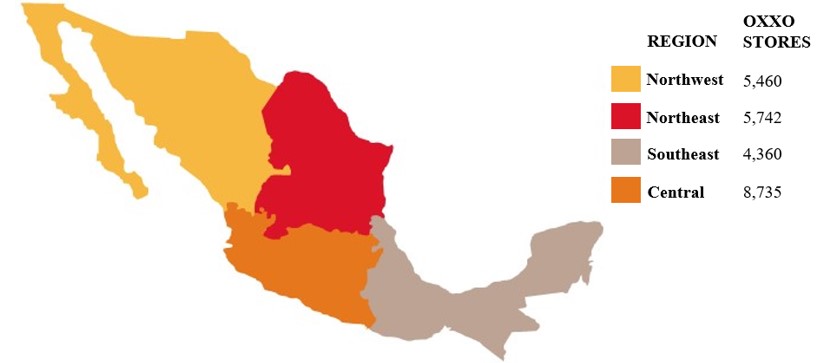
Historically, Proximity Americas Division has rapidly expanded the number of OXXO stores. During 2025 and 2024, it achieved this by emphasizing growth in areas of high economic potential in existing markets and expanding in underserved and unexploited markets.
OXXO Stores
Total Growth
| Year Ended December 31, | |||||||||||||||||||||||
| 2025 | 2024 | 2023 | |||||||||||||||||||||
| Total OXXO stores | 25,587 | 24,462 | 22,866 | ||||||||||||||||||||
| Store growth (% change over previous year) | 4.6 | % | 6.9 | % | 6.6 | % | |||||||||||||||||
Most of the OXXO stores are operated under lease agreements, and are adjusted annually to an inflation index. This approach provides Proximity Americas Division the flexibility to adjust locations as cities grow and effectively adjust its footprint based on stores’ performance.
Both the identification of locations and the pre-opening planning to optimize the results of new OXXO stores are important elements in Proximity Americas Division’s growth plan. Proximity Americas Division continuously reviews store performance against certain operating and financial benchmarks to optimize the overall performance of the chain. Stores of Proximity Americas Division that are unable to maintain benchmark standards are generally closed. Between December 31, 2024 and 2025 the total number of OXXO stores increased by 1,125, which resulted from the opening of 1,348 new stores and the closing of 223 stores. In addition, in the past there have been instances where we have decided to temporarily close OXXO stores in certain territories due to increased criminal activity as a measure to protect the safety of our employees. Historically, these closures have been short-lived and have not had a material impact on sales or consumption trends or on our results or operating performance generally.
36
Competition
Proximity Americas Division, mainly through OXXO stores, competes in the retail market, which is highly competitive. OXXO stores face competition from small-format stores such as 7-Eleven and Circle K in Mexico, Tiendas D1, Ara and Tostao in Colombia, upa! in Chile, Tambo Mas in Peru, and Circle K and Speedway in the U.S., as well as from other numerous retail and grocery chains (such as Wal-Mart, H-E-B, Soriana, La Comer and Chedraui, among others) to small informal neighborhood stores across the markets where they operate. In addition, as more services and products are offered in OXXO stores, the number and type of competitors have also increased, including banks and fast-food outlets, among others. OXXO stores compete not only for consumers and new store locations but also for human resources to operate those stores. Proximity Americas Division has more presence in Mexico than any of its competitors, with operations in every state, and it also operates in Colombia, Chile, Peru, Brazil and the U.S.
Additionally, OXXO competes with delivery aggregators and express delivery services such as Rappi, Uber Eats, and PedidosYa, among others.
In Brazil, OXXO competes in a fragmented traditional market and with institutional convenience store operators, such as BR Distribuidora and Ipiranga, among others.
Market and Store Characteristics
Market Characteristics
Proximity Americas Division is placing increased emphasis on market segmentation and store format differentiation to more appropriately serve the needs of customers on a location-by-location basis. The principal segments include residential neighborhoods, commercial office locations and stores near schools, universities and other types of specialized locations.
In Mexico, approximately 45% of OXXO stores’ customers are between the ages of 15 and 35. Proximity Americas Division also segments the market according to demographic criteria, including income level.
Finally, Spin Premia accounts for up to 49.3% of sales, meaning that for every Ps. 10 of sales in store, Ps. 4.93 can be traced to the loyalty program.
OXXO Store Characteristics
The average size of an OXXO store is approximately 104 square meters of selling space, excluding space dedicated to refrigeration, storage or parking. The average constructed area of a store is approximately 195 square meters, and when parking areas are included, the average store size is approximately 420 square meters. In 2025, a typical OXXO in Mexico store carried an average of 3,470 different stock keeping units (SKUs) in 25 main product categories. Additionally, a typical OXXO store in Mexico offers approximately 6,331 different electronic and individual payment services, such as account deposits and cash withdrawals, including those offered by Spin by OXXO, remittances, and money transfers between stores, as well as bill payment services, such as household electricity bills, cable television, among others. These revenues are accounted for as a fee income in Proximity Americas Division's revenues, as Proximity Americas Division is acting as an agent in these transactions.
Proximity Americas Division—Operating Indicators
| Year Ended December 31, | |||||||||||||||||||||||
| 2025 | 2024 | 2023 | |||||||||||||||||||||
| (Percentage change compared to previous year) | |||||||||||||||||||||||
| Total revenues | 7.0 | % | 10.3 | % | 19.0 | % | |||||||||||||||||
OXXO same-store sales(1) | 1.0 | % | 4.2 | % | 14.2 | % | |||||||||||||||||
(1)Same-store sales increase is calculated by comparing the sales of stores for each year that have been in operation for more than 12 months with the sales of those same stores during the previous year.
Beer, cigarettes, soft drinks and other beverages and snacks continue to represent the main product categories for OXXO stores in Mexico.
37
Advertising and Promotion
Proximity Americas Division’s marketing efforts for OXXO stores include both specific product promotions and image advertising campaigns. These strategies are designed to increase store traffic, increase sales and continue to promote the OXXO brand and market position. One such example is our expansion of Retina Media, our retail media platform that connects brands with advertising opportunities within OXXO stores. By leveraging OXXO’s extensive network and customer data, Retina Media offers advertisers the possibility of executing targeted campaigns through a wide array of our channels, including on-site within our digital ecosystems, off-site on external platforms, in-store on digital screens and direct-to-consumer (“D2C”). Retina Media provides data-driven solutions, enabling brands to reach OXXO’s broad customer base, drive sales and build loyalty through personalized advertising and D2C engagement. Retina Media is present in more than 6,250 stores in Mexico.
Proximity Americas Division manages its advertising for OXXO stores on three levels depending on the nature and scope of the specific campaign: (1) local or store-specific, (2) regional and (3) national. Store-specific and regional campaigns are closely monitored to ensure consistency with the overall corporate image of OXXO stores and to avoid conflicts with national campaigns. Proximity Americas Division primarily uses point-of-purchase materials, banners, flyers, handbills, in-store video screens, and print and radio media for promotional campaigns, although television is used occasionally for the introduction of new products and services. OXXO stores’ image and brand name are presented consistently across all stores, irrespective of location.
Inventory and Purchasing
Proximity Americas Division has placed considerable emphasis on improving operating performance. As part of these efforts, Proximity Americas Division continues to invest in extensive information management systems to improve inventory management.
Management believes that the OXXO store chain’s scale of operations provides Proximity Americas Division with a competitive advantage in its ability to realize strategic alliances with suppliers. General category offerings are determined on a national level, although purchasing decisions are implemented on a local, regional or national level, depending on the nature of the product category. In Mexico, given the fragmented nature of the retail industry in general, Mexican producers of beer, soft drinks, bread, dairy products, snacks and other high-frequency products have established proprietary distribution systems with extensive direct distribution routes. As a result, approximately 49% of the OXXO store chain’s total sales in Mexico consist of products that are delivered directly to the stores by suppliers. Other products with longer shelf lives are distributed to stores by Proximity Americas Division’s Mexican distribution system, which includes 22 regional warehouses located in Mexicali, Jalisco, Tabasco, Obregón, Puebla, Querétaro, Chihuahua, Reynosa, Tampico, Tijuana, Toluca, Veracruz, Coahuila, Culiacán, Baja California Sur, Yucatán, Aguascalientes, Guanajuato, two in State of Mexico and two in Monterrey. Additionally, there are three warehouses in Colombia, and one in each of Peru and Brazil. The Proximity Americas Division operates a fleet of approximately 1,239 trucks in Mexico dedicated to OXXO that make deliveries from the distribution centers to each store approximately two times per week.
Seasonality
OXXO stores in Mexico traditionally experience periods of high demand in December, as a result of the holidays, and in July and August, as a result of increased consumption of beer and soft drinks during these hot summer months. The months of November and February are generally the weakest sales months for OXXO stores. In general, the colder weather during these months in Mexico reduces store traffic and cold beverage consumption overall.
38
Proximity Europe Division
Overview
Proximity Europe Division has two main businesses, retail and food service. As of December 31, 2025, Proximity Europe Division had 2,755 multi-format outlets in Switzerland, Germany, Austria, Luxembourg and the Netherlands, with 13 different sales formats. Most of Proximity Europe Division’s outlets are organized as franchises and agencies.
The agency model is an entrepreneurial business model. Agency partners are independently responsible for the point of sales operations. Valora, a Swiss retail and food-service company that operates convenience stores, kiosks, and quick-service food outlets located mainly in high-traffic areas across several European countries, which was acquired by us in 2022, pays a commission to the agent for running the shop and paying the staff, meaning there is no staff for agencies on Valora’s payroll. In contrast to franchise stores, the inventory of agencies is owned by Valora and sales are recognized in Valora’s books (for franchise stores only a franchise fee is booked in Valora’s revenue).
Proximity Europe Division—Overview
Year Ended December 31, 2025
| (in millions of Mexican pesos, except percentages) | |||||||||||||||||||||||||||||||||||
| Total Revenues | Gross Profit | ||||||||||||||||||||||||||||||||||
| 2025 | 2025 vs.2024 | 2025 | 2025 vs.2024 | ||||||||||||||||||||||||||||||||
Proximity Europe Division | Ps. | 57,028 | 14.6 | % | Ps. | 23,250 | 8.9 | % | |||||||||||||||||||||||||||
39
The following is a summary of the key brands under which Proximity Europe Division is operated:
| Brand | # of Outlets as of December 31, 2025 | Switzerland | Germany | Austria | Luxembourg | Netherlands | Predominant Model | |||||||||||||||||||
| Retail | avec | 371 | ✓ | ✓ | Agency | |||||||||||||||||||||
| ServiceStore DB | 74 | ✓ | Owned | |||||||||||||||||||||||
| U-Store | 24 | ✓ | Franchise | |||||||||||||||||||||||
| k kiosk | 1,066 | ✓ | ✓ | ✓ | Agency | |||||||||||||||||||||
| cigo | 374 | ✓ | Franchise | |||||||||||||||||||||||
| Press & Books | 180 | ✓ | ✓ | ✓ | ✓ | Owned | ||||||||||||||||||||
| Total | 2,089 | ✓ | ✓ | ✓ | ✓ | |||||||||||||||||||||
| Brand | # of Outlets as of December 31, 2025 | Switzerland | Germany | Austria | Luxembourg | Netherlands | Predominant Model | |||||||||||||||||||
| Food Service | BackWerk (including Back-Factory) | 351 | ✓ | ✓ | ✓ | ✓ | Franchise | |||||||||||||||||||
| Brezelkönig | 68 | ✓ | ✓ | Agency | ||||||||||||||||||||||
| Ditsch | 170 | ✓ | Agency | |||||||||||||||||||||||
Caffè Spettacolo | 26 | ✓ | ✓ | Owned | ||||||||||||||||||||||
| Frittenwerk | 51 | ✓ | Owned | |||||||||||||||||||||||
| Total | 666 | ✓ | ✓ | ✓ | ✓ | ✓ | ||||||||||||||||||||
Additionally, Proximity Europe Division provides financial services on a digital platform through its fintech bob Finance and has nineteen pretzel production lines in Germany, the U.S. and Switzerland.
40
Business Strategy
A fundamental element of Proximity Europe Division’s business strategy is to provide the best comprehensive foodvenience retail concepts offering in the geographies where it has operations: nearby, quick, convenient and fresh products and services. Proximity Europe Division intends to move closer to its vision of having the best food and convenience concepts, focusing on five strategic pillars: (i) growth, (ii) efficiency, (iii) innovation, (iv) performance-oriented culture and (v) sustainability.
(i) Growth: Proximity Europe Division seeks to further expand its network of sales outlets, focusing on growing both its retail and food service network, leveraging its strong brand portfolio to expand in selected geographies while constantly evolving its value proposition to increase the contribution of higher-margin food categories, especially fresh products. Additionally, Proximity Europe Division aims to further expand its range of digital and other services.
(ii) Efficiency: Proximity Europe Division seeks to continue increasing its efficiency through automation, retail analytics and efficient working procedures as well as enhanced cooperation within its operations, in addition to enabling know-how transfer with Proximity Americas Division and other FEMSA businesses.
(iii) Innovation: Proximity Europe Division aims to access new income sources through innovation in order to remain competitive. Its objective is to launch fresh food and new concepts and products. It also uses new technologies to develop software-based solutions for customers, its own operations and the organization.
(iv) Performance-oriented culture: The Proximity Europe Division relies on entrepreneurial operators and motivated staff to implement its strategy. It plans to further expand its entrepreneurial models, especially the agency model, along with the franchise model.
(v) Sustainability: The Proximity Europe Division pursues a comprehensive approach to sustainability in line with FEMSA’s sustainability strategy.
Store Formats
Proximity Europe Division uses thirteen sales formats, between its retail and foodvenience operations, which are principally small-scale points of sale that Proximity Europe Division seeks to locate at highly frequented locations.
Retail
k kiosk is a market leader in the convenience kiosk business, based on internal information of our main competitors; mainly supplying tobacco, lottery products, snacks and press. It also has a growing share of food, fresh products and a varied range of digital services offerings. As of December 31, 2025, k kiosk had 774 sales outlets in Switzerland, 225 sales outlets in Germany and 67 in Luxembourg, including own outlets, agencies and franchise stores.
cigo is a tobacco retailer also offering press products and a range of services for people on the move. As of December 31, 2025, cigo had 374 sales outlets in Germany, including own outlets, agencies and franchise stores.
avec provides a modern convenience format at highly frequented locations, for example train or service stations, with an extensive offering of fresh food and regional products. As of December 31, 2025, avec had 352 sales outlets in Switzerland and 19 sales outlets in Germany, including own outlets, agencies and franchise stores.
ServiceStore DB and U-Store are convenience formats located at Deutsche Bahn and U-Bahn (underground) as well as in major bus stations in Germany. As of December 31, 2025, ServiceStore DB had 74 sales outlets operated as own and franchise stores, and U-Store had 24 sales outlets, operated as own outlets, agencies and franchise stores.
Press & Books is a market leader in the German railway station bookshop market with an extensive press and selected book offering complemented by a range of services for people on the move, including an online shop with store pick up. As of December 31, 2025, Press & Books had 22 sales outlets in Switzerland, 143 sales outlets in Germany, seven in Luxembourg and eight in Austria, including own outlets and agencies.
Food Service
BackWerk (which includes Back-Factory) is Germany’s largest food service bakery concept with a broad and flexible range of snacks and a growing offering of fresh products. As of December 31, 2025, BackWerk (including
41
Back-Factory) had four sales outlets in Switzerland, 294 sales outlets in Germany, 19 in Austria and 34 in the Netherlands, which are mainly franchise stores.
Ditsch provides pretzels and other snacks at highly frequented locations in Germany. Brezelkönig sells high-end lye bread products, such as pretzels, baguettes, croissants, hot dogs and selected sandwich snacks. As of December 31, 2025, Ditsch had 170 sales outlets in Germany, mainly in agency format; Brezelkönig had 62 sales outlets in Switzerland and six in Austria, in agency and franchise format.
Caffè Spettacolo is an Italian-themed coffee bar concept operating its sales outlets as own and as agencies. As of December 31, 2025, Caffè Spettacolo had 24 sales outlets in Switzerland and two in Luxembourg.
Frittenwerk is a leading fast-casual dining format in Germany focusing on modern interpretations of Canada’s snack bar classic, poutine, with a fully developed self-service concept. As of December 31, 2025, Frittenwerk had 51 sales outlets in Germany, including owned outlets and franchise stores.
Proximity Europe Division is also one of the world’s leading producers of pretzels, based on internal information of our main competitors. It operates 19 production lines in Germany, the US and Switzerland. It primarily supplies a number of third-party food service customers as well as the retail and wholesale markets in addition to its own Ditsch, BackWerk and Back-Factory sales outlets in Germany, Brezelkönig branches in Switzerland and other Proximity Europe Division formats.
Competition
Proximity Europe Division competes in the highly competitive and fragmented retail and food service markets. Competitors include small scale stores or food services operations, grocery stores and retail locations and small informal neighborhood stores in the markets where Proximity Europe Division has operations. Proximity Europe Division competes on product and service offering, convenience of locations and price.
Advertising and Promotion
Proximity Europe Division aims to further consolidate its position as a preferred marketing platform. The direct customer contact in the Proximity Europe Division formats allows partner companies to present their products and strengthen their brand value. Notable examples include promotions for food, tobacco products and press articles.
Inventory and Purchasing
Proximity Europe Division sources their inventory from international and local suppliers. Management constantly seeks to improve inventory management. The purchase process varies across the different business models and formats. For point of sales, the purchase process is largely decentralized, as the individual stores place their main orders under centralized supply contracts. In franchise formats, inventory is owned and managed by the franchisee.
Seasonality
Given the number of formats and locations in which Proximity Europe Division has operations, the business has not historically experienced significant seasonality. Typically, between 45% and 50% of Proximity Europe Division’s net sales are generated in the first half of the year, while the remaining 50% to 55% is generated in the second half of the year.
Health Division
Overview
The Health Division operates pharmacy services locations and related operations with 4,503 points of sale in Mexico, Chile, Ecuador and Colombia as of December 31, 2025.
42
Health Division—Overview
Year Ended December 31, 2025
| (in millions of Mexican pesos, except percentages) | |||||||||||||||||||||||||||||||||||
| Total Revenues | Gross Profit | ||||||||||||||||||||||||||||||||||
| 2025 | 2025 vs.2024 | 2025 | 2025 vs.2024 | ||||||||||||||||||||||||||||||||
| Health Division | Ps. | 88,129 | 10.5 | % | Ps. | 23,854 | (0.8) | % | |||||||||||||||||||||||||||
Business Strategy
The Health Division’s vision is based on two core pillars. The first is the development of fully autonomous businesses with strong local capabilities, enabling them to respond effectively and efficiently to local risks, challenges, and opportunities, supported by teams with clear accountability. The second is the continuous enhancement of its value proposition and service offering by strengthening proximity to customers through an expanding store network, improved distribution capabilities, digital platforms and loyalty programs. This approach is intended to provide customers with a broader assortment, improved options and greater availability of medicines, personal care, beauty and other health and wellness products and services.
The Health Division has sustained its growth, primarily driven by its retail operations in Colombia, Ecuador and Chile, notwithstanding a challenging macroeconomic environment.
The priorities of the Health Division's new management include: (i) focusing on operational improvements and execution, (ii) addressing structural challenges and stabilizing operations in the Mexican market (rather than further expanding them), and (iii) optimizing the business portfolio balance between our core and institutional businesses in the Colombian market and (iv) launching a series of initiatives focused on more disciplined use of capital and commercial practices, with a focus on cashflow generation and return on invested capital.
Locations
As of December 31, 2025, the Health Division operated 4,503 locations, including 1,317 in Mexico, 1,049 in Chile, 1,078 in Ecuador and 1,059 in Colombia.
During 2025, the Health Division expanded its operations in Chile, Colombia, and Ecuador by opening 264 net additional locations, compared to the 2,922 locations operated as of 2024, reflecting a continued focus on the development of its retail business. In contrast, operations in Mexico underwent a significant restructuring process, which resulted in the closure of 422 net locations.
Expansion is primarily carried out in underserved areas, where our expansion models identify and prioritize attractive growth opportunities.
Competition
The Health Division operates in a highly competitive pharmacy retail market. Depending on the product category, its pharmacies face competition from a broad range of retail formats, including large chains, independent pharmacies, supermarkets, online retailers, and convenience stores. In Mexico, the principal competitors include Farmacias Guadalajara, Farmacias del Ahorro, and Farmacias Benavides. In Chile, the leading chains are Farmacias Ahumada and Salcobrand. In Colombia, key competitors include La Rebaja, Unidrogas, Olímpica, Cafam, Colsubsidio, and Farmatodo. In Ecuador, the principal competitors are Grupo Difare and Farmaenlace. The low‑cost segment is expanding rapidly, with Farmacias Similares as the dominant player in Mexico and Chile, which has recently begun expanding its operations in Colombia.
Market and Location Characteristics
Market Characteristics
The pharmacy services locations market in Mexico is highly fragmented, comprising national and regional chains, independent pharmacies, supermarkets and other informal neighborhood drugstores. We are a relatively small participant in the market, representing 2.8% of the total number of pharmacy services locations in Mexico with a presence in 12 of 32 states in the country.
43
The market in Colombia is slightly less fragmented and generally consists of national and regional chains. The national healthcare system in Colombia covers a large portion of the country’s population and operates through Health Promoting Entities (Entidades Promotoras de Salud). The public healthcare sector is undergoing significant transformations in the country and proper assessments are underway to find our optimal business portfolio mix. We see increased opportunities for sales in the retail market, as a result of challenges and pressures with respect to supply in the national healthcare system.
In Chile, the market is more concentrated, and through Cruz Verde, the Health Division is the leading player. We also operate B2B businesses: we are the primary distributor to independent pharmacies and a significant participant in institutional markets, both private (clinics and medical centers) and public (hospitals). The Chilean market continues to represent an attractive growth opportunity.
In Ecuador, the market is highly competitive, and our Health Division, through Corporación GPF, is among the leading operators in the country, along with Difare and Farmaenlace. The market continues to experience steady organic growth, and we and our competitors participate in retail, franchises and distribution, all of which present attractive growth opportunities for the Health Division.
Location Characteristics
The Health Division’s pharmacy services locations are operated under the following trade names: Farmacias YZA, Farmacias Moderna and Farmacias Farmacon in Mexico; Fybeca and Sana Sana (low cost) in Ecuador; Farmacias Cruz Verde and Super Sana (low cost) in Chile and Farmacias Cruz Verde and La Rana que Sana (low cost) in Colombia. The Health Division also operates beauty stores in Chile under the trade name Maicao. The average size of the Health Division’s locations is 127 square meters in Mexico, 164 square meters in Chile, 125 square meters in Colombia and 160 square meters in Ecuador, including selling floor and storage area. On average, each pharmacy service location has between three and ten employees depending on the size of and traffic into the location. Patented and generic pharmaceutical drugs, beauty products, medical supplies, wellness, and personal care products are the main products sold at the Health Division’s locations.
Advertising and Promotion
The Health Division’s marketing efforts for its pharmacy services location include both targeted product promotions and brand-building advertising campaigns. These initiatives are designed to increase location traffic, improve access, and strengthen brand recognition and market positioning. In Chile, pharmaceutical advertising through mass media is subject to regulatory restrictions. However, the promotion of over-the-counter products is permitted through point-of-purchase materials, flyers and printed catalogs. In addition, television, radio, print media and digital platforms are used for seasonal and promotional campaigns, in compliance with applicable regulations.
Inventory and Purchasing
The operations of our Health Division are focused on aligning purchasing and logistics processes with consumer needs. A key competitive advantage is the Health Division’s robust logistics network, which is based on an integrated, end‑to‑end view of the supply chain. In Chile, the Health Division operates two distribution centers, the largest of which is a modern facility equipped with advanced technology that services both owned and third‑party pharmacies, as well as healthcare institution customers nationwide. In Colombia and Ecuador, the Health Division operates two distribution centers, one in each country, which serve all its locations nationwide.
In Mexico, the Health Division currently operates two distribution centers across the country. One distribution center primarily serves pharmacies in northwestern Mexico and the other supports operations in the southeastern region. The Health Division also relies on third‑party distributors for certain products in Mexico.
Seasonality
The Health Division’s sales are subject to seasonality, with pharmaceutical drug sales influenced by the timing and severity of the cough, cold, and flu season. Revenues generally increase during the winter months; however, this effect may be partially offset in certain regions of Mexico by extreme weather associated with the rainy season in December and January. Revenues from the Health Division’s operations in Chile, Colombia, and Ecuador tend to be higher in December, primarily driven by increased consumer demand for beauty and personal care products during the holiday period. Following the holidays, revenues typically decline modestly in January and February.
44
Fuel Division
Overview
The Fuel Division operates retail service stations for fuels, motor oils and other car care products. As of December 31, 2025, the Fuel Division operated 552 service stations located in 17 states throughout Mexico, concentrated mainly in the northern region of Mexico.
Fuel Division—Overview
Year Ended December 31, 2025
| (in millions of Mexican pesos, except percentages) | |||||||||||||||||||||||||||||||||||
| Total Revenues | Gross Profit | ||||||||||||||||||||||||||||||||||
| 2025 | 2025 vs.2024 | 2025 | 2025 vs.2024 | ||||||||||||||||||||||||||||||||
| Fuel Division | Ps. | 67,195 | 2.8 | % | Ps. | 8,191 | 3.2 | % | |||||||||||||||||||||||||||
Business Strategy
The Fuel Division aims to strengthen its services in its retail gas stations in Mexico to fulfill consumers’ needs and increase traffic in those service stations while developing and maintaining an attractive value proposition to draw potential customers in a competitive environment. Furthermore, although Proximity Americas Division and Fuel Divisions operate as separate businesses, the Fuel Division’s service stations often have an OXXO store on the premises, strengthening the OXXO brand and complementing the value proposition. Despite market volatility, the Fuel Division remains focused on improving its customer value proposition and enhancing underlying profitability by fine-tuning our business model, revenue management capabilities and adjusting its pricing strategies in an increasingly competitive market.
The Fuel Division also seeks to increase its exposure to institutional customers to supply fuel and related products to third-parties.
Service Station Locations
As of December 31, 2025, the Fuel Division operated 552 service stations, concentrated in the northern region of the country but with a presence in 17 states throughout Mexico.
Competition
Despite the existence of other groups competing in this sector, the Fuel Division’s main competitors continue to be small retail service station chains owned by regional family businesses and operating under the PEMEX banner, which compete in the aggregate with the Fuel Division in total sales, new station locations and labor. The biggest chains competing with the Fuel Division in terms of number of service stations are regional chains such as Petro-7 (operated by 7-Eleven Mexico), Corpo Gas, G500, Hidrosina, international players operating in Mexico through dealers, such as British Petroleum, Mobil, Valero and ARCO, among others.
Market and Store Characteristics
Market Characteristics
The retail service station market in Mexico has approximately 14,197 service stations and is highly fragmented. The majority of the retail service stations in the country are either owned by small regional family businesses or are other regional chains such as Petro-7 and G500. In recent years, however, international players such as British Petroleum, Mobil, Valero and ARCO have increased their network of franchised service stations in Mexico, and now also represent significant competition.
Service Station Characteristics
Each service station under the “OXXO Gas” trade name comprises offices, parking lots, a fuel service area and an area for storage of gasoline in underground tanks.
45
The average size of the fuel service dispatch area is 190 square meters. On average, each service station has 10 employees.
Gasoline, diesel, oil and additives are the main products sold at OXXO Gas service stations.
Advertising and Promotion
Through promotional activities, the Fuel Division seeks to provide additional value to customers by offering, along with gasoline, oils and additives, quality products and services at affordable prices. The best tool for communicating these promotions has been coupon promotions in partnership with third parties, including cross-promotional strategies jointly with OXXO stores.
Inventory and Purchasing
The distribution, mainly from gasoline and diesel, for the supply of our operations in the Fuel Division is mainly carried out directly between our supplier and our service stations. Since we do not have storage facilities, the product delivery is made daily according to a supply and logistics plan, which considers the capacity and inventory levels as well as the behavior of the demand of each one of our service stations, ensuring a continuous and sufficient supply to serve the markets where we have operations.
Seasonality
Traditionally, the Fuel Division experiences especially high demand during the second half of the year. The lowest demand is in January through April.
Other Businesses
Spin
Spin, which includes Spin by OXXO and Spin Premia, is FEMSA’s tech and innovation business unit aligned with the OXXO store network, focused on building a value-added digital and financial ecosystem for end customers and businesses, while enabling and leveraging FEMSA's strategic retail assets in Mexico. Spin’s value proposition aims to help people and businesses solve their daily needs and do more with their money, through hyper-personalized products, services, and experiences. This includes solutions such as:
•Fintech for Consumers: Spin by OXXO is a debit card and digital wallet designed to offer frictionless payment solutions and consumer lending opportunities to customers, making everyday transactions seamless and efficient.
•Digital Solutions for Businesses: Payment method solutions for micro, small, and medium sized businesses and independent merchants in Mexico, complemented by value-added financial services.
•Loyalty: Our strategy seeks to further develop the Spin Premia loyalty program, rewarding OXXO customers for their day-to-day spending while strengthening engagement across the ecosystem.
Spin does not meet the quantitative thresholds according with IFRS in relation with FEMSA’s consolidated financial results to be considered as a separate reportable segment, therefore, its financial results are included in our Other Businesses segment.
Bara
Bara is a proximity discount grocery business whose value proposition is based on a low-cost model to provide consumers with a selection of national and private label products at the most competitive prices. We are developing Bara in the Jalisco and Bajio regions and expanding its presence in the northern region of Mexico, allowing us to build a strong market position and leverage our deep understanding and operational expertise in these markets. As of 2025, Bara operated 636 stores across the states of Jalisco, Guanajuato, Nuevo León, Aguascalientes, Hidalgo, Querétaro and San Luis Potosí in México.
Description of Property, Plant and Equipment
As of December 31, 2025, Coca-Cola FEMSA owned 55 bottling plants. By country, as of such date, Coca-Cola FEMSA had 27 bottling plants in Mexico, seven in Central America, seven in Colombia, 11 in Brazil, two in Argentina and one in Uruguay. As of December 31, 2025, Coca-Cola FEMSA operated 256 distribution centers, of
46
which 137 were in its Mexican territories. As of such date, Coca-Cola FEMSA owned 46 of the total distribution centers and leased the remainder. This calculation considers owned and third-party distribution centers managed by Coca-Cola FEMSA in Mexico.
As of December 31, 2025, Proximity Americas Division owned approximately 11.1% of OXXO store properties in Mexico, while the remaining stores are located on leased properties and substantially all of its distribution centers are under long-term lease arrangements with third parties.
As of December 31, 2025, Proximity Europe Division owned four manufacturing facilities in Germany, the U.S., and Switzerland, with one additional manufacturing facility under construction to produce bakery products, mainly pretzels. In addition, Proximity Europe Division owned its sales outlets’ store equipment.
As of December 31, 2025, the Health Division leases six distribution centers, two of which are in Chile, two in Mexico, one in Colombia and one in Ecuador, and it also has one manufacturing facility for pharmaceuticals in Chile. Most of the Health Division’s locations are under lease arrangements with third parties.
Capital Expenditures
Our consolidated capital expenditures, net of disposals for the years ended December 31, 2025, 2024 and 2023 were Ps. 45,315, Ps. 51,069, and Ps. 38,611 million, respectively, which were primarily funded with cash from operations generated by our subsidiaries. These amounts were invested in the following manner:
| Year Ended December 31, | |||||||||||||||||||||||||||||
| 2025 | 2024 | 2023 | |||||||||||||||||||||||||||
| (in millions of Mexican pesos) | |||||||||||||||||||||||||||||
| Coca-Cola FEMSA | Ps. | 27,059 | Ps. | 29,553 | Ps. | 21,396 | |||||||||||||||||||||||
Proximity Americas Division | 13,721 | 16,239 | 13,387 | ||||||||||||||||||||||||||
Proximity Europe Division | 1,938 | 2,270 | 1,654 | ||||||||||||||||||||||||||
| Health Division | 1,608 | 1,835 | 1,750 | ||||||||||||||||||||||||||
| Fuel Division | 208 | 398 | 186 | ||||||||||||||||||||||||||
Other (1) | 781 | 774 | 238 | ||||||||||||||||||||||||||
Total (2) | Ps. | 45,315 | Ps. | 51,069 | Ps. | 38,611 | |||||||||||||||||||||||
(1)Includes consolidation adjustments.
(2)The disposals of property, plant and equipment for 2024 and 2023 are for Ps. 150, and Ps. 400, respectively.
Coca-Cola FEMSA
In 2025, 2024 and 2023 Coca-Cola FEMSA focused its capital expenditures on investments in (i) increasing production capacity; (ii) increasing distribution capacity and efficiency; (iii) placing coolers with retailers; (iv) returnable bottles and cases; and (v) information technology.
Proximity Americas Division
Proximity Americas Division’s principal investment activity is the construction and opening of new stores and refurbishment of existing stores, which are mostly OXXO Stores. During 2025, Proximity Americas Division opened 1,348 new stores and permanently closed 223, resulting in 1,125 net new OXXO stores.
Proximity Americas Division invested Ps. 13,721 million in 2025 in the addition of new stores, warehouses and improvements to leased properties, renewal of equipment and information technology related investments.
Proximity Europe Division
During 2025, Proximity Europe Division’s principal investment activity was the rebranding of stores to avec format, refurbishment of existing stores across Europe, as well as maintenance of the production facilities.
47
Health Division
The Health Division’s primary investments relate to the opening of new locations and the maintenance of existing locations in the countries where it has operations. During 2025, the Health Division closed 443 locations in Mexico and opened 361 new locations in Chile, Colombia and Ecuador. The Health Division's capital expenditures for 2025 totaled Ps. 1,608 million and included investments in location openings and maintenance, technology, and supply chain improvements.
Fuel Division
During 2025, the Fuel Division invested Ps. 208 million on capital expenditures, mainly in maintenance of service stations and IT systems.
Regulatory Matters
We are subject to different regulations in each of the territories where we have operations. The adoption of new laws or regulations or changes in existing laws or regulations in the countries where we have operations may increase our operating and compliance costs or our liabilities, or impose restrictions on our operations which, in turn, may adversely affect our business, financial condition and results of operations. This section addresses the regulations most relevant to FEMSA and its business units; however, we are subject to many other applicable laws in the countries in which we have operations.
Regulatory matters related to Coca-Cola FEMSA are included in Item 4, pages 31-39, of Coca-Cola FEMSA’s Form 20-F filed on April 15, 2026, which pages in relevant part are hereby incorporated by reference.
Tax Reforms
Mexico
A new tax reform applicable to fiscal year 2026 was enacted in Mexico during December 2025. The main considerations that are relevant for the Company and its subsidiaries are the following:
•As of January 1, 2026, the special tax applicable to the production, sale and import of beverages with added sugar and HFCS is increased to Ps. 3.0818 per liter. Additionally, a new fee of Ps. 1.50 per liter was established for beverages containing non-caloric sweeteners. These excise tax rates will be in effect until December 31, 2026, and will thereafter be subject to an annual increase based on the previous year’s inflation rate.
•Elimination of the exemption of securing tax claims when taxpayers file an Administrative Appeal (Recurso de Revocación) before the tax authorities.
•As a transitional measure applicable to fiscal year 2026, a six-month period is granted for the resolution of such appeals without the obligation to provide a guarantee. If the appeal is not resolved within this timeframe, taxpayers must secure the tax claim pursuant to the statutory order of priority and rules discussed above. This transitional measure is subject to renewal on an annual basis.
•Mexican tax authorities have expanded their enforcement powers to conduct specific tax audits targeting taxpayers that issue electronic tax invoices without the support of valid and legally substantiated transactions. If tax authorities determine that a taxpayer has engaged in such practices, the electronic tax invoices issued by that taxpayer may be deemed invalid, which could result in significant consequences, such as limitations to issuing invoices, restrictions on the ability to comply with certain tax obligations, and potential criminal exposure for both the issuer and, in certain circumstances, the recipients of such invoices.
•Tax authorities may publicly disclose on their official website a list of taxpayers identified as issuers of invalid or non-existent transaction invoices. Recipients of invoices issued by taxpayers included on such list are required to reverse or cancel any tax benefits derived from those invoices within 30 calendar days following the public disclosure, regardless of whether the recipient holds documentation purporting to support a legitimate transaction. Failure to comply with these requirements may result in temporary restrictions on invoicing activities, denial of access to certain tax procedures, and the initiation of additional administrative audits or inspections.
48
•In addition, Mexican tax authorities may temporarily restrict a taxpayer’s ability to issue electronic tax invoices when (i) the taxpayer has a final and non-appealable tax liability that has not been fully paid (including its related surcharges and penalties), and (ii) the aggregate amount of the electronic tax invoices issued by such taxpayer during the immediately preceding fiscal year, exceeds four times the historical amount of such unpaid tax liability.
Colombia
In 2023, a tax reform that was approved in December 2022 began to apply in Colombia. The main provisions of the reform are the following:
•Introduction of an excise duty on beverages with added sugar based on the following timetable:
◦From November 1, 2023 to December 31, 2023, a tax of 18 Colombian pesos (approximately Ps. 0.09 as of December 31, 2025) was applied to beverages containing 6 to 10 grams of added sugar per 100 ml and a tax of 35 Colombian pesos (approximately Ps. 0.17 as of December 31, 2025) was applied to beverages with more than 10 grams of added sugar per 100 ml;
◦From January 1, 2024 to December 31, 2024, a tax of 28 Colombian pesos (approximately Ps. 0.13 to December 31, 2025) was applied to beverages containing 6 to 10 grams of added sugar per 100 ml and a tax of 55 Colombian pesos (approximately Ps. 0.26 as of December 31, 2024) was applied to beverages with more than 10 grams of added sugar per 100 ml;
◦From January 1, 2025 to December 31, 2025, a tax of 38 Colombian pesos (approximately Ps. 0.18 as of December 31, 2025) will apply to beverages containing between 5 grams and 9 grams of added sugar per 100 ml and a tax of 65 Colombian pesos (approximately Ps. 0.31 as of December 31, 2025) will apply to beverages with more than 9 grams of added sugar per 100 ml;
◦From January 1, 2026 to December 31, 2026, a tax of 40 Colombian pesos (approximately Ps. 0.19 to December 31, 2025) will apply for beverages containing between 5 grams to 9 grams of added sugar per 100 ml and a tax of 68 Colombian pesos (approximately Ps. 0.33 as of December 31, 2025) will apply for beverages with more than 9 grams of added sugar per 100 ml. This tax will be adjusted annually according to the same percentage used to update the Tax Value Unit, as defined below. For 2026, the Tax Value Unit is 52,374 Colombian pesos (approximately Ps. 258.59 as of December 31, 2025); and
◦Ultra-processed foods: 10% (2023) on the value of the product, 15% (2024), 20% (2025 onwards) on the value of products high in added sugars, sodium or saturated fats.
•Introduction of a tax on single-use plastics, with a rate of 0.00005 on one “Tax Value Unit” per gram of plastic. One Tax Value Unit is equivalent to 49,799 Colombian pesos (approximately Ps. 225.91 as of December 31, 2024). This tax is applicable to our products that are not considered part of the basic shopping basket. However, this tax can be waived with a circular economy certification that will be issued in case recycled resin is incorporated into the packaging. In 2023, the Constitutional Court of Colombia issued a resolution (Resolution C-526/23) requiring that the producer of single-use plastics be responsible for the payment of this tax.
•Increase in the income tax rate as of January 1, 2023, from 20.0% to 35.0%, on taxable income obtained from free zones within Colombia. This change took effect on January 1, 2026 for free zone companies with a revenue increase of 60.0% in 2022 compared to 2019. However, the Constitutional Court of Colombia ruled that this law will not apply to entities that obtained approval to be considered a free zone company prior to December 13, 2022, as is the case of our Colombian subsidiaries.
•Elimination of the possibility of offsetting municipal sales taxes against income tax.
•Increase in the occasional income tax rate from 10.0% to 15.0% applicable to sales of fixed assets and introduction of a stamp duty at a rate between 0.0% and 3.0%, on the sale price of real estate and other assets.
•Introduction of a minimum income tax rate of 15.0%, which must be calculated on the basis of adjusted financial profit or “adjusted income.” For entities that are required to calculate such minimum income tax, if such calculation results in a tax greater than 15.0%, such entity shall pay only the regular rate of income tax and if the result is less than 15.0%, such entity shall pay an additional amount to reach the rate of 15.0%.
49
In February 2025, the Colombian government issued a decree containing temporary tax measures applicable from February 22, 2025 to December 31, 2025. Such decree imposes a stamp tax rate of 1.0% for public and private documents exceeding 6,000 Tax Value Units (approximately Ps. 1,434,211.20 as of December 31, 2025) that are subscribed, modified or extended and are granted or accepted in Colombia, or granted abroad but executed with Colombian jurisdiction. This stamp tax is no longer applicable as of 2026.
In February 2026, the Colombian government issued a decree containing temporary tax measures applicable from January 1 to December 31, 2026. Such decree introduced, among other provisions, a net wealth tax (impuesto al patrimonio) that took effect as of March 31, 2026. The tax is assessed based on an entity’s equity and is subject to a rate of 0.5%; the payment may be made in two installments of 50.0% each, due in April and May.
Costa Rica
On January 1, 2023, a tax reform became effective that reintroduced the standard debt and credit system for producers, wholesalers and retailers at a tax rate of 13.0%. Further, whereas producer and importers were previously responsible for collecting value-added taxes on carbonated beverages from supply chain participants, following this reform, wholesalers and retailers assume their own collections obligations. Accordingly, Coca-Cola FEMSA's Costa Rican subsidiary is no longer responsible for collecting such tax throughout the entire supply chain.
Brazil
In early 2017, Brazil’s Federal Supreme Court ruled that value-added tax should not be used as a basis for calculating federal sales tax, resulting in a reduction of federal sales tax. Our subsidiaries in Brazil initiated legal proceedings to confirm their right to calculate federal sales tax without using value-added tax as a basis, in accordance with the initial ruling of the Supreme Court, obtaining a final favorable resolution in 2019. However, Brazilian tax authorities appealed the decision, and their appeal was rejected in May 2021. Under the favorable 2019 resolution, federal sales and production taxes resulted in an average of 14.6% on net sales in 2024 and 2025.
As of December 31, 2025, Brazil imposes a value-added tax on the sale of sparkling beverages of 16.0% in the state of Rio de Janeiro, 17.0% in the state of Santa Catarina, 18.0% in the states of São Paulo, Minas Gerais, Rio Grande do Sul and Parana, 19.0% in the state of Goias and 20.0% in the state of Mato Grosso do Sul. The states of Rio de Janeiro, Goias, Minas Gerais and Parana also charge an additional 2.0% on sales as a contribution to a poverty eradication fund. In Brazil, the value-added tax is grossed-up and added, along with federal sales tax, at the taxable basis. In addition, Coca-Cola FEMSA is responsible for charging and collecting the value-added tax from each of its retailers in Brazil, based on average retail prices for each state where it operates, defined primarily through a survey conducted by the government of each state, which for Coca-Cola FEMSA amounted to an average taxation of approximately 17.0% over net sales in 2025.
In December 2023, the Brazilian government published an interim measure establishing the amount of tax credits subject to a final and unrepealable judicial decision, pursuant to which any credit exceeding 10 million Brazilian reais (approximately Ps.33.7 million as of December 31, 2024) can only be applied on a monthly basis up to 1/60 of the total value of the tax credit.
Furthermore, in December 2023, the Brazilian government published a constitutional amendment enacting a broad tax reform that will replace the current indirect tax system in Brazil with a new system to be phased in starting on January 1, 2026 and fully adopted by 2033. The municipal service tax, state value-added tax and federal sales tax will be replaced by a dual value-added tax, composed of the federal “CBS” and the state and municipal "IBS". This dual value-added tax will apply to all tangible and intangible goods, rights and services and will be calculated based on the amount charged at the location where goods are consumed or the rights or services are provided. The system will be non-cumulative, allowing tax credits from previous transactions. Initially, there will be a standard rate for all goods and services, with reductions ranging from 100.0% to a 30.0% discount for sectors such as education, health, public transportation and food products. Federal, state and municipal governments may define specific rates, and the final rate will be the sum of the IBS and CBS rates.
On January 1, 2024, new transfer pricing rules that were previously published in December 2022, and relevant guidelines required to comply with such rules, became effective. These rules aim to align the Brazilian transfer pricing system with the transfer pricing guidelines recommended by the Organization for Economic Cooperation and Development (the “OECD”).
On January 1, 2024, a law published in December 2023 became effective, establishing that any subsidies granted by municipalities or the states should be taxed by the income tax and social contribution at the combined tax rate of 34.0% and will be subject to other contributions at a combined tax rate of 9.25%. In addition, the law establishes that
50
federal Brazilian government will grant an income tax credit of 25.0% on the municipality or state subsidy, limited to the lower of (i) 25.0% of the tax benefit itself or (ii) 25.0% of the depreciation of such assets applied on approved development or expansion projects which caused such subsidy, provided that certain conditions are met. In response to a legal action initiated by Coca-Cola FEMSA's Brazilian subsidiary, a federal court issued a favorable ruling excluding tax incentives recorded as capital reserves from the taxable base established by the new legislation.
In December 2024, Congress approved the complementary law establishing the foundation of the new regulations, which was approved by the President of Brazil in January 2025. The reform also includes the creation of a Selective Tax (“IS”) on products such as sugary beverages starting in 2027. This tax will be single-phase (charged only once), will not generate tax credits, and will be included in the tax base of other levies. The federal production and sales tax will be reduced to zero, except for products from the Manaus Free Trade Zone, which has remained at a rate of 8.0% since May 2022.Further regulations detailing the dual value-added tax and IS will be issued, however as of the date of his annual report, neither rate has been defined. Additionally, the reform establishes five-year reviews of the combined CBS and IBS rates. If the total exceeds 26.5%, the government must propose a reduction to Congress.
In December 2024, the Brazilian government published a law, which established the Additional Social Contribution on Net Profit (“Additional CSLL”) and introduced the Qualifsied Minimum Domestic Complementary Tax (“QDMTT”) method, in alignment with the OECD Pillar Two rule. This Additional CSLL aims to guarantee a minimum taxation of 15% for large multinational groups and began applying in January 2025, with the first payment to be made in 2026. As of the date of this annual report, is not expected to be applicable to Coca-Cola FEMSA's Brazilian subsidiary. However, the legislation requires an annual assessment to determine its applicability in future periods
In June 2025, a new decree related to the Financial Transaction Tax (“IOF”) was enacted in Brazil. The decree increased the IOF rate applicable to foreign exchange, credit, cross-border payments, remittances and other financial transactions to rates of up to 3.5%, depending on the nature of the transaction.
In November 2025, the Brazilian government enacted new tax legislation requiring Brazilian legal entities to withhold income tax on certain dividend distributions commencing on January 1, 2026. Dividends paid to non-resident shareholders and certain resident individuals will be subject to a 10.0% withholding income tax upon payment, crediting, delivery, employment or remittance. The legislation provides for a transitional regime pursuant to which dividends related to profits accrued and formally approved for distribution on or before December 31, 2025 will remain exempt of such withholding, provided that such dividends are paid, credited, delivered, employed and remitted no later than December 31, 2028.
From January 1, 2026, dividend distributions made by Brazilian legal entities will be subject to an ISR withholding of 10%, except on accumulated earnings available as of December 31, 2025 as long as they are distributed or used before December 31, 2028.
Argentina
In December 2023, the Argentine government issued an executive decree (Decree 29/2023) that increased the Program for an Inclusive and Supportive Argentina (“PAIS”) tax rate to 17.5%. This tax was in effect for five fiscal periods, from December 2019 to December 2024, and as of the date of this report it has not been renewed by the Argentine government.
Chile
On October 24, 2024, Law No. 21,713 was enacted, establishing rules to ensure compliance with tax obligations within the pact for economic growth, social progress and fiscal responsibility, reforming tax legislation in several aspects. The main modifications included:
•Modifications to the power of the Internal Revenue Service (“SII”) to assess the price or value assigned to the object of a sale or service, establishing a concept of “market value.” In addition, the concept of “legitimate business reason” is defined, considering that the appraisal power does not apply to the contributions of assets made in the context of a business group reorganization, provided that a series of copulative requirements are met and the operation has a legitimate business reason.
•Changes in the procedure and application of the General Anti-Avoidance Rule (“NGA”). An Executive Committee was created to evaluate the implementation of the NGA and to make recommendations to the director of the SII on its implementation.
•New rule to set an interest rate applicable to taxes paid after the deadline of 1.5% per month (18% per annum) that accrues on taxes paid after the applicable deadline. This default interest accrues and is calculated for each day of delay.
51
•Creation of the figure of the “anonymous whistleblower” as a collaborator in the investigation of tax crimes. Individuals who voluntarily collaborate with investigations of facts constituting tax crimes, provided that they meet certain requirements, will be entitled to receive 10% of the fine applied as a result of their collaboration.
•Audit of business groups by the SII, with effect for all the entities that make up such group.
•Change in the relationship rule to establish the control of entities under the Controlled Foreign Corporation, on the recognition of passive income abroad.
•Transitory tax amnesty to declare capital and income abroad, which establishes a single tax of 12% for taxpayers domiciled or resident in Chile, established or incorporated in the country prior to January 1, 2023, with respect to assets and income that are abroad but which, when having been subject to taxes in Chile, had not been duly declared or taxed.
•Incorporation of digital platforms as VAT taxpayers, assimilating them to digital service providers and subjecting them to the simplified taxation regime.
Ecuador
Due to recent developments in Ecuador regarding insecurity, the government decreed the payment of a temporary contribution for the years 2024 and 2025, equivalent to 3.25% of the income tax base for the fiscal year 2022. Similarly, to finance measures to address the country’s internal conflict, the government decreed an increase in the VAT from 12.0% to 15.0%.
The profit attributable to new investments made during 2024 and 2023 can benefit from a 3.0% or 5.0% decrease in the calculation of income tax. Since 2024, a self-withholding regime (advance income tax) was established for large taxpayers where rates of between 1.25% and 2.25% of total sales were established for the pharmaceutical retail sector. The year 2025 closed with a rate of 1.25% of total sales as an advance payment for this concept.
Since 2025, the general rate of the Foreign Exchange Exit Tax ("ISD") is 5%, however, by presidential decree the differentiated rate of 2.5% and 0% is established for the payment of imports of certain types of productive goods and pharmaceutical products, as established by the corresponding ministry of state.
As of 2025, the government ordered the payment of a percentage between 0.75% and 2.5% on account of the amount of undistributed profits that an entity registers as of July 31 of each year. This value may be considered a tax credit under certain conditions or may be converted into final tax.
As for the distribution of profits to non-resident shareholders in Ecuador, by Ecuadorian companies, since September 2025 it is directly subject to the 10% rate.
Uruguay
In December 2025, the Uruguayan government enacted legislation introducing a Domestic Minimum Top-up Tax (“IMGD”) within the framework of the OECD Pillar Two global minimum tax initiative. The IMGD is designed to ensure a minimum effective taxation level of 15.0% on qualifying entities, and applies where the effective tax rate, as determined under the applicable OECD Pillar Two rules, is below such threshold. As of the date of this annual report, this tax is not expected to apply to our Uruguayan subsidiary. However, the legislation requires an annual assessment to determine its applicability in future periods.
Antitrust Legislation
We are subject to antitrust legislation in the countries where we have operations. Certain relevant acquisitions or divestitures of businesses may be subject to the requirement to obtain certain authorizations from the relevant authorities.
The Federal Antitrust Law (Ley Federal de Competencia Económica) regulates monopolistic and anti-competitive practices in Mexico and requires approval of certain mergers and acquisitions that exceed certain amounts or that may have anti-competition effects. The Federal Antitrust Law subjects the activities of certain Mexican companies, including us, to regulatory scrutiny. In 2025, the National Antirust Commission (Comisión Nacional Antimonopolio) was created as the new regulatory agency replacing the Federal Antitrust Commission (Comisión Federal de Competencia Económica, or “COFECE”). The National Antitrust Commission has technical and operational autonomy to oversee and sanction monopolistic and anticompetitive practices across all sectors and markets in Mexico, and it is empowered to regulate essential facilities, order the divestment of assets and eliminate barriers to competition. The new agency also has the authority to set higher fines for violations of the Federal Antitrust Law, implement important changes to rules governing mergers and anti-competitive behavior, and limit the availability of legal defenses against the application
52
of the law. Accordingly, since October 2025, the National Antitrust Commission has been the authority responsible for carrying antitrust regulatory functions in Mexico.
Price Controls
Voluntary price restraints or statutory price controls have been imposed historically in several of the countries where we have operations. Currently, we are subject to voluntary temporary price controls on fuel that are not material to our operations on a consolidated basis. Additionally, in 2020, the Argentine government imposed statutory price restraints with respect to certain of our products and the list of products to which the voluntary price restraints applies was expanded. Any changes to applicable law affecting prices could have an adverse effect on our business. See “Item 3. Key Information—Risk Factors—Risks Related to Our Company—Regulatory developments in the countries where we have operations may adversely affect our business, financial condition and results of operations.”
Environmental Regulations
We have an Environmental Management System (“EMS”) that includes environmental policies and procedures that intend to identify, address and minimize environmental risks, as well as to implement appropriate strategies for the use of clean and renewable energy, efficient use of water and waste management throughout the value chain of all of our operations. We have programs that seek to reduce energy use and diversify our portfolio of clean and renewable energy sources to reduce greenhouse gas emissions and contribute to the fight against climate change. In addition, we establish short-, medium-, and long-term goals and indicators for the use, management, confinement and/or disposal of energy, air emissions, water discharges, solid waste and hazardous materials.
In 2025, 64.8% of Proximity Americas Division’s total energy requirements in Mexico were obtained from renewable energy sources.
In all the countries where we have operations, we are subject to federal, state and local laws and regulations relating to the protection of the environment. In Mexico, the principal legislation is the Federal General Law for Ecological Equilibrium and Environmental Protection (Ley General de Equilibrio Ecológico y Protección al Ambiente, or the Mexican Environmental Law), and the General Law for the Prevention and Integral Management of Waste (Ley General para la Prevención y Gestión Integral de los Residuos) which are enforced by the Ministry of the Environment and Natural Resources (Secretaría del Medio Ambiente y Recursos Naturales, or SEMARNAT). SEMARNAT can bring administrative and criminal proceedings against companies that violate environmental laws, and it also has the power to close non-complying facilities. Under the Mexican Environmental Law, rules have been promulgated concerning water, air and noise pollution and hazardous substances.
Energy Regulations
We believe that the Fuel Division is in material compliance with the relevant Security, Energy and Environment Agency (the Agencia de Seguridad, Energia y Ambiente, or “ASEA”) and CNE regulations and administrative provisions. As part of the secondary legislation in connection with the Mexican Energy Reform, the ASEA was created as a decentralized administrative body of SEMARNAT. ASEA is responsible for regulating and supervising industrial and operational safety and environmental protection in the installations and activities of the hydrocarbons sector, which includes all our Fuel Division operations. Additionally, the CNE is the regulatory body responsible for the authorization of sale of fuel to the public at gas stations.
Effective as of July 2020, the now extinct Energy Regulatory Commission (Comisión Reguladora de Energía, or “CRE”) approved an increase to transmission fees payable by entities that generate energy from renewable sources or efficient cogeneration sources. While this increase applies directly to the energy producers of such projects, end-users, such as ourselves, may face increases in our costs for energy consumption from such energy producers. A number of legal recourses against this increase were filed by the energy producers (including our energy providers). The matter was resolved in a definitive manner in favor of the energy producers, and, as a result, the increase to the transmission fees was not and will not be applied.
In October 2020, the now extinct CRE approved resolution RES/1094/2020, which modifies the existing rules for the amendment or assignment of power generation permits. This resolution limits the incorporation of new consumption centers to self-supply schemes, which was previously done in order to receive electric power from clean renewable sources at competitive prices. The now extinct CRE revoked such resolution in May 2024.
We are aware that the now extinct CRE launched investigations against certain private power generators that could result in the cancellation of such generators’ power supply permits. In the event any of those proceedings affect us due to the revocation of power supply permits from our energy suppliers, we would consider pursuing any available legal recourses. To date, through appropriate legal remedies, we have managed to contain an investigation by the now extinct CRE and the newly formed CNE into one of our energy supplier’s facilities.
53
In March 2021, the Mexican government approved changes to the Mexican Electricity Law to, among other things, modify the order in which the energy of the National Electric System (Sistema Eléctrico Nacional) is dispatched; condition the granting of permits to conform with the planning criteria of the National Electric System; and allow the authorities to revoke energy self-supply permits, such as those granted to certain companies that supply us with electricity. Such changes were challenged by different market participants and its effectiveness has been suspended by the courts until the legal proceedings are definitively resolved. We have filed a legal recourse against these amendments, which is pending resolution. If our legal recourse is unsuccessful, this resolution could have an adverse impact on our business and results of operations in Mexico.
In December 2024, a reform was published in the Mexican Federal Official Gazette (Diario Oficial de la Federación), establishing the creation of the Mexican National Energy Commission (Comisión Nacional de Energía), an agency of the Ministry of Energy (Secretaría de Energía), which has since replaced the CRE.
In February 2025, a new Mexican Electricity Sector Law (Ley del Sector Eléctrico) was enacted, replacing the Electricity Industry Law (Ley de la Industria Eléctrica), which had been in force since August 2014. Additionally, a Mexican National Energy Commission Law (Ley de la Comisión Nacional de Energía), a Federal Electricity Commission State Public Company Law (Ley de la Empresa Pública del Estado, Comisión Federal de Electricidad) and an Energy Planning and Transition Law (Ley de Planeación y Transición Energética) were also enacted, and the Federal Public Administration Organic Law (Ley Orgánica de la Administración Pública Federal) was amended. These laws introduce significant regulatory changes affecting the electricity sector, including modifications to market structure, generation, distribution, and private sector participation.
During 2025, we engaged in discussions with the Ministry of Energy and the CNE with the aim of enabling private-sector participants who currently operate under the self-supply regime to transition to the wholesale electricity market (Mercado Eléctrico Mayorista). The CNE, jointly with the National Commission of Regulatory Improvement (Comisión Nacional de Mejora Regulatoria), published a draft of the Guidelines for the Voluntary and Expedited Migration of Self-Supply, Cogeneration, and Independent Power Production Projects to the Regimes Provided for under the Electricity Sector Law (Lineamientos Para La Migración Voluntaria y Expedita de Autoabastecimiento, Cogeneración y Producción Independiente a las Figuras Previstas en la Ley del Sector Eléctrico), which addresses the migration to the wholesale electricity market or to Federal Electricity Commission (the Comisión Federal de Electricidad) Basic Supply. While this draft of the guidelines reflects the Government’s main objective, we believe that, as currently proposed, the guidelines lack sufficient regulatory certainty and do not address the necessary economic conditions to enable a viable migration for private-sector participants.
Health Regulations
Mexico
General Health Law (Ley General de Salud)
On March 30, 2022, Articles 225 and 226 Bis 1 of the General Health Law were modified and now provides that the prescribers of medication are obliged to prescribe medication by generic names, avoiding the prescription of brand-name medication when a generic option is available in the market. While these modifications could potentially boost the sales of generic controlled (scheduled) medication, which is typically sold at lower retail prices, as of December 31, 2025, the Mexican government had yet to issue the necessary regulations required for the implementation of these amendments.
Colombia
Health Reform Bill (Ley de Reforma a la Salud)
During 2025, the Colombian Congress discussed a healthcare bill that would have substantially modified the structure of the national health system and the operational framework applicable to pharmacy services. The proposed legislation contemplated a comprehensive overhaul of the public healthcare insurance system, including a potential reduction or elimination of the role of the Health Promoting Entities (Entidades Promotoras de Salud, or “EPS”) as intermediaries. In addition, the bill proposed extensive measures to reorient the health system toward primary and preventive care, particularly in rural and suburban areas that are currently underserved. The bill was ultimately dismissed in December 2025.
Regulations on the Pharmaceutical Operators (Gestores Farmacéuticos)
54
In 2025, Colombia passed new regulations directed at governing the legal framework of pharmaceutical operators, establishing financial portfolio, asset and management requirements, and which are expected to be implemented by May 2026.
Chile
Health System Reform
The Chilean administration is contemplating a reform of its national health system. This includes the creation of a universal health fund that would be financed with a 7% mandatory contribution reduced from worker’s salaries, which would imply that all Social Security Institutions (ISAPRES) cease to exist. Voluntary private “second floor” insurance (supplementary and complementary) may be contracted, nonetheless.
Pharmaceutical Bill II (Ley de Fármacos II)
A bill that modifies the Chilean Health Code to further regulate and update regulations on generic bioequivalent drugs, also known as Pharmaceutical Bill II, has been in the Senate since March 2020. It puts forward a change in the model of marketing for medicines, with a focus on health centers. It would also prevent the vertical integration between health centers and pharmaceutical laboratories.
The Senate commission in charge of passing the bill dismissed the draft in March 2022, however, the Senate made the decision not to conclude the process and to summon a new commission for discussion, replacing parliamentarians who ceased to perform their duties. This bill would bring several important challenges to manufacturers, distributors, health centers, health professionals and patients.
Fintech Regulations
Our digital business initiatives in Mexico are regulated through the Law to Regulate Financial Technology Institutions (Ley para Regular las Instituciones de Tecnología Financiera) enacted on March 2018, which establishes a regulatory framework for financial technology institutions that offer financial products through digital means and aims to promote financial inclusion, protect consumers, and foster competition in the Mexican financial sector. These services contemplate the issuance, administration and redemption of electronically registered money balances to make payments and transfers. Providing these services require an express authorization issued by the National Banking and Securities Commission together with the Ministry of Finance and Public Credit and the Banco de México.
In addition, we have other digital solutions within our Spin ecosystem that are not regulated activities, such as Spin Premia and Lending.
Anti-Bribery Regulations
In recent years, several governments in the countries where we have operations have enacted regulations addressing corporate policies for the prevention of money laundering and finance of terrorism, as well as cross-border anti-bribery programs. In compliance with such regulations, we have implemented internal policies including know-your-counterparty procedures, anti-money laundering and finance of terrorism clauses in agreements and reporting of suspicious operations and established anti-bribery programs to comply with the basic requirements set forth in these regulations, such as performing due diligence in merger and acquisition transactions and including clauses regarding delivery of gifts, remuneration to contractors, political contributions, donations, whistleblowing channels and anti–corruption in agreements.
Other Regulations
In September 2024, a constitutional reform overhauling the judicial system in Mexico became effective, introducing a judiciary tribunal with power to supervise and sanction judges, and providing for the election of all federal judges, magistrates and ministers by popular vote, starting with first election of federal judges on June 1, 2025.
In March 2026, the Mexican government approved a constitutional amendment reducing the statutory maximum workweek from 48 hours to 40 hours, among other related labor reforms. This reform is expected to be implemented gradually over a period of five years, with full implementation targeted by 2030. Although secondary legislation and implementing regulations have yet to be issued, compliance with the new framework may require
55
adjustments in our operations and may increase our labor costs and affect our business, financial condition or results of operations in Mexico.
ITEM 4A. UNRESOLVED STAFF COMMENTS
None.
ITEM 5. OPERATING AND FINANCIAL REVIEW AND PROSPECTS
The following discussion should be read in conjunction with, and is entirely qualified by reference to, our audited consolidated financial statements and the notes to those financial statements. Our consolidated financial statements were prepared in accordance with IFRS.
Overview of Events, Trends and Uncertainties
Management currently considers the following events, trends and uncertainties to be important to understanding our results of operation and financial position during the periods discussed in this section:
•Coca-Cola FEMSA’s results were affected by changes in economic conditions in Mexico, Brazil, and in the other countries where it has operations. For the year ended December 31, 2025, 74.9% of their total revenues were attributable to Mexico and Brazil. Some of these economies continue to be influenced by the U.S. economy, and therefore, deterioration in economic conditions in the U.S. economy may affect these economies. Deterioration or prolonged periods of weak economic conditions in the countries where Coca-Cola FEMSA conducts operations may have, and in the past have had, a negative effect on Coca-Cola FEMSA and a material adverse effect on its results and financial condition. Coca-Cola FEMSA’s business may also be significantly affected by the interest rates, inflation rates and exchange rates of the local currencies of the countries where it has operations. Decreases in growth rates, periods of negative growth and/or increases in inflation or interest rates may result in lower demand for Coca-Cola FEMSA products, lower real pricing of its products or a shift to lower margin products. In addition, an increase in interest rates would increase the cost to Coca-Cola FEMSA of variable rate funding, which would have an adverse effect on its financial position.
•Proximity Americas Division navigated a dynamic consumer landscape throughout 2025. OXXO Mexico had a challenging first half, impacted by adverse weather conditions and a continuation of a soft consumer environment, which resulted in lower traffic. However, the second half saw an improvement over the first half of the year as the division realigned its execution initiatives to better meet current consumer needs. Nevertheless, the division saw a significant improvement in gross margin driven by higher commercial income revenue and sustained growth in our high-margin service categories, which continues to gain relevance in the channel, coupled with the improvement in Latam which reflected the benefits of scale and more disciplined commercial negotiation with suppliers. While operating expenses increased, mainly reflecting higher labor costs and minimum wage increases in Mexico, effective expense management allowed operating margin to remain relatively stable during the year. In South America, expansion strategies varied by market. In Colombia and Brazil, the business expansion was measured as we refine processes in our stores and manage the separation of our joint venture in Brazil, Grupo Nós, keeping strong same-store sales growth, while in Chile and Peru, expansion was put on hold since last year to focus on improving results. The division also benefited from an increase in average ticket, with mixed performance in the first half of the year of the gathering-related consumer categories, offset by a recovery in the second half from our efforts to improve competitiveness in our thirst, gathering and impulse occasions. Despite this, Proximity Americas Division saw top line growth for OXXO operations in Mexico, mainly reflecting store expansion, complemented by a recovering same-store sales growth in the latter half of the year. Furthermore, Proximity Americas Division paused its pace of expansion in Chile and Peru. In the U.S. market, after a full year of consolidating the Delek acquisition in October 2024, our expansion strategy will focus more on inorganic opportunities. During 2025, Proximity Americas Division’s joint venture in Brazil with Raízen, Grupo Nós, decelerated its pace of expansion. As of December 31, 2025 this joint venture had 1,829 stores in Brazil, including 607 company-owned and operated OXXO stores. As of February 2, 2026, the division completed the separation of the Grupo Nós joint venture with Raízen, with Proximity Americas Division assuming full ownership of all OXXO stores in Brazil under the separation agreement.
•In 2025, the Proximity Europe Division delivered strong operating results, driven by the positive performance of its retail operations, particularly in Switzerland, despite continued consumer weakness in our foodservice segment. Results also benefited from favorable translation effects, as the appreciation of both the Swiss Franc and the Mexican peso against the U.S. dollar resulted in a net positive currency impact. This was partially offset by lower sales in the business-to-business ("B2B") foodservice segment. Strict cost management and operational efficiencies allowed Proximity Europe to
56
improve results within a challenging economic environment. As of December 31, 2025, the Proximity Europe Division had reached 2,755 points of sale.
•The Fuel Division benefited from a sustained increase in consumer mobility driving solid growth in same-station sales during 2025. This volume growth was supported in part by industry-wide price caps on unleaded gasoline, which boosted demand but resulted in weaker pricing dynamics. In response, the Fuel Division implemented procurement savings and operating efficiencies to offset the impact of these price constraints. Additionally, a decline in lower-margin wholesale volumes contributed to an improvement in price mix. As a result, through disciplined expense management, capital deployment and a leaner operating structure, the Fuel Division was able to sustain and grow profitability.
•The Health Division delivered consolidated revenue growth, reflecting strong performance in our retail business in Colombia, steady profitability in Chile, and positive trends in Ecuador. This was offset by a negative performance in the institutional business in Colombia and results in Mexico reflecting a continuingly challenging competitive environment and the strategic closure of stores. Currency appreciation against the Mexican peso supported results. In Chile and Ecuador, the Health Division maintained relevant competitive positions in both markets, while in Colombia, it accelerated growth in its retail format. Despite this growth in sales, profitability for the year was impacted by fixed costs in Mexico and expansion-related expenses. The Health Division will continue to use its integrated scale to drive profitability, grow our retail format in Colombia, continue to optimize its presence in Ecuador and restructure and adapt its operations to the competitive environment in Mexico, while also maintaining its relevant market position in Chile.
•Spin redefined its ecosystem as a model centered on OXXO Mexico, strengthening the alignment between Spin and the store network. This redefinition will enable the integration of digital and physical capabilities, combining payments, loyalty, data, services, consumer lending opportunities and talent into an aligned value proposition embedded directly into the store experience. As part of this strategic refinement, Spin will not pursue third-party partners for the Premia loyalty platform.
•As part of our FEMSA Forward strategy:
•in 2023, we sold 13.9% of economic interests in Heineken, retaining an economic interest of less than 1%;
•in October 2023, we merged Envoy Solutions with Brady and retained an ownership stake of 37.08% in the combined entity;
•in November 2024, we completed the divestment of our refrigeration and foodservice equipment operations, Imbera and Torrey;
•in January 2025, we divested our plastic solutions business;
•in May 2025, we sold our remaining economic interest in Heineken;
•in July 2025, we completed the Solistica Logistics Transaction;
In addition:
•in February 2026, we completed the separation of the Grupo Nós joint venture in Brazil with Raizen. As a result of this transaction, we retained the OXXO stores, as well as the distribution center located in Cajamar, Sao Paulo, while Raízen retained the Shell Select stores;
•in March 2026, an all-equity merger transaction to combine BradyPLUS with Imperial Dade was concluded following a definitive agreement entered into in August 2025. As a result, FEMSA has retained approximately 18.75% ownership of the merged company.
See “Item 4. Information on the Company.”
•Our results of operation and financial position are affected by the economic and market conditions in the countries where our subsidiaries conduct their operations, particularly in Mexico. Changes in these conditions are influenced by a number of factors, including those discussed in “Item 3. Key Information—Risk Factors.”
Effects of Changes in Economic Conditions
Our results are affected by changes in economic conditions in Mexico, Brazil, the U.S. and the other countries where we have operations. For the years ended December 31, 2025, 2024 and 2023, 64.4%, 64.4% and 65.0%, respectively, of our total sales were attributable to Mexico. The participation of these other countries as a percentage of our total sales has not changed significantly during the last five years.
57
Our results are affected by the economic conditions in the countries where we conduct operations. Some of these economies continue to be influenced by the U.S. economy, and therefore, deterioration in the U.S. economy may affect the economies in which we have operations. Deterioration or prolonged periods of weak economic conditions in the countries where we conduct operations may have, and in the past have had, a negative effect on our company and a material adverse effect on our results and financial condition. Our business may also be significantly affected by the interest rates, inflation rates and exchange rates of the currencies of the countries where we have operations. Decreases in growth rates, periods of negative growth and/or increases in inflation or interest rates may result in lower demand for Coca-Cola FEMSA’s products or the other products we carry in our stores, our services, lower real pricing of products or a shift to lower margin products, or a decrease in store traffic or average ticket. In addition, an increase in interest rates would increase the cost to us of variable rate funding, which would have an adverse effect on our financial position.
Beginning in the fourth quarter of 2024 and through 2025, the exchange rate between the Mexican peso and the U.S. dollar fluctuated from a low of Ps. 17.91 per US$1.00, to a high of Ps. 20.94 per US$1.00. At December 31, 2025, the exchange rate (noon buying rate) was Ps. 18.0057 per US$1.00. On April 17, 2026 this exchange rate was Ps. 17.2380 per US$1.00.
We have raw materials purchases and capital expenditures priced in U.S. dollars, in which a depreciation of the Mexican peso or local currencies in the countries where we have operations will increase our costs and investments. Further, an appreciation of the Mexican peso or local currencies generates savings in our costs for raw materials and investments.
In addition, we have U.S. dollar-denominated debt obligations, in which a depreciation of the Mexican peso relative to the U.S. dollar will increase our liability; moreover an appreciation of the Mexican peso reduce the corresponding liability. However, this effect could be offset by a corresponding appreciation or depreciation of our U.S. dollar-denominated cash position.
Liquidity and Capital Resources
Liquidity
As of December 31, 2025, 57.5% of our outstanding consolidated total indebtedness was at the level of our operating subsidiaries. Our principal source of liquidity has been cash flows from our operations. We have traditionally been able to rely on cash generated from the sales of Coca-Cola FEMSA and Proximity Americas Division, as well as the Fuel Division, whose sales are typically conducted on a cash basis or under short-term credit terms. For the year ended December 31, 2025, our net cash flow from operating activities before changes in operating accounts was Ps. 124,374 million. We always try to maintain sufficient cash flow to meet our short-term operating costs and short-term debt obligations by using our resources efficiently. For the year ended December 31, 2025, we had a negative working capital cash flow of Ps. 26,405 million. Further, this is related with payments to suppliers, as well as accounts receivable, in order to meet growth in anticipated sales, which is a significant cash requirement in our operation. We expect our working capital to be sufficient for our current operating cash requirements. However, our operating subsidiaries generally incur short-term indebtedness or are financed by balances from the holding company level if they are temporarily unable to finance operations or meet any capital requirements with cash from operations.
Other major cash requirements include obligations to support our ongoing operation, which consist primarily of salary and commissions expenses for employees and contractual obligations for our lease agreements mainly in Proximity Americas Division, Proximity Europe Division and Health Division. Additionally, we must face the repayment obligations with our debt holders through periodic payments, which include both principal and interest. We disclose the maturity dates associated with our short- term and long-term financial liabilities as of December 31, 2025, in Note 19 of our audited consolidated financial statements. We generally make payments associated with our financial obligations with cash generated from our operations.
Other principal uses of cash have generally been for capital expenditures, acquisitions, dividend payments, and share buybacks. We continuously evaluate opportunities to pursue acquisitions or engage in joint ventures or other transactions. We would expect to finance any significant future transactions with a combination of cash from operations, long-term indebtedness and issuance of shares.
If existing cash and cash generated from operations are insufficient to satisfy our liquidity requirements, we expect to continue financing our operations and capital requirements (e.g., acquisitions, investments or capital expenditures) with cash on hand, and domestic and international funding through bank loans at the level of our operating subsidiaries. Other than in these instances, it is generally more convenient that our foreign operations be financed directly through us because of the more favorable terms of our financing market conditions. Nonetheless, operating subsidiaries may decide to incur indebtedness in the future to finance their operations and working capital requirements or significant acquisitions, investments, or capital expenditures. As a holding company, we depend on dividends and other distributions from our subsidiaries to service our indebtedness.
58
A major decline in the business of any of our operating subsidiaries may affect their ability to fund their capital requirements. A significant and prolonged deterioration of the economies in which we have operations or in our businesses may affect our ability to obtain short-term and long-term credit or to refinance existing indebtedness on terms satisfactory to our management.
As of December 31, 2025, 2024 and 2023, our supplier financing was as detailed in the table below.
| 2025 | 2024 | |||||||||||||||||||
| Carrying amount of trade payables that are part of a supplier finance arrangement | Ps. | 17,185 | Ps. | 10,590 | ||||||||||||||||
| Of which suppliers have received payment | 8,668 | 22,001 | ||||||||||||||||||
| 2023 | ||||||||
| Ps. | 2,416 | |||||||
| 823 | ||||||||
For more information, see Note 21.11 to our consolidated financial statements.
The following is a summary of the principal sources and uses of cash for the years ended December 31, 2025, 2024 and 2023 from our consolidated statement of cash flows:
Principal Sources and Uses of Cash
Years ended December 31, 2025, 2024 and 2023
(in millions of Mexican pesos)
| 2025 | 2024 | 2023 | |||||||||||||||||||||||||||
| Net cash generated by operating activities | Ps. | 71,080 | Ps. | 71,510 | Ps. | 49,679 | |||||||||||||||||||||||
| Net cash (used in) generated by investing activities | (2,061) | (33,122) | 132,292 | ||||||||||||||||||||||||||
| Net cash used in financing activities | (92,000) | (84,049) | (92,552) | ||||||||||||||||||||||||||
| Dividends paid | (49,925) | (25,080) | (18,798) | ||||||||||||||||||||||||||
Principal Sources and Uses of Cash for the Year ended December 31, 2025 Compared to the Year Ended December 31, 2024
Our net cash generated by operating activities decreased by Ps. 430 million to Ps. 71,080 million in 2025 compared to Ps. 71,510 million in 2024. This was primarily the result of:
•Operating cash flow from activities before changes in operating accounts increased by Ps. 18,092 million, due to the improved operating results at top line across all our business units in 2025, compared to 2024, as well as a more favorable year-over-year comparison in foreign exchange effects, which changed from a gain of Ps. 11,929 million in 2024 to a loss of Ps. 5,747 million in 2025. This was partially offset by impairments losses in 2024 in Proximity Americas and Health Division; and
•An increase in negative working capital of Ps. 17,076 million, primarily driven by higher payments to suppliers partially offset by favorable inventory purchasing dynamics in 2025, as compared to 2024.
Our net cash used in investing activities was Ps. 2,061 million for the year ended December 31, 2025, compared to Ps. 33,122 million used in investing activities for the year ended December 31, 2024, representing an overall decrease in cash outflows related to investing activities of Ps. 31,061 million. This was primarily the result of:
•Lower cash inflows from divestitures of Ps. 10,636 million, reflecting proceeds of Ps. 14,387 million in 2025 related to PTM, Heineken, and Solistica, as compared to Ps. 25,023 million in 2024 related to Imbera and Jetro Restaurant Depot;
•Lower cash outflows reflecting fewer business acquisitions year-over year of Ps. 7,517 million, as compared to 2024;
•Higher cash inflows of Ps. 26,995 million, primarily reflecting the settlement of short-term investments of Ps. 18,255 million in 2025, as compared to cash outflows of Ps. 8,740 million in 2024 related to the acquisition of short-term investments;
•Lower cash inflows from interest received of Ps. 4,375 million, as cash balances declined consistent with our FEMSA Forward strategy; and
59
•Lower cash outflows of Ps. 6,080 million related with discontinued operations in 2025, as compared to 2024.
Our net cash used in financing activities was Ps. 92,000 million for the year ended December 31, 2025, compared to Ps. 84,049 million used in financing activities for the year ended December 31, 2024, an overall increase in cash outflows related to financing activities of Ps. 7,951 million. This was primarily due to:
•Lower cash outflows of Ps. 7,947 million reflecting lower share repurchases as part of our capital allocation strategy, with repurchases of Ps. 12,364 million in 2025, compared to Ps. 20,311 million in 2024;
•Higher cash outflows of Ps. 24,845 million due to higher dividend payments, which totaled Ps. 49,925 million in 2025, compared to Ps. 25,080 million in 2024;
•Higher cash inflows of Ps. 10,126 million mainly due to higher proceeds from borrowings in 2025 of Ps. 11,333 million, as compared to Ps. 1,207 million in 2024;
•Lower cash outflows of Ps. 4,547 million due to lower payments of borrowings in 2025 of Ps. 1,817 million, as compared to Ps. 6,364 million in 2024;
•Higher cash outflows of Ps. 4,386 million due to lease payments, including interest paid. In 2025, amounting to Ps. 24,061 million, as compared to 19,675 million in 2024; and
•Higher cash outflows of Ps. 3,222 million due to acquisition of non-controlling interest in 2025, primarily related with Caffenio.
Principal Sources and Uses of Cash for the Year ended December 31, 2024 Compared to the Year Ended December 31, 2023
Our net cash generated by operating activities increased Ps. 21,831 million to Ps. 71,510 million in 2024 compared to Ps. 49,679 million in 2023. This was primarily the result of:
•An increase in cash flow of Ps. 15,347 million from operating activities before changes in operating working capital accounts, mainly due to the improved operating results at top line across all our business units in 2024, compared to 2023;
•A negative change in working capital of Ps. 6,286 million due to supplier credit net of increase in accounts receivable and inventory purchases, as compared to 2023; and
•An increase in cash flow of Ps. 11,048 million from discontinued operations, as compared to 2023.
Our net cash used in investing activities was Ps. 33,122 million for the year ended December 31, 2024, compared to Ps. 132,292 million generated by investing activities for the year ended December 31, 2023, representing an overall decrease in cash outflows related to investing activities of Ps. 165,414 million. This was primarily the result of:
•Lower cash inflows of Ps. 140,634 million due to the divestment of Imbera and Torrey, as well as the inflows for the receivable of Jetro Restaurant Depot in 2024, as compared to the divestment of Heineken, Envoy Solutions and Jetro Restaurant Depot in 2023;
•Lower cash outflows of Ps. 17,985 million due to lower purchases of cash investments in 2024, as compared to 2023;
•Higher cash outflows of Ps. 3,731 million due to higher business acquisitions in 2024, as compared to 2023;
•Higher cash outflows of Ps. 9,193 million due to higher capital expenditures in 2024, as compared to 2023; and
•Higher cash outflows of Ps. 31,433 million related with discontinued operations, as compared to 2023.
Our net cash used in financing activities was Ps. 84,049 million for the year ended December 31, 2024, compared to Ps. 92,552 million used in financing activities for the year ended December 31, 2023, an overall decrease in cash outflows related to financing activities of Ps. 8,503 million. This was primarily due to:
•Cash outflows of Ps. 20,311 million due to shares repurchase in 2024 as part of our capital allocation strategy;
•Lower cash inflows of Ps. 10,031 million mainly due to lower proceeds from bank loans and notes payable in 2024 of Ps. 1,207 million, as compared to Ps. 11,238 million in 2023;
•Lower cash outflows of Ps. 37,057 million due to lower payments of bank loans and notes payable in 2024 of Ps. 6,364 million, as compared to Ps. 43,421 million in 2023; and
60
•Lower cash outflows of Ps. 1,984 million due to lower interest payments in 2024, amounting to Ps. 8,603 million as compared to 10,587 million in 2023.
Consolidated Total Indebtedness
Our consolidated total indebtedness as of December 31, 2025 was Ps. 147,666 million compared to Ps. 148,204 million in 2024. Short-term debt (including maturities of long-term debt) and long-term debt were Ps. 20,674 million and Ps. 126,992 million, respectively, as of December 31, 2025, as compared to Ps. 6,722 million and Ps. 141,482 million, respectively, as of December 31, 2024 . Cash and cash equivalents were Ps. 107,980 million as of December 31, 2025, as compared to Ps. 139,834 million as of December 31, 2024.
In March 2023, we completed a tender offer to purchase, for cash, certain of our outstanding 3.500% Senior Notes due 2050, 4.375% Senior Notes due 2043, 0.500% Senior Notes due 2028, and 1.000% Senior Notes due 2033. As a result of this offer, we acquired approximately US$943,054,000 principal amount (settlement price US$709,912,000) of 3.500% Senior Notes due 2050, US$147,170,000 principal amount (settlement price US$127,975,000) of 4.375% Senior Notes due 2043, €406,531,000 principal amount (settlement price €345,047,000) of 0.500% Senior Notes due 2028, and €259,188,000 principal amount (settlement price €194,777,000) of 1.000% Senior Notes due 2033. In November 2023, we completed a tender offer to purchase, for cash, any and all of our outstanding 4.375% Senior Notes due 2043 denominated in U.S. dollars. As a result of this offer, we acquired approximately US$126,799,000 principal amount (settlement price US$114,146,000) of 4.375% Senior Notes due 2043.
In July 2024, we completed a tender offer to reduce our indebtedness by purchasing for cash certain of our outstanding 3.500% Senior Notes due 2050. As a result of this offer, we acquired approximately US$206,762,000 principal amount (settlement price US$ 164,363,000) of 3.500% Senior Notes due 2050.
61
Contractual Obligations
The table below sets forth our contractual obligations as of December 31, 2025.
| Maturity | |||||||||||||||||||||||||||||||||||||||||||||||
| Less than | In excess | ||||||||||||||||||||||||||||||||||||||||||||||
| 1 year | 1-3 years | 3-5 years | of 5 years | Total | |||||||||||||||||||||||||||||||||||||||||||
| (in millions of Mexican pesos) | |||||||||||||||||||||||||||||||||||||||||||||||
| Short-Term Debt | |||||||||||||||||||||||||||||||||||||||||||||||
| Mexican pesos | Ps. | 3,143 | Ps. | — | Ps. | — | Ps. | — | Ps. | 3,143 | |||||||||||||||||||||||||||||||||||||
| Colombian pesos | 398 | — | — | — | 398 | ||||||||||||||||||||||||||||||||||||||||||
| Chilean pesos | 1,687 | — | — | — | 1,687 | ||||||||||||||||||||||||||||||||||||||||||
| Argentine pesos | 634 | — | — | — | 634 | ||||||||||||||||||||||||||||||||||||||||||
| Long-Term Debt | |||||||||||||||||||||||||||||||||||||||||||||||
| Mexican pesos | 3,295 | 19,964 | 5,693 | 8,436 | 37,388 | ||||||||||||||||||||||||||||||||||||||||||
| Brazilian reais | 3 | — | — | — | 3 | ||||||||||||||||||||||||||||||||||||||||||
| Colombian pesos | 975 | — | — | — | 975 | ||||||||||||||||||||||||||||||||||||||||||
| U.S. dollars | — | 2,066 | 18,576 | 61,040 | 81,682 | ||||||||||||||||||||||||||||||||||||||||||
| Euro | 10,539 | 6,182 | — | 5,035 | 21,756 | ||||||||||||||||||||||||||||||||||||||||||
Interest payments (1) | |||||||||||||||||||||||||||||||||||||||||||||||
| Mexican pesos | 504 | 1,565 | 565 | 814 | 3,448 | ||||||||||||||||||||||||||||||||||||||||||
| Colombian pesos | 142 | — | — | — | 142 | ||||||||||||||||||||||||||||||||||||||||||
| U.S. dollars | — | 106 | 514 | 2,328 | 2,948 | ||||||||||||||||||||||||||||||||||||||||||
| Argentine pesos | 229 | — | — | — | 229 | ||||||||||||||||||||||||||||||||||||||||||
| Chilean pesos | 102 | — | — | — | 102 | ||||||||||||||||||||||||||||||||||||||||||
| Euro | 277 | 31 | — | 50 | 358 | ||||||||||||||||||||||||||||||||||||||||||
Interest rate swaps and cross currency swaps (2) | |||||||||||||||||||||||||||||||||||||||||||||||
| Mexican pesos | 4,445 | 8,756 | 8,078 | 28,513 | 49,792 | ||||||||||||||||||||||||||||||||||||||||||
| U.S. dollars | 1,982 | 3,610 | 3,019 | 14,100 | 22,711 | ||||||||||||||||||||||||||||||||||||||||||
| Colombian pesos | 4 | — | — | — | 4 | ||||||||||||||||||||||||||||||||||||||||||
| Brazilian reals | 1,000 | 1,335 | 652 | — | 2,987 | ||||||||||||||||||||||||||||||||||||||||||
| Chilean pesos | 18 | — | — | — | 18 | ||||||||||||||||||||||||||||||||||||||||||
| Euro | 42 | — | — | — | 42 | ||||||||||||||||||||||||||||||||||||||||||
| Commodity price contracts | |||||||||||||||||||||||||||||||||||||||||||||||
Sugar (3) | 2,085 | 1,672 | — | — | 3,757 | ||||||||||||||||||||||||||||||||||||||||||
Aluminum (3) | 1,619 | — | — | — | 1,619 | ||||||||||||||||||||||||||||||||||||||||||
| Expected benefits to be paid for pension and retirement plans, seniority premiums, post-retirement medical services and post-employment | 2,318 | 3,093 | 3,171 | 8,405 | 16,987 | ||||||||||||||||||||||||||||||||||||||||||
Lease liabilities (5) | 20,885 | — | 76,202 | 54,013 | 151,100 | ||||||||||||||||||||||||||||||||||||||||||
Other long-term liabilities (4) | — | — | — | 15,812 | 15,812 | ||||||||||||||||||||||||||||||||||||||||||
(1)Interest was calculated using long-term debt outstanding and interest rates in effect on December 31, 2025 without considering interest rate swap agreements. The debt and applicable interest rates in effect are shown in Note 19 to our audited consolidated financial statements. Liabilities denominated in U.S. dollars were translated to Mexican pesos at an exchange rate of Ps. 17.9667 per US$1.00, the exchange rate quoted to us by Banco de México for the settlement of obligations in foreign currencies on December 31, 2025.
(2)Reflects the amount of future payments that we would be required to make. The amounts were calculated by applying the rates giving effect to interest rate swaps and cross-currency swaps applied to long-term debt as of December 31, 2025, and the market value of the unhedged cross-currency swaps.
(3)Reflects the notional amount of the futures and forward contracts used to hedge sugar and aluminum cost with a fair value liability of Ps. 320 million. See Note 21.5 to our audited consolidated financial statements.
(4)Other long-term liabilities include provisions and others, but not deferred taxes. Other long-term liabilities additionally reflect those liabilities whose maturity date is undefined and depends on a series of circumstances out of our control; therefore, these liabilities have been considered to have a maturity of more than five years.
(5)Amount of Ps. 76,202 million reflects the payments of leases from 1 to 5 years. See Note 12 to our audited consolidated financial statements.
As of December 31, 2025, Ps. 20,674 million of our total consolidated indebtedness was short-term debt (including maturities of long-term debt).
62
As of December 31, 2025, our consolidated average cost of borrowing, after giving effect to the cross-currency and interest rate swaps, was approximately 7.0%, as compared to 7.2% at December 31, 2024 (the total amount of debt used in the calculation of this percentage was obtained by converting only the units of investment debt for the related cross-currency swap, and it also includes the effect of related interest rate swaps). As of December 31, 2025, after giving effect to cross-currency swaps, approximately 53.4% of our total consolidated indebtedness was denominated and payable in Mexican pesos, 27.0% in U.S. dollars, 9.3% in Brazilian reais, 7.2% in euros, 1.6% in Colombian pesos, 1.1% in Chilean pesos and the remaining 0.4% in Argentine pesos.
Overview of Debt Instruments
The following table shows the allocations of total debt of our company as of December 31, 2025:
| Total Debt Profile of the Company | ||||||||||||||||||||||||||||||||||||||||||||||||||
| FEMSA and | Coca-Cola | Proximity | Health | Total | ||||||||||||||||||||||||||||||||||||||||||||||
| Others | FEMSA | Americas | Division | Debt | ||||||||||||||||||||||||||||||||||||||||||||||
| In millions of Mexican pesos | ||||||||||||||||||||||||||||||||||||||||||||||||||
| Short-term Debt | ||||||||||||||||||||||||||||||||||||||||||||||||||
| Mexican pesos: | ||||||||||||||||||||||||||||||||||||||||||||||||||
| Bank loans | Ps. | — | Ps. | 3,000 | Ps. | 143 | Ps. | — | Ps. | 3,143 | ||||||||||||||||||||||||||||||||||||||||
| Colombian pesos: | ||||||||||||||||||||||||||||||||||||||||||||||||||
| Bank Loans | — | 398 | — | — | 398 | |||||||||||||||||||||||||||||||||||||||||||||
| Chilean pesos: | ||||||||||||||||||||||||||||||||||||||||||||||||||
| Bank Loans | — | — | — | 1,687 | 1,687 | |||||||||||||||||||||||||||||||||||||||||||||
| Argentine pesos: | ||||||||||||||||||||||||||||||||||||||||||||||||||
| Bank loans | — | 634 | — | — | 634 | |||||||||||||||||||||||||||||||||||||||||||||
Long-term Debt (1) | ||||||||||||||||||||||||||||||||||||||||||||||||||
| Mexican pesos: | ||||||||||||||||||||||||||||||||||||||||||||||||||
| Bank loans | — | — | 1,241 | — | 1,241 | |||||||||||||||||||||||||||||||||||||||||||||
| Senior notes | 9,263 | 26,884 | — | — | 36,147 | |||||||||||||||||||||||||||||||||||||||||||||
| U.S. dollars: | ||||||||||||||||||||||||||||||||||||||||||||||||||
| Bank loans | — | — | — | 2,066 | 2,066 | |||||||||||||||||||||||||||||||||||||||||||||
| Senior Notes | 31,732 | 47,884 | — | — | 79,616 | |||||||||||||||||||||||||||||||||||||||||||||
| Brazilian reais: | ||||||||||||||||||||||||||||||||||||||||||||||||||
| Bank Loans | — | 3 | — | — | 3 | |||||||||||||||||||||||||||||||||||||||||||||
| Colombian pesos: | ||||||||||||||||||||||||||||||||||||||||||||||||||
| Bank Loans | — | 975 | — | — | 975 | |||||||||||||||||||||||||||||||||||||||||||||
| Euros: | ||||||||||||||||||||||||||||||||||||||||||||||||||
| Senior unsecured notes | 21,756 | — | — | — | 21,756 | |||||||||||||||||||||||||||||||||||||||||||||
| Total Debt | Ps. | 62,751 | Ps. | 79,778 | Ps. | 1,384 | Ps. | 3,753 | Ps. | 147,666 | ||||||||||||||||||||||||||||||||||||||||
Average Cost (2) | ||||||||||||||||||||||||||||||||||||||||||||||||||
| Mexican pesos | 9.1 | % | 8.5 | % | 9.8 | % | — | 8.7 | % | |||||||||||||||||||||||||||||||||||||||||
| U.S. dollars | 2.7 | % | 4.3 | % | — | 5.1 | % | 3.5 | % | |||||||||||||||||||||||||||||||||||||||||
| Euros | 2.6 | % | — | — | — | 2.6 | % | |||||||||||||||||||||||||||||||||||||||||||
| Brazilian reais | — | 10.9 | % | — | — | 10.9 | % | |||||||||||||||||||||||||||||||||||||||||||
| Argentine pesos | — | 36.2 | % | — | — | 36.2 | % | |||||||||||||||||||||||||||||||||||||||||||
| Colombian pesos | — | 8.6 | % | — | — | 8.6 | % | |||||||||||||||||||||||||||||||||||||||||||
| Chilean pesos | — | — | — | 6.0 | % | 6.0 | % | |||||||||||||||||||||||||||||||||||||||||||
| Weighted average cost | 5.6 | % | 8.3 | % | 9.8 | % | 5.5 | % | 7.0 | % | ||||||||||||||||||||||||||||||||||||||||
(1)Includes the Ps. 14,812 million current portion of long-term debt.
(2)Includes the effect of cross-currency and interest rate swaps. Average cost is determined based on interest rates as of December 31, 2025.
63
Summary of Significant Debt Instruments
| Issue Year | Maturity | Amount Issued | Amount Outstanding | Rate | ||||||||||||||||||||||
| 2022 | 2027 | Ps. 827 million | Ps. 827 million | 28-day TIIE + 0.10% | ||||||||||||||||||||||
| 2022 | 2032 | Ps. 8,446 million | Ps. 8,446 million | 9.65 | % | |||||||||||||||||||||
| 2021 | 2033 | EUR€ 500 million | EUR€ 241 million | 1.00 | % | |||||||||||||||||||||
| 2021 | 2028 | EUR€ 700 million | EUR€ 293 million | 0.500 | % | |||||||||||||||||||||
| 2020 | 2050 | US$ 2,500 million | US$ 1,350 million | 3.500 | % | |||||||||||||||||||||
| 2013 | 2043 | US$ 700 million | US$ 426 million | 4.375 | % | |||||||||||||||||||||
2023 | 2026 | EUR€ 500 million | EUR€ 500 million | 2.625 | % | |||||||||||||||||||||
Restrictions Imposed by Debt Instruments
Generally, our credit agreements include restrictive covenants applicable to our company, our operating subsidiaries and their subsidiaries. We and our operating subsidiaries are in compliance with all of our covenants. A significant and prolonged deterioration in our consolidated results could cause us to cease to be in compliance under certain indebtedness in the future. We can provide no assurances that we will be able to incur indebtedness or to refinance existing indebtedness on similar terms in the future.
Summary of Liquidity
We believe that the funds of cash and cash equivalents, in addition to the cash generated by our operations, are sufficient to meet our operating requirements.
The following is a summary and description of our liquidity as of December 31, 2025:
Coca-Cola FEMSA
•Coca-Cola FEMSA’s total indebtedness was Ps. 79,778 million as of December 31, 2025, as compared to Ps. 73,697 million as of December 31, 2024. Short-term debt and long-term debt were Ps. 7,944 million and Ps. 71,834 million, respectively, as of December 31, 2025, as compared to Ps. 3,314 million and Ps. 70,383 million, respectively, as of December 31, 2024. Total indebtedness increased Ps. 6,081 million in 2025, as compared to year-end 2024. As of December 31, 2025, Coca-Cola FEMSA’s cash and cash equivalents were Ps. 28,067 million, as compared to Ps. 32,779 million as of December 31, 2024. Coca-Cola FEMSA had cash outflows in 2025 mainly resulting from dividend payments and increase in capital expenditures. As of December 31, 2025, Coca-Cola FEMSA’s cash and cash equivalents were comprised of 55.2% U.S. dollars, 20.4% Mexican pesos, 11.5% Brazilian reais, 5.9% Colombian pesos, 2.1% Argentine pesos and 4.9% other legal currencies. Coca-Cola FEMSA believes that these funds, in addition to the cash generated by its operations, are sufficient to meet their own operating requirements.
Proximity Americas Division
•As of December 31, 2025, Proximity Americas Division had a total outstanding debt of Ps. 1,384 million related to bank loans of Caffenio. Short-term debt (including the current portion of long-term debt) and long-term debt were Ps. 504 million and Ps. 880 million, respectively. As of December 31, 2025 and 2024, cash and cash equivalents were Ps. 10,299 and Ps. 9,219 million, respectively.
Health Division
•As of December 31, 2025, Health Division had a total outstanding debt of Ps. 3,753 million. As of December 31, 2025 and 2024, cash and cash equivalents were Ps. 4,210 million and Ps. 3,788 million, respectively.
Other Businesses
•As of December 31, 2025, FEMSA and its other businesses had a total outstanding debt of Ps. 62,751 million, composed of Ps. 7,586 million of senior notes due 2043, Ps. 24,146 million of senior notes due 2050, Ps. 11,217 million of Senior Unsecured Notes due 2028 and 2033, Ps. 9,263 million of senior notes due 2027 and 2032 and Ps. 10,539 million of Senior Unsecured Notes due 2026. See “Item 5. Operating and Financial Review and
64
Prospects—Liquidity and Capital Resources—Liquidity.” FEMSA and other businesses’ average cost of debt, after giving effect to interest rate swaps and cross-currency swaps, as of December 31, 2025, was 9.1% in Mexican pesos. As of December 31, 2025 and 2024, cash and cash equivalents were Ps. 61,707 and Ps. 90,852 million, respectively.
Contingencies
We have various loss contingencies, including related to tax, labor and other legal proceedings, for which reserves have been recorded in those cases where we believe an unfavorable resolution is probable and can be reasonably quantified. See “Item 8. Financial Information—Legal Proceedings.” Any amounts required to be paid in connection with these loss contingencies would be required to be paid from available cash.
The following table displays the nature and amount of the loss contingencies recorded as of December 31, 2025 and 2024:
| As of December 31, | As of December 31, | |||||||||||||||||||
| 2025 | 2024 | |||||||||||||||||||
| (in millions of Mexican pesos) | (in millions of Mexican pesos) | |||||||||||||||||||
| Tax | Ps. | 1,139 | Ps. | 1,277 | ||||||||||||||||
| Legal | 826 | 1,153 | ||||||||||||||||||
| Labor | 1,357 | 1,445 | ||||||||||||||||||
| Total | Ps. | 3,322 | Ps. | 3,875 | ||||||||||||||||
In Brazil, FEMSA and its subsidiaries have been required by the relevant authorities to collateralize tax contingencies currently in litigation by pledging fixed assets, or providing bank guarantees. See Note 26.8 to our consolidated financial statements. In Mexico, FEMSA and its subsidiaries have adapted its ongoing tax risk management processes in response to recent reforms to the tax and judicial frameworks, including provisions aimed at strengthening the review and audit powers of tax authorities. As of the date of this annual report, FEMSA and its subsidiaries are parties to certain tax matters related to their ordinary course of its business, which are at various stages of administrative proceedings and litigation. While FEMSA and its subsidiaries believe that its positions are supported by sound technical grounds, tax controversies are subject to inherent uncertainty, and the timing and final outcome may differ from its expectations. See Note 26.7 to our consolidated financial statements.
We have other contingencies that, based on a legal assessment of their risk of loss, have been classified by our internal legal counsel as more than remote but less than probable. These contingencies have a financial impact that is disclosed as loss contingencies in Note 26.7 of the audited consolidated financial statements. These contingencies, or our assessment of them, may change in the future, and we may record reserves or be required to pay amounts in respect of these contingencies. As of December 31, 2025, the aggregate amount of such contingencies for which we had not recorded a reserve was Ps. 190,305 million.
Capital Expenditures and Divestitures
For the past five years, we have had significant capital expenditure programs, which for the most part were financed with cash from operations. Investments in capital expenditures were Ps. 45,315 million in 2025, compared to Ps. 51,069 million in 2024, a decrease of 11.3%. The amount invested in 2025 was driven by investments related to the opening of new stores and locations in Proximity Americas Division, Proximity Europe Division and the Health Division. The principal investments of Coca-Cola FEMSA have been related to increasing production capacity, increasing distribution capacity and efficiency, placing coolers with retailers, increasing and replacing returnable bottles and cases and information technology. See “Item 4. Information on the Company—Capital Expenditures.”
Expected Capital Expenditures for 2026
Our capital expenditure budget for 2026 is expected to be approximately Ps. 49,870 million (US$2,598 million). The following discussion is based on each of our businesses’ internal budgets. The capital expenditure plan for 2026 is subject to change based on market and other conditions, and our subsidiaries’ results and financial resources.
Coca-Cola FEMSA has budgeted capital expenditures in an amount ranging between 7.0% and 7.5% of total revenues for 2026. These expenditures are anticipated to be primarily directed toward strengthening its infrastructure, including investments in manufacturing, distribution and assets that increase its presence in the market, such as coolers and returnable bottles and cases, coupled with investments in information technology, all with the objective of
65
supporting operational efficiency and asset optimization across its territories. As is customary, this amount will depend on market and other conditions across its territories. Coca-Cola FEMSA estimates that, of its projected capital expenditures for 2026, approximately 41.6% will be for its Mexican territories and the remaining will be for its non-Mexican territories. Coca-Cola FEMSA believes that internally generated funds will be sufficient to meet its budgeted capital expenditure for 2026.
Proximity Americas Division’s capital expenditures budget in 2026 is expected to total approximately Ps. 17,045 million (US$888 million) and will be allocated to the opening of new OXXO stores and the refurbishing of existing OXXO stores. In addition, investments are planned for IT systems, ERP software updates and transportation equipment.
Proximity Europe Division’s capital expenditures budget in 2026 is expected to total approximately Ps. 2,481 million (US$129 million) and will be mainly allocated to the opening of new stores and refurbishing of existing stores, as well as the maintenance of production facilities.
The Health Division’s capital expenditures budget in 2026 is expected to total approximately Ps. 1,414 million (US$74 million) and will be allocated to the opening of new locations and, to a lesser extent, the refurbishing of existing locations. In addition, investments are planned in warehouses, IT hardware and ERP software updates.
The Fuel Division’s capital expenditures budget in 2026 is expected to total approximately Ps. 203 million (US$11 million) and will be allocated to the refurbishing of existing OXXO Gas service stations and investments in IT systems.
Our capital expenditures budget in 2026 for Other Businesses is expected to total approximately Ps. 3,076 million (US$160 million) and will be allocated to the opening of new Bara stores and investment in points of sale terminals in Spin.
Divestitures
As part of our FEMSA Forward strategy:
•in 2023, we sold 13.9% of economic interests in Heineken, retaining an economic interest of less than 1%;
•in October 2023, we merged Envoy Solutions with Brady and retained an ownership stake of 37.08% in the combined entity;
•in November 2024, we completed the divestment of our refrigeration and foodservice equipment operations, Imbera and Torrey;
•in January 2025, we divested our plastic solutions business;
•in May 2025, we sold our remaining economic interest in Heineken;
•in July 2025, we completed the Solistica Logistics Transaction;
In addition:
•in February 2026, we completed the separation of the Grupo Nós joint venture in Brazil with Raizen. As a result of this transaction, we retained the OXXO stores, as well as the distribution center located in Cajamar, Sao Paulo, while Raízen retained the Shell Select stores;
•in March 2026, an all-equity merger transaction to combine BradyPLUS with Imperial Dade was concluded following a definitive agreement entered into in August 2025. As a result, FEMSA has retained approximately 18.75% ownership of the merged company.
See “Item 4. Information on the Company.”
Hedging Activities
In the ordinary course of business we may enter into derivative instruments to hedge our exposure to market risks related to changes in interest rates, foreign currency exchange rates and commodity price risk. See “Item 11. Quantitative and Qualitative Disclosures about Market Risk.”
The following table provides a summary of the fair value and maturity of derivative financial instruments as of December 31, 2025. If such instruments are not traded in a formal market, fair value is determined by applying
66
techniques based upon technical models we believe are supported by sufficient, reliable and verifiable market data, recognized in the financial sector.
Fair Value At December 31, 2025 | |||||||||||||||||||||||||||||||||||||||||||||||
| Maturity | Maturity | Fair Value | |||||||||||||||||||||||||||||||||||||||||||||
| less than | Maturity | Maturity | in excess of | Asset | |||||||||||||||||||||||||||||||||||||||||||
| 1 year | 1-3 years | 3-5 years | 5 years | (Liability) | |||||||||||||||||||||||||||||||||||||||||||
| (in millions of Mexican pesos) | |||||||||||||||||||||||||||||||||||||||||||||||
| Derivative financial instruments position | Ps. | (988) | Ps. | (835) | Ps. | 1,313 | Ps. | (1,264) | Ps. | (1,774) | |||||||||||||||||||||||||||||||||||||
Off-balance sheet arrangements
We do not have any off balance sheet arrangements.
Operating Leverage
Companies with structural characteristics that result in margin expansion in excess of sales growth are referred to as having high “operating leverage.”
The operating subsidiaries of Coca-Cola FEMSA are engaged, to varying degrees, in capital-intensive activities. The high utilization of the installed capacity of the production facilities results in better fixed cost absorption, as increased output results in higher revenues without additional fixed costs. Absent significant increases in variable costs, gross profit margins will expand when production facilities are operated at higher utilization rates. Alternatively, higher fixed costs will result in lower gross profit margins in periods of lower output.
In addition, the commercial operations of Coca-Cola FEMSA are carried out through extensive distribution networks, the principal fixed assets of which are warehouses and trucks and are designed to handle large volumes of beverages. Fixed costs represent an important proportion of the total distribution expense of Coca-Cola FEMSA. Generally, the higher the volume that passes through the distribution system, the lower the fixed distribution cost as a percentage of the corresponding revenues. As a result, operating margins improve when the distribution capacity is operated at higher utilization rates. Alternatively, periods of decreased utilization because of lower volumes will negatively affect our operating margins.
Proximity Americas Division, Proximity Europe Division, the Health Division and the Fuel Division operations are characterized by low margins and relatively high fixed costs. These two characteristics make these segments businesses with an operating margin that might be affected more easily by a change in sales levels.
Critical Accounting Judgments and Estimates
For a description of the critical accounting judgments and estimates made, see Note 2.3 to our consolidated financial statements.
Future Impact of Recently Issued Accounting Standards not yet in Effect
For a description of the recent IFRS and amendments to IFRS adopted during 2025, see Note 2.4 to our consolidated financial statements. In addition, for a description of the recently issued accounting standards, see Note 29 to our audited consolidated financial statements.
67
Operating Results
The following table sets forth our consolidated income statement under IFRS for the years ended December 31, 2025, 2024 and 2023.
| Year Ended December 31, | ||||||||||||||||||||||||||||||||||||||
| 2025⁽¹⁾ | 2025⁽²⁾ | 2024 | 2023 | |||||||||||||||||||||||||||||||||||
| (in millions of U.S. dollars and Mexican pesos) | ||||||||||||||||||||||||||||||||||||||
| Net sales | $ | 46,340 | Ps. | 834,390 | Ps. | 775,551 | Ps. | 699,640 | ||||||||||||||||||||||||||||||
| Other operating revenues | 365 | 6,564 | 6,034 | 3,052 | ||||||||||||||||||||||||||||||||||
| Total revenues | 46,705 | 840,954 | 781,585 | 702,692 | ||||||||||||||||||||||||||||||||||
| Cost of goods sold | 27,734 | 499,378 | 460,072 | 423,185 | ||||||||||||||||||||||||||||||||||
| Gross profit | 18,971 | 341,576 | 321,513 | 279,507 | ||||||||||||||||||||||||||||||||||
| Administrative expenses | 2,184 | 39,325 | 39,085 | 32,307 | ||||||||||||||||||||||||||||||||||
| Selling expenses | 12,736 | 229,324 | 211,966 | 188,732 | ||||||||||||||||||||||||||||||||||
| Other income | 184 | 3,317 | 3,588 | 13,102 | ||||||||||||||||||||||||||||||||||
| Other expenses | 341 | 6,133 | 9,440 | 6,252 | ||||||||||||||||||||||||||||||||||
| Interest expense | 1,183 | 21,303 | 20,002 | 14,916 | ||||||||||||||||||||||||||||||||||
| Interest income | 426 | 7,662 | 11,910 | 17,609 | ||||||||||||||||||||||||||||||||||
| Foreign exchange loss (gain) , net | 319 | 5,747 | (11,929) | 9,849 | ||||||||||||||||||||||||||||||||||
| Gain on monetary position for subsidiaries in hyperinflationary economies | 21 | 385 | 209 | 94 | ||||||||||||||||||||||||||||||||||
| Market value (gain) loss on financial instruments | (96) | (1,729) | 2,109 | 440 | ||||||||||||||||||||||||||||||||||
| Income before income taxes and share in the profit of equity method accounted investees | 2,935 | 52,837 | 66,547 | 57,816 | ||||||||||||||||||||||||||||||||||
| Income taxes | 1,103 | 19,860 | 25,433 | 12,971 | ||||||||||||||||||||||||||||||||||
| Share in the loss of equity method accounted investees | (83) | (1,498) | (993) | (406) | ||||||||||||||||||||||||||||||||||
| Net income from continuing operations | 1,749 | 31,479 | 40,121 | 44,439 | ||||||||||||||||||||||||||||||||||
| Net income from discontinued operations | 87 | 1,574 | 115 | 32,238 | ||||||||||||||||||||||||||||||||||
| Consolidated Net Income | $ | 1,836 | Ps. | 33,053 | Ps. | 40,236 | Ps. | 76,677 | ||||||||||||||||||||||||||||||
| Attributable to: | ||||||||||||||||||||||||||||||||||||||
| Controlling interest | 1,079 | 19,431 | 26,735 | 65,689 | ||||||||||||||||||||||||||||||||||
| Non-controlling interest | 757 | 13,622 | 13,501 | 10,988 | ||||||||||||||||||||||||||||||||||
| Consolidated Net Income | $ | 1,836 | Ps. | 33,053 | Ps. | 40,236 | Ps. | 76,677 | ||||||||||||||||||||||||||||||
(1) Translation to U.S. dollar amounts at an exchange rate of Ps. 18.0057 to US$ 1.00, provided solely for the convenience of the reader.
(2) Until January 1, 2025, our less-than-truckload operations in Brazil were held for sale, at which point it was reclassified as continuing operations.
The following table sets forth certain operating results, including intercompany transactions before consolidation adjustments, by reportable segment under IFRS for each of our segments for the years ended December 31, 2025, 2024 and 2023.
| Year Ended December 31, | ||||||||||||||||||||||||||||||||||||||||||||
| 2025 | 2024 | 2023 | 2025 vs 2024 | 2024 vs 2023 | ||||||||||||||||||||||||||||||||||||||||
| (in millions of Mexican pesos, | Percentage Growth | |||||||||||||||||||||||||||||||||||||||||||
| except margins) | (Decrease) | |||||||||||||||||||||||||||||||||||||||||||
| Net sales | ||||||||||||||||||||||||||||||||||||||||||||
| Coca-Cola FEMSA | Ps. | 291,147 | Ps. | 279,030 | Ps. | 244,264 | 4.3 | % | 14.2 | % | ||||||||||||||||||||||||||||||||||
| Proximity Americas Division | 328,839 | 307,131 | 278,443 | 7.1 | % | 10.3 | % | |||||||||||||||||||||||||||||||||||||
| Proximity Europe Division | 57,028 | 49,755 | 43,552 | 14.6 | % | 14.2 | % | |||||||||||||||||||||||||||||||||||||
| Health Division | 87,939 | 78,522 | 75,357 | 12.0 | % | 4.2 | % | |||||||||||||||||||||||||||||||||||||
68
| Fuel Division | 67,195 | 65,302 | 58,437 | 2.9 | % | 11.7 | % | |||||||||||||||||||||||||||||||||||||
| Total revenues | ||||||||||||||||||||||||||||||||||||||||||||
| Coca-Cola FEMSA | 291,746 | 279,793 | 245,088 | 4.3 | % | 14.2 | % | |||||||||||||||||||||||||||||||||||||
| Proximity Americas Division | 328,839 | 307,197 | 278,520 | 7.0 | % | 10.3 | % | |||||||||||||||||||||||||||||||||||||
| Proximity Europe Division | 57,028 | 49,755 | 43,552 | 14.6 | % | 14.2 | % | |||||||||||||||||||||||||||||||||||||
| Health Division | 88,129 | 79,755 | 75,358 | 10.5 | % | 5.8 | % | |||||||||||||||||||||||||||||||||||||
| Fuel Division | 67,195 | 65,365 | 58,499 | 2.8 | % | 11.7 | % | |||||||||||||||||||||||||||||||||||||
| Cost of goods sold | ||||||||||||||||||||||||||||||||||||||||||||
| Coca-Cola FEMSA | 158,570 | 151,057 | 134,228 | 5.0 | % | 12.5 | % | |||||||||||||||||||||||||||||||||||||
| Proximity Americas Division | 180,344 | 170,204 | 161,458 | 6.0 | % | 5.4 | % | |||||||||||||||||||||||||||||||||||||
| Proximity Europe Division | 33,778 | 28,411 | 24,930 | 18.9 | % | 14.0 | % | |||||||||||||||||||||||||||||||||||||
| Health Division | 64,275 | 55,714 | 52,859 | 15.4 | % | 5.4 | % | |||||||||||||||||||||||||||||||||||||
| Fuel Division | 59,004 | 57,430 | 51,155 | 2.7 | % | 12.3 | % | |||||||||||||||||||||||||||||||||||||
| Gross profit | ||||||||||||||||||||||||||||||||||||||||||||
| Coca-Cola FEMSA | 133,176 | 128,736 | 110,860 | 3.4 | % | 16.1 | % | |||||||||||||||||||||||||||||||||||||
| Proximity Americas Division | 148,495 | 136,993 | 117,062 | 8.4 | % | 17.0 | % | |||||||||||||||||||||||||||||||||||||
| Proximity Europe Division | 23,250 | 21,344 | 18,622 | 8.9 | % | 14.6 | % | |||||||||||||||||||||||||||||||||||||
| Health Division | 23,854 | 24,041 | 22,499 | (0.8) | % | 6.9 | % | |||||||||||||||||||||||||||||||||||||
| Fuel Division | 8,191 | 7,935 | 7,344 | 3.2 | % | 8.0 | % | |||||||||||||||||||||||||||||||||||||
Gross margin (1) (2) | ||||||||||||||||||||||||||||||||||||||||||||
| Coca-Cola FEMSA | 45.6 | % | 46.0 | % | 45.2 | % | (0.4) | p.p | 0.8 | p.p | ||||||||||||||||||||||||||||||||||
| Proximity Americas Division | 45.2 | % | 44.6 | % | 42.0 | % | 0.6 | p.p | 2.6 | p.p | ||||||||||||||||||||||||||||||||||
| Proximity Europe Division | 40.8 | % | 42.9 | % | 42.8 | % | (2.1) | p.p | 0.1 | p.p | ||||||||||||||||||||||||||||||||||
| Health Division | 27.1 | % | 30.1 | % | 29.9 | % | (3.0) | p.p | 0.2 | p.p | ||||||||||||||||||||||||||||||||||
| Fuel Division | 12.2 | % | 12.1 | % | 12.6 | % | 0.1 | p.p | (0.5) | p.p | ||||||||||||||||||||||||||||||||||
| Administrative expenses | ||||||||||||||||||||||||||||||||||||||||||||
| Coca-Cola FEMSA | 15,043 | 13,678 | 12,820 | 10.0 | % | 6.7 | % | |||||||||||||||||||||||||||||||||||||
| Proximity Americas Division | 10,405 | 9,306 | 6,514 | 11.8 | % | 42.9 | % | |||||||||||||||||||||||||||||||||||||
| Proximity Europe Division | 3,884 | 3,793 | 3,231 | 2.4 | % | 17.4 | % | |||||||||||||||||||||||||||||||||||||
| Health Division | 2,455 | 4,348 | 2,788 | (43.5) | % | 56.0 | % | |||||||||||||||||||||||||||||||||||||
| Fuel Division | 290 | 343 | 299 | (15.5) | % | 14.7 | % | |||||||||||||||||||||||||||||||||||||
| Selling expenses | ||||||||||||||||||||||||||||||||||||||||||||
| Coca-Cola FEMSA | 76,664 | 74,423 | 63,278 | 3.0 | % | 17.6 | % | |||||||||||||||||||||||||||||||||||||
| Proximity Americas Division | 108,018 | 97,989 | 84,543 | 10.2 | % | 15.9 | % | |||||||||||||||||||||||||||||||||||||
| Proximity Europe Division | 17,018 | 15,748 | 14,371 | 8.1 | % | 9.6 | % | |||||||||||||||||||||||||||||||||||||
| Health Division | 18,270 | 16,144 | 16,404 | 13.2 | % | (1.6) | % | |||||||||||||||||||||||||||||||||||||
| Fuel Division | 4,967 | 4,792 | 4,548 | 3.7 | % | 5.4 | % | |||||||||||||||||||||||||||||||||||||
| Share of the profit of associates and joint ventures accounted for using the equity method, net of taxes | ||||||||||||||||||||||||||||||||||||||||||||
| Coca-Cola FEMSA | 531 | 306 | 215 | 73.5 | % | 42.3 | % | |||||||||||||||||||||||||||||||||||||
| Proximity Americas Division | (801) | (623) | (611) | 28.6 | % | 2.0 | % | |||||||||||||||||||||||||||||||||||||
(1)Gross margin is calculated as gross profit divided by total revenues.
(2)As used herein, p.p. refers to a percentage point increase (or decrease) contrasted with a straight percentage increase (or decrease).
69
Results from our Operations for the Year Ended December 31, 2025 Compared to the Year Ended December 31, 2024
FEMSA Consolidated
FEMSA’s consolidated total revenues increased 7.6% to Ps. 840,954 million in 2025 compared to Ps. 781,585 million in 2024, reflecting growth across all of our business units, favorable currency translation effects, and the consolidation of our U.S. operations. Coca-Cola FEMSA’s total revenues increased 4.3% to Ps. 291,746 million. Proximity Americas Division’s revenues increased 7.0% to Ps. 328,839 million, driven by an average increase of 1.0% in same-store sales and the addition of 1,125 net new stores during the year. Proximity Europe Division’s revenues increased 14.6% to Ps. 57,028 million, reflecting growth in our retail and B2C foodservice businesses, mainly in Switzerland, as well as favorable currency translation effects. The Health Division’s revenues increased 10.5% to Ps. 88,129 million, reflecting growth in Chile, Colombia, particularly in the retail segment, and Ecuador, coupled with favorable currency translation effects and an increase of 8.0% in same-store sales. This was partially offset by a sustained challenging environment in Mexico and the net closure of 158 locations across the Division. The Fuel Division’s revenues increased 2.8% to Ps. 67,195 million in 2025, driven by a 6.9% increase in same-station sales, offset by a decline in volume from our wholesale operation.
Consolidated gross profit increased 6.2% to Ps. 341,576 million in 2025 compared to Ps. 321,513 million in 2024. Gross margin decreased 50 basis points to 40.6% of total revenues compared to 2024, reflecting gross margin contraction in Coca-Cola FEMSA, Health and Proximity Europe Divisions, and nearly flat margin at our Fuel Division, as well as the reclassification of distribution expenses at the Health and Europe Divisions from selling expenses to cost of goods sold. This was partially offset by margin expansion at the Proximity Americas Division.
Consolidated administrative expenses slightly increased 0.6% to Ps. 39,325 million in 2025 compared to Ps. 39,085 million in 2024. As a percentage of total revenues, consolidated administrative expenses decreased 30 basis points, from 5.0% in 2024 to 4.7% in 2025. In 2025, we reclassified certain administrative expenses into selling expenses for the full year; for comparability purposes, the sum of selling and administrative expenses are comparable.
Consolidated selling expenses increased 8.2% to Ps. 229,324 million in 2025 as compared to Ps. 211,966 million in 2024. As a percentage of total revenues, selling expenses increased 20 basis points, from 27.1% in 2024 to 27.3% in 2025.
Some of our subsidiaries pay management fees to us in consideration for corporate services we provide to them. These fees are recorded as administrative expenses in the respective business segments. Our subsidiaries’ payments of management fees are eliminated in consolidation and, therefore, have no effect on our consolidated operating expenses.
During 2025, other income decreased to Ps. 3,317 million from Ps. 3,588 million in 2024, mainly driven by higher insurance recovery, and higher foreign exchange gains, and a higher gain on sale of long-lived assets, which was offset by lower recoveries of prior years' taxes, a non-recurrence of tax credit recovery and other investments as compared to 2024. See Note 20 of our consolidated financial statements.
During 2025, other expenses decreased to Ps. 6,133 million from Ps. 9,440 million in 2024, mainly reflecting the non-recurrence of 2024's impairment of long-lived assets and a tax credit recovery payment to former shareholders, partially offset by a foreign exchange loss relating to operating activities. See Note 20 of our consolidated financial statements.
Foreign exchange loss was Ps. 5,747 million in 2025 as compared to a gain of Ps. 11,929 million recorded during the same period of 2024, related to the effect of FEMSA’s U.S. dollar-denominated cash position impacted by the appreciation of the Mexican peso during 2025 relative to its depreciation in 2024. In addition, we recognized a higher gain in monetary position recording Ps. 385 million in 2025, compared to a Ps. 209 million during the previous year. The market value of financial instruments registered a gain of Ps. 1,729 million during 2025, as compared to a loss of Ps. 2,109 million in 2024. Net interest expense in 2025 was Ps. 13,641 million, compared to a net interest expense of Ps. 8,092 million in 2024, mainly driven by a comparison base which included gains on derivative instruments in 2024, and a decrease in interest income as a result of a lower cash position and lower interest rates.
Our provision for income taxes in 2025 was Ps. 19,956 million which includes the provision for income taxes from continued operations of Ps. 19,860 million, and Ps. 96 million from discontinued operations. The effective tax rate from continued operations in 2025 was 36.4%, compared to 37.1% in 2024. The gap between our effective tax rate and the statutory rate of 30% for 2025 is mainly explained by a combination of charges, namely (i) non-deductible losses
70
from Spin; and (ii) non-deductible labor related expenses in Mexico, both of which weighed more heavily given the lower pre-tax profits caused in part by FX losses relating to our U.S. dollar cash balances. The effective tax rate from discontinued operations was 0.2% in 2025. See Note 25.8 of our consolidated financial statements.
Share in the loss of equity accounted investees, net of taxes, resulted in a loss of Ps. 1,498 million in 2025 compared to Ps. 993 million in 2024, reflecting an increase in the loss in Grupo Nós, our joint venture in Brazil.
Despite improved operating results, consolidated net income was Ps. 33,053 million in 2025 compared to Ps. 40,236 million in 2024. This decrease is explained by: i) a non-cash foreign exchange loss of Ps. 5,747 million in 2025, compared to a gain of Ps. 11,929 million in 2024, related to our U.S. dollar-denominated cash position impacted by the appreciation of the Mexican peso, reflecting a Ps. 17,676 million swing from gain to loss, and ii) a higher net interest expense of Ps. 13,641 million, compared to Ps. 8,092 million in 2024 due to lower interest income as a result of lower cash position and interest rates. This was partially offset by: i) a 4.7% increase in income from operations, ii) a decrease in income taxes of Ps. 5,573 million as explained above; and iii) a financial instrument gain of Ps. 1,729 million compared to a Ps. 2,109 million expense in 2024, which included our remaining position in Heineken.
Coca-Cola FEMSA
The comparability of Coca Cola FEMSA’s financial and operating performance in 2025 as compared to 2024 was affected by the following factors: (1) translation effects from fluctuations in exchange rates and (2) its results in Argentina, whose economy meets the criteria to be considered a hyperinflationary economy. To translate the full-year results of Argentina for the years ended December 31, 2025 and 2024, Coca-Cola FEMSA used the exchange rate at December 31, 2025 of 1,455.00 Argentine pesos per U.S. dollar and the exchange rate at December 31, 2024 of 1,032.00 Argentine pesos per U.S. dollar. The depreciation of the exchange rate of the Argentine peso at December 31, 2025, as compared to the exchange rate at December 31, 2024, was 41.0%. In addition, the average depreciation of currencies used in its main operations relative to the U.S. dollar in 2025, as compared to 2024, was 3.7% for the Brazilian real and 5.1% for the Mexican peso, and an appreciation of 0.5% for the Colombian peso relative to the U.S. dollar.
Coca-Cola FEMSA’s consolidated total revenues increased by 4.3% to Ps. 291,746 million in 2025 as compared to 2024, mainly as a result of revenue management initiatives and partially offset by volume decline and unfavorable currency translation effects into Mexican pesos.
Total sales volume decreased by 1.8% to 4,150.4 million unit cases in 2025 as compared to 2024, driven mainly by volume decline in Mexico, Colombia and Panama, and partially offset by volume growth in the rest of Coca-Cola FEMSA's territories.
•In 2025, sales volume of Coca Cola FEMSA’s sparkling beverage portfolio decreased by 2.3%, sales volume of Coca Cola FEMSA’s colas portfolio decreased by 2.4%, and sales volume of Coca-Cola FEMSA’s flavored sparkling beverage portfolio decreased by 2.1%, in each case as compared to 2024.
•Sales volume of Coca Cola FEMSA’s still beverage portfolio increased by 3.3% in 2025 as compared to 2024.
•Sales volume of Coca Cola FEMSA’s bottled water category, excluding bulk water, increased by 1.0% in 2025 as compared to 2024.
•Sales volume of Coca-Cola FEMSA’s bulk water category decreased by 3.4% in 2025 as compared to 2024.
Consolidated average price per unit case increased by 6.0% to Ps. 68.09 in 2025, as compared to Ps. 64.23 in 2024, mainly as a result of revenue management initiatives. These factors were offset by the negative translation effect resulting from the appreciation of most of Coca-Cola FEMSA's operating currencies relative to the Mexican peso.
Coca-Cola FEMSA’s cost of goods sold increased by 5.0% to Ps. 158,570 million in 2025 as compared to 2024 and had an effect on gross profit as further described below. The components of cost of goods sold include raw materials (principally concentrate, sweeteners and packaging materials), depreciation costs attributable to Coca-Cola FEMSA’s production facilities, wages and other labor costs associated with labor force employed at its production facilities and certain overhead costs. Concentrate prices are determined as a percentage of the retail price of its products in local currency, net of applicable taxes. Packaging material purchases, mainly PET resin and aluminum, and HFCS, used as a sweetener in some countries, are denominated in U.S. dollars.
71
Coca-Cola FEMSA’s gross profit increased by 3.4% to Ps. 133,176 million in 2025 as compared to 2024, with a gross margin decrease of 40 basis points as compared to 2024 to reach 45.6% in 2025. This gross margin decrease was mainly driven by higher promotional discounts and an unfavorable mix, coupled with higher fixed costs such as labor. These effects were partially offset by lower sweetener costs and revenue growth.
Coca-Cola FEMSA’s administrative and selling expenses increased by 4.1% to Ps. 91,708 million in 2025 as compared to 2024. Coca-Cola FEMSA’s administrative and selling expenses as a percentage of total revenues decreased by 10 basis points to 31.4% in 2025 as compared to 2024, mainly driven by a decline in freight and marketing expenses. These effects were partially offset by higher labor and depreciation.
Coca-Cola FEMSA recorded other net gains of Ps. 635 million in 2025 as compared to expenses of Ps. 719 million in 2024. This decrease was mainly as a result of a non-cash foreign exchange loss, as compared to a foreign exchange gain in the previous year, mainly related to the appreciation of the Mexican peso and the recognition of insurance claims related to the impact of hurricanes in Mexico and floods in Brazil. For more information, see Notes 2.5 and 18 to Coca-Cola FEMSA's consolidated financial statements.
Coca-Cola FEMSA’s interest expense in 2025 was Ps. 8,130 million as compared to Ps. 7,532 million in 2024. This 7.9% increase was mainly driven by Coca-Cola FEMSA's issuance of U.S. dollar-denominated bonds due 2035 during the second quarter of 2025 as well as an increase in the notional in Mexican pesos.
Coca-Cola FEMSA’s interest income in 2025 was Ps. 2,369 million as compared to 3,040 million in 2024. This was mainly driven by a decrease in notional in U.S. dollars and Argentine pesos.
Coca-Cola FEMSA recorded a foreign exchange gain of Ps. 20 million as compared to a gain of Ps. 304 million recorded during the same period in 2024. The gain this year was driven mainly by the appreciation of most of Coca-Cola FEMSA's operating currencies as applied to its U.S. dollar cash position and partially offset by the appreciation of the Mexican peso as applied to Coca-Cola FEMSA's U.S. dollar-denominated debt.
Coca-Cola FEMSA recognized a higher gain in monetary position for subsidiaries in inflationary economies, recording Ps. 383 million during 2025, as compared to a gain of Ps. 216 million during the previous year. This increase was driven mainly by an increase in Coca-Cola FEMSA's liabilities in Argentina, which were favorably influenced by inflationary effects.
Coca-Cola FEMSA recorded a gain in the market value of financial instruments of Ps. 412 million during 2025, as compared to a gain of Ps. 67 million during 2024. This effect was driven mainly by increasing interest rates in Brazil as applied to Coca-Cola FEMSA's floating rate financial instruments.
In 2025, Coca-Cola FEMSA’s effective income tax rate increased to 34.1%, as compared to its effective income tax rate of 32.7% in 2024 due to non-recurring effects and inflationary effects from previous fiscal years, coupled with non-creditable taxes. For more information, see Note 23.1 to Coca-Cola FEMSA’s consolidated financial statements.
In 2025, the share in the profit of equity accounted investees, net of taxes, increased 7.4% to a gain of Ps. 531 million, as compared to a gain of Ps. 306 million registered during the previous year, mainly due to the results of Jugos del Valle and Fountain Água Mineral Ltda.
Coca-Cola FEMSA reported a net controlling interest income of Ps. 23,845 million in 2025, as compared to Ps. 23,729 million in 2024. This 0.5% increase was mainly driven by operating income growth and partially offset by an increase in Coca-Cola FEMSA's comprehensive financing, coupled with an increase in its effective tax rate during the year.
Proximity Americas Division
Proximity Americas Division’s total revenues increased 7.0% to Ps. 328,839 million in 2025 compared to Ps. 307,197 million in 2024, reflecting an average increase in same-store sales of 1.0%, resulting from a challenging first half, driven primarily by weaker traffic in Mexico amid a soft consumer environment and adverse weather conditions; however, results improved sequentially in the second half of the year supported by affordability initiatives, ticket growth, as well as the addition of 1,125 net new stores during the year. This includes 240 stores from our acquisition of Delek’s
72
retail operations in the USA, which we started consolidating in the fourth quarter of 2024, marking now a full year of consolidation. As of December 31, 2025, there were a total of 25,587 stores. As referenced above, OXXO same-store sales increased an average of 1.0% compared to 2024, driven by a higher average ticket that mitigated negative traffic trends in Mexico, reflecting a sequential recovery during the second half of the year as our affordability strategy in price-package architecture supported consumption despite a persistently soft consumer environment in Mexico. Outside of Mexico, performance was supported by growth in same-store sales across most of the countries in which we operate. Total sales growth was related to footprint expansion in Colombia and Peru and same store sales growth across all our South America territories. This was partially offset by store base adjustments in Chile.
Cost of goods sold increased 6.0% to Ps. 180,344 million in 2025, compared to Ps. 170,204 million in 2024. Gross margin increased 60 basis points to reach 45.2% of total revenues. This increase reflects strong contribution from commercial income and an increase in financial services, as well as gross margin expansion in the U.S., Chile, Peru and Colombia. As a result, gross profit increased 8.4% to Ps. 148,495 million in 2025 compared with 2024.
Administrative expenses increased 11.8% to Ps. 10,405 million in 2025, compared to Ps. 9,306 million in 2024. As a percentage of sales, administrative expenses increased to 3.2% in 2025, from 3.0% in 2024. This increase reflects higher expenses related to the expansion of our store base offset by overhead savings. Selling expenses increased 10.2% to Ps. 108,018 million in 2025 compared with Ps. 97,989 million in 2024. As a percentage of sales, selling expenses increased to 32.8% in 2025 from 31.9% in 2024. This was driven by the minimum wage increase in Mexico during 2025.
Proximity Europe Division
Proximity Europe Division’s total revenues for 2025 amounted to Ps. 57,028 million compared to Ps. 49,755 million in 2024, a 14.6% increase, reflecting positive trends in our Swiss retail operations and B2C foodservice, and benefited from a net favorable currency translation effect during the period in which both the Swiss Franc and the Mexican peso appreciated against the U.S. dollar. As of December 31, 2025, the Proximity Europe Division network was comprised of 2,755 points of sale.
Cost of goods sold amounted to Ps. 33,778 million, compared to Ps. 28,411 million in 2024, a 18.9% increase. Gross margin was 40.8% of total revenues, showing a dilution of 210 basis points from 42.9% gross margin reported in 2024. As a result, gross profit amounted to Ps. 23,250 million in the consolidated period of 2025 compared with Ps. 21,344 in 2024, reflecting a reclassification of distribution expenses from selling expenses to cost of goods sold, partially offset by higher promotional income and changes to the operating model in our retail operations.
Administrative expenses increased 2.4% to Ps. 3,884 million in 2025, compared to 3,793 million in 2024. As a percentage of sales, administrative expenses amounted to 6.8% in 2025, compared to 7.6% in 2024 due to expense containment initiatives. Selling expenses amounted to Ps. 17,018 million compared to Ps. 15,748 million in 2024. As a percentage of sales, selling expenses amounted to 29.8% in 2025, from 31.7% in 2024. This decrease was explained by a reclassification of distribution expenses to cost of goods sold, coupled by higher operating leverage, effective expense control, and operational efficiencies.
Health Division
Health Division total revenues increased 10.5% to Ps. 88,129 million compared to Ps. 79,755 million in 2024, reflecting growth in Chile, Ecuador and our retail business in Colombia; while Mexico remained under pressure primarily due to a lower store base and weaker same store sales compared to last year, following the closure of underperforming locations as part of our restructuring efforts, coupled with a deteriorating environment in the Colombian institutional business. During 2025 same-store sales increased 8.0%, reflecting a strong performance in our retail stores in Colombia, coupled with positive results in Ecuador and Chile, offset by an underperformance of our stores in Mexico.
Cost of goods sold increased 15.4% to Ps. 64,275 million in 2025, compared with Ps. 55,714 million in 2024. Gross margin decreased 300 basis points to reach 27.1% of total revenues, which was mainly driven by a reclassification of distribution expenses from selling expenses to cost of goods sold. Mainly as a result of this reclassification, gross profit decreased 0.8% compared to 2024, reaching Ps. 23,854 million in 2025.
Administrative expenses decreased 43.5% to Ps. 2,455 million in 2025, compared with Ps. 4,348 million in 2024. As a percentage of sales, administrative expenses decreased to 2.8% in 2025 from 5.5% in 2024. This decrease reflects a reclassification of certain administrative expenses into selling expenses. Selling expenses increased 13.2% to Ps. 18,270 million in 2025 compared with Ps. 16,144 million in 2024. As a percentage of sales, selling expenses reached 20.7% in 2025, an increase of 50 basis points from 20.2% reached in 2024, mainly reflecting the reclassification of
73
distribution expenses discussed above. This increase also reflects a reclassification of certain administrative expenses into selling expenses. The sum of operating expenses increased 1.1% to Ps. 20,725 million in 2025, compared with Ps. 20,492 million in 2024.
Fuel Division
Fuel Division total revenues increased 2.8% to Ps. 67,195 million in 2025 compared to Ps. 65,365 million in 2024, reflecting robust same-station sales growth mostly driven by an increase in average volume of our stations, this was offset by a decline in volume from our wholesale business . As of December 31, 2025, there were a total of 552 OXXO Gas service stations. The same-station sales increase of 6.9%, reflected a 0.8% increase in the average price per liter, coupled with a 6.0% increase in average volume.
Cost of goods sold increased 2.7% to Ps. 59,004 million in 2025, compared to Ps. 57,430 million in 2024. Gross margin increased 10 basis points to reach 12.2% of total revenues. This increase reflects revenue management initiatives, partially offset by higher per unit costs mainly related to our wholesale business. Gross profit increased 3.2% to Ps. 8,191 million in 2025 compared with 2024.
Administrative expenses decreased 15.8% to Ps. 290 million in 2025, compared to Ps. 343 million in 2024. As a percentage of sales, administrative expenses decreased 10 basis points to 0.4% in 2025 compared to 0.5% in 2024, reflecting ongoing efforts to operate with a leaner organization. The decrease in aggregate administrative expenses reflects the completion of a restructuring process and disciplined cost control to face voluntary industry-wide price commitments. Selling expenses increased 3.7% to Ps. 4,967 million in 2025 compared with Ps. 4,792 million in 2024. As a percentage of sales, selling expenses increased 10 basis points to 7.4% in 2025.
Results from our Operations for the Year Ended December 31, 2024 Compared to the Year Ended December 31, 2023
FEMSA Consolidated
FEMSA’s consolidated total revenues increased 11.2% to Ps. 781,585 million in 2024 compared to Ps. 702,692 million in 2023, reflecting growth across all of our business units. Coca-Cola FEMSA’s total revenues increased 14.2% to Ps. 279,793 million. Proximity Americas Division’s revenues increased 10.3% to Ps. 307,197 million, driven by an average increase of 4.2% in same-store sales and the addition of 1,596 net new stores during the year. Proximity Europe Division’s revenues increased 14.2% to Ps. 49,755 million for the consolidated period of 2024, reflecting growth across our B2B foodservice and retail business, as well as favorable currency translation effects. The Health Division’s revenues increased 5.8% to Ps. 79,755 million, reflecting the addition of 187 net locations across the Health Division’s territories and favorable currency translation effects, offset by a decrease of 0.3% in same-store sales. The Fuel Division’s revenues increased 11.7% to Ps. 65,365 million in 2024, driven by a 9.9% increase in same-station sales.
Consolidated gross profit increased 15.0% to Ps. 321,513 million in 2024 compared to Ps. 279,507 million in 2023. Gross margin increased 130 basis points to 41.1% of total revenues compared to 2023, reflecting gross margin expansion in Health, Proximity Americas and Coca-Cola FEMSA, offset by margin contractions at the Fuel and Proximity Europe Divisions.
Consolidated administrative expenses increased 21.0% to Ps. 39,085 million in 2024 compared to Ps. 32,307 million in 2023. As a percentage of total revenues, consolidated administrative expenses increased 40 basis points, from 4.6% in 2023 to 5.0% in 2024.
Consolidated selling expenses increased 12.3% to Ps. 211,966 million in 2024 as compared to Ps. 188,732 million in 2023. As a percentage of total revenues, selling expenses increased 20 basis points, from 26.9% in 2023 to 27.1% in 2024.
Some of our subsidiaries pay management fees to us in consideration for corporate services we provide to them. These fees are recorded as administrative expenses in the respective business segments. Our subsidiaries’ payments of management fees are eliminated in consolidation and, therefore, have no effect on our consolidated operating expenses.
During 2024, other income decreased to Ps. 3,588 million from Ps. 13,102 million in 2023, mainly driven by insurance rebates, recoveries of other years taxes, and foreign exchange gains, offset by lower amounts of equity instruments, lower gain on sales of long-lived assets, and lower dividends received from Heineken, as compared to 2023. See Note 20 of our consolidated financial statements.
74
During 2024, other expenses increased to Ps. 9,440 million from Ps. 6,252 million in 2023. This increase reflects higher impairments of long-lived assets and severance payments. Additionally, other expenses include loss on sale of property, plant and equipment, donations, foreign exchange loss, recovery from prior years, items without tax requirements and contingencies associated with prior acquisitions. See Note 20 of our consolidated financial statements.
Foreign exchange gain was Ps. 11,929 million in 2024 as compared to a loss of Ps. 9,849 million recorded during the same period of 2023, related to the effect of FEMSA’s U.S. dollar-denominated cash position impacted by the depreciation of the Mexican peso during 2024 relative to its appreciation in 2023. In addition, we recognized a higher gain in monetary position recording Ps. 209 million in 2024, compared to a Ps. 94 million during the previous year. The market value of financial instruments registered a loss of Ps. 2,109 million during 2024, as compared to a loss of Ps. 440 million in 2023. Net interest expense in 2024 was Ps. 8,092 million, compared to a net interest income of Ps. 2,693 million in 2023, mainly driven by a comparison base which included gains on derivative instruments in 2023, higher interest expense and a decrease in interest income from our cash position.
Our provision for income taxes in 2024 was Ps. 27,389 million which includes the provision for income taxes from continued operations of Ps. 25,433 million, and Ps. 1,956 million from discontinued operations. The effective tax rate from continued operations in 2024 was 37.1%, compared to 22.7% in 2023 when a deferred tax asset was recognized, which reduced the effective tax rate for that year. The increase for 2024 was mainly explained by a combination of charges, namely (i) a higher effective rate at Coca-Cola FEMSA due to adjustments in deferred tax assets and higher non-deductible expenses, (ii) non-recoverable tax losses from our Spin business and (iii) non-deductible impairment charges in the Proximity and Health Divisions, as well as a structurally higher effective tax rate due to increased non-deductible expenses. The effective tax rate from discontinued operations was 2.8% in 2024. See Note 25.8 of our consolidated financial statements.
Share in the loss of equity accounted investees, net of taxes, resulted in a loss of Ps. 993 million in 2024 compared to Ps. 406 million in 2023, reflecting an increased loss in Grupo Nós, our joint venture in Brazil.
Despite improved operating results, consolidate net income was Ps. 40,236 million in 2024 compared to Ps. 76,677 million in 2023. This decrease is explained by (i) a challenging comparative base from full year 2023, which included the reclassification of FEMSA’s investment in Heineken to discontinued operations and subsequent sale; (ii) a lower interest income of Ps. 11,910 million compared to Ps. 17,609 million in 2023 attributable gains from the purchase of US$1.7 billion of debt during 2023, as well as lower cash balances; and (iii) a higher interest expense amounting to Ps. 20,002 million, compared to Ps. 14,916 million net of interest gains, reflecting a comparison base which included gains on derivative instruments in 2023. Consolidated net income was partially offset by a Ps. 11,929 foreign exchange gain, related to FEMSA’s U.S. dollar-denominated cash position, which was favorably impacted by the depreciation of the Mexican peso.
Coca-Cola FEMSA
The comparability of Coca Cola FEMSA’s financial and operating performance in 2024 as compared to 2023 was affected by the following factors: (1) translation effects from fluctuations in exchange rates and (2) its results in Argentina, whose economy meets the criteria to be considered a hyperinflationary economy. To translate the full-year results of Argentina for the years ended December 31, 2024 and 2023, Coca-Cola FEMSA used the exchange rate at December 31, 2024 of 1,032.00 Argentine pesos per U.S. dollar and the exchange rate at December 31, 2023 of 808.45 Argentine pesos per U.S. dollar. The depreciation of the exchange rate of the Argentine peso at December 31, 2024, as compared to the exchange rate at December 31, 2023, was 27.7%. In addition, the average depreciation of currencies used in its main operations relative to the U.S. dollar in 2024, as compared to 2023, was 7.9% for the Brazilian real and 3.0% for the Mexican peso, and an appreciation of 5.8% for the Colombian peso relative to the U.S. dollar.
Coca-Cola FEMSA’s consolidated total revenues increased by 14.2% to Ps. 279,793 million in 2024 as compared to 2023, mainly as a result of volume growth, revenue management initiatives and favorable mix effects.
Total sales volume increased by 4.4% to 4,224.6 million unit cases in 2024 as compared to 2023, driven mainly by growth in most of Coca-Cola FEMSA’s territories, including a strong performance in Mexico, Brazil and Guatemala, partially offset by volume decline in Argentina and Uruguay.
75
•In 2024, sales volume of Coca Cola FEMSA’s sparkling beverage portfolio increased by 4.3%, sales volume of Coca Cola FEMSA’s colas portfolio increased by 5.3%, and sales volume of Coca-Cola FEMSA’s flavored sparkling beverage portfolio increased by 0.2%, in each case as compared to 2023.
•Sales volume of Coca Cola FEMSA’s still beverage portfolio increased by 6.5% in 2024 as compared to 2023.
•Sales volume of Coca Cola FEMSA’s bottled water category, excluding bulk water, increased by 8.5% in 2024 as compared to 2023.
•Sales volume of Coca-Cola FEMSA’s bulk water category increased by 0.6% in 2024 as compared to 2023.
Consolidated average price per unit case increased by 9.7% to Ps. 64.23 in 2024, as compared to Ps. 58.54 in 2023, mainly as a result of revenue management initiatives and favorable mix effect. These factors were offset by the negative translation effect resulting from the depreciation of most of Coca-Cola FEMSA’s operating currencies relative to the Mexican peso.
Coca-Cola FEMSA’s cost of goods sold increased by 12.5% to Ps. 151,057 million in 2024 as compared to 2023 and had an effect on gross profit as further described below. Coca-Cola FEMSA's cost of goods sold as a percentage of total revenues decreased by 80 basis points to 54.0% in 2024 as compared to 2023. The components of cost of goods sold include raw materials (principally concentrate, sweeteners and packaging materials), depreciation costs attributable to Coca-Cola FEMSA’s production facilities, wages and other labor costs associated with labor force employed at its production facilities and certain overhead costs. Concentrate prices are determined as a percentage of the retail price of its products in local currency, net of applicable taxes. Packaging material purchases, mainly PET resin and aluminum, and HFCS, used as a sweetener in some countries, are denominated in U.S. dollars.
Coca-Cola FEMSA’s gross profit increased by 16.1% to Ps. 128,736 million in 2024 as compared to 2023, with a gross margin increase of 80 basis points as compared to 2023 to reach 46.0% in 2024. This gross margin increase was mainly driven by top-line growth, favorable packaging and sweetener costs, and hedging initiatives. These effects were partially offset by an increase in fixed costs and the depreciation of most of Coca-Cola FEMSA’s operating currencies as applied to U.S. dollar-denominated raw material costs, coupled with purchases of finished products and inventory write-offs in Brazil, both related to the floods that affected Coca-Cola FEMSA's plant in Porto Alegre.
Coca-Cola FEMSA’s administrative and selling expenses increased by 15.8% to Ps. 88,101 million in 2024 as compared to 2023. Coca-Cola FEMSA’s administrative and selling expenses as a percentage of total revenues increased by 50 basis points to 31.5% in 2024 as compared to 2023, mainly driven by increased marketing, maintenance and labor expenses. In addition, Coca-Cola FEMSA’s recognized additional expenses related to the impact of hurricanes in Mexico and floods in Brazil. In 2024, Coca-Cola FEMSA continued investing across its territories to support marketplace execution and increase cooler coverage and production and distribution capacity.
Coca-Cola FEMSA recorded other expenses net of Ps. 719 million in 2024 as compared to Ps. 1,272 million in 2023. This decrease was mainly as a result of the recognition of insurance claims related to the impact of hurricanes in Mexico and floods in Brazil. These effects were partially offset by an increase in provisions for contingencies and a lower gain on sales of long-lived assets compared to 2023. In addition, Coca-Cola FEMSA recognized a non-cash foreign exchange loss, as compared to a foreign exchange gain in the previous year, mainly related to the depreciation of the Mexican peso. Finally, Coca-Cola FEMSA recognized additional expenses related to asset write-offs resulting from the impact of hurricanes in Mexico and floods in Brazil. For more information, see Notes 18 and 24.6 to Coca-Cola FEMSA's consolidated financial statements.
Coca-Cola FEMSA’s interest expense in 2024 was Ps. 7,532 million as compared to Ps. 7,102 million in 2023. This 6.1% increase was mainly driven by decrease in its interest rates in Argentina and Brazil, that were partially offset by an increase in the notional in U.S. dollar and Brazilian real, coupled with increases in interest rates in U.S. dollar and Mexican peso.
Coca-Cola FEMSA’s interest income in 2024 was Ps. 3,040 million as compared to Ps. 3,188 million in 2023. This was mainly driven by decreases in interest rates.
76
Coca-Cola FEMSA recorded a foreign exchange gain of Ps. 304 million as compared to a loss of Ps. 1,046 million recorded during the same period in 2023, as its cash exposure in U.S. dollars was positively impacted by the depreciation of the Mexican peso. In addition, Coca-Cola FEMSA recognized a higher gain in monetary position in inflationary subsidiaries, recording Ps. 216 million during 2024, as compared to a gain of Ps. 93 million during the previous year. This increase was driven mainly by an increase in liabilities in Argentina, which were favorably influenced by inflationary effects.
Coca-Cola FEMSA recorded a gain in the market value of financial instruments of Ps. 67 million during 2024, as compared to a gain of Ps. 169 million during 2023. This effect was driven mainly by increasing interest rates in Brazil as applied to its floating rate financial instruments.
In 2024, Coca-Cola FEMSA’s effective income tax rate increased to 32.7%, as compared to its effective income tax rate of 30.5% in 2023 due to adjustments in deferred tax assets and non-deductible expenses. For more information, see Note 23.1 to Coca-Cola FEMSA’s consolidated financial statements.
In 2024, Coca-Cola FEMSA recorded a gain of Ps. 306 million in the share in the profit of equity accounted investees, net of taxes, mainly due to the results of PIASA, Coca-Cola FEMSA’s sugar producing associate in Mexico, as compared to a gain of Ps. 215 million registered during the previous year.
Coca-Cola FEMSA reported a net controlling interest income of Ps. 23,729 million in 2024, as compared to Ps. 19,536 million in 2023. This 21.5% increase was mainly driven by operating income growth, coupled with a decrease in Coca-Cola FEMSA’s comprehensive financing result partially offset by an increase in its effective tax rate during the year.
Proximity Americas Division
Proximity Americas Division’s total revenues increased 10.3% to Ps. 307,197 million in 2024 compared to Ps. 278,520 million in 2023, reflecting an average increase in same-store sales of 4.2%, resulting from mixed performance of the gathering consumer goods category, including a challenging demand environment in beer and groceries, and softer traffic, which was offset by growth in soft drinks and still beverages, as well as the addition of 1,596 net new stores. This includes 249 stores from our acquisition of Delek’s retail operations in the USA, which we started consolidating in the fourth quarter of 2024. As of December 31, 2024, there were a total of 24,462 stores. As referenced above, OXXO same-store sales increased an average of 4.2% compared to 2023, driven by a 5.7% increase in average ticket, and by a 1.5% decrease in same-store traffic.
Cost of goods sold increased 5.4% to Ps. 170,204 million in 2024, compared to Ps. 161,458 million in 2023. Gross margin increased 260 basis points to reach 44.6% of total revenues. This increase reflects higher income from financial services, and strong commercial income dynamics. As a result, gross profit increased 17.0% to Ps. 136,993 million in 2024 compared with 2023.
Administrative expenses increased 32.7% to Ps. 8,642 million in 2024, compared to Ps. 6,514 million in 2023. As a percentage of sales, administrative expenses increased to 2.8% in 2024, from 2.3% in 2023. This increase reflects higher expenses related to the expansion of our store base. Selling expenses increased 16.7% to Ps. 98,653 million in 2024 compared with Ps. 84,543 million in 2023. As a percentage of sales, selling expenses increased to 32.1% in 2024 from 30.4% in 2023. This was driven by an increase in labor expenses resulting from labor reforms implemented in Mexico, including the minimum salary increase during 2024, partially offset by efficiencies within the store operations.
Proximity Europe Division
Proximity Europe Division’s total revenues for 2024 amounted to Ps. 49,755 million compared to Ps. 43,552 million in 2023, a 14.2% increase, reflecting strong promotional income, positive results in B2B foodservice and retail, and a relevant impact from the appreciation of European currencies against the Mexican peso. As of December 31, 2024, the Proximity Europe Division network was comprised of 2,778 points of sale.
Cost of goods sold amounted to Ps. 28,412 million, compared to Ps. 24,930 million in 2023, a 14.0% increase. Gross margin was 42.9% of total revenues, showing little change relative to the 42.8% gross margin reported in 2023. As a result, gross profit amounted to Ps. 21,344 million compared with 2023, reflecting a positive result in the B2B foodservice business, which represented a positive price-mix effect and higher promotional income.
77
Administrative expenses increased 17.4% to Ps. 3,793 million in 2024, compared to 3,231 million in 2023. As a percentage of sales, administrative expenses amounted to 7.6% in 2024, compared to 7.4% in 2023. This increase reflects higher lease and labor costs. Selling expenses amounted to Ps. 15,748 million compared to Ps. 14,371 million in 2023. As a percentage of sales, selling expenses amounted to 31.7% in 2024, from 33.0% in 2023. This decrease was explained by higher total revenues reflecting higher operating leverage, effective expense control, and certain one-time favorable effects.
Health Division
Health Division total revenues increased 5.8% to Ps. 79,755 million compared to Ps. 75,358 million in 2023, reflecting the addition of 187 net new locations during the period, as well as favorable currency dynamics. During 2024 same-store sales decreased 0.3%, reflecting a challenging competitive environment in Mexico and stable trends in Ecuador, offset by: (i) a positive foreign currency exchange effect against the Mexican peso; (ii) continued expansion of our retail format in Colombia; and (iii) a sustained stable performance in Chile.
Cost of goods sold increased 5.4% to Ps. 55,714 million in 2024, compared with Ps. 52,859 million in 2023. Gross margin increased 20 basis points to reach 30.1% of total revenues, which was mainly driven by: (i) strategic commercial efforts and proactive cost management, (ii) sustained efficiencies leveraged through our centralized purchasing office that enabled optimizing procurement, and (iii) higher retail sales in Colombia, which benefited from structurally higher margins, partially offset by lower sales in our operations in Mexico. Gross profit increased 6.9% compared to 2023, reaching Ps. 24,041 million in 2024.
Administrative expenses increased 56.0% to Ps. 4,348 million in 2024, compared with Ps. 2,788 million in 2023. As a percentage of sales, administrative expenses increased to 5.5% in 2024 from 3.7% in 2023. This increase reflects expenses incurred from higher labor costs, utilities and expansion of stores. Selling expenses decreased 1.6% to Ps. 16,144 million in 2024 compared with Ps. 16,404 million in 2023. As a percentage of sales, selling expenses reached 20.6% in 2024, a 120 basis points improvement from 21.8% reached in 2023. This decrease was explained by a higher comparison base against 2023, mostly explained by a reserve for potential uncollectible account receivables in the aggregate amount of Ps. 527 million in Colombia recorded in 2023.
Fuel Division
Fuel Division total revenues increased 11.7% to Ps. 65,365 million in 2024 compared to Ps. 58,499 million in 2023, reflecting a 9.9% average increase in same-station sales, and increases in our institutional and wholesale customers and growth in volume and price throughout the year. As of December 31, 2024, there were a total of 571 OXXO Gas service stations. The same-station sales increase reflected a 5.0% increase in the average price per liter, coupled with a 4.6% increase in average volume.
Cost of goods sold increased 12.3% to Ps. 57,430 million in 2024, compared to Ps. 51,155 million in 2023. Gross margin decreased 50 basis points to reach 12.1% of total revenues. This decrease reflects a negative mix impact driven by an increase in our institutional and wholesale customer sales, partially offset by cost efficiencies and revenue management initiatives. Gross profit increased 8.0% to Ps. 7,935 million in 2024 compared with 2023.
Administrative expenses increased 14.7% to Ps. 343 million in 2024, compared to Ps. 299 million in 2023. As a percentage of sales, administrative expenses remained stable at 0.5% in 2024 compared to 0.5% in 2023, reflecting a positive operating leverage. The increase in aggregate administrative expenses reflects OXXO Gas organic growth, offset by tight expense control and increased expense efficiencies. Selling expenses increased 5.4% to Ps. 4,792 million in 2024 compared with Ps. 4,548 million in 2023. As a percentage of sales, selling expenses decreased 50 basis points to 7.3% in 2024.
ITEM 6. DIRECTORS, SENIOR MANAGEMENT AND EMPLOYEES
Directors
Management of our business is vested in the board of directors and in our CEO. Our bylaws provide that the board of directors will consist of no more than 21 directors and their corresponding alternate directors elected by our shareholders at the AGM. Directors are elected for a term of one year. Alternate directors are authorized to serve on the board of directors in place of their specific directors who are unable to attend meetings and may participate in the activities of the board of directors. Our bylaws provide that the holders of the Series B Shares elect at least nine directors and that the holders of the Series D Shares elect five directors. See “Item 10. Additional Information—Bylaws.”
78
In accordance with our bylaws and article 24 of the Mexican Exchange Market Law, at least 25% of the members of our board of directors must be independent (as defined by the Mexican Exchange Market Law).
The Board of Directors may appoint interim directors in the event that a director is absent or an elected director and corresponding alternate are unable to serve. Such interim directors shall serve until the next, at which the shareholders shall ratify or elect a replacement.
Our bylaws provide that the Board of Directors shall meet at least once every three months and actions by the Board of Directors must be approved by at least a majority of the directors present and voting. The chairman of the Board of Directors, the chairman of our audit or corporate practices and nominating committee or at least 25% of our directors may call a Board of Directors’ meeting and include matters in the meeting agenda.
Our Board of Directors was elected at the AGM held on March 27, 2026, and currently comprises fifteen directors, out of which ten were elected by Series B shareholders and five were elected by Series D shareholders, and twelve alternate directors, out of which nine were elected by Series B shareholders and three were elected by Series D shareholders. The following table sets forth the current members of our Board of Directors:
Series B Directors
José Antonio Fernández Carbajal(1)(2)(8) Executive Chairman of the Board of Directors | Born: | 1954 | ||||||||||||
Appointed to the Board of Directors: | 1984 as member of the Board of Directors. | |||||||||||||
| 2001 as chairman of the Board of Directors. | ||||||||||||||
| Term expires: | 2027 | |||||||||||||
| Principal occupation: | Executive Chairman of the Board of Directors of FEMSA. | |||||||||||||
| FEMSA Committees: | Chairman of the Operations and Strategy Committee. | |||||||||||||
| Public Companies Directorships | Executive Chairman of the Board of Directors of FEMSA and Chairman of the Board of Directors of Coca-Cola FEMSA. Member of the Board of Directors of Industrias Peñoles, S.A.B. de C.V. (“Peñoles”). | |||||||||||||
| Other Directorships: | Chairman of the Board of Directors of Fundación FEMSA, A.C. (“Fundación FEMSA”), member of the Board of Directors of Massachusetts Institute of Technology (“MIT”), member of the Board of Directors of Instituto Tecnológico y de Estudios Superiores de Monterrey (“ITESM”), and member of the Board of Global Advisors of the Council for Foreign Relations. | |||||||||||||
79
Business experience and expertise: | After 11 years of experience in other companies, he joined FEMSA in 1988 holding positions such as strategic planning manager and later as CEO of OXXO and Vice-President of Cuauhtémoc Moctezuma Holding, S.A. de C.V., formerly FEMSA Cerveza, S.A. de C.V. ("FEMSA Cerveza" or "Heineken México"). In 1995, he was appointed CEO of FEMSA and in 2001, Chairman of the Board of Directors of FEMSA, serving in both positions until December 2013. From 2014 to 2023, he served as Executive Chairman of the Board of Directors of FEMSA, and from July 2023 to November 2025, he reassumed the role of CEO of FEMSA in addition to his duties as Executive Chairman of the Board of Directors. His extensive background and experience brings to the Board of Directors a strategic vision, conscientious leadership, deep industry knowledge, talent attraction skills, culture and corporate governance reinforcement, as well as a deep understanding of Latin American markets. | |||||||||||||
| Education: | Holds a degree in Industrial Engineering and a Master’s degree in Business Administration (“MBA”) from ITESM. | |||||||||||||
| Alternate director: | Francisco Javier Fernández Carbajal(2) | |||||||||||||
Eva María Garza Lagüera Gonda(1)(3)(6)(8) | Born: | 1958 | ||||||||||||
| Director | Appointed to the Board of Directors: | 1999 | ||||||||||||
| Term expires: | 2027 | |||||||||||||
| Principal occupation: | Private investor. | |||||||||||||
| FEMSA Committees: | None. | |||||||||||||
| Public Companies Directorships: | Member of the Board of Directors of FEMSA. | |||||||||||||
| Other directorships: | Member of the Boards of Directors of ITESM, Premio Eugenio Garza Sada, Inmobiliaria Valmex, S.A. de C.V. (“Valmex”), Peñitas, S.A. de C.V. (“Peñitas”), Desarrollo Inmobiliario la Sierrita, S.A. de C.V. (“Desarrollo Inmobiliario la Sierrita”), Refrigeración York, S.A. de C.V. (“Refrigeración York”). | |||||||||||||
Business experience and expertise: | As a private investor, she makes a strong contribution to the Board of Directors, with her extensive experience in corporate governance, while bringing broad philanthropic, cultural, and leadership knowledge to decision-making processes and to support the achievement of strategic objectives. | |||||||||||||
| Education: | Holds a Bachelor’s degree in Communication Sciences and an MBA, both from ITESM. | |||||||||||||
| Alternate director: | José Antonio Fernández Garza Lagüera.(8) | |||||||||||||
80
Mariana Garza Lagüera Gonda(3)(6) | Born: | 1970 | ||||||||||||
| Director | Appointed to the Board of Directors: | 2005 | ||||||||||||
| Term expires: | 2027 | |||||||||||||
| Principal occupation: | Private Investor. | |||||||||||||
FEMSA Committees: | None. | |||||||||||||
| Public Companies Directorships: | Member of the Board of Directors of FEMSA. | |||||||||||||
Other directorships: | Member of the Board of Directors of ITESM, Patronage of the Museo de Historia Mexicana, A.C., Patronage of the Hospital Metropolitano de Monterrey, A.C., Patronage of the Instituto Renace, A.B.P., member of the Board of Directors of Valmex, Desarrollo Inmobiliario la Sierrita, Refrigeración York, Peñitas, and Monte Serena, S.A. de C.V. | |||||||||||||
Business experience and expertise: | As a private investor, she is a solid contributor to the Board of Directors, bringing a high level of expertise in finance and corporate governance. She also provides extensive philanthropic, cultural and leadership knowledge, contributing to the fulfillment of strategic objectives and decision-making. | |||||||||||||
| Education: | Holds an Industrial Engineering degree from ITESM and a Master’s degree in International Management from Thunderbird American Graduate School of Global Management. | |||||||||||||
| Alternate director: | Javier Gerardo Astaburuaga Sanjines | |||||||||||||
Francisco José Calderón Rojas(4) | Born: | 1966 | ||||||||||||
Director | Appointed to the Board of Directors: | 2023 | ||||||||||||
| Term expires: | 2027 | |||||||||||||
| Principal occupation: | President of Regio Franca, S.A. de C.V. (“Regio Franca”) | |||||||||||||
FEMSA Committees: | None. | |||||||||||||
| Public Companies Directorships: | Member of the Boards of Directors of FEMSA and Alpek, S.A.B. de C.V. | |||||||||||||
| Other Directorships: | Member of the Board of Directors of Regio Franca, Franca Industrias, S.A. de C.V. (“Franca Industrias”), and Franca Servicios, S.A. de C.V. (“Franca Servicios”). | |||||||||||||
Business experience and expertise: | Currently serving as President of Regio Franca, Franca Servicios, Franca Industrias, and Servicios Administrativos de Monterrey, S.A. of C.V., he has a distinguished professional career with expertise in finance and strategic planning, along with valuable experience in the consumer goods industry. | |||||||||||||
| Education: | Holds a Bachelor’s degree in Economics from ITESM and an MBA from UCLA Anderson School of Management. | |||||||||||||
| Alternate director: | Diego Eugenio Calderon Rojas(4) | |||||||||||||
Alfonso Garza Garza(5)(6) | Born: | 1962 | ||||||||||||
81
Director | Appointed to the Board of Directors: | 2016 | ||||||||||||
| Term expires: | 2027 | |||||||||||||
| Principal occupation: | Private investor. | |||||||||||||
FEMSA Committees: | None. | |||||||||||||
| Public Companies Directorships: | Member of the Board of Directors of FEMSA. | |||||||||||||
| Other Directorships: | Member of the Boards of Directors of Grupo Nutec, S.A. de C.V. and Brady Plus. | |||||||||||||
Business experience and expertise: | He has an extensive track record, having served as Director of Strategic Businesses and Director of Human Resources at FEMSA, as well as CEO of FEMSA Empaques, S.A. de C.V. and Grafo Regia. During his tenure at FEMSA Cerveza, he held the positions of Director of Procurement, Export Manager, Procurement Manager and Export Executive. With his experience, he brings a broad focus on the fast-moving consumer goods, or FMCG industry, as well as on corporate governance, innovation and technology, highlighting his leadership and strategic vision. | |||||||||||||
| Education: | Holds an Industrial Engineering degree from ITESM and a MBA from Instituto Panamericano de Alta Dirección de Empresa (“IPADE”). | |||||||||||||
| Alternate director: | Juan Carlos Garza Garza(5)(6) | |||||||||||||
Bertha Paula Michel González(7) | Born: | 1964 | ||||||||||||
| Director | Appointed to the Board of Directors: | 2020 | ||||||||||||
| Term expires: | 2027 | |||||||||||||
| Principal occupation: | Chairwoman of Casa Córdoba. | |||||||||||||
| FEMSA Committees: | None. | |||||||||||||
| Public Companies Directorships: | Member of the Board of Directors of FEMSA. | |||||||||||||
| Other Directorships: | Member of the Boards of Directors of Círculo Francés de México, A.C. and ITESM. | |||||||||||||
Business experience and expertise: | She has an extensive career as a teacher and researcher. She was a professor at the Faculty of Science of the National Autonomous University of Mexico (“UNAM”) and an associate researcher at the Institute of Physiology, in addition to a postdoctoral fellow at Harvard Medical School. She is the current Chairwoman of Casa Córdoba, a philanthropic initiative that seeks to create collaboration and support networks for organizations doing social impact work. With her expertise in research, innovation and technology, she offers a global impact approach that enables project expansion and creation of solutions. | |||||||||||||
| Education: | Holds a degree in Basic Biomedical Research from UNAM, and Master’s degree in Basic Biomedical Reseach from UNAM and a doctorate in Biotechnology from UNAM. | |||||||||||||
| Alternate director: | Maximino José Michel González(7) | |||||||||||||
82
Alejandro Baillères Gual | Born: | 1960 | ||||||||||||
| Director | Appointed to the Board of Directors: | 2022 | ||||||||||||
| Term expires: | 2027 | |||||||||||||
| Principal occupation: | Chairman of the Board of Directors of Servicios Corporativos BAL, S.A. de C.V., and Chairman of the Board of Governors of the Instituto Tecnológico y Autónomo de México (“ITAM”), and Chairman of the Board of Directors of Fundación Alberto Baillères, A.C. | |||||||||||||
| FEMSA Committees: | None. | |||||||||||||
| Public Companies Directorships: | Member of the Board of Directors of FEMSA, Chairman of the Board of Directors of Peñoles, Chairman of the Board of Directors of Grupo Nacional Provincial, S.A.B. de C.V. (“GNP”), Chairman of the Board of Directors of Fresnillo plc (“Fresnillo”), Chairman of the Board of Directors of Grupo Palacio de Hierro, S.A.B. de C.V. (“Palacio de Hierro”), and Chairman of Grupo Profuturo, S.A.B. de C.V. (“Profuturo”). | |||||||||||||
| Other directorships: | Chairman of the Board of Directors of Profuturo Pensiones, S.A. de C.V., Chairman of the Board of Directors of Profuturo Afore, S.A. de C.V. (“Profuturo Afore”), Chairman of the Board of Directors of Asociación Mexicana de Cultura, A.C., Chairman of the Board of Directors of Centro Cultural Manuel Gómez Morín, A.C. and member of the Board of Directors of Valores Mexicanos Casa de Bolsa, S.A. de C.V. | |||||||||||||
Business experience and expertise: | He has extensive experience in publicly traded companies, with in-depth knowledge of risk management, corporate governance and financial markets. | |||||||||||||
| Education: | Executive Program from Stanford University. | |||||||||||||
| Alternate director: | Arturo Fernández Pérez | |||||||||||||
Bárbara Garza Lagüera Gonda(3)(6) | Born: | 1959 | ||||||||||||
Director | Appointed to the Board of Directors: | 2004 | ||||||||||||
| Term expires: | 2027 | |||||||||||||
| Principal occupation: | Private Investor. | |||||||||||||
FEMSA Committees: | None. | |||||||||||||
| Public Companies Directorships: | Member of the Board of Directors of FEMSA and Grupo Aeroportuario del Sureste, S.A.B. de C.V. | |||||||||||||
83
| Other directorships: | Member of the Boards of Directors of ITESM Mexico City campus, Valmex, Peñitas, Desarrollo Inmobiliario la Sierrita, Refrigeración York, BECL, S.A. de C.V., Board of Trustees of the International Council of the Museum of Modern Art, Board of Trustees of Museo de Arte Contemporáneo, A.C., Board of Trustees of Fondo para la Paz IAP and Board of Trustees of the Franz Mayer Museum. | |||||||||||||
Business experience and expertise: | She serves as Chairwoman of the Acquisitions Committee of the FEMSA Collection. She is a member of the Board of Directors of several companies, and thus brings broad financial, corporate governance and cultural knowledge that provides strategic focus and leadership in decision-making. | |||||||||||||
| Education: | Holds a Bachelor’s degree in Business Administration and an MBA from ITESM. | |||||||||||||
| Alternate director: | Paulina Garza Lagüera Gonda.(3)(6) | |||||||||||||
Olga González Aponte | Born: | 1966 | ||||||||||||
Independent Director | Appointed to the Board of Directors: | 2024 | ||||||||||||
| Term expires: | 2027 | |||||||||||||
| Principal occupation: | CEO and President of Wild Fork US. | |||||||||||||
FEMSA Committees: | Audit Committee. | |||||||||||||
| Public Companies Directorships: | Member of the Board of Directors of FEMSA, WM Technology, Inc., and Coca-Cola FEMSA. | |||||||||||||
Business experience and expertise: | She has experience in public companies, having served as a Director on the Board of Directors of Walmart México and Central America. She has held international internal audit and Chief Financial Officer ("CFO") roles for Walmart, Inc. with expat assignments in Chile and Mexico. She is the former Senior Vice President and CFO for Walmart México and Central America. She has extensive knowledge of finance and auditing, risk management and corporate governance, as well as of Latin American markets. | |||||||||||||
| Education: | Holds a Bachelor’s degree in accounting from the Pontificia Universidad Católica de Puerto Rico and an MBA from Florida International University. | |||||||||||||
Alternate director: | Enrique F. Senior Hernández. | |||||||||||||
Michael Larson | Born: | 1959 | ||||||||||||
Independent Director | Appointed to the Board of Directors: | 2011 | ||||||||||||
| Term expires: | 2027 | |||||||||||||
| Principal occupation: | Chief Investment Officer of Cascade Asset Management Company (William H. Gates III). | |||||||||||||
| FEMSA Committees: | Operations and Strategy Committee. | |||||||||||||
84
| Public Companies Directorships: | Member of the Boards of Directors of FEMSA, Ecolab, Inc., Republic Services, Inc., and Western Asset Funds. | |||||||||||||
Business experience and expertise: | He has more than 40 years of portfolio management experience, deep investment expertise and a broad understanding of capital markets, business cycles and capital efficiency and allocation practices. He also has served on several other public company Board of Directors, providing relevant corporate governance experience. | |||||||||||||
| Education: | Holds a Bachelor of Arts degree from Claremont McKenna College and an MBA from the University of Chicago. | |||||||||||||
Series D Directors
Ricardo Ernesto Saldívar Escajadillo | Born: | 1952 | ||||||||||||
Independent Director | Appointed to the Board of Directors: | 2015 | ||||||||||||
| Term expires: | 2027 | |||||||||||||
| Principal occupation: | Private Investor. | |||||||||||||
| FEMSA Committees: | Chairman of the Corporate Practices and Nominating Committee and the Operations and Strategy Committee of FEMSA. | |||||||||||||
| Public Companies Directorships: | Member of the Boards of Directors of FEMSA, Axtel, S.A.B. de C.V., Alfa, S.A.B. de C.V. ("Grupo Alfa") and Grupo Industrial Saltillo, S.A.B. de C.V. | |||||||||||||
| Other Directorships: | Chairman of the Board of Directors of ITESM and member of the advisory board of Sigma Alimentos, S.A. de C.V. | |||||||||||||
Business experience and expertise: | He served as CEO and Chairman of the Board of Directors of The Home Depot México. Previously, he held various executive positions at Grupo Alfa as well as serving as Chairman of the Board of Directors of Universidad Tecmilenio. His leadership and vision bring a clear understanding of the retail industry, complemented by extensive knowledge in management, innovation and technology and management, as well as experience in public companies, corporate governance and Latin American markets. | |||||||||||||
| Education: | Holds a Mechanical Engineering Administrator degree from ITESM, a Master’s degree in Systems Engineering from Georgia Tech Institute and a diploma in Business Administration from IPADE. | |||||||||||||
| Víctor Alberto Tiburcio Celorio | Born: | 1951 | ||||||||||||
Independent Director and Financial Expert | Appointed to the Board of Directors: | 2019 | ||||||||||||
| Term expires: | 2027 | |||||||||||||
| Principal occupation: | Independent Consultant. | |||||||||||||
| FEMSA Committees: | Chairman of the Audit Committee. | |||||||||||||
85
| Public Companies Directorships: | Member of the board of directors of FEMSA, Coca-Cola FEMSA, Palacio de Hierro, Fresnillo, and GNP. | |||||||||||||
Other Directorships: | Member of the Board of Directors of Profuturo Afore, Grupo Financiero Scotiabank Inverlat, S.A., de C.V., Governing Board of ITAM and Governing Council of Transparencia Mexicana. | |||||||||||||
Business experience and expertise: | Due to his extensive background, he provides a broad knowledge in financial reporting, auditing, corporate governance, regulatory compliance and risk prevention to ensure the sustainable value of the organization. In addition, he has experience in the financial sector, consumer goods, consulting and Latin American markets through his involvement as consultant to public and private companies. He was previously a partner at Mancera, S.C. (Ernst & Young Mexico) (“Mancera”) as well as its managing director for 13 years. He is qualified as “financial expert” under the Sarabens-Oxley Act. | |||||||||||||
| Education | Holds a Public Accountant degree from Universidad Iberoamericana and an MBA from the ITAM. | |||||||||||||
Daniel Alegre | Born: | 1968 | ||||||||||||
| Independent Director | Appointed to the Board of Directors: | 2023 | ||||||||||||
| Term expires: | 2027 | |||||||||||||
| Principal Occupation: | CEO of TelevisaUnivisión Inc. | |||||||||||||
| FEMSA Committees: | Member of the Operations and Strategy Committee. | |||||||||||||
| Public Companies Directorships: | Member of the Board of Directors of FEMSA. | |||||||||||||
Other Directorships: | Cinépolis, S.A. de C.V. | |||||||||||||
Business experience and expertise: | He began his career in executive positions at Bertelsmann and BMG Music. In 2004, he joined Google as Vice President, leading the launch of operations in Latin America, and later served as President of the Asia-Pacific region, Global President of Strategic Alliances, and President of Commerce, Procurement and Payments. In April 2020, he was appointed as President and Chief Operating Officer of the gaming company Activision Blizzard. Former CEO of Yuga Labs, Inc. He has an extensive career in commerce, innovation and technology. His professional background provides him with leadership and management skills, as well as extensive experience in global markets and marketing. | |||||||||||||
| Education: | Holds a Bachelor of Arts degree from Princeton University’s Woodrow Wilson School of Public and International Affairs, an MBA from Harvard Business School and a Juris Doctor Degree from Harvard Law School. | |||||||||||||
86
| Gibu Thomas | Born: | 1971 | ||||||||||||
Independent Director | Appointed to Board of Directors: | 2023 | ||||||||||||
| Term expires: | 2027 | |||||||||||||
| Principal Occupation: | Executive Vice President and President, Online, of The Estée Lauder Companies, Inc. | |||||||||||||
| FEMSA Committees: | Member of the Operations and Strategy Committee and the Corporate Practices and Nominating Committee. | |||||||||||||
| Public Companies Directorships: | Member of the Board of Directors of FEMSA. | |||||||||||||
| Other Directorships: | None. | |||||||||||||
Business experience and expertise: | Earlier in his career, he was a serial entrepreneur in Silicon Valley, helping to build multiple innovative startups, including SugarSync, a pioneer in mobile synchronization and cloud services, where he served as CEO. He also served as Senior Vice President of mobile and digital and Senior Vice President of Strategy and Global E-Commerce for Walmart, Inc. He was the Senior Vice President and Head of Global E-commerce at PepsiCo, Inc., where he was responsible for the holistic strategic direction and execution of the company's global e-commerce business. He is currently the Executive Vice President and President, Online, for Estée Lauder Companies, Inc., where he leads the company's global online business including e-commerce, technology infrastructure, digital media, mobile and omnichannel. He is a highly talented and respected e-commerce and digital transformation expert, with leadership and management skills and broad knowledge of sales, innovation and technology. | |||||||||||||
| Education: | Holds a Bachelor of Technology degree in Computer Science from the College of Engineering, Trivandrum, and an MBA from the Stanford School of Business. | |||||||||||||
Elane Stock | Born: | 1965 | ||||||||||||
Independent Director | Appointed to the Board of Directors: | 2024 | ||||||||||||
| Term expires: | 2027 | |||||||||||||
| Principal occupation: | Independent Consultant. | |||||||||||||
| FEMSA Committees: | Operations and Strategy Committee. | |||||||||||||
| Public Companies Directorships: | Member of the Board of Directors of FEMSA and Reckitt, PLC. | |||||||||||||
Other Directorships: | None. | |||||||||||||
87
Business experience and expertise: | Earlier in her career, she was partner and managing director at McKinsey & Company in the United States and Ireland. She is a former Group President of Kimberly-Clark International and was also Group President of the Kimberly-Clark Professional. She previously served as CEO of ServiceMaster Brands. She has experience in public companies, having served on the boards of directors of Yum! Brands, Equifax and Kimberly-Clark de México. She has extensive knowledge in global consumer industries, strategy and geographic expansion, as well as extensive experience in strategic and leadership positions. | |||||||||||||
| Education: | Holds a Bachelor of Arts in Political Sciences from the University of Illinois and a MBA in finance from the Wharton School of the University of Pennsylvania. | |||||||||||||
Series D Alternate Directors
| Michael Kahn | Born: | 1981 | ||||||||||||
Independent Alternate Director | Principal occupation: | Founder and Managing Partner of Triavera Capital. | ||||||||||||
| FEMSA Committees: | Operations and Strategy Committee | |||||||||||||
| Public Companies Directorships: | Member of the Board of Directors of FEMSA. | |||||||||||||
Other Directorships: | None. | |||||||||||||
Business experience and expertise: | He was a private investor at Silver Lake and an investment banker at Morgan Stanley. He then was a founding member of Valiant Capital Management, a global investment firm based in San Francisco, that invests in public and private companies. At Valiant, he was a partner and senior member of the Investment Committee for 15 years. He led public and private investments globally, with a focus on the consumer technology and business service industries. He is currently the Founder and Managing Partner of Triavera Capital, an investment form based in Larkspur, California. His experience includes extensive knowledge of the capital markets, finance, technology and consumer industries. | |||||||||||||
| Education: | Bachelor of Arts from Dartmouth College and holds an MBA from the Stanford University School of Business he was an Arjay Miller Scholar. | |||||||||||||
Francisco Zambrano Rodríguez | Born: | 1953 | ||||||||||||
Independent Alternate Director | Principal Occupation: | Independent Consultant and Co-CEO of Desarrollo Inmobiliario y de Valores, S.A. de C.V. (“Desarrollo Inmobiliario”), Corporativo Zeta DIVASA, S.A.P.I. de C.V. (“Corporativo Zeta DIVASA”) and IPFC Inmuebles, S.A.P.I. de C.V. (“IPFC Inmuebles”. | ||||||||||||
FEMSA Committees: | Audit Committee. | |||||||||||||
88
Public Companies Directorships: | Member of the Board of Directors of Coca- Cola FEMSA. | |||||||||||||
Other Directorships: | Member of the Board of Directors of Desarrollo Inmobiliario, member of the Board of Directors of Corporativo Zeta DIVASA, member of the Board of Directors of IPFC Inmuebles. Member of the Audit and Risk Control Committee of ITESM. | |||||||||||||
Business experience and expertise: | He has extensive knowledge of the financial sector, banking and private investment services, development and management of real estate projects and private investment funds in the real estate sector, as well as experience as an estate planning consultant. He contributes extensively by providing a financial approach to strategic decision-making, leadership and management, as well as an understanding of corporate governance. | |||||||||||||
Education: | Holds a Chemical Engineering Administrator from ITESM and an MBA from the University of Texas at Austin. | |||||||||||||
| Jaime A. El Koury | Born: | 1953 | ||||||||||||
Independent Alternate Director | Principal Occupation: | General Counsel of the Financial Oversight and Management Board for Puerto Rico. | ||||||||||||
FEMSA Committees: | Member of the Corporate Practices and Nominating Committee. | |||||||||||||
| Public Companies Directorships: | Member of the Board of Directors of FEMSA, Coca-Cola FEMSA and Grupo Bimbo, S.A.B. de C.V. | |||||||||||||
Other Directorships: | None. | |||||||||||||
Business experience and expertise: | He practiced law at the law firm of Cleary Gottlieb Steen & Hamilton LLP starting in 1980, and was a partner of the firm from 1986 to 2014. Acts as General Counsel of the Financial Oversight and Management Board for Puerto Rico, a governmental entity created in 2016 under U.S. federal statute. His extensive background provides the Board with in-depth knowledge of the industry, banking and finance, risk prevention, corporate governance, regulatory compliance and Latin American markets. | |||||||||||||
Education: | Holds a Bachelor’s degree in Economics from Yale University and a Law degree from Yale Law School. | |||||||||||||
(1)José Antonio Fernández Carbajal and Eva María Garza Lagüera Gonda are spouses.
(2)José Antonio Fernández Carbajal and Francisco Javier Fernández Carbajal are siblings.
(3)Mariana Garza Lagüera Gonda, Eva María Garza Lagüera Gonda, Paulina Garza Lagüera Gonda and Bárbara Garza Lagüera Gonda are siblings.
(4)Francisco José Calderón Rojas and Diego Eugenio Calderón Rojas are siblings.
(5)Alfonso Garza Garza and Juan Carlos Garza Garza are siblings.
(6)Juan Carlos Garza Garza and Alfonso Garza Garza are cousins of Eva María Garza Lagüera Gonda, Mariana Garza Lagüera Gonda, Paulina Garza Lagüera Gonda and Bárbara Garza Lagüera Gonda.
(7)Bertha Michel González and Maximino José Michel González are siblings.
89
(8)José Antonio Fernández Carbajal and Eva María Garza Lagüera Gonda are parents of José Antonio Fernández Garza Lagüera.
Senior Management
The names and positions of the members of our current senior management and that of our core businesses, their dates of birth and information on their principal business activities both within and outside of FEMSA are as follows:
FEMSA
José Antonio Fernández Carbajal Executive Chairman of the Board of Directors | Born: | 1954 | ||||||||||||
Appointed to the Board of Directors: | 1984 as member of the Board of Directors. | |||||||||||||
| 2001 as chairman of the Board of Directors. | ||||||||||||||
| Term expires: | 2027 | |||||||||||||
| Principal occupation: | Executive Chairman of the Board of Directors of FEMSA. | |||||||||||||
| FEMSA Committees: | Chairman of the Operations and Strategy Committee. | |||||||||||||
| Public Companies Directorships | Executive Chairman of the Board of Directors of FEMSA and Chairman of the Board of Directors of Coca-Cola FEMSA. Member of the Board of Directors of Peñoles. | |||||||||||||
| Other Directorships: | Chairman of the Board of Directors of Fundación FEMSA, member of the Board of Directors of MIT, member of the Board of Directors of ITESM, and member of the Board of Global Advisors of the Council for Foreign Relations. | |||||||||||||
Business experience and expertise: | After 11 years of experience in other companies, he joined FEMSA in 1988 holding positions such as strategic planning manager and later as CEO of OXXO and Vice-President of FEMSA Cerveza. In 1995, he was appointed CEO of FEMSA and in 2001, Chairman of the Board of Directors of FEMSA, serving in both positions until December 2013. From 2014 to 2023, he served as Executive Chairman of the Board of Directors of FEMSA, and from July 2023 to November 2025, he reassumed the role of CEO of FEMSA in addition to his duties as Executive Chairman of the Board of Directors. His extensive background and experience brings to the Board of Directors a strategic vision, conscientious leadership, deep industry knowledge, talent attraction skills, culture and corporate governance reinforcement, as well as a deep understanding of Latin American markets. | |||||||||||||
| Education: | Holds a degree in Industrial Engineering and a MBA from ITESM. | |||||||||||||
| Alternate director: | Francisco Javier Fernández Carbajal | |||||||||||||
Martin Felipe Arias Yaniz | Born: | 1967 | ||||||||||||
90
Chief Financial Officer of FEMSA | Joined FEMSA: | 2003 | ||||||||||||
| Appointed to current position: | 2024 | |||||||||||||
Business experience and expertise: | From 1992 to 1996, he worked at Cleary Gottlieb Steen & Hamilton as a corporate attorney in New York, specializing in Latin America M&A and capital markets. Subsequently, he worked at Morgan Stanley as an Associate, Vice President and Executive Director in Latin American M&A based in New York from 1996 to 2003, specializing in the consumer, telecom and utilities industries. From 2003 to 2014, he had various responsibilities for mergers and acquisitions, or M&A, as well as Corporate Treasury and Strategic Planning at Coca-Cola FEMSA. From 2014 to 2019, he was Director of Strategic Planning and Corporate Development at FEMSA. In 2019, he left FEMSA and worked as a financial and strategic advisor and board member for several companies, including Copa Airlines, Grand Bay Group, focused on consumer paper products, and Hacienda El Limon, which focuses on real estate. In addition, during this time, he continued to serve as an external advisor to FEMSA and worked on all transactions relating to FEMSA Forward. Since April 2024, he is the CFO of FEMSA. | |||||||||||||
| Education: | Holds a Bachelor’s degree in Economics from Georgetown University and Juris Doctor degree from University of Pennsylvania Law School. | |||||||||||||
Carlos Gerardo Arroyo Rico Chief Executive Officer of OXXO México | Born: | 1974 | ||||||||||||
Joined FEMSA: | 2024 | |||||||||||||
Appointed to current position: | 2026 | |||||||||||||
Business experience and expertise: | He has held various strategic roles within The Coca-Cola Company. With a solid track record in both global and national companies, he has held key leadership positions at Walmart, where he served as Senior Vice President and General Manager of Walmart Central America, and later as Senior Vice President and Chief Operating Officer for Walmart Mexico. He also served as Chief Executive Officer of Grupo Diagnóstico PROA. Joined FEMSA in 2024. In his role as Chief Executive Officer of OXXO Mexico, he leads the company’s operational and commercial strategy, driving initiatives focused on customer experience, innovation, and the sustainable growth of the business. | |||||||||||||
Education: | Holds a Bachelor’s degree in Business Administration from ITESM, as well as an MBA from ESADE Business School and a diploma in Marketing from ITESM. | |||||||||||||
91
Jacobo Caller Celestino Chief Executive Officer Health and Multi-Formats | Born: | 1970 | ||||||||||||
Joined FEMSA: | 2023 | |||||||||||||
Appointed to current position: | 2026 | |||||||||||||
Business experience and expertise: | With over 20 years of experience in leading international consumer-oriented companies, he has held positions such as CEO of Food Delivery Brands, Senior Vice President of the International Retail Division at Walgreens Boots Alliance, CEO Iberia and COO Europe at Toys "R" Us, and CEO of Spain, Romania, Russia and Turkey at Carrefour. He joined FEMSA in January 2024 as Director of the Multiformats Division. | |||||||||||||
Education: | Holds a degree in Law from the Universidad Autónoma de Madrid. | |||||||||||||
Ian Marcel Craig García Chief Executive Officer, Coca-Cola FEMSA | Born: | 1972 | ||||||||||||
| Joined FEMSA: | 1994 | |||||||||||||
| Appointed to current position: | 2023 | |||||||||||||
Business experience and expertise: | Joined Coca-Cola FEMSA in 2003. With over 27 years of experience in the beverage industry, previously served in several senior management positions at Coca-Cola FEMSA, including as Chief Operating Officer of Argentina, CFO and Strategic Planning Director of South America Division, CFO, Planning and Corporate Affairs Director of Mercosur Region, and Corporate Finance and Treasury Director of Coca-Cola FEMSA and from 2016 to 2022, as Director of Operations for the Brazil Division. | |||||||||||||
| Education: | Holds a Bachelor’s degree in Industrial Engineering from ITESM, an MBA from the University of Chicago Booth School of Business, and a Master’s degree in International Commercial Law from ITESM. | |||||||||||||
Michael Mueller | Born: | 1972 | ||||||||||||
Chief Executive Officer Proximity Europe | Joined FEMSA: | 2022 | ||||||||||||
| Appointed to current position: | 2022 | |||||||||||||
Education: | Holds a Master’s degree in Law (lic. iur. HSG) from the University of St. Gallen. | |||||||||||||
Business experience and expertise: | He was a merger & acquisitions advisor in investment banking at Goldman Sachs and he worked for Bain & Company as a strategy consultant in strategic transformation and restructuring programmes. He was CEO of GVO Asset Management Ltd. between 2007 and 2009, CEO / Delegate and Member of the Board of Directors of Jelmoli Holding AG between 2007 and 2010, as well as Owner & Managing Director of Rubus Capital Management Ltd. between 2010 and 2012. He joined Valora on November 1, 2012, initially as CFO of Valora Holding AG and, since March 1, 2014, he has been the CEO. | |||||||||||||
92
Jessica Ponce de León Gaitán | Born: | 1974 | ||||||||||||
Chief Sustainability Officer of | Joined FEMSA: | 2015 | ||||||||||||
FEMSA | Appointed to current position: | 2024 | ||||||||||||
Business experience and expertise: | With over 20 years of experience, she has worked in logistics, as well as in the mass consumer products industries and in projects in different countries in Latin America, both in FEMSA and other companies. She has held different roles, including in commercial, operations, human resources, strategic planning and supply chain areas. Her most recent responsibilities were at Solistica, where she held the position of Global Transportation Director from 2020 to 2022, and in January 2022, she assumed the position of CEO of the business. | |||||||||||||
Education: | Holds a degree in Industrial Engineering from ITESM. | |||||||||||||
Constantino Spas Montesinos Chief Executive Officer Americas and Mobility | Born: | 1970 | ||||||||||||
Joined FEMSA: | 2023 | |||||||||||||
Appointed to current position: | 2023 | |||||||||||||
Business experience and expertise: | Has more than 30 years of experience in the food and beverage sector in companies such as Coca-Cola FEMSA, Grupo Mavesa and Empresas Polar in Venezuela, Kraft Foods, SAB Miller in Latin America and Bacardi y Compañía S.A. de C.V. in Mexico, holding different positions in finance, marketing, as regional officer and as VP Managing Director. | |||||||||||||
Education: | Holds a Bachelor's Degree in Business Administration from Universidad Metropolitana in Caracas and an MBA from Emory University-Goizueta Business school in Atlanta, Georgia. | |||||||||||||
Roberto Rafael Campa Cifrián Corporate Affairs Officer | Born: | 1957 | ||||||||||||
| Joined FEMSA: | 2019 | |||||||||||||
| Appointed to current position | 2019 | |||||||||||||
Business experience and expertise: | Has an extensive professional career in the public, private and social sectors. His positions include those of Secretary of Labor and Social Welfare of the Federal Government, Undersecretary of the Interior, Federal Consumer Attorney, representative in the Legislative Assembly of the Federal District (now Congreso de la Ciudad de México) and was Federal Deputy. | |||||||||||||
| Education: | Holds a Law degree from Universidad Anáhuac with studies in Economics from ITAM. | |||||||||||||
93
Gerardo Estrada Attolini Administration and Corporate Control Officer | Born: | 1957 | ||||||||||||
| Joined FEMSA: | 2000 | |||||||||||||
| Appointed to current position: | 2020 | |||||||||||||
Business experience and expertise: | Director of Corporate Finance of Grupo Financiero Bancomer from 1995 to 2000, Director of Corporate Finance of FEMSA from 2000 to 2001, CFO of FEMSA Cerveza from 2001 to 2006, and held the position of Director of Corporate Finance of FEMSA from 2006 to 2020. | |||||||||||||
| Education: | Holds a degree in accounting and an MBA, both from ITESM. | |||||||||||||
Alejandro Gil Ortiz General Counsel and Secretary of the Board of Directors | Born: | 1980 | ||||||||||||
| Joined FEMSA: | 2007 | |||||||||||||
| Appointed to current position: | 2022 | |||||||||||||
Position: | Secretary of the board of directors of FEMSA, and Coca-Cola FEMSA. | |||||||||||||
Business experience and expertise: | Held positions of International Legal Director at FEMSA. International and Operations Legal Manager at FEMSA Cerveza and International Legal Manager at Gruma, S.A.B. de C.V. | |||||||||||||
| Education: | Holds a Law degree from ITESM, an LLM from Harvard Law School and an MBA from IPADE. | |||||||||||||
Sara Robles Romero | Born: | 1975 | ||||||||||||
Vice President of Human Resources | Joined FEMSA: | 2023 | ||||||||||||
Appointed to current position: | 2025 | |||||||||||||
Business experience and expertise: | With over 25 years of experience in Human Resources, she has transformed organizations in Europe, Latin America, and Africa. Her career includes 21 years at Danone, where she held key roles, including Human Resources Director for Argentina and Latin America, Human Resources Director for North Latin America, Vice President of Human Resources for Africa, and Global Vice President of Organizational Development, among others. She joined FEMSA in 2023 as Human Resources Director for the Proximity and Health Division. | |||||||||||||
Education: | Sara Robles holds a Law degree from the University of Granada and an MBA from ESADE Business School. | |||||||||||||
Compensation of Directors and Senior Management
The compensation of Directors is approved at the AGM. For the year ended December 31, 2025, the aggregate compensation paid by FEMSA to its directors was approximately Ps. 39 million. In addition, in the year ended
94
December 31, 2025, Coca-Cola FEMSA paid approximately Ps. 6.18 million in aggregate compensation to the Directors and executive officers of FEMSA who also serve as directors on the board of Coca-Cola FEMSA.
For the year ended December 31, 2025, the aggregate compensation paid to executive officers and senior management of FEMSA and its subsidiaries was approximately Ps. 4,921 million. See Note 15 to our consolidated financial statements. Aggregate compensation includes bonuses we paid to certain members of senior management and payments in connection with the EVA stock incentive plan described in the section below and in Note 18 to our audited consolidated financial statements. Our senior management and executive officers participate in our benefit plan and post-retirement medical services plan on the same basis as our other employees. Members of our board of directors do not participate in our benefit plan and post-retirement medical services plan, unless they are retired employees of our company. As of December 31, 2025, amounts set aside or accrued for all employees under these retirement plans were Ps. 23,125 million, of which Ps. 16,992 million is already funded. See Note 17.2 to our consolidated financial statements.
EVA Stock Incentive Plan
In 2004, we, along with our subsidiaries, commenced a new stock incentive plan for the benefit of our senior executives, which we refer to as the EVA stock incentive plan. This plan uses as its main evaluation metric the Economic Value Added (“EVA”) framework developed by Stern Value Management, a compensation consulting firm. Under the EVA stock incentive plan, eligible employees are entitled to receive a special cash bonus, which will be used to purchase shares of FEMSA (in the case of employees of FEMSA) or of both FEMSA and Coca-Cola FEMSA (in the case of employees of Coca-Cola FEMSA). Under the plan, it is also possible to provide stock options of FEMSA or Coca-Cola FEMSA to employees; however, since the plan’s inception, only shares have been granted.
Under this plan, each year, our Chief Executive Officer together with the Corporate Practices and Nominations Committee of our board of directors, together with the Chief Executive Officer of the respective operating subsidiary, determines the employees eligible to participate in the plan. A bonus formula is then created for each eligible employee, using the EVA framework, which determines the number of shares to be received by such employee. The terms and conditions of the share-based payment arrangement are then agreed upon with the eligible employee, such that the employee can begin to accrue shares under the plan. The shares vest ratably over a three-year period. We account for the EVA stock incentive plan as an equity-settled share-based payment transaction, as we will ultimately settle our obligations with our employees by having the Administrative Trust, as defined below, purchase the respective shares of FEMSA or those of our subsidiary, Coca-Cola FEMSA.
The bonus amount is determined based on each eligible participant’s level of responsibility and based on the EVA generated by the applicable business unit the employee works for. The formula considers the employees’ level of responsibility within the organization, the employees’ evaluation and competitive compensation in the market. The bonus is granted to the eligible employee on an annual basis after withholding applicable taxes.
The shares are administered by a trust for the benefit of the eligible executives (the “Administrative Trust”). We created the Administrative Trust with the objective of administering the purchase of FEMSA and Coca-Cola FEMSA shares, so that the shares can then be assigned to the eligible executives participating in the EVA stock incentive plan. The Administrative Trust’s objectives are to acquire shares of FEMSA or of Coca-Cola FEMSA and to manage the shares granted to the individual employees based on instructions set forth by the Technical Committee of the Administrative Trust. Once the shares are acquired following the Technical Committee’s instructions, the Administrative Trust assigns to each participant their respective rights. As the trust is controlled and therefore consolidated by FEMSA, shares purchased in the market and held within the Administrative Trust are presented as treasury stock (as it relates to FEMSA’s shares) or as a reduction of the non-controlling interest (as it relates to Coca-Cola FEMSA’s shares). Should an employee leave prior to their shares vesting, they would lose the rights to such shares, which would then remain within the Administrative Trust and be able to be reallocated to other eligible employees as determined by us. The incentive plan target is expressed in months of salary, and the final amount payable is computed based on a percentage of compliance with the goals established every year.
All shares held in the Administrative Trust are considered outstanding for diluted earnings per share purposes, and dividends on shares held by the trusts are charged to retained earnings.
As of April 1, 2026, the trust that manages the EVA stock incentive plan held a total of 6,278,148 BD Units of FEMSA and 1,592,385 BL Units of Coca-Cola FEMSA, each representing 0.31% and 0.04% of the total number of shares outstanding of FEMSA and of Coca-Cola FEMSA, respectively.
95
Insurance Policies
We maintain life insurance policies for all of our employees. These policies mitigate the risk of having to pay benefits in the event of an industrial accident, natural or accidental death within or outside working hours and total and permanent disability. We maintain a directors’ and officers’ insurance policy covering all directors and certain key executive officers for liabilities incurred in their capacities as directors and officers.
Share Ownership
To our knowledge, based on publicly available information several of our directors, alternate directors and officers are participants of a voting trust (the “Voting Trust”). Each of the trust participants of the Voting Trust is deemed to have beneficial ownership with shared voting power over the shares deposited in the Voting Trust. As of April 1, 2026, 6,922,134,985 Series B Shares representing 76.27% of the outstanding Series B Shares were deposited in the Voting Trust. See “Item 7. Major Shareholders and Related Party Transactions.”
The following table sets forth the B Units, each consisting of five Series B Shares, without par value, and BD Units, each consisting of one Series B Share, two Series D-B Shares and two Series D-L Shares, without par value, as of April 1, 2026, beneficially owned by our directors, alternate directors and officers who are participants in the Voting Trust, other than shares deposited in the Voting Trust.
B Units(1) | BD Units(1) | ||||||||||||||||||||||||||||
| Percent of | Percent of | ||||||||||||||||||||||||||||
Directors, Alternate Directors and Officers | Units | Class(2) | Units | Class(3) | |||||||||||||||||||||||||
Eva María Garza Lagüera Gonda | 19,402 | 0.0013 | % | 2,735,480.80 | 0.1374 | % | |||||||||||||||||||||||
José Antonio Fernández Garza Lagüera | 50.00 | 0.00 | % | 348,999.00 | 0.00 | % | |||||||||||||||||||||||
Mariana Garza Lagüera Gonda | 12,502 | 0.0008 | % | 2,815,480.80 | 0.1415 | % | |||||||||||||||||||||||
Bárbara Garza Lagüera Gonda | 12,502 | 0.0008 | % | 2,665,480.80 | 0.1339 | % | |||||||||||||||||||||||
Paulina Garza Lagüera Gonda | 12,502 | 0.0008 | % | 2,665,480.80 | 0.1339 | % | |||||||||||||||||||||||
Alejandro Baillères Gual | 316,116 | 0.0223 | % | 2,000,645.00 | 0.1005 | % | |||||||||||||||||||||||
Alfonso Garza Garza | 3,831,417 | 0,27038 | % | 3,808,369.00 | 0.1914 | % | |||||||||||||||||||||||
Juan Carlos Garza Garza | 3,829,640 | 0.27025 | % | 2,470,500.00 | 0.1241 | % | |||||||||||||||||||||||
Maximino Michel González | — | 0 | % | 5,635,016.00 | 0.2832 | % | |||||||||||||||||||||||
Bertha Paula Michel González | — | 0 | % | 4,340,202.00 | 0.2181 | % | |||||||||||||||||||||||
Francisco José Calderón Rojas | — | 0 | % | 21,787.00 | 0.00109 | % | |||||||||||||||||||||||
Diego Eugenio Calderón Rojas | — | 0 | % | 130.00 | 0.00001 | % | |||||||||||||||||||||||
(1)This information derives from public filings with the SEC as of April 1, 2026. The number of our B and BD Units beneficially owned by each individual is determined in accordance with the rules of the SEC, and the information is not necessarily indicative of beneficial ownership for any other purpose.
(2)The percentage of ownership is based on 1,417,048,500 B Units outstanding as of April 1, 2026.
(3)The percentage of ownership is based on 1,989,766,175 BD Units outstanding as of April 1, 2026.
The following table sets forth the B Units, each consisting of five Series B Shares, without par value, and BD Units, each consisting of one Series B Share, two Series D-B Shares and two Series D-L Shares, without par value, as of April 1, 2026, beneficially owned by our directors, alternate directors and officers, other than those who are participants in the Voting Trust.
B Units(1) | BD Units(1) | ||||||||||||||||||||||||||||
| Percent of | Percent of | ||||||||||||||||||||||||||||
Directors, Alternate Directors and Officers | Units | Class(2) | Units | Class(3) | |||||||||||||||||||||||||
Daniel Alegre | — | 0 | % | 33,000.00 | 0.00166 | % | |||||||||||||||||||||||
Javier Gerardo Astaburuaga Sanjines | 1,000 | 0.00007 | % | 1,275,254.00 | 0.06409 | % | |||||||||||||||||||||||
96
José Antonio Fernández Carbajal | 1,000 | 0.00007 | % | 6,838,272.00 | 0.3436 | % | |||||||||||||||||||||||
Michael Larson | — | 0 | % | 65,000.00 | 0.00327 | % | |||||||||||||||||||||||
Ricardo Ernesto Saldívar Escajadillo | — | 0 | % | 10,000.00 | 0.0005 | % | |||||||||||||||||||||||
Alejandro Gil Ortiz | — | 0 | % | 92,979.00 | 0.0046 | % | |||||||||||||||||||||||
Carlos Gerardo Arroyo Rico | — | 0 | % | 142,126.00 | 0.0071 | % | |||||||||||||||||||||||
Constantino Spas Montesinos | — | 0 | % | 374,465.00 | 0.0188 | % | |||||||||||||||||||||||
Gerardo Estrada Attolini | 500 | 0.00004 | % | 517,042.00 | 0.0259 | % | |||||||||||||||||||||||
Ian Marcel Craig García | — | 0 | % | 208,329.00 | 0.0104 | % | |||||||||||||||||||||||
Jacobo Caller Celestino | — | 0 | % | 149,213.00 | 0.0074 | % | |||||||||||||||||||||||
Jessica Ponce de León Gaitán | — | 0 | % | 154,272.00 | 0.0077 | % | |||||||||||||||||||||||
Roberto Rafael Campa Cifrián | — | 0 | % | 282,559.00 | 0.0142 | % | |||||||||||||||||||||||
Sara Robles Romero | — | 0 | % | 51,992.00 | 0.0026 | % | |||||||||||||||||||||||
(1)This information derives from public filings with the SEC as of April 1, 2026. The number of our B and BD Units beneficially owned by each individual is determined in accordance with the rules of the SEC, and the information is not necessarily indicative of beneficial ownership for any other purpose.
(2)The percentage of ownership is based on 1,417,048,500 B Units outstanding as of April 1, 2026.
(3)The percentage of ownership is based on 1,989,766,175 BD Units outstanding as of April 1, 2026.
Except as shown in the tables above, we are not aware of our directors, alternate directors or members of our senior management having a beneficial ownership in any class of our capital stock as of April 1, 2026. None of the above shareholders have voting rights that differ from the voting rights of other shareholders.
See Note 18 to our consolidated financial statements.
Board Practices
Our bylaws state that the board of directors will meet at least once every three months following the end of each quarter to discuss our operating results and the advancement in the achievement of strategic objectives. Our board of directors can also hold extraordinary meetings. See “Item 10. Additional Information—Bylaws.”
Under our bylaws, directors serve one-year terms, although they continue in office even after the term for which they were appointed ends for up to 30 calendar days, as set forth in article 24 of Mexican Exchange Market Law. None of our directors or senior managers of our subsidiaries has service contracts providing for benefits upon termination of employment, other than post-retirement medical services plans and post-retirement pension plans for our senior managers on the same basis as our other employees.
Our board of directors is supported by committees, which are working groups that analyze issues and provide recommendations to the board of directors regarding their respective areas of focus. The executive officers interact periodically with these committees to address management issues. Each committee has a secretary who attends meetings but is not a member of the committee. The following are the three committees of the board of directors, the members of which were elected at our AGM on March 27, 2026:
•Audit Committee. The Audit Committee is responsible for (i) reviewing our quarterly and annual financial statements in accordance with accounting, regulatory, internal control and auditing requirements applicable to us, as well as reviewing our accounting policies and principles, (ii) supervising our internal control over financial reporting and establishing risk mitigation and control policies, as well as overseeing the internal audit function and ensuring that it is objective and competent, (iii) recommending the hiring and compensation of our external audit firm, as well as evaluating and supervising its performance and independence, (iv) reviewing the audit plan and its results, as well as any findings or recommendations, (v) overseeing the internal audit function and ensuring that it is objective and competent, (vi) overseeing compliance, ethics and whistleblower programs, and ensuring that they are aligned with our Code of Ethics, and (vii) supervising the management and compliance with our sustainability programs; and (viii) identifying and following-up on contingencies and legal proceedings. The Audit Committee has implemented procedures for receiving, retaining and addressing complaints regarding accounting, internal control and auditing matters, including the submission of confidential, anonymous complaints from employees regarding questionable accounting or auditing matters. Pursuant to the Mexican Securities Market Law, the chairman of the audit committee is elected by the shareholders at the AGM. The chairman of the Audit Committee submits a quarterly and an annual report to the board of directors of the Audit Committee’s activities performed during the corresponding fiscal year, and the annual report is submitted at the AGM for approval. The current Audit Committee members are: Víctor Alberto
97
Tiburcio Celorio (Chairman and Financial Expert), Olga González Aponte, and Francisco Zambrano Rodríguez. Each member of the Audit Committee is an independent director, as required by the Mexican Exchange Market Law and applicable U.S. securities laws and applicable NYSE listing standards.
•Operations and Strategy Committee. The Operations and Strategy Committee’s responsibilities include making recommendations to our Board of Directors regarding (i) the annual operating plans and strategic projects of FEMSA’s business units, and (ii) on annual operation plans and strategic projects for our business units, as well as their growth alternatives and long-term plans, and supervising transformational initiatives, (iii) evaluating our investment, risk management and financing policies, (iv) reviewing and, if appropriate, recommending to the Board of Directors, the dividends policy, for subsequent approval by the shareholders in our AGM, and (v) providing support in the review of strategic projects that are explicitly requested by our Board of Directors. The current Operations and Strategy Committee members are: José Antonio Fernández Carbajal (Chairman), Francisco Javier Fernández Carbajal, Javier Gerardo Astaburuaga Sanjines, José Antonio Fernández Garza Lagüera, Michael Larson, Enrique F. Senior Hernández, Ricardo E. Saldívar Escajadillo, Michael Kahn, Daniel Alegre, Gibu Thomas and Elane Stock.
•Corporate Practices and Nominations Committee. The Corporate Practices and Nominations Committee is responsible for (i) reviewing and approving the compensation scheme for the Chief Executive Officer and our senior management, (ii) conducting searches, evaluations and nominations of Series D and independent directors with appropriate qualifications and experience to support corporate decisions, (iii) proposing to the Board of Directors and the Series D shareholders, new independent directors, informing of their qualifications and experience, and providing shareholders with a summary of the election process, (iv) supporting our Board of Directors in the succession processes of the Chief Executive Officer and our senior management, and providing the Board of Directors with an opinion regarding their selection, and (v) reviewing and approving internal policies in connection with use of assets and related party transactions. The committee may call a shareholders’ meeting and include matters on the agenda for that meeting that it may deem appropriate, approve policies on the use of our company’s assets or related-party transactions, approve the compensation of the Chief Executive Officer and relevant officers and support our board of directors in the elaboration of reports on accounting practices. Pursuant to the Mexican Exchange Market Law, the chairman of the Corporate Practices and Nominations Committee is elected by the shareholders at the AGM. The chairman of the Corporate Practices and Nominations Committee submits a quarterly and an annual report to the board of directors of the Corporate Practices and Nominations Committee’s activities performed during the corresponding fiscal year, and the annual report is submitted at the AGM for approval. The members of the Corporate Practices and Nominations Committee are: Ricardo E. Saldívar Escajadillo (Chairman), Gibu Thomas and Jaime A. El Koury. Each member of the Corporate Practices and Nominations Committee is an independent director.
Employees
As of December 31, 2025, our headcount by geographic region was as follows: 263,630 in Mexico, 10,239 in Central America, 24,832 in Colombia, 36,377 in Brazil, 4,304 in Argentina, 1,803 in the U.S., 4,492 in Ecuador, 1,886 in Peru, 1,573 in Uruguay, 13,300 in Chile, 1,392 in Switzerland, 4,781 in Germany, 83 in Austria, 46 in Luxembourg, 34 in the Netherlands and 4 in other countries. The table below sets forth headcount for the years ended December 31, 2025, 2024 and 2023:
| 2025 | 2024 | 2023 | ||||||||||||||||||||||||||||||||||||||||||||||||||||||
| Non-union | Union | Total | Non-union | Union | Total | Non-union | Union | Total | ||||||||||||||||||||||||||||||||||||||||||||||||
| Sub-holding company: | ||||||||||||||||||||||||||||||||||||||||||||||||||||||||
Coca-Cola FEMSA (1) | 49,426 | 59,414 | 108,840 | 56,618 | 60,101 | 116,719 | 60,226 | 57,138 | 117,364 | |||||||||||||||||||||||||||||||||||||||||||||||
Proximity Americas Division (1)(2) | 57,565 | 145,971 | 203,536 | 57,613 | 134,877 | 192,490 | 60,458 | 125,447 | 185,905 | |||||||||||||||||||||||||||||||||||||||||||||||
Proximity Europe Division (3) | 4,946 | 1,606 | 6,552 | 9,106 | 1,671 | 10,777 | 4,451 | 1,783 | 6,234 | |||||||||||||||||||||||||||||||||||||||||||||||
Fuel Division (1) | 983 | 5,056 | 6,039 | 1,092 | 5,114 | 6,206 | 1,091 | 5,307 | 6,398 | |||||||||||||||||||||||||||||||||||||||||||||||
Health Division (1) | 27,383 | 6,274 | 33,657 | 26,140 | 8,045 | 34,185 | 24,747 | 8,958 | 33,705 | |||||||||||||||||||||||||||||||||||||||||||||||
Other (1) | 6,101 | 4,051 | 10,152 | 13,456 | 15,166 | 28,622 | 17,328 | 25,998 | 43,326 | |||||||||||||||||||||||||||||||||||||||||||||||
| Total | 146,404 | 222,372 | 368,776 | 164,025 | 224,974 | 388,999 | 168,301 | 224,631 | 392,932 | |||||||||||||||||||||||||||||||||||||||||||||||
(1)Includes employees of third-party distributors, who are not our employees, amounting to 21,172, 30,137 and 33,637 in 2025, 2024 and 2023.
(2)Includes non-management store employees, who are not our employees, amounting to 26,330, 30,229 and 35,510 in 2025, 2024 and 2023.
(3)Excludes employees of franchises.
As of December 31, 2025, approximately 69% of our employees, most of whom are employed in Mexico, were members of labor unions. We had 523 separate collective bargaining agreements with 142 labor unions. In general, we have good relationships with the labor unions throughout our operations.
98
The table below sets forth the number of collective bargaining agreements and unions for our employees:
Collective Bargaining Labor Agreements between
Sub-holding Companies and Unions
As of December 31, 2025
| Collective | ||||||||||||||
| Bargaining | Labor | |||||||||||||
| Sub-holding Company | Agreements | Unions | ||||||||||||
| Coca-Cola FEMSA | 212 | 111 | ||||||||||||
Proximity Americas Division (1) | 159 | 6 | ||||||||||||
Proximity Europe Division | 20 | 3 | ||||||||||||
| Fuel Division | 38 | 3 | ||||||||||||
Health Division (2) | 28 | 14 | ||||||||||||
Other (3) | 66 | 5 | ||||||||||||
| Total | 523 | 142 | ||||||||||||
(1)Does not include non-management store employees, who are employed directly by each individual store.
(2)Closure of 422 stores in Mexico.
(3)Decrease in number of collective bargaining agreements and unions, as a result of the divestment of Solistica and Alpunto business units.
Approximately 15% of OXXO stores in Mexico are operated by independent managers responsible for all aspects of store operations. The store managers are commission agents and are not employees of Proximity Americas Division. Each store manager is the legal employer of the store’s staff, which typically numbers six people per store.
ITEM 7. MAJOR SHAREHOLDERS AND RELATED PARTY TRANSACTIONS
Major Shareholders
The following table identifies each owner of more than 5% of any class of our shares known to our company as of April 1, 2026. Except as described below, we are not aware of any holder of more than 5% of any class of our shares. Only the Series B Shares have full voting rights under our bylaws.
Ownership of Capital Stock as of April 1, 2026
| Total | |||||||||||||||||||||||||||||||||||||||||||||||
Series B Shares | Series D-B Shares | Series D-L Shares | Shares | ||||||||||||||||||||||||||||||||||||||||||||
| of FEMSA | |||||||||||||||||||||||||||||||||||||||||||||||
| Percent | Percent | Percent | Capital | ||||||||||||||||||||||||||||||||||||||||||||
| Shares Owned | of Class | Shares Owned | of Class | Shares Owned | of Class | Stock | |||||||||||||||||||||||||||||||||||||||||
| Shareholder | |||||||||||||||||||||||||||||||||||||||||||||||
Technical Committee and Trust Participants under the Voting Trust(1) | 6,922,134,985 | 76.27 | % | 39.90 | % | ||||||||||||||||||||||||||||||||||||||||||
William H. Gates III(2) | 278,887,350 | 3.07 | % | 557,774,700 | 14.02 | % | 557,774,700 | 14.02 | % | 8.19 | % | ||||||||||||||||||||||||||||||||||||
(1)As a consequence of the voting trust’s internal procedures, the following trust participants are deemed to have beneficial ownership with shared voting power of the shares deposited in the voting trust:
Banco Invex, S.A., as Trustee under Trust No. 3763 (controlled by the Garza Lagüera Gonda Family), Max Brittingham, Maia Brittingham, Bárbara Braniff Garza Lagüera, Eugenia Braniff Garza Lagüera, Lorenza Braniff Garza Lagüera, Paula Treviño Garza Lagüera, Inés Treviño Garza Lagüera, Eugenio Fernández Garza Lagüera, Daniela Fernández Garza Lagüera, Eva María Fernández Garza Lagüera, José Antonio Fernández Garza Lagüera, Alepage, S.A. (controlled by the Garza Garza Family), BBVA Bancomer Servicios, S.A. as Trustee under Trust No. F/411245 (controlled by the Garza Garza family), Alfonso Garza Garza, Juan Pablo Garza García, Alfonso Garza García, María José Garza García, Eugenia María Garza García, Patricio Garza Garza, Viviana Garza Zambrano, Patricio Garza Zambrano, Marigel Garza Zambrano, Ana Isabel Garza Zambrano, Juan Carlos Garza Garza, José Miguel Garza Celada, Gabriel Eugenio Garza Celada, Ana Cristina Garza Celada, Juan Carlos Garza Celada, Eduardo Garza Garza, Eduardo
99
Garza Páez, Balbina Consuelo Garza Páez, Eugenio Andrés Garza Páez, Eugenio Garza Garza, Camila Garza Garza, Ana Sofía Garza Garza, Celina Garza Garza, Marcela Garza Garza, Carolina Garza Garza, María Teresa Gual y Aspe, Alejandro Baillères Gual, Raúl Baillères Gual, Xavier Baillères Gual, Juan Pablo Baillères Gual, María Teresa Baillères Gual, Corbal, S.A. de C.V. (controlled by the Baillères Family), BBVA Bancomer Servicios, S.A., as Trustee under Trust No. F/29490-0 (controlled by the Baillères Family), Max David Michel, Juan Maria Pedro David Michel, Monique Berthe Michele Madeleine David Michel, Magdalena María Guichard Michel, Rene Cristobal Guichard Michel, Juan Bautista Guichard Michel, Miguel Graciano José Guichard Michel, Graciano Mario Juan Guichard Michel, Banco Invex, S.A., as Trustee under Trust No. F/4165 (controlled by the Michel González Family). Franca Servicios, S.A. de C.V. (controlled by the Calderón Rojas family), and BBVA Bancomer Servicios, S.A. as Trustee under Trust No. F/29013-0 (controlled by the Calderón Rojas family).
(2)Includes aggregate shares beneficially owned by Cascade Investments, LLC, over which William H. Gates III has sole voting and dispositive power.
As of April 1, 2026, there were 48 holders of record of ADSs in the U.S., which represented approximately 46.41% of our outstanding BD Units. Since a substantial number of ADSs are held in the name of nominees of the beneficial owners, including the nominee of The Depository Trust Company, the number of beneficial owners of ADSs is substantially greater than the number of record holders of these securities.
Related-Party Transactions
Voting Trust
The trust participants, who are our major shareholders, agreed on May 6, 1998 to deposit a majority of their shares, which we refer to as the trust assets, of FEMSA into the voting trust, and later entered into an amended agreement on August 8, 2005, following the substitution by Banco Invex, S.A., Institución de Banca Múltiple, Invex Grupo Financiero as trustee to the voting trust, which agreement was subsequently renewed on August 30, 2019. The primary purpose of the voting trust is to permit the trust assets to be voted as a block, in accordance with the instructions of the technical committee of the voting trust. The trust participants are separated into seven trust groups, and the technical committee comprises one representative appointed by each trust group. The number of B Units corresponding with each trust group (the proportional share of the shares deposited in the trust of such group) determines the number of votes that each trust representative has on the technical committee. Most matters are decided by a simple majority of the trust assets.
The trust participants agreed to certain transfer restrictions with respect to the trust assets. The trust is irrevocable, for a term that will conclude on December 31, 2030 (subject to additional ten-year renewal terms), during which time trust assets may be transferred by trust participants to spouses and immediate family members and, subject to certain conditions, to companies that are 100% owned by trust participants, which we refer to as the permitted transferees, provided in all cases that the transferee agrees to be bound by the terms of the voting trust. In the event that a trust participant wishes to sell part of its trust assets to someone other than a permitted transferee, the other trust participants have a right of first refusal to purchase the trust assets that the trust participant wishes to sell. If none of the trust participants elects to acquire the trust assets from the selling trust participant, the technical committee will have a right to nominate (subject to the approval of technical committee members representing 75% of the trust assets, excluding trust assets that are the subject of the sale) a purchaser for such trust assets. In the event that none of the trust participants or a nominated purchaser elects to acquire trust assets, the selling trust participant will have the right to sell the trust assets to a third party on the same terms and conditions that were offered to the trust participants. Acquirors of trust assets will only be permitted to become parties to the voting trust upon the affirmative vote by the technical committee of at least 75% of the trust shares, which must include trust shares represented by at least three trust group representatives. In the event that a trust participant holding a majority of the trust assets elects to sell its trust assets, the other trust participants have “tag along” rights that will enable them to sell their trust assets to the acquiror of the selling trust participant’s trust assets.
Because of their ownership of a majority of the Series B Shares, the trust participants may be deemed to control our company. Other than as a result of their ownership of the Series B Shares, the trust participants do not have any voting rights that are different from those of other shareholders.
Interest of Management in Certain Transactions
The following is a summary of: (i) the main transactions we have entered into with entities for which members of our board of directors or management serve as a member of the board of directors or management, (ii) the main transactions our subsidiaries have entered into with entities for which members of their board of directors or management serve as members of the board of directors or management, and (iii) the main transactions our subsidiaries have entered into with related entities. Each of these transactions was entered into in the ordinary course of business, and we believe each is on terms comparable to those that could be obtained in arm’s length negotiations with unaffiliated third parties. Under our bylaws, transactions entered with related parties not in the ordinary course of business are subject to the approval of our board of directors, subject to the prior opinion of the Corporate Practices and Nominating Committee.
100
We, along with certain of our subsidiaries, regularly engage in financing and insurance coverage transactions, including entering into loans and bond offerings in the local capital markets, with subsidiaries of Grupo Financiero BBVA Bancomer, a financial services holding company of which Ricardo Guajardo Touché, who served as an alternate director of FEMSA and a director of Coca-Cola FEMSA, was a director until 2024. During Ricardo Guajardo Touché's tenure as a director of Grupo Financiero BBVA Bancomer, we made interest expense payments and fees paid to Grupo Financiero BBVA Bancomer in respect of these transactions of Ps. 206 million and Ps. 215 million as of December 31, 2024 and 2023, respectively. The total amount due to Grupo Financiero BBVA Bancomer as of the end of December 31, 2024 and 2023 was Ps. 1,566 million and Ps. 1,651 million respectively. We also had a receivable balance with Grupo Financiero BBVA Bancomer of Ps. 3,576 million and Ps. 5,233 million, respectively, as of December 31, 2024 and 2023, and interest revenues of Ps. 2,732 million and Ps. 3,346 million as of December 31, 2024 and 2023, respectively.
We, along with certain of our subsidiaries, spent Ps. 196 million in the ordinary course of business in 2023 in publicity and advertisement purchased from Televisa, a media corporation in which our alternate director and director of Coca-Cola FEMSA, Enrique F. Senior Hernández, served as director for such year.
Proximity Americas Division, in its ordinary course of business, purchased Ps. 7,418 million, Ps. 7,249 million and Ps. 7,264 million in 2025, 2024 and 2023 respectively, in baked goods and snacks for its stores from subsidiaries of Bimbo, of which Ricardo Guajardo Touché, who served as one of FEMSA’s alternate directors and director of Coca-Cola FEMSA, was a director, and Jaime A. El Koury, one of our alternate directors and alternate director of Coca-Cola FEMSA, is a director. Proximity Americas Division also purchased Ps. 2,066 million, Ps. 2,315 million and Ps. 1,582 million in 2025, 2024 and 2023, respectively, in juices from subsidiaries of Jugos del Valle.
José Antonio Fernández Carbajal, Eva Maria Garza Lagüera Gonda, Javier Gerardo Astaburuaga Sanjines, Mariana Garza Lagüera Gonda, Alfonso Garza Garza and Ricardo Ernesto Saldívar Escajadillo, who are directors or alternate directors of FEMSA or Coca-Cola FEMSA, are also members of the board of directors of ITESM, which is a prestigious university system with headquarters in Monterrey, Mexico that routinely receives donations from FEMSA and its subsidiaries. For the years ended December 31, 2025, 2024 and 2023 donations to ITESM amounted to Ps. 210 million, Ps. 241 million and Ps. 237 million, respectively.
José Antonio Fernández Carbajal, Jessica Ponce de León, Eva María Fernández Garza Lagüera, Ian Craig García, Martin Felipe Arias Yaniz and Roberto Rafael Campa Cifrán, who are directors, alternate directors or senior officers of FEMSA or Coca-Cola FEMSA, are also members of the board of directors of Fundación FEMSA, A.C., which is a social investment instrument for communities in Latin America. For the years ended December 31, 2025, 2024 and 2023 donations to Fundación FEMSA, A.C. amounted to Ps. 335 million, Ps. 344 million and Ps. 309 million, respectively.
Business Transactions between Coca-Cola FEMSA, FEMSA and The Coca-Cola Company
Coca-Cola FEMSA regularly engages in transactions with TCCC and its affiliates. Coca-Cola FEMSA purchases all of its concentrate requirements for Coca-Cola trademark beverages from affiliates of TCCC. Total expenses charged to Coca-Cola FEMSA by TCCC for concentrates were Ps. 51,740 million, Ps. 54,502 million and Ps. 46,461 million in 2025, 2024 and 2023, respectively. Coca-Cola FEMSA and TCCC develop an annual marketing strategy to promote the sale and consumption of products. In order to implement this strategy, Coca-Cola FEMSA and TCCC first develop an allocation of marketing expenditures amongst themselves, which Coca-Cola FEMSA monitors and tracks during the year. At the end of the year, Coca-Cola FEMSA reviews the actual marketing expenditures and pays or receives a reimbursement from TCCC in accordance with the agreed-upon allocation. Marketing reimbursements from TCCC were Ps. 2,721 million, Ps. 2,012 million and Ps. 2,450 million in 2025, 2024 and 2023, respectively. TCCC also makes contributions to Coca-Cola FEMSA that Coca-Cola FEMSA generally uses for initiatives that promote volume growth of Coca-Cola trademark beverages.
Coca-Cola FEMSA purchases products from Jugos del Valle, a joint business acquired together with TCCC, in the amount of Ps. 7,899 million, Ps. 4,763 million and Ps. 3,718 million in 2025, 2024 and 2023, respectively, which is mainly related to certain juice-based beverages and dairy products that are part of Coca-Cola FEMSA’s product portfolio. As of the date of this report, Coca-Cola FEMSA held a 28.2% interest in Jugos del Valle.
Coca-Cola FEMSA purchases products from Leão Alimentos, a business acquired together with TCCC, in the amount of Ps. 112 million, and Ps. 181 million in 2024 and 2023, respectively, which is mainly related to certain juice-based beverages and teas that are part of Coca-Cola FEMSA’s product portfolio. As of the date of this report, Coca-Cola FEMSA held a 25.1% indirect interest in Leão Alimentos.
ITEM 8. FINANCIAL INFORMATION
101
Consolidated Financial Statements
See “Item 18. Financial Statements” on pages F-1 through F-122, incorporated herein by reference.
Dividend Policy
For a discussion of our dividend policy, See “Item 3. Key Information—Dividends” and “Item 10. Additional Information.”
Legal Proceedings
We are party to various legal proceedings in the ordinary course of business. Other than as disclosed in this annual report, we are not currently involved in any litigation or arbitration proceeding, including any proceeding that is pending or threatened of which we are aware, which we believe will have, or has had, a material adverse effect on our company. Other legal proceedings that are pending against or involve us and our subsidiaries are incidental to the conduct of our and their business. We believe that the ultimate resolution of such other proceedings individually or on an aggregate basis will not have a material adverse effect on our consolidated financial condition or results.
For a description of other unsettled lawsuits with tax authorities and other parties, see Note 26.7 to our consolidated financial statements.
Significant Changes
Except as disclosed under “Information on the Company” in Item 4, no significant changes have occurred since the date of the annual financial statements included in this annual report.
ITEM 9. THE OFFER AND LISTING
Description of Securities
We have three series of capital stock, each with no par value:
•Series B Shares (“Series B Shares”);
•Series D-B Shares (“Series D-B Shares”); and
•Series D-L Shares (“Series D-L Shares”).
Series B Shares have full voting rights, and Series D-B and D-L Shares have limited voting rights. The shares of our company are not separable and may be transferred only in the following forms:
•B Units, consisting of five Series B Shares; and
•BD Units, consisting of one Series B Share, two Series D-B Shares and two Series D-L Shares.
102
The following table sets forth information regarding our capital stock issued as of April 1, 2026.
| Percentage of | |||||||||||||||||||||||
| Percentage of | Full Voting | ||||||||||||||||||||||
| Number | Capital | Rights | |||||||||||||||||||||
| Class | |||||||||||||||||||||||
| Series B Shares (no par value) | 9,080,926,415 | 53.22 | % | 100.00 | % | ||||||||||||||||||
| Series D-B Shares (no par value) | 3,991,367,830 | 23.39 | % | — | % | ||||||||||||||||||
| Series D-L Shares (no par value) | 3,991,367,830 | 23.39 | % | — | % | ||||||||||||||||||
| Total Shares | 17,063,662,075 | 100.00 | % | 100.00 | % | ||||||||||||||||||
| Units | |||||||||||||||||||||||
| BD Units | 1,995,683,915 | 58.48 | % | 21.98 | % | ||||||||||||||||||
| B Units | 1,417,048,500 | 41.52 | % | 78.02 | % | ||||||||||||||||||
| Total Units | 3,412,732,415 | 100.00 | % | 100.00 | % | ||||||||||||||||||
Trading Markets
Since May 11, 1998, ADSs representing BD Units have been listed on the NYSE, and the BD Units and the B Units have been listed on the Mexican Stock Exchange. Each ADS represents 10 BD Units deposited under the deposit agreement with the ADS depositary. As of April 1, 2026, approximately 46.41% of BD Units traded in the form of ADSs.
The NYSE trading symbol for the ADSs is “FMX” and the Mexican Stock Exchange trading symbols are “FEMSA UBD” for the BD Units and “FEMSA UB” for the B Units.
Fluctuations in the exchange rate between the Mexican peso and the U.S. dollar have affected the U.S. dollar equivalent of the Mexican peso price of our shares on the Mexican Stock Exchange and, consequently, have also affected the market price of our ADSs, at times positively and at times negatively.
Trading on the Bolsa Mexicana de Valores, S.A.B. de C.V. and Bolsa Institucional de Valores, S.A. de C.V.
The Bolsa Mexicana de Valores, S.A.B. de C.V. (Mexican Stock Exchange or "BMV"), and the Bolsa Institucional de Valores, S.A. de C.V. are both located in Mexico City, and are the two operating stock exchanges in Mexico. Trading takes place principally through automated systems that are open between the hours of 8:30 a.m. and 3:00 p.m. Mexico City time, each business day. During daylight savings time, trading hours change to match the NYSE trading hours, opening at 7:30 a.m. and closing at 2:00 p.m. local time. Both stock exchanges operate a system of automatic suspension of trading in shares of a particular issuer as a means of controlling excessive price volatility, but under current regulations this system does not apply to securities such as the units represented by ADSs that are directly or indirectly quoted on a stock exchange outside of Mexico.
Settlement is effected one business day after a stock transaction. Deferred settlement, even by mutual agreement, is not permitted without the approval of the Mexican Stock Exchange or the Bolsa Institucional de Valores, S.A. de C.V. Most securities traded on the Mexican Stock Exchange and on the Bolsa Institucional de Valores, S.A. de C.V., including our units, are on deposit with S.D. Indeval Institución para el Depósito de Valores S.A. de C.V., which we refer to as “Indeval,” a privately owned securities depositary that acts as a clearinghouse for transactions on the Mexican Stock Exchange.
ITEM 10. ADDITIONAL INFORMATION
Bylaws
The following is a summary of the material provisions of our bylaws and applicable Mexican law. Our bylaws were last amended on March 27, 2026. For a description of the provisions of our bylaws relating to our board of directors and executive officers, see “Item 6. Directors, Senior Management and Employees.”
Organization and Registry
We are a publicly listed company with variable capital (sociedad anónima bursátil de capital variable) organized in Mexico under the Mexican Corporations General Law (Ley General de Sociedades Mercantiles) and the Mexican Exchange Market Law (Ley del Mercado de Valores). We were incorporated in 1936 under the name Valores Industriales, S.A., as a sociedad anónima, and our current corporate name is Fomento Económico Mexicano, S.A.B. de
103
C.V. We are registered in the Public Registry of Property and Commerce (Registro Público de la Propiedad y del Comercio) of Monterrey, Nuevo León.
Voting Rights and Certain Minority Rights
Each Series B Share entitles its holder to one vote at any of our ordinary or extraordinary general shareholders meetings. Our bylaws state that the board of directors must be composed of no more than 21 members, at least 25% of whom must be independent. Holders of Series B Shares are entitled to elect at least nine members of our board of directors. Holders of Series D Shares are entitled to elect five members of our board of directors. Our bylaws also contemplate that, should a conversion of the Series D-L Shares to Series L Shares occur pursuant to the vote of our Series D-B and Series D-L shareholders at special and extraordinary shareholders meetings, the holders of Series D-L shares (who would become holders of newly issued Series L Shares) will be entitled to elect two members of the board of directors. None of our shares has cumulative voting rights, which is a right not regulated under Mexican law.
Under our bylaws, the holders of Series D Shares are entitled to vote at extraordinary shareholders meetings called to consider any of the following limited matters: (i) the transformation from one form of corporate organization to another, other than from a company with variable capital stock to a company without variable capital stock or vice versa, (ii) any merger in which we are not the surviving entity or with other entities whose principal corporate purposes are different from those of our company or our subsidiaries, (iii) change of our jurisdiction of incorporation, (iv) dissolution and liquidation and (v) the cancellation of the registration of the Series D Shares or Series L Shares in the Mexican Stock Exchange or in any other foreign stock market where listed, except in the case of the conversion of these shares as provided for in our bylaws.
Holders of Series D Shares are also entitled to vote on the matters that they are expressly authorized to vote on by the Mexican Exchange Market Law and at any extraordinary shareholders meeting called to consider any of the following matters:
•To approve a conversion of all of the outstanding Series D-B Shares and Series D-L Shares into Series B shares with full voting rights and Series L Shares with limited voting rights, respectively.
•To agree to the unbundling of their share Units.
This conversion and/or unbundling of shares would become effective two years after the date on which the shareholders agreed to such conversion and/or unbundling.
Under Mexican law, holders of shares of any series are entitled to vote as a class in a special meeting governed by the same rules that apply to extraordinary shareholders meetings on any action that would have an effect on the rights of holders of shares of such series. There are no procedures for determining whether a particular proposed shareholder action requires a class vote, and Mexican law does not provide extensive guidance on the criteria to be applied in making such a determination.
The Mexican Exchange Market Law, the Mexican General Corporations Law and our bylaws provide for certain minority shareholder protections. These minority protections include provisions that permit:
•holders of at least 10% of our outstanding capital stock entitled to vote, including in a limited or restricted manner, to require the chairman of the board of directors or of the Audit or Corporate Practices and Nominations Committees to call a shareholders’ meeting;
•holders of at least 5% of our outstanding capital stock, including limited or restricted vote, may bring an action for liabilities against our directors, the secretary of the board of directors or certain key officers (as a shareholder derivative suit, for our benefit, as opposed to the benefit of shareholders initiating the action);
•holders of at least 10% of our outstanding capital stock who are entitled to vote, including limited or restricted vote, at any shareholders meeting to request that resolutions with respect to any matter on which they considered they were not sufficiently informed be postponed;
•holders of 20% of our outstanding capital stock to oppose any resolution adopted at a shareholders meeting in which they are entitled to vote, including limited or restricted vote, and file a petition for a court order to suspend the resolution temporarily within 15 days following the adjournment of the meeting at which the action was taken, provided that (i) the challenged resolution violates Mexican law or our bylaws, (ii) the opposing shareholders neither attended the meeting nor voted in favor of the challenged resolution and (iii) the opposing shareholders deliver a bond to the court to secure payment of any damages that we may suffer as a result of suspending the resolution in the event that the court ultimately rules against the opposing shareholder; and
104
•holders of at least 10% of our outstanding capital stock who are entitled to vote, including limited or restricted vote, to appoint one member of our board of directors and one alternate member of our board of directors.
Shareholders Meetings
General shareholders meetings may be ordinary meetings or extraordinary meetings. Extraordinary meetings are those called to consider certain matters specified in Article 182 and 228 BIS of the Mexican General Corporations Law, Articles 53 and 108(ii) of the Mexican Exchange Market Law and in our bylaws. These matters include: amendments to our bylaws, liquidation, dissolution, merger, spin-off and transformation from one form of corporate organization to another, issuance of preferred stock and increases and reductions of the fixed portion of our capital stock. In addition, our bylaws require a general shareholders’ extraordinary meeting to consider the cancellation of the registration of shares with the Mexican Registry of Securities (“RNV”) or with other foreign stock exchanges on which our shares may be listed, the amortization of distributable earnings into capital stock, and an increase in our capital stock in terms of the Mexican Exchange Market Law. General meetings called to consider all other matters, including increases or decreases affecting the variable portion of our capital stock, are ordinary meetings. An ordinary meeting must be held at least once each year within the first four months following the end of the preceding fiscal year. Holders of BD Units or B Units are entitled to attend all shareholders meetings of the Series B Shares and Series D Shares and to vote on matters that are subject to the vote of holders of the underlying shares.
The quorum for an ordinary shareholders meeting on first call is more than 50% of the Series B Shares, and action may be taken by a majority of the Series B Shares represented at the meeting. If a quorum is not available, a second or subsequent meeting may be called and held by whatever number of Series B Shares is represented at the meeting, at which meeting action may be taken by a majority of the Series B Shares that are represented at the meeting.
The quorum for an extraordinary shareholders meeting is at least 75% of the shares entitled to vote at the meeting, and action may be taken by a vote of the majority of all the outstanding shares that are entitled to vote. If a quorum is not available, a second meeting may be called, at which the quorum will be the majority of the outstanding capital stock entitled to vote, and actions will be taken by holders of the majority of all the outstanding capital stock entitled to vote.
Shareholders meetings may be called by the board of directors, the audit committee or the corporate practices committee and, under certain circumstances, a Mexican court. Additionally, holders of 10% or more of our capital stock may require the chairman of the board of directors, or the chairman of the audit or corporate practices committees to call a shareholders meeting. A notice of meeting and an agenda must be published in the electronic system of the Secretary of Economy (Secretaría de Economía) and in the Official State Gazette of Nuevo León (Periódico Oficial del Estado de Nuevo León) or a newspaper of general distribution in Monterrey, Nuevo León, Mexico at least 15 days prior to the date set for the meeting. Notices must set forth the place, date and time of the meeting and the matters to be addressed and must be signed by whoever convened the meeting. Shareholders meetings will be deemed validly held and convened without a prior notice or publication only to the extent that the required quorum representing our capital stock are fully represented. All relevant information relating to the shareholders meeting must be made available to shareholders starting on the date of publication of the notice involving such shareholders meeting. To attend a meeting, shareholders must deposit their shares with our company or with Indeval or an institution for the deposit of securities prior to the meeting as indicated in the notice. If entitled to attend a meeting, a shareholder may be represented by an attorney-in-fact.
In addition to the provisions of the Mexican General Corporations Law, the ordinary shareholders meeting shall be convened to approve any transaction that, in a fiscal year, represents 20% or more of the consolidated assets of our company as of the immediately prior quarter, whether such transaction is executed in one or several operations, to the extent that, according to the nature of such transactions, they may be deemed the same. All shareholders shall be entitled to vote on in such ordinary shareholders meeting, including those with limited or restricted voting rights.
Dividend Rights
At the AGM, the board of directors submits the financial statements of our company for the previous fiscal year, together with a report thereon by the board of directors. Once the holders of Series B Shares have approved the financial statements, they determine the allocation of our net profits for the preceding year. Mexican law requires the allocation of at least 5% of net profits to a legal reserve, which is not subsequently available for distribution, until the amount of the legal reserve equals 20% of our capital stock. Thereafter, the holders of Series B Shares may determine and allocate a certain percentage of net profits to any general or special reserve, including a reserve for buyback programs of our shares. The remainder of net profits is available for distribution in the form of dividends to the shareholders. Dividends may only be paid if net profits are enough to offset losses from prior fiscal years.
105
Our bylaws provide that dividends will be allocated among the shares outstanding and fully paid at the time a dividend is declared in such manner that each Series D-B Share and Series D-L Share receives 125% of the dividend distributed in respect of each Series B Share. Holders of Series D-B Shares and Series D-L Shares are entitled to this dividend premium in connection with all dividends paid by us.
Change in Capital
Our outstanding capital stock consists of both a fixed and a variable portion. The fixed portion of our capital stock may be increased or decreased only by an amendment of the bylaws adopted by an extraordinary shareholders meeting. The variable portion of our capital stock may be increased or decreased by resolution of an ordinary shareholders meeting. Capital increases and decreases must be recorded in our share registry and book of capital variations, if applicable.
A capital stock increase may be effected through the issuance of new shares for payment in cash or in kind, or by capitalization of indebtedness or of certain items of stockholders’ equity. Treasury stock may only be sold pursuant to a public offering.
Any increase or decrease in our capital stock or any redemption or repurchase will be subject to the following limitations: (i) Series B Shares will always represent at least 51% of our outstanding capital stock and the Series D-L Shares and Series L Shares will never represent more than 25% of our outstanding capital stock; and (ii) the Series D-B, Series D-L and Series L Shares will not exceed, in the aggregate, 49% of our outstanding capital stock.
Preemptive Rights
Under Mexican law, except in limited circumstances which are described below, in the event of an increase in our capital stock, a holder of record generally has the right to subscribe shares of a series held by such holder enough to keep such holder’s existing proportionate holding of shares of that series. Preemptive rights must be exercised during a term fixed by the shareholders at the meeting declaring the capital increase, which term must last at least 15 days following the publication of notice of the capital increase in the Official State Gazette. As a result of applicable U.S. securities laws, holders of ADSs may be restricted in their ability to participate in the exercise of preemptive rights under the terms of the deposit agreement. Shares subject to a preemptive rights offering, with respect to which preemptive rights have not been exercised, may be sold by us to third parties on the same terms and conditions previously approved by the shareholders or the board of directors. Under Mexican law, preemptive rights cannot be waived in advance or be assigned, or be represented by an instrument that is negotiable separately from the corresponding shares.
Our bylaws provide that shareholders will not have preemptive rights to subscribe shares in the event of a capital stock increase or listing of treasury stock in any of the following events: (i) merger of our company; (ii) conversion of obligations (conversión de obligaciones) in terms of the Mexican General Credit Instruments and Credit Operations Law (Ley General de Títulos y Operaciones de Crédito); (iii) public offering made according to the terms of articles 53, 56 and related provisions of the Mexican Exchange Market Law; and (iv) capital increase made through the payment in kind of the issued shares or through the cancellation of debt of our company.
Limitations on Share Ownership
Ownership of shares of Mexican companies by non-Mexican residents is regulated by the Foreign Investment Law and its regulations. The Foreign Investment Commission is responsible for the enforcement of the Foreign Investment Law and its regulations.
As a general rule, the Foreign Investment Law allows foreign holdings of up to 100% of the capital stock of Mexican companies, except for those companies engaged in certain specified restricted industries. The Foreign Investment Law and its regulations require that Mexican shareholders retain the power to determine the administrative control and the management of corporations in industries in which special restrictions on foreign holdings are applicable. Foreign investment in our shares is not limited under either the Foreign Investment Law or its regulations.
Management of our Company
Management of our company is entrusted to the Board of Directors and also to the chief executive officer, who is required to follow the strategies, policies and guidelines approved by the board of directors and the authority, obligations and duties expressly authorized in the Mexican Exchange Market Law.
At least 25% of the members of the Board of Directors shall be independent. Independence of the members of the board of directors is determined by the shareholders meeting, subject to the CNBV’s challenge of such determination. In the performance of its responsibilities, the board of directors will be supported by a corporate practices committee and an audit committee. The corporate practices committee and the audit committee consist solely of
106
independent directors. Each committee is formed by at least three board members appointed by the shareholders or by the board of directors. The chairmen of said committees are appointed (taking into consideration their experience, capacity and professional prestige) and removed exclusively by a vote in a shareholders meeting.
Surveillance
Surveillance of our company is entrusted to the Board of Directors, which shall be supported in the performance of these functions by the corporate practices committee, the audit committee and our external auditor. The external auditor may be invited to attend board of directors meetings as an observer, with a right to participate but without voting rights.
Authority of the Board of Directors
The board of directors is our legal representative and is authorized to take any action in connection with our operations not expressly reserved to our shareholders. Pursuant to the Mexican Exchange Market Law, the board of directors must approve, observing at all moments their duty of care and duty of loyalty, among other matters:
•any related-party transactions which are deemed to be outside the ordinary course of our business;
•significant asset transfers or acquisitions;
•material guarantees or collateral;
•internal policies; and
•other material transactions.
Meetings of the board of directors are validly convened and held if a majority of the members are present. Resolutions passed at these meetings will be valid if approved by a majority of members of the board of directors present at the meeting. If required, the chairman of the board of directors may cast a tie-breaking vote.
Redemption
We may redeem part of our shares for cancellation with distributable earnings pursuant to a decision of a shareholders meeting. Only shares subscribed and fully paid for may be redeemed. Any shares intended to be redeemed shall be purchased on the Mexican Stock Exchange in accordance with the Mexican General Corporations Law and the Mexican Exchange Market Law. No shares will be redeemed, if as a consequence of such redemption, the Series D and Series L Shares in the aggregate exceed the percentages permitted by our bylaws or if any such redemption will reduce our fixed capital below its minimum.
Repurchase of Shares
According to our bylaws, subject to the provisions of the Mexican Exchange Market Law and under rules issued by the CNBV, we may repurchase our shares at any time at the then prevailing market price. The maximum amount available for repurchase of our shares must be approved at the AGM and may not exceed retained earnings. The economic and voting rights corresponding to such repurchased shares may not be exercised while our company owns the shares.
In accordance with the Mexican Exchange Market Law, our subsidiaries may not purchase, directly or indirectly, shares of our capital stock or any security that represents such shares.
Forfeiture of Shares
As required by Mexican law, our bylaws provide that non-Mexican holders of BD Units, B Units or shares (i) are considered to be Mexican with respect to such shares that they acquire or hold and (ii) may not invoke the protection of their own governments in respect of the investment represented by those shares. Failure to comply with our bylaws may result in a penalty of forfeiture of a shareholder’s capital stock in favor of the Mexican state. In the opinion of Alejandro Gil Ortiz, our general counsel, under this provision, a non-Mexican shareholder (including a non-Mexican holder of ADSs) is deemed to have agreed not to invoke the protection of its own government by asking such government to interpose a diplomatic claim against the Mexican state with respect to its rights as a shareholder, but is not deemed to have waived any other rights it may have, including any rights under the U.S. securities laws, with respect to its investment in our company. If a shareholder should invoke governmental protection in violation of this agreement, its shares could be forfeited to the Mexican state.
107
Duration
The bylaws provide that the duration of our company is 99 years, commencing on May 30, 1936, unless extended by a resolution of an extraordinary shareholders meeting.
Appraisal Rights
Whenever the shareholders approve a change of corporate purpose, change of jurisdiction of incorporation or the transformation from one form of corporate organization to another, any shareholder entitled to vote on such change that has voted against it, may withdraw as a shareholder of our company and have its shares redeemed by FEMSA at a price per share calculated as specified under applicable Mexican law (based on the specific book value in our balance sheet last approved by our shareholders), provided that it exercises its right within 15 days following the adjournment of the meeting at which the change was approved. Under Mexican law, the amount which a withdrawing shareholder is entitled to receive is equal to its proportionate interest in our capital stock or according to our most recent balance sheet approved by an ordinary general shareholders meeting.
Delisting of Shares
In the event of a cancellation of the registration of any of our shares with the RNV, whether by order of the CNBV or at our request with the prior consent of 95% of the holders of our outstanding capital stock, our bylaws and the new Mexican Exchange Market Law require us to make a public offer to acquire these shares prior to their cancellation.
Liquidation
Upon the dissolution of our company, one or more liquidators must be appointed by an extraordinary general meeting of the shareholders to wind up its affairs. All fully paid and outstanding shares of capital stock will be entitled to participate equally in any distribution upon liquidation.
Actions Against Directors
Shareholders (including holders of Series D-B and Series D-L Shares) representing, in the aggregate, not less than 5% of our capital stock may directly bring an action against directors.
In the event of actions derived from any breach of the duty of care and the duty of loyalty, liability is exclusively in favor of our company. The Mexican Exchange Market Law establishes that liability may be imposed on the members and the secretary of the board of directors, as well as to the relevant officers.
Notwithstanding, the Mexican Exchange Market Law provides that the members of the board of directors will not incur, individually or jointly, liability for damages and losses caused to our company, when their acts were made in good faith, in any of the following events: (i) the directors complied with the requirements of the Mexican Exchange Market Law and with our company’s bylaws; (ii) the decision making or voting was based on information provided by the relevant officers, the external auditor or the independent experts, whose capacity and credibility do not offer reasonable doubt; (iii) the negative economic effects could not have been foreseen, based on the information available; and (iv) they comply with the resolutions of the shareholders’ meeting when such resolutions comply with applicable law.
Fiduciary Duties—Duty of Care
The Mexican Securities Market Law provides that the directors shall act in good faith and in our best interest and in the best interest of our subsidiaries. In order to fulfill its duty, the board of directors may:
•request information about us or our subsidiaries that is reasonably necessary to fulfill its duties;
•require our officers and certain other persons, including the external auditors and independent experts, to appear at board of directors’ meetings to report or provide information to the Board of Directors;
•postpone Board of Directors’ meetings for up to three days when a director has not been given sufficient notice of the meeting or in the event that a director has not been provided with the information provided to the other directors; and
•require a matter be discussed and voted upon by the full board of directors in the presence of the secretary of the Board of Directors.
108
Our directors may be liable for damages for failing to comply their duty of care if such failure causes economic damage to us or our subsidiaries and the director (i) failed to attend Board of Directors’ or committee meetings and as a result of such failure, the board of directors was unable to take action, unless such absence is approved by the shareholders meeting, (ii) failed to disclose to the board of directors or the committees material information necessary for the board of directors to reach a decision, unless legally or contractually prohibited from doing so in order to maintain confidentiality and (iii) failed to comply with the duties imposed by the Mexican Exchange Market Law or our bylaws.
Fiduciary Duties—Duty of Loyalty
The Mexican Exchange Market Law provides that the directors and secretary of the Board of Directors shall keep confidential any non-public information and matters about which they have knowledge as a result of their position. Also, directors should abstain from participating, attending or voting at meetings related to matters where they have a conflict of interest.
The directors and secretary of the Board of Directors will be deemed to have violated the duty of loyalty, and will be liable for damages, when they obtain an economic benefit by virtue of their position. Further, the directors will fail to comply with their duty of loyalty if they:
•vote at a Board of Directors’ meeting or take any action on a matter involving our assets where there is a conflict of interest;
•fail to disclose a conflict of interest during a Board of Directors’ meeting;
•enter into a voting arrangement to support a particular shareholder or group of shareholders against the other shareholders;
•approve of transactions without complying with the requirements of the Mexican Exchange Market Law;
•use company property in violation of the policies approved by the Board of Directors;
•unlawfully use material non-public information; and
•usurp a corporate opportunity for their own benefit or the benefit of third parties, without the prior approval of the Board of Directors.
Limited Liability of Shareholders
The liability of shareholders for our company’s losses is limited to their shareholdings in our company.
Taxation
The following summary contains a description of certain U.S. federal income and Mexican federal tax consequences of the purchase, ownership and disposition of our ADSs, but it does not purport to be a description of all of the possible tax considerations that may be relevant to a decision to purchase, hold or dispose of ADSs. For purposes of this summary, the term “U.S. holder” means a holder that is a citizen or resident of the U.S., a U.S. domestic corporation or a person or entity that otherwise will be subject to U.S. federal income tax on a net income basis in respect of our ADSs. In particular, this discussion does not address all Mexican or U.S. federal income tax considerations that may be relevant to a particular investor, nor does it address the special tax rules applicable to certain categories of investors, such as banks, dealers, traders who elect to mark to market, tax-exempt entities, insurance companies, certain short-term holders of ADSs or investors who hold our ADSs as part of a hedge, straddle, conversion or integrated transaction, partnerships that hold ADSs or partners therein, nonresident aliens present in the U.S. for more than 182 days in a taxable year, or investors who have a “functional currency” other than the U.S. dollar. This summary deals only with U.S. holders that hold or will hold our ADSs as capital assets and does not address the tax treatment of a U.S. holder that owns or is treated as owning 10% or more of the shares by vote or value (including ADSs) of our company.
This summary is based upon the federal tax laws of the U.S. and Mexico as in effect on the date of this annual report, including the provisions of the income tax treaty between the U.S. and Mexico which we refer to as the Tax Treaty, which are subject to change. The summary does not address any tax consequences under the laws of any state or locality of Mexico or the U.S. or the laws of any taxing jurisdiction other than the federal laws of Mexico and the U.S. Holders of our ADSs should consult their tax advisors as to the U.S., Mexican or other tax consequences of the purchase, ownership and disposition of ADSs, including, in particular, the effect of any foreign, state or local tax laws.
109
Mexican Taxation
For purposes of this summary, the term “non-resident holder” means a holder that is not a resident of Mexico for tax purposes and that does not hold our ADSs in connection with the conduct of a trade or business through a permanent establishment for tax purposes in Mexico. For purposes of Mexican taxation, an individual is a resident of Mexico if he or she has established his or her home in Mexico, or if he or she has another home outside Mexico, but his or her Center of Vital Interests (Centro de Intereses Vitales) (as defined in the Mexican Tax Code) is located in Mexico and, among other circumstances, when more than 50% of that person’s total income during a calendar year comes from sources within Mexico. A legal entity is a resident of Mexico if it has either its principal place of business or its place of effective management in Mexico. A Mexican citizen is presumed to be a resident of Mexico unless he or she can demonstrate that the contrary is true. If a legal entity or an individual is deemed to have a permanent establishment in Mexico for tax purposes, all income attributable to the permanent establishment will be subject to Mexican taxes, in accordance with applicable tax laws.
Taxation of Dividends. Under Mexican income tax law, dividends, either in cash or in kind, paid with respect to our shares represented by our ADSs are not subject to Mexican withholding tax if such dividends were distributed from the net taxable profits generated before 2014. Dividends distributed from the net taxable profits account (CUFIN) generated after or during 2014 will be subject to Mexican withholding tax at a rate of 10%.
Taxation of Dispositions of ADSs. Gains from the sale or disposition of ADSs by non-resident holders will not be subject to Mexican tax, if the disposition is carried out through a stock exchange recognized under applicable Mexican tax law and the transferor is resident of a country with which Mexico has entered into a tax treaty for the avoidance of double taxation; if the transferor is not a resident of such a country, the gain will be taxable at the rate of 10% or higher, in which case the tax will be withheld by the financial intermediary.
In compliance with certain requirements, gains on the sale or other disposition of ADSs made in circumstances different from those set forth in the prior paragraph generally would be subject to Mexican tax, at the general rate of 25% of the gross income, regardless of the nationality or residence of the transferor. However, under the Tax Treaty, a holder that is eligible to claim the benefits of the Tax Treaty will be exempt from Mexican tax on gains realized on a sale or other disposition of our ADSs in a transaction that is not carried out through the Mexican Stock Exchange or other approved securities markets, so long as the holder did not own, directly or indirectly, 25% or more of our outstanding capital stock (including shares represented by our ADSs) within the 12-month period preceding such sale or other disposition. Deposits of shares in exchange for ADSs and withdrawals of shares in exchange for our ADSs will not give rise to Mexican tax.
Other Mexican Taxes. There are no Mexican inheritance, gift, succession or value added taxes applicable to the ownership, transfer, exchange or disposition of our ADSs. There are no Mexican stamp, issue, registration or similar taxes or duties payable by holders of our ADSs.
U.S. Taxation
Tax Considerations Relating to the ADSs
In general, for U.S. federal income tax purposes, holders of ADSs will be treated as owners of the shares represented by those ADSs.
Taxation of Dividends. The gross amount of any distributions paid with respect to our shares represented by our ADSs, to the extent paid out of our current or accumulated earnings and profits, as determined for U.S. federal income tax purposes, generally will be included in the gross income of a U.S. holder as foreign source dividend income on the day on which the dividends are received by the ADS depositary and will not be eligible for the dividends received deduction allowed to corporations under the Internal Revenue Code of 1986, as amended. Because we do not expect to maintain calculations of our earnings and profits in accordance with U.S. federal income tax principles, it is expected that distributions paid to U.S. holders generally will be reported as dividends.
Dividends, which will be paid in Mexican pesos, will be includible in the income of a U.S. holder in a U.S. dollar amount calculated, in general, by reference to the exchange rate in effect on the date that they are received by the ADS depositary (regardless of whether such Mexican pesos are in fact converted into U.S. dollars on such date). If such dividends are converted into U.S. dollars on the date of receipt, a U.S. holder generally should not be required to recognize foreign currency gain or loss in respect of the dividends. U.S. holders should consult their tax advisors regarding the treatment of the foreign currency gain or loss, if any, on any Mexican pesos received that are converted into U.S. dollars on a date subsequent to the date of receipt.
The U.S. dollar amount of dividends received by an individual U.S. holder in respect of the ADSs generally is subject to taxation at the reduced rate applicable to long-term capital gains if the dividends are “qualified dividends.”
110
Subject to certain expectations for short-term and hedged positions, dividends paid on the ADSs will be treated as qualified dividends if (i) we are eligible for the benefits of a comprehensive income tax treaty with the U.S. that the Internal Revenue Service (“IRS”) has approved for the purposes of the qualified dividend rules, or the dividends are paid with respect to ADSs that are “readily tradable on an established U.S. securities market” and (ii) we were not, in the year prior to the year in which the dividend was paid, and are not, in the year in which the dividend is paid, a passive foreign investment company (or “PFIC,” as further explained below under “Passive Foreign Investment Company Rules”). The income tax treaty between Mexico and the U.S. has been approved for the purposes of the qualified dividend rules. The ADSs are listed on the NYSE, and will qualify as readily tradable on an established securities market in the U.S. so long as they are so listed. Based on our audited consolidated financial statements and relevant market and shareholder data, we believe that we were not treated as a passive foreign investment company for U.S. federal income tax purposes with respect to our 2025 taxable year. In addition, based on our audited consolidated financial statements and our current expectations regarding the value and nature of our assets, the sources and nature of our income and relevant market and shareholder data, we do not anticipate becoming a passive foreign investment company for our 2026 taxable year.
Subject to generally applicable limitations and conditions, Mexican dividend withholding tax paid at the appropriate rate applicable to the U.S. holder may be eligible for a credit against such U.S. holder’s U.S. federal income tax liability. These generally applicable limitations and conditions include requirements adopted by the IRS in regulations promulgated in December 2021 and any Mexican tax will need to satisfy these requirements in order to be eligible to be a creditable tax for a U.S. holder. In the case of a U.S. holder that either (i) is eligible for, and properly elects, the benefits of the Tax Treaty, or (ii) consistently elects to apply a modified version of these rules under temporary guidance and complies with specific requirements set forth in such guidance, the Mexican tax on dividends will be treated as meeting the new requirements and therefore as a creditable tax. In the case of all other U.S. holders, the application of these requirements to the Mexican tax on dividends is uncertain and we have not determined whether these requirements have been met. If the Mexican dividend tax is not a creditable tax for a U.S. holder or the U.S. holder does not elect to claim a foreign tax credit for any foreign income taxes paid or accrued in the same taxable year, the U.S. holder may be able to deduct the Mexican tax in computing such U.S. holder’s taxable income for U.S. federal income tax purposes. Dividend distributions will constitute income from sources without the U.S. and, for U.S. holders that elect to claim foreign tax credits, generally will constitute “passive category income” for foreign tax credit purposes.
The availability and calculation of foreign tax credits and deductions for foreign taxes depend on a U.S. holder’s particular circumstances and involve the application of complex rules to those circumstances. The temporary guidance discussed above also indicates that the Treasury Department and the IRS are considering proposing amendments to the December 2021 regulations and that the temporary guidance can be relied upon until additional guidance is issued that withdraws or modifies the temporary guidance. U.S. holders should consult their own tax advisors regarding the application of these rules to their particular situations.
Distributions to holders of additional shares with respect to our ADSs that are made as part of a pro rata distribution to all of our shareholders generally will not be subject to U.S. federal income tax.
Taxation of Capital Gains. Subject to the discussion below under “Passive Foreign Investment Company Rules”, gain or loss realized by a U.S. holder on the sale or other taxable disposition of ADSs will be subject to U.S. federal income taxation as capital gain or loss in an amount equal to the difference between the amount realized on the disposition and such U.S. holder’s tax basis in the ADSs (each calculated in dollars). Any such gain or loss will be a long-term capital gain or loss if the ADSs were held for more than one year on the date of such sale. All long-term capital gain recognized by a U.S. holder that is an individual is generally subject to a reduced rate of U.S. federal income taxation. The deduction of capital losses is subject to limitations for U.S. federal income tax purposes. Deposits and withdrawals of shares by U.S. holders in exchange for ADSs will not result in the realization of gains or losses for U.S. federal income tax purposes.
A U.S. holder generally will not be entitled to credit any Mexican tax imposed on the sale or other disposition of the ADSs against such U.S. holder’s federal income tax liability, except in the case of a U.S. holder that consistently elects to apply a modified version of the U.S. foreign tax credit rules that is permitted under recently issued temporary guidance and complies with the specific requirements set forth in such guidance. Additionally, capital gain or loss recognized by a U.S. holder on the sale or other disposition of the ADSs generally will be U.S. source gain or loss for U.S. foreign tax credit purposes. Consequently, even if the Mexican tax qualifies as a creditable tax, a U.S. holder may not be able to credit the tax against its U.S. federal income tax liability unless such credit can be applied (subject to generally applicable conditions and limitations) against tax due on other income treated as derived from foreign sources. If the Mexican tax is not a creditable tax, the tax would reduce the amount realized on the sale or disposition of the
111
ADSs even if the U.S. holder has elected to claim a foreign tax credit for other taxes in the same year. The temporary guidance discussed above also indicates that the Treasury Department and the IRS are considering proposed amendments to the December 2021 regulations and that the temporary guidance can be relied upon until additional guidance is issued that withdraws or modifies the temporary guidance. U.S. holders should consult their own tax advisors regarding the application of the foreign tax credit rules to a sale or other disposition of the ADSs and any Mexican tax imposed on such sale or disposition.
Passive Foreign Investment Company Rules. Special U.S. tax rules apply to companies that are considered to be PFICs. We will be classified as a PFIC in a particular taxable year if, taking into account our proportionate share of the income and assets of our subsidiaries under applicable “look-through” rules, either
•75 percent or more of our gross income for the taxable year is passive income; or
•the value of our assets (generally based on a quarterly average) that produce or are held for the production of passive income is at least 50 percent.
For this purpose, passive income generally includes dividends, interest, gains from certain commodities transactions, rents, royalties and the excess of gains over losses from the disposition of assets that produce passive income.
Based on our audited consolidated financial statements and relevant market and shareholder data, we believe that we were not treated as a PFIC for U.S. federal income tax purposes with respect to our 2025 taxable year. In addition, based on our audited consolidated financial statements and our current expectations regarding the value and nature of our assets, the sources and nature of our income and relevant market and shareholder data, we do not anticipate becoming a passive foreign investment company for our 2026 taxable year. However, the determination of whether we are a PFIC must be made annually after the close of the taxable year and based on the facts and circumstances at that time, some of which may be beyond our control, such as the valuation of our assets, including goodwill and other intangible assets, at the time. Accordingly, no assurance can be given that we will not be a PFIC in the current year or in future years. If we are classified as a PFIC, and you do not make one of the elections described below, you will be subject to a special tax at ordinary income tax rates on “excess distributions,” including certain distributions by us and gain that you recognize on the sale of your ADSs. The amount of income tax on any excess distributions will be increased by an interest charge to compensate for tax deferral, calculated as if the excess distributions were earned ratably over the period you hold your ADSs. Classification as a PFIC may also have other adverse tax consequences, including, in the case of individuals, the denial of a step-up in the basis of your ADSs at death.
If we are a PFIC in a taxable year and the ADSs are considered “marketable,” you generally will not be subject to the rules described in the preceding paragraph if you elect to mark your ADSs to market. The ADSs will be marketable if they are regularly traded on certain qualifying U.S. stock exchanges, including the New York Stock Exchange, or on a foreign stock exchange that meets certain requirements. If you make this mark-to-market election, you will be required in any year in which we are a PFIC to include as ordinary income the excess of the fair market value of your ADSs at the end of your taxable year over your basis in those ADSs. If at the end of your taxable year, your basis in the ADSs exceeds their fair market value, you will be entitled to deduct the excess as an ordinary loss, but only to the extent of your net mark-to-market gains from previous years. Your adjusted tax basis in the ADSs will be adjusted to reflect any income or loss recognized under these rules. In addition, any gain you recognize upon the sale of your ADSs will be taxed as ordinary income in the year of sale and any loss will be treated as an ordinary loss to the extent of your net mark-to-market gains from previous years. Once made, the election cannot be revoked without the consent of the IRS unless the shares cease to be marketable.
If you are a U.S. Holder that owns an equity interest in a PFIC, you generally must annually file IRS Form 8621, and may be required to file other IRS forms. A failure to file one or more of these forms as required may toll the running of the statute of limitations in respect of each of your taxable years for which such form is required to be filed. As a result, the taxable years with respect to which you fail to file the form may remain open to assessment by the IRS indefinitely, until the form is filed.
You should consult your own tax advisor regarding the U.S. federal income tax considerations discussed.
U.S. Backup Withholding and Information Reporting. A U.S. holder of ADSs may, under certain circumstances, be subject to “information reporting” and “backup withholding” with respect to certain payments to such U.S. holder, such as dividends or the proceeds of a sale or disposition of ADSs, unless such holder (i) comes within certain exempt categories, and demonstrates this fact when so required, or (ii) in the case of backup withholding, provides a correct taxpayer identification number, certifies that it is not subject to backup withholding and otherwise complies with
112
applicable requirements of the backup withholding rules. Any amount withheld under these rules does not constitute a separate tax and will be creditable against the holder’s U.S. federal income tax liability, provided the required information is furnished to the IRS in a timely matter.
Specified Foreign Financial Assets. Certain U.S. holders that own “specified foreign financial assets” with an aggregate value in excess of USD 50,000 on the last day of the taxable year or USD 75,000 at any time during the taxable year are generally required to file an information statement along with their tax returns, currently on IRS Form 8938, with respect to such assets. “Specified foreign financial assets” include any financial accounts held at a non-U.S. financial institution, as well as securities issued by a non-U.S. issuer (which would include the ADSs) that are not held in accounts maintained by financial institutions. Higher reporting thresholds apply to certain individuals living abroad and to certain married individuals. Regulations extend this reporting requirement to certain entities that are treated as formed or availed of to hold direct or indirect interests in specified foreign financial assets based on certain objective criteria. U.S. holders who fail to report the required information could be subject to substantial penalties. Prospective investors should consult their own tax advisors concerning the application of these rules to their investment in the ADSs, including the application of the rules to their particular circumstances.
U.S. Tax Consequences for Non-U.S. Holders
Taxation of Dividends and Capital Gains. Subject to the discussion below under “U.S. Backup Withholding and Information Reporting,” a holder of ADSs that is not a U.S. holder (a “non-U.S. holder”) generally will not be subject to U.S. federal income or withholding tax on dividends received on ADSs or on any gain realized on the sale of ADSs.
U.S. Backup Withholding and Information Reporting. While non-U.S. holders generally are exempt from information reporting and backup withholding, a non-U.S. holder may, in certain circumstances, be required to comply with certain information and identification procedures in order to prove this exemption in connection with payments received within the United States or through certain U.S. related intermediaries.
The amount of any backup withholding collected from a payment to a holder will be allowed as a credit against the holder’s U.S. federal income tax liability and may entitle the holder to a refund, provided that certain required information is furnished to the Internal Revenue Service.
Material Contracts
We and our subsidiaries are parties to a variety of material agreements with third parties, including shareholders’ agreements, supply agreements and purchase and service agreements. Set forth below are summaries of the material terms of such agreements. The actual agreements have either been filed as exhibits to, or incorporated by reference in, this annual report. See “Item 19. Exhibits.”
Material Contracts Relating to Coca-Cola FEMSA
Shareholders Agreement
Coca-Cola FEMSA operates pursuant to a shareholders agreement among our company and TCCC and certain of its subsidiaries. This agreement, together with Coca-Cola FEMSA’s bylaws, sets forth the basic rules pursuant to which Coca-Cola FEMSA operates.
In 2010, Coca-Cola FEMSA’s main shareholders, FEMSA and TCCC, amended the shareholders agreement, and Coca-Cola FEMSA’s bylaws were amended accordingly. The amendment mainly related to changes in the voting requirements for decisions on: (i) ordinary operations within an annual business plan and (ii) appointment of the chief executive officer and all officers reporting to him, all of which may be taken by the board of directors by simple majority voting. Also, the amendment provided that payment of dividends, up to an amount equivalent to 20% of the preceding years’ consolidated net profits, may be approved by a simple majority of the voting capital stock and any payment of dividends above 20.0% of the preceding years’ consolidated net profits shall require the approval of a majority of the voting capital stock, which majority must also include a majority of Coca-Cola FEMSA Series D shares. Any decision on extraordinary matters, as they are defined in Coca-Cola FEMSA’s bylaws and which include, among other things, any new business acquisition, business combinations or any change in the existing line of business shall require the approval of the majority of the members of the board of directors, with the vote of two of the members appointed by TCCC.
Under Coca-Cola FEMSA’s bylaws and shareholders agreement, its Series A Shares, Series B Shares and Series D Shares are the only shares with full voting rights and, therefore, control actions by its shareholders.
The shareholders agreement also sets forth the principal shareholders’ understanding as to the effect of adverse actions of TCCC under the bottler agreements. Coca-Cola FEMSA’s bylaws and shareholders agreement provide that a
113
majority of the directors appointed by the holders of its Series A Shares, upon making a reasonable, good faith determination that any action of TCCC under any bottler agreement between TCCC and Coca-Cola FEMSA or any of its subsidiaries is materially adverse to Coca-Cola FEMSA’s business interests and that TCCC has failed to cure such action within 60 days of notice, may declare a “simple majority period,” as defined in Coca-Cola FEMSA’s bylaws, at any time within 90 days after giving notice. During the simple majority period certain decisions, namely the approval of material changes in Coca-Cola FEMSA’s business plans, the introduction of a new, or termination of an existing, line of business, and related-party transactions outside the ordinary course of business, to the extent the presence and approval of at least two Coca-Cola FEMSA Series D directors would otherwise be required, can be made by a simple majority vote of its entire board of directors, without requiring the presence or approval of any Coca-Cola FEMSA Series D director. A majority of the Coca-Cola FEMSA Series A directors may terminate a simple majority period but, once having done so, cannot declare another simple majority period for one year after the termination. If a simple majority period persists for one year or more, the provisions of the shareholders agreement for resolution of irreconcilable differences may be triggered, with the consequences outlined in the following paragraph.
In addition to the rights of first refusal provided for in Coca-Cola FEMSA’s bylaws regarding proposed transfers of its Series A Shares or Series D Shares, the shareholders agreement contemplates three circumstances under which one principal shareholder may purchase the interest of the other in Coca-Cola FEMSA: (i) a change in control in a principal shareholder; (ii) the existence of irreconcilable differences between the principal shareholders; or (iii) the occurrence of certain specified events of default.
In the event that (i) one of the principal shareholders buys the other’s interest in Coca-Cola FEMSA in any of the circumstances described above or (ii) the beneficial ownership of TCCC or FEMSA is reduced below 20% of our outstanding voting stock, and upon the request of the shareholder whose interest is not so reduced, the shareholders agreement will be terminated and Coca-Cola FEMSA’s bylaws will be amended to eliminate all share transfer restrictions and all special-majority voting and quorum requirements.
The shareholders agreement also contains provisions relating to the principal shareholders’ understanding as to Coca-Cola FEMSA’s growth. It states that it is TCCC’s intention that Coca-Cola FEMSA will be viewed as one of a small number of its “anchor” bottlers in Latin America. In particular, the parties agree that it is desirable that Coca-Cola FEMSA expands by acquiring additional bottler territories in Mexico and other Latin American countries in the event any become available through horizontal growth. In addition, TCCC has agreed, subject to a number of conditions, that if it obtains ownership of a bottler territory that fits with Coca-Cola FEMSA’s operations, it will give Coca-Cola FEMSA the option to acquire such territory. TCCC has also agreed to support reasonable and sound modifications to Coca-Cola FEMSA’s capital structure to support horizontal growth. TCCC’s agreement as to horizontal growth expires upon either the elimination of the super-majority voting requirements described above or TCCC’s election to terminate the agreement as a result of a default.
The Coca-Cola Memorandum
In connection with the acquisition of Panamco, in 2003, Coca-Cola FEMSA established certain understandings primarily relating to operational and business issues with both TCCC and our company that were memorialized in writing prior to completion of the acquisition. Although the memorandum has not been amended, Coca-Cola FEMSA continues to develop its relationship with TCCC (through, inter alia, acquisitions and taking on new product categories), and Coca-Cola FEMSA therefore believes that the memorandum should be interpreted in the context of subsequent events, some of which have been noted in the description below. The main terms are as follows:
•The shareholder arrangements between our company and TCCC and certain of its subsidiaries will continue in place. In 2010, FEMSA amended its shareholders agreement with TCCC. See “Item 10. Additional Information—Material Contracts—Material Contracts Relating to Coca-Cola FEMSA—Shareholders Agreement.”
•We will continue to consolidate Coca-Cola FEMSA’s financial results under IFRS.
•TCCC and our company will continue to discuss in good faith the possibility of implementing changes to Coca-Cola FEMSA’s capital structure in the future.
•TCCC may require the establishment of a different long-term strategy for Brazil. If, after taking into account Coca-Cola FEMSA’s performance in Brazil, TCCC does not consider Coca-Cola FEMSA to be part of this long-term strategic solution for Brazil, then Coca-Cola FEMSA will sell its Brazilian franchise to TCCC or its designee at fair market value. Fair market value would be determined by independent investment bankers retained by each party at their own expense pursuant to specified procedures. In light of the performance of Coca-Cola FEMSA’s business in Brazil and the fact that TCCC authorized Coca-Cola FEMSA to acquire five Coca-Cola bottlers in Brazil from 2008 to 2022 and participate in the acquisition of
114
Brazilian operations of Jugos del Valle, Leão Alimentos, Laticínios Verde Campo Ltda, the AdeS business in Brazil, among others, Coca-Cola FEMSA believe that this provision is no longer applicable.
•Coca-Cola FEMSA would like to keep open strategic alternatives that relate to the integration of sparkling beverages and beer. TCCC, our company and Coca-Cola FEMSA would explore these alternatives on a market-by-market basis at the appropriate time.
•TCCC agreed to sell to us sufficient shares to permit us to beneficially own 51% of Coca-Cola FEMSA outstanding capital stock (assuming that we do not sell any shares and that there are no issuances of Coca-Cola FEMSA stock other than as contemplated by the acquisition). As a result of this understanding, in November 2006, we acquired, through a subsidiary, 148,000,000 of Coca-Cola FEMSA Series D shares from certain subsidiaries of TCCC, representing 9.4% of the total outstanding voting shares and 8% of the total outstanding equity of Coca-Cola FEMSA, at a price of US$2.888 per share for an aggregate amount of US$427.4 million. Pursuant to our bylaws, the acquired shares were converted from Series D shares to Series A shares.
•Coca-Cola FEMSA may be entering some markets where significant infrastructure investment may be required. TCCC and our company will conduct a joint study that will outline strategies for these markets, as well as the investment levels required to execute these strategies. Subsequently, it is intended that our company and TCCC will reach an agreement on the level of funding to be provided by each of the partners. The parties intend that this allocation of funding responsibilities would not be overly burdensome for either partner.
Cooperation Framework with The Coca-Cola Company
In 2016, Coca-Cola FEMSA announced a new, comprehensive framework with TCCC. This cooperation framework seeks to maintain a mutually beneficial business relationship over the long-term, which will allow both companies to focus on continuing to drive the business forward and generating profitable growth. The cooperation framework contemplates the following main objectives:
•Long-term guidelines to the relationship economics. Concentrate prices for sparkling beverages in Mexico gradually increased from 2017 through July 2019.
•Other Concentrate Price Adjustments. Potential future concentrate price adjustments for sparkling beverages and flavored water in Mexico will take into account investment and profitability levels that are beneficial both to Coca-Cola FEMSA and TCCC.
•Marketing and commercial strategies. Coca-Cola FEMSA and TCCC are committed to implementing marketing and commercial strategies as well as productivity programs to maximize profitability. Coca-Cola FEMSA believes that these initiatives will partially mitigate the effects of concentrate price adjustments.
As part of a shared vision for the future, and to continue strengthening Coca-Cola FEMSA’s relationship with TCCC and combined strategy, in 2021, Coca-Cola FEMSA and TCCC agreed to enhance the Cooperation Framework. This enhancement includes additional drivers to grow the business and strengthen Coca-Cola FEMSA’s successful and longstanding partnership with TCCC.
This update contemplates the following main objectives:
•Growth principles. Coca-Cola FEMSA and The Coca-Cola Company agreed to continuously build and align ambitious business growth plans to increase Coca-Cola FEMSA operating income via top-line growth, cost and expense efficiencies and the implementation of marketing, commercial strategies and productivity programs
•Relationship economics. Ensure that the economics of Coca-Cola FEMSA’s business and management incentives are fully aligned towards long-term system value creation. Potential future concentrate price adjustments for sparkling beverages and flavored water in all Coca-Cola FEMSA’s territories will be based on mutual consensus between The Coca-Cola Company and Coca-Cola FEMSA as to which investment and profit split levels are mutually beneficial for both parties, including in such profit split levels the results from potential new business and ventures.
•Potential new business and ventures. As the Coca-Cola system continues to evolve, leveraging Coca-Cola FEMSA’s sales and distribution network, it may be allowed to engage in the distribution of potential new businesses such as the distribution of beer, spirits and other consumer goods.
115
•Digital strategy. Development of a joint general framework for digital initiatives as part of both companies’ industry-leading digitization efforts.
Bottler Agreements
Bottler agreements entered into by Coca-Cola FEMSA are described in Item 4, pages 40-41, of Coca-Cola FEMSA’s Form 20-F filed on April 15, 2026, which pages in relevant part are hereby incorporated by reference.
Debt Agreements
See “Item 5. Operating and Financial Review and Prospects—Summary of Significant Debt Instruments” for a brief discussion of certain terms of our significant debt agreements.
Agreements with our affiliates and associated companies
See “Item 7. Major Shareholders and Related Party Transactions—Related-Party Transactions” for a discussion of other transactions and agreements with our affiliates and associated companies.
Documents on Display
We file reports, including annual reports on Form 20-F, and other information with the SEC pursuant to the rules and regulations of the SEC that apply to foreign private issuers. Any filings we make electronically are available to the public over the internet at the SEC’s web site at www.sec.gov and at our website at www.femsa.com. (This URL is intended to be an inactive textual reference only. It is not intended to be an active hyperlink to our website. The information on our website, which might be accessible through a hyperlink resulting from this URL, is not and shall not be deemed to be incorporated into this annual report.)
ITEM 11. QUANTITATIVE AND QUALITATIVE DISCLOSURES ABOUT MARKET RISK
Our business activities require the holding or issuing of derivative financial instruments that expose us to market risks related to changes in interest rates, foreign currency exchange rates, equity risk and commodity price risk.
Interest Rate Risk
Interest rate risk exists principally with respect to our indebtedness that bears interest at floating rates. At December 31, 2025, we had outstanding total debt of Ps. 147,666 million, of which 6.9% bore interest at variable interest rates and 93.1% bore interest at fixed interest rates. After giving effect to derivative hedging contracts, as of December 31, 2025, 83.5% of our total debt was fixed rate and 16.5% of our total debt was variable rate (the total amount of debt and of variable rate debt and fixed rate debt used in the calculation of this percentage includes the effect of cross-currency and interest rate swaps). The interest rate on our variable rate debt is determined by reference to the Secured Overnight Financing Rate (“SOFR”), a benchmark rate used for U.S. dollar loans), the Equilibrium Interbank Interest Rate (Tasa de Interés Interbancaria de Equilibrio, or “TIIE”), and the Treasury Certificates (Certificados de la Tesorería, or “CETES”) rate. SOFR is subject to U.S. and international regulatory guidance and proposals for reform. These reforms and other pressures may cause SOFR to become unavailable or to perform or be reported differently than in the past. The consequences of these developments cannot be entirely predicted but could include an increase in the cost of our floating rate debt or exposure under our interest rate derivative transactions. We do not anticipate a significant impact to our financial position given our current mix of variable and fixed-rate debt, taking into account the impact of our interest rate hedging. If any of the above-described reference rates increase, our interest payments would consequently increase.
The table below also includes the estimated fair value as of December 31, 2025 of:
•short and long-term debt, based on the discounted value of contractual cash flows, in which the discount rate is estimated using rates currently offered for debt with similar terms and remaining maturities;
•long-term notes payable based on quoted market prices; and
•cross-currency swaps and interest rate swaps, based on quoted market prices to terminate the contracts as of December 31, 2025
As of December 31, 2025, the fair value represents a decrease in total debt. This represents Ps. 9,831 million less than book value.
116
As of December 31, (1) | ||||||||||||||||||||||||||||||||||||||||||||||||||||||||||||||||||||||||||||||||||||||
| Carrying | Fair | Carrying | ||||||||||||||||||||||||||||||||||||||||||||||||||||||||||||||||||||||||||||||||||||
| Value at | Value at | Value at | ||||||||||||||||||||||||||||||||||||||||||||||||||||||||||||||||||||||||||||||||||||
| (in millions of Mexican pesos) | 2026 | 2027 | 2028 | 2029 | 2030 | 2031 and thereafter | December 31, 2025 | December 31, 2025 | December 31, 2024 | |||||||||||||||||||||||||||||||||||||||||||||||||||||||||||||||||||||||||||||
| Short-term debt: | ||||||||||||||||||||||||||||||||||||||||||||||||||||||||||||||||||||||||||||||||||||||
| Fixed-rate debt: | ||||||||||||||||||||||||||||||||||||||||||||||||||||||||||||||||||||||||||||||||||||||
| Argentine pesos | ||||||||||||||||||||||||||||||||||||||||||||||||||||||||||||||||||||||||||||||||||||||
| Bank loans | Ps. | 634 | — | — | — | — | — | Ps. | 634 | 634 | 638 | |||||||||||||||||||||||||||||||||||||||||||||||||||||||||||||||||||||||||||
| Interest rate | 36.2 | % | — | — | — | — | — | 36.2 | % | — | 50.1 | % | ||||||||||||||||||||||||||||||||||||||||||||||||||||||||||||||||||||||||||
| Chilean pesos | ||||||||||||||||||||||||||||||||||||||||||||||||||||||||||||||||||||||||||||||||||||||
| Bank loans | 448 | — | — | — | — | — | 448 | 448 | 460 | |||||||||||||||||||||||||||||||||||||||||||||||||||||||||||||||||||||||||||||
| Interest rate | 6.0 | % | — | — | — | — | — | 6.0 | % | — | 6.4 | % | ||||||||||||||||||||||||||||||||||||||||||||||||||||||||||||||||||||||||||
| Colombian pesos | ||||||||||||||||||||||||||||||||||||||||||||||||||||||||||||||||||||||||||||||||||||||
| Bank loans | — | — | — | — | — | — | — | — | 345 | |||||||||||||||||||||||||||||||||||||||||||||||||||||||||||||||||||||||||||||
| Interest rate | — | — | — | — | — | — | — | — | 10.4 | % | ||||||||||||||||||||||||||||||||||||||||||||||||||||||||||||||||||||||||||||
| Uruguayan pesos | ||||||||||||||||||||||||||||||||||||||||||||||||||||||||||||||||||||||||||||||||||||||
| Bank loans | — | — | — | — | — | — | — | — | 46 | |||||||||||||||||||||||||||||||||||||||||||||||||||||||||||||||||||||||||||||
| Interest rate | — | — | — | — | — | — | — | — | 10.8 | % | ||||||||||||||||||||||||||||||||||||||||||||||||||||||||||||||||||||||||||||
| Variable-rate debt: | ||||||||||||||||||||||||||||||||||||||||||||||||||||||||||||||||||||||||||||||||||||||
| Mexican pesos | ||||||||||||||||||||||||||||||||||||||||||||||||||||||||||||||||||||||||||||||||||||||
| Bank loans | 3,143 | — | — | — | — | — | 3,143 | 3,143 | 650 | |||||||||||||||||||||||||||||||||||||||||||||||||||||||||||||||||||||||||||||
| Interest rate | 7.8 | % | — | — | — | — | — | 7.8 | % | — | 13.5 | % | ||||||||||||||||||||||||||||||||||||||||||||||||||||||||||||||||||||||||||
| Chilean pesos | ||||||||||||||||||||||||||||||||||||||||||||||||||||||||||||||||||||||||||||||||||||||
| Bank loans | 1,239 | — | — | — | — | — | 1,239 | 1,240 | 1,222 | |||||||||||||||||||||||||||||||||||||||||||||||||||||||||||||||||||||||||||||
| Interest rate | 4.5 | % | — | — | — | — | — | 4.5 | % | — | 6.4 | % | ||||||||||||||||||||||||||||||||||||||||||||||||||||||||||||||||||||||||||
| Colombian pesos | ||||||||||||||||||||||||||||||||||||||||||||||||||||||||||||||||||||||||||||||||||||||
| Bank loans | 398 | — | — | — | — | — | 398 | 398 | 414 | |||||||||||||||||||||||||||||||||||||||||||||||||||||||||||||||||||||||||||||
| Interest rate | 10.5 | % | — | — | — | — | — | 10.5 | % | — | 10.4 | % | ||||||||||||||||||||||||||||||||||||||||||||||||||||||||||||||||||||||||||
| Total short-term debt | Ps. | 5,862 | Ps. | — | Ps. | — | Ps. | — | Ps. | — | Ps. | — | Ps. | 5,862 | Ps. | 5,863 | Ps. | 3,775 | ||||||||||||||||||||||||||||||||||||||||||||||||||||||||||||||||||||
(1)All interest rates shown in this table are weighted average contractual annual rates.
117
As of December 31, (1) | ||||||||||||||||||||||||||||||||||||||||||||||||||||||||||||||||||||||||||||||||||||||
| Carrying Value at December 31, 2025 | Fair Value at December 31, 2025 | Carrying Value at December 31, 2024⁽¹⁾ | ||||||||||||||||||||||||||||||||||||||||||||||||||||||||||||||||||||||||||||||||||||
| 2031 and thereafter | ||||||||||||||||||||||||||||||||||||||||||||||||||||||||||||||||||||||||||||||||||||||
| (in millions of Mexican pesos) | 2026 | 2027 | 2028 | 2029 | 2030 | |||||||||||||||||||||||||||||||||||||||||||||||||||||||||||||||||||||||||||||||||
| Long-term debt: | ||||||||||||||||||||||||||||||||||||||||||||||||||||||||||||||||||||||||||||||||||||||
| Fixed-rate debt: | ||||||||||||||||||||||||||||||||||||||||||||||||||||||||||||||||||||||||||||||||||||||
| Euro | ||||||||||||||||||||||||||||||||||||||||||||||||||||||||||||||||||||||||||||||||||||||
| Senior unsecured notes | Ps. | 10,539 | Ps. | — | Ps. | 6,182 | Ps. | — | Ps. | — | Ps. | 5,035 | Ps. | 21,756 | Ps. | 20,626 | Ps. | 21,748 | ||||||||||||||||||||||||||||||||||||||||||||||||||||||||||||||||||||
| Interest rate | 2.6 | — | 0.5 | % | — | — | 1.0 | % | 1.6 | % | — | 1.6 | % | |||||||||||||||||||||||||||||||||||||||||||||||||||||||||||||||||||||||||
| U.S. dollars | ||||||||||||||||||||||||||||||||||||||||||||||||||||||||||||||||||||||||||||||||||||||
Yankee bond (2) | — | — | — | — | 18,576 | 29,308 | 47,884 | 46,069 | 43,504 | |||||||||||||||||||||||||||||||||||||||||||||||||||||||||||||||||||||||||||||
| Interest rate | — | — | — | — | 2.8 | % | 3.9 | % | 3.4 | % | — | 3.1 | % | |||||||||||||||||||||||||||||||||||||||||||||||||||||||||||||||||||||||||
| Bank of NY (FEMSA USD 2043) | — | — | — | — | — | 7,586 | 7,586 | 6,736 | 8,563 | |||||||||||||||||||||||||||||||||||||||||||||||||||||||||||||||||||||||||||||
Interest rate (1) | — | — | — | — | — | 4.4 | % | 4.4 | % | — | 4.4 | % | ||||||||||||||||||||||||||||||||||||||||||||||||||||||||||||||||||||||||||
| Bank of NY (FEMSA USD 2050) | — | — | — | — | — | 24,146 | 24,146 | 17,778 | 27,249 | |||||||||||||||||||||||||||||||||||||||||||||||||||||||||||||||||||||||||||||
Interest rate (1) | — | — | — | — | — | 3.5 | % | 3.5 | % | — | 3.5 | % | ||||||||||||||||||||||||||||||||||||||||||||||||||||||||||||||||||||||||||
| Bank loans | — | 2,066 | — | — | — | — | 2,066 | 2,066 | 2,469 | |||||||||||||||||||||||||||||||||||||||||||||||||||||||||||||||||||||||||||||
| Interest rate | — | 5.1 | % | — | — | — | — | 5.1 | % | — | 5.2 | % | ||||||||||||||||||||||||||||||||||||||||||||||||||||||||||||||||||||||||||
| Mexican pesos | ||||||||||||||||||||||||||||||||||||||||||||||||||||||||||||||||||||||||||||||||||||||
| (CEBUR MXN L22-2L) | — | — | — | — | — | 8,436 | 8,436 | 8,762 | 8,435 | |||||||||||||||||||||||||||||||||||||||||||||||||||||||||||||||||||||||||||||
Interest rate (1) | — | — | — | — | — | 9.7 | % | 9.7 | % | — | 9.7 | % | ||||||||||||||||||||||||||||||||||||||||||||||||||||||||||||||||||||||||||
| Domestic senior notes | — | 8,497 | 9,959 | 5,494 | — | — | 23,950 | 23,952 | 23,949 | |||||||||||||||||||||||||||||||||||||||||||||||||||||||||||||||||||||||||||||
| Interest rate | — | 7.9 | % | 7.4 | % | 10.0 | % | — | — | % | 5.3 | % | — | 8.1 | % | |||||||||||||||||||||||||||||||||||||||||||||||||||||||||||||||||||||||
| Bank loans | 116 | 87 | 19 | — | — | — | 222 | 223 | 458 | |||||||||||||||||||||||||||||||||||||||||||||||||||||||||||||||||||||||||||||
| Interest rate | 11.6 | % | 12.1 | % | 12.3 | % | — | — | — | 11.9 | % | — | 11.6 | % | ||||||||||||||||||||||||||||||||||||||||||||||||||||||||||||||||||||||||
| Colombian pesos | ||||||||||||||||||||||||||||||||||||||||||||||||||||||||||||||||||||||||||||||||||||||
| Bank loans | 359 | — | — | — | — | — | 359 | 359 | — | |||||||||||||||||||||||||||||||||||||||||||||||||||||||||||||||||||||||||||||
| Interest rate | 9.9 | % | — | % | — | % | — | % | — | % | — | % | 9.9 | % | — | — | % | |||||||||||||||||||||||||||||||||||||||||||||||||||||||||||||||||||||
| Subtotal | Ps. | 11,014 | Ps. | 10,650 | Ps. | 16,160 | Ps. | 5,494 | Ps. | 18,576 | Ps. | 74,511 | Ps. | 136,405 | Ps. | 126,571 | Ps. | 136,375 | ||||||||||||||||||||||||||||||||||||||||||||||||||||||||||||||||||||
(1)All interest rates shown in this table are weighted average contractual annual rates.
118
As of December 31, (1) | ||||||||||||||||||||||||||||||||||||||||||||||||||||||||||||||||||||||||||||||||||||||
| Carrying Value at December 31, 2025 | Fair Value at December 31, 2025 | Carrying Value at December 31, 2024⁽¹⁾ | ||||||||||||||||||||||||||||||||||||||||||||||||||||||||||||||||||||||||||||||||||||
| 2031 and Thereafter | ||||||||||||||||||||||||||||||||||||||||||||||||||||||||||||||||||||||||||||||||||||||
| (in millions of Mexican pesos) | 2026 | 2027 | 2028 | 2029 | 2030 | |||||||||||||||||||||||||||||||||||||||||||||||||||||||||||||||||||||||||||||||||
| Variable-rate debt: | ||||||||||||||||||||||||||||||||||||||||||||||||||||||||||||||||||||||||||||||||||||||
| Mexican pesos | ||||||||||||||||||||||||||||||||||||||||||||||||||||||||||||||||||||||||||||||||||||||
| (CEBUR MXN L22) | — | 827 | — | — | — | — | 827 | 831 | 826 | |||||||||||||||||||||||||||||||||||||||||||||||||||||||||||||||||||||||||||||
Interest rate (1) | — | 11.6 | % | — | % | — | — | — | 11.6 | % | — | 11.6 | % | |||||||||||||||||||||||||||||||||||||||||||||||||||||||||||||||||||||||||
| Domestic senior notes | 2,934 | — | — | — | — | — | 2,934 | 2,934 | 4,654 | |||||||||||||||||||||||||||||||||||||||||||||||||||||||||||||||||||||||||||||
Interest rate (1) | 7.6 | % | — | — | — | — | — | 7.6 | % | — | 10.5 | % | ||||||||||||||||||||||||||||||||||||||||||||||||||||||||||||||||||||||||||
| Bank Loans | 245 | 275 | 300 | 162 | 37 | — | 1,019 | 1,017 | 2,565 | |||||||||||||||||||||||||||||||||||||||||||||||||||||||||||||||||||||||||||||
Interest rate (1) | 6.4 | % | 9.5 | % | 12.3 | % | 9.4 | % | 9.3 | % | — | 9.5 | % | — | 13.3 | % | ||||||||||||||||||||||||||||||||||||||||||||||||||||||||||||||||||||||
| Brazilian reais | ||||||||||||||||||||||||||||||||||||||||||||||||||||||||||||||||||||||||||||||||||||||
| Bank loans | 3 | — | — | — | — | — | 3 | 3 | 9 | |||||||||||||||||||||||||||||||||||||||||||||||||||||||||||||||||||||||||||||
| Interest rate | 8.8 | % | — | — | — | — | — | 8.8 | % | — | 9.1 | % | ||||||||||||||||||||||||||||||||||||||||||||||||||||||||||||||||||||||||||
| Colombian pesos | ||||||||||||||||||||||||||||||||||||||||||||||||||||||||||||||||||||||||||||||||||||||
| Bank loans | 616 | — | — | — | — | — | 616 | 617 | — | |||||||||||||||||||||||||||||||||||||||||||||||||||||||||||||||||||||||||||||
| Interest rate | 10.5 | % | — | — | — | — | — | 10.5 | % | — | — | % | ||||||||||||||||||||||||||||||||||||||||||||||||||||||||||||||||||||||||||
| Subtotal | Ps. | 3,798 | Ps. | 1,102 | Ps. | 300 | Ps. | 162 | Ps. | 37 | Ps. | — | Ps. | 5,399 | Ps. | 5,402 | Ps. | 8,054 | ||||||||||||||||||||||||||||||||||||||||||||||||||||||||||||||||||||
| Total long-term debt | Ps. | 14,812 | Ps. | 11,752 | Ps. | 16,460 | Ps. | 5,656 | Ps. | 18,613 | Ps. | 74,511 | Ps. | 141,804 | Ps. | 131,973 | Ps. | 144,429 | ||||||||||||||||||||||||||||||||||||||||||||||||||||||||||||||||||||
| Current portion of long-term debt | (14,812) | (2,947) | ||||||||||||||||||||||||||||||||||||||||||||||||||||||||||||||||||||||||||||||||||||
| Ps. | 147,666 | Ps. | 148,204 | |||||||||||||||||||||||||||||||||||||||||||||||||||||||||||||||||||||||||||||||||||
(1)All interest rates shown in this table are weighted average contractual annual rates.
(2)Interest rate derivatives that have been designated as fair value hedge relationships have been used by Coca-Cola FEMSA to mitigate the volatility in the fair value of existing financing instruments due to changes in floating interest rate benchmarks. Gains and losses on these instruments are recorded in “Market value (gain) loss on financial instruments” in the period in which they occur. During December 31, 2025, we are applying IFRS 9 to the hedged portion of the Senior Notes of US$705, which are linked to an interest rate swap. Starting in 2022, the hedging gain or loss adjusts the carrying amount of the hedged item and is recognized in the consolidated income statement under “Market value (gain) loss in financial instruments.” During the year ended December 31, 2025, the Company recognized a loss of Ps. 544 in the consolidated income statement under “Market value (gain) loss in financial instruments”, which offsets the loss on interest rate derivatives used to hedge debt denominated in USD, that resulted from increases in interest rates.
A hypothetical, instantaneous and unfavorable change of 100 basis points in the average interest rate applicable to variable-rate liabilities held at FEMSA as of December 31, 2025 would increase our interest expense by approximately Ps. 211 million, or 1.0%, over the 12-month period of 2025, assuming no additional debt is incurred during such period, in each case after giving effect to all of our interest and cross-currency swap agreements.
119
Foreign Currency Exchange Rate Risk
Our principal exchange rate risk involves changes in the value of the local currencies, of each country where we have operations, relative to the U.S. dollar. In 2025, the percentage of our consolidated total revenues was denominated as follows:
Total Revenues by Currency at December 31, 2025
| % of Consolidated | |||||||||||||||||
| Total | |||||||||||||||||
| Region | Currency | Revenues* | |||||||||||||||
| Mexico and Central America | Mexican peso, Guatemalan quetzal, Panamanian balboa, Costa Rican colon, Nicaraguan córdoba and U.S. dollar | 67 | % | ||||||||||||||
| South America | Brazilian reais, Argentine peso, Colombian peso, Chilean peso, Uruguayan peso and Peru sol | 25 | % | ||||||||||||||
U.S. | U.S. dollar | 2 | % | ||||||||||||||
| Europe | Euros and Swiss franc | 7 | % | ||||||||||||||
*Numbers may not total due to rounding.
We estimate that a majority of our consolidated costs and expenses are denominated in Mexican pesos for Mexican subsidiaries and in the aforementioned currencies for the foreign subsidiaries, which are principally subsidiaries of Coca-Cola FEMSA. Substantially all of our costs and expenses denominated in a foreign currency, other than the functional currency of each country where we have operations, are denominated in U.S. dollars. As of December 31, 2025, after giving effect to all cross-currency swaps and interest rate swaps, 53.4% of our long-term indebtedness was denominated in Mexican pesos, 27.0% was denominated in U.S. dollars, 7.2% was denominated in euros, 9.3% was denominated in Brazilian reais, 1.1% was denominated in Chilean pesos, 1.6% was denominated in Colombian pesos and 0.4% in Argentine pesos. We also have short-term indebtedness, which mostly consists of bank loans in Colombian pesos, Chilean pesos, Mexican pesos and Argentine pesos. Decreases in the value of the different currencies relative to the U.S. dollar will increase the cost of our foreign currency denominated operating costs and expenses, and the debt service obligations with respect to our foreign currency-denominated indebtedness. A depreciation of the Mexican peso relative to the U.S. dollar will also result in foreign exchange losses, as the Mexican peso value of our foreign currency-denominated long-term indebtedness is increased.
Our exposure to market risk associated with changes in foreign currency exchange rates relates primarily to U.S. dollar and euro-denominated debt obligations as shown in the interest rate risk table above. We occasionally utilize financial derivative instruments to hedge our exposure to the U.S. dollar relative to the Mexican peso and other currencies.
As of December 31, 2025, we had forward agreements that met the hedging criteria for accounting purposes, to hedge our transactions denominated in U.S. dollars. The notional amount of these forward agreements was Ps. 10,533 million that expire in 2026, for which we have recorded a net fair value liability of Ps. 619 million. The fair value of foreign currency forward contracts is estimated based on the quoted market price of each agreement at year-end assuming the same maturity dates originally contracted for. For the year ended December 31, 2025, a loss of Ps. 2 million on expired forward agreements was recorded in our consolidated results.
As of December 31, 2024, we had forward agreements that met the hedging criteria for accounting purposes, to hedge our transactions denominated in U.S. dollars. The notional amount of these forward agreements was Ps. 8,052 million that expired in 2025, for which we have recorded a net fair value asset of Ps. 422 million. The fair value of foreign currency forward contracts is estimated based on the quoted market price of each agreement at year-end assuming the same maturity dates originally contracted for. For the year ended December 31, 2024, a gain of Ps. 3 million on expired forward agreements was recorded in our consolidated results.
As of December 31, 2023, we had forward agreements that met the hedging criteria for accounting purposes, to hedge our transactions denominated in U.S. dollars. The notional amount of these forward agreements was (i) Ps. 11,449 million that expired in 2024, for which we have recorded a net fair value liability of Ps. 537 million. The fair value of foreign currency forward contracts is estimated based on the quoted market price of each agreement at year-end assuming the same maturity dates originally contracted for. For the year ended December 31, 2023, a loss of Ps. 180 million on expired forward agreements was recorded in our consolidated results.
120
As of December 31, 2025 and 2024, we did not have any non-derivative financial liability as a hedge on net investments.
As of December 31, 2023, our net investment in Heineken was designated as a non-derivative hedge on long-term debt in an aggregate amount of €534 million. In 2023, following the divestment of our stake in Heineken, this net investment hedge was discontinued, recycling the effects of Heineken’s hedge in the consolidated income statements, which amounted to a gain of Ps. 5,763 million, net of tax. Additionally, as of December 31, 2023, our net investments in Jetro Restaurant Depot and Envoy Solutions were designated as non-derivative hedges on long-term debt in the aggregate amount of U.S. $1,557 million. In 2023, following our divestment of our investments in Jetro Restaurant Depot and Envoy Solutions, these net investment hedges were discontinued, with respect to Envoy Solution’s hedge, recycling its effects in the consolidated income statements, which amounted to a gain of Ps. 3,910 million, net of tax, and with respect to Jetro Restaurant Depot’s hedge, remaining in other comprehensive income, as this investment was classified as FVOCI, which amounted to a gain of Ps. 1,188 million, net of tax. See Note 4.3.1 to our consolidated financial statements.
The following table illustrates the effects that hypothetical fluctuations in the exchange rates of the U.S. dollar and the euro relative to the Mexican peso, and the U.S. dollar relative to the Brazilian real and Colombian peso, would have on our equity and profit or loss:
| Effect on Equity | |||||||||||||||||
| Change in | (in millions of | ||||||||||||||||
| Exchange | Mexican | ||||||||||||||||
| Foreign Currency Risk | Rate | pesos) | |||||||||||||||
| 2025 | |||||||||||||||||
FEMSA(1) | +9% MXN/USD | Ps. | — | ||||||||||||||
| ‑9% MXN/USD | — | ||||||||||||||||
| +5% CHF/EUR | 85 | ||||||||||||||||
| ‑5% CHF/EUR | (85) | ||||||||||||||||
| Coca-Cola FEMSA | +9% MXN/USD | 565 | |||||||||||||||
| ‑9% MXN/USD | (565) | ||||||||||||||||
| +10% BRL/USD | 194 | ||||||||||||||||
| ‑10% BRL/USD | (194) | ||||||||||||||||
| +11% COP/USD | 91 | ||||||||||||||||
| ‑11% COP/USD | (91) | ||||||||||||||||
| +25% ARS/USD | 40 | ||||||||||||||||
| ‑25% ARS/USD | (40) | ||||||||||||||||
| +6% UYU/USD | 25 | ||||||||||||||||
| ‑6% UYU/USD | (25) | ||||||||||||||||
| +3% CRC/USD | 10 | ||||||||||||||||
| -3% CRC/USD | (10) | ||||||||||||||||
| 2024 | |||||||||||||||||
FEMSA(1) | +13% MXN/USD | Ps. | 15 | ||||||||||||||
| ‑13% MXN/USD | (15) | ||||||||||||||||
| +5% CHF/EUR | 125 | ||||||||||||||||
| ‑5% CHF/EUR | (125) | ||||||||||||||||
| +7% CHF/USD | 7 | ||||||||||||||||
| ‑7% CHF/USD | (7) | ||||||||||||||||
| Coca-Cola FEMSA | +13% MXN/USD | 183 | |||||||||||||||
| ‑13% MXN/USD | (183) | ||||||||||||||||
| +13% BRL/USD | 50 | ||||||||||||||||
| ‑13% BRL/USD | (50) | ||||||||||||||||
| +11% COP/USD | 34 | ||||||||||||||||
| ‑11% COP/USD | (34) | ||||||||||||||||
121
| +2% ARS/USD | 11 | ||||||||||||||||
| ‑2% ARS/USD | (11) | ||||||||||||||||
| +5% UYU/USD | 13 | ||||||||||||||||
| ‑5% UYU/USD | (13) | ||||||||||||||||
| +5% CRC/USD | 14 | ||||||||||||||||
| -5% CRC/USD | (14) | ||||||||||||||||
| 2023 | |||||||||||||||||
FEMSA(1) | +11% MXN/USD | Ps. | 9 | ||||||||||||||
| ‑11% MXN/USD | (9) | ||||||||||||||||
| +7% CHF/EUR | 78 | ||||||||||||||||
| ‑7% CHF/EUR | (78) | ||||||||||||||||
| +7% EUR/USD | (6) | ||||||||||||||||
| ‑7% EUR/USD | 6 | ||||||||||||||||
| Coca-Cola FEMSA | +11% MXN/USD | 465 | |||||||||||||||
| ‑11% MXN/USD | (465) | ||||||||||||||||
| +12% BRL/USD | 521 | ||||||||||||||||
| ‑12% BRL/USD | (521) | ||||||||||||||||
| +16% COP/USD | 225 | ||||||||||||||||
| ‑16% COP/USD | (225) | ||||||||||||||||
| +120% ARS/USD | 685 | ||||||||||||||||
| ‑120% ARS/USD | (685) | ||||||||||||||||
| +5% UYU/USD | 20 | ||||||||||||||||
| ‑5% UYU/USD | (20) | ||||||||||||||||
| +7% CRC/USD | 15 | ||||||||||||||||
| -7% CRC/USD | (15) | ||||||||||||||||
(1)Does not include Coca-Cola FEMSA.
As of December 31, 2025, we had (i) cross-currency swaps designated as fair value hedges under contracts with an aggregate notional amount of Ps. 7,217 million that expire in 2026, for which we have recorded a net fair value liability of Ps. 165 million; (ii) cross-currency swaps designated as fair value hedges under contracts with an aggregate notional amount of Ps. 11,913 million that expire in 2027, for which we have recorded a net fair value liability of Ps. 981 million; (iii) cross-currency swaps designated as fair value hedges under contracts with an aggregate notional amount of Ps. 8,705 million that expire in 2028, for which we have recorded a net fair value asset of Ps. 238 million; (iv) cross-currency swaps designated as fair value hedges under contracts with an aggregate notional amount of Ps. 1,327 million that expire in 2029, for which we have recorded a net fair value asset of Ps. 358 million; (v) cross-currency swaps designated as fair value hedges under contracts with an aggregate notional amount of Ps. 19,526 million that expire in 2030, for which we have recorded a net fair value asset of Ps. 955 million; (vi) cross-currency swaps designated as fair value hedges under contracts with an aggregate notional amount of Ps. 3,683 million that expire in 2032, for which we have recorded a net fair value of Ps. 0 million; (vii) cross-currency swaps designated as fair value hedges under contracts with an aggregate notional amount of Ps. 4,722 million that expire in 2033, for which we have recorded a net fair value asset of Ps. 296 million; (viii) cross-currency swaps designated as fair value hedges under contracts with an aggregate notional amount of Ps. 11,797 million that expire in 2035, for which we have recorded a net fair value liability of Ps. 3,507 million; (ix) cross-currency swaps designated as fair value hedges under contracts with an aggregate notional amount of Ps. 5,398 million that expire in 2043, for which we have recorded a net fair value asset of Ps. 2,029 million; and (x) cross-currency swaps designated as fair value hedges under contracts with an aggregate notional amount of Ps. 3,471 million that expire in 2050, for which we have recorded a net fair value asset of Ps. 1,118 million.
As of December 31, 2024, we had (i) cross-currency swaps designated as fair value hedges under contracts with an aggregate notional amount of Ps. 4,483 million that expire in 2025, for which we have recorded a net fair value asset of Ps. 679 million; (ii) cross-currency swaps designated as fair value hedges under contracts with an aggregate notional amount of Ps. 7,243 million that expire in 2026, for which we have recorded a net fair value asset of Ps. 546 million; (iii) cross-currency swaps designated as fair value hedges under contracts with an aggregate notional amount of Ps. 19,300 million that expire in 2027, for which we have recorded a net fair value liability of Ps. 699 million; (iv) cross-currency swaps designated as fair value hedges under contracts with an aggregate notional amount of Ps. 6,819 million
122
that expire in 2028, for which we have recorded a net fair value liability of Ps. 211 million; (v) cross-currency swaps designated as fair value hedges under contracts with an aggregate notional amount of Ps. 2,182 million that expire in 2029, for which we have recorded a net fair value asset of Ps. 615 million; (vi) cross-currency swaps designated as fair value hedges under contracts with an aggregate notional amount of Ps. 26,086 million that expire in 2030, for which we have recorded a net fair value asset of Ps. 3,098 million; (vii) cross-currency swaps designated as fair value hedges under contracts with an aggregate notional amount of Ps. 263 million that expire in 2033, for which we have recorded a net fair value liability of Ps. 31 million; (viii) cross-currency swaps designated as fair value hedges under contracts with an aggregate notional amount of Ps. 10,000 million that expire in 2035, for which we have recorded a net fair value liability of Ps. 2,248 million; (ix) cross-currency swaps designated as fair value hedges under contracts with an aggregate notional amount of Ps. 12,492 million that expire in 2043, for which we have recorded a net fair value asset of Ps. 3,588 million; and (x) cross-currency swaps designated as fair value hedges under contracts with an aggregate notional amount of Ps. 3,471 million that expire in 2050, for which we have recorded a net fair value asset of Ps. 1,714 million.
As of December 31, 2023, we had (i) cross-currency swaps designated as fair value hedges under contracts with an aggregate notional amount of Ps. 954 million that expired in 2024, for which we have recorded a net fair value asset of Ps. 68 million; (ii) cross-currency swaps designated as fair value hedges under contracts with an aggregate notional amount of Ps. 49,834 million that expire in 2025, for which we have recorded a net fair value asset of Ps. 118 million; (iii) cross-currency swaps designated as fair value hedges under contracts with an aggregate notional amount of Ps. 6,045 million that expire in 2026, for which we have recorded a net fair value liability of Ps. 919 million; (iv) cross currency swaps designated as fair value hedges under contracts with an aggregate notional amount of Ps. 8,949 million that expire in 2027, for which we have recorded a net fair value liability of Ps. 1,382 million; (v) cross-currency swaps designated as fair value hedges under contracts with an aggregate notional amount of Ps. 6,009 million that expire in 2028, for which we have recorded a net fair value asset of Ps. 89 million; (vi) cross-currency swaps designated as fair value hedges under contracts with an aggregate notional amount of Ps. 20 million that expire in 2029, for which we have recorded a net fair value asset of Ps. 337 million; (vii) cross-currency swaps designated as fair value hedges under contracts with an aggregate notional amount of Ps. 13,633 million that expire in 2030, for which we have recorded a net fair value liability of Ps. 803 million; (viii) cross-currency swaps designated as fair value hedges under contracts with an aggregate notional amount of Ps. 845 million that expire in 2032, for which we have recorded a net fair value liability of Ps. 51 million; (ix) cross-currency swaps designated as fair value hedges under contracts with an aggregate notional amount of Ps. 4,931 million that expire in 2033, for which we have recorded a net fair value asset of Ps. 117 million; (x) cross-currency swaps designated as fair value hedges under contracts with an aggregate notional amount of Ps. 10,000 million that expire in 2035, for which we have recorded a net fair value liability of Ps. 3,809 million; (xi) cross-currency swaps designated as fair value hedges under contracts with an aggregate notional amount of Ps. 5,398 million that expire in 2043, for which we have recorded a net fair value asset of Ps. 1,877 million; and (xii) cross-currency swaps designated as fair value hedges under contracts with an aggregate notional amount of Ps. 3,471 million that expire in 2050, for which we have recorded a net fair value asset of Ps. 1,235 million.
Certain cross-currency swap instruments did not meet the hedging criteria for accounting purposes. For the years ended December 31, 2025, 2024 and 2023 changes in the estimated fair value were recorded in the income statement. The changes in fair value of these contracts represented a gain of Ps. 185 million, Ps. 938 million and Ps. 141 million in 2025, 2024, and 2023, respectively.
A hypothetical, instantaneous and unfavorable 10% devaluation of the Mexican peso relative to the U.S. dollar occurring on December 31, 2025 would result in a foreign exchange gain increasing our consolidated net income by approximately Ps. 4,336 million over the 12-month period of 2025, reflecting greater foreign exchange loss related to our U.S. dollar denominated indebtedness, net of a gain in the cash balances held by us in U.S. dollars and euros.
123
As of April 17, 2026, the exchange rates relative to the U.S. dollar of all the countries where we have operations, as well as their depreciation/appreciation effect compared to December 31, 2025, were as follows:
| Exchange Rate | |||||||||||||||||||||||
as of April 17, | (Depreciation) / | ||||||||||||||||||||||
| Country | Currency | 2026 | Appreciation | ||||||||||||||||||||
| Mexico | Mexican peso | 17.2723 | 3.9 | % | |||||||||||||||||||
| Brazil | Brazilian reais | 4.97 | 9.7 | % | |||||||||||||||||||
| Colombia | Colombian peso | 3,615.10 | 3.8 | % | |||||||||||||||||||
| Argentina | Argentine peso | 1,364.50 | 6.2 | % | |||||||||||||||||||
| Costa Rica | Colon | 459.59 | 8.3 | % | |||||||||||||||||||
| Guatemala | Quetzal | 7.64 | 0.3 | % | |||||||||||||||||||
| Nicaragua | Cordoba | 36.62 | — | ||||||||||||||||||||
| Panama | U.S. dollar | 1.00 | — | ||||||||||||||||||||
| Euro Zone | Euro | 0.85 | 0.2 | % | |||||||||||||||||||
| Peru | Nuevo sol | 3.44 | (2.0) | % | |||||||||||||||||||
| Chile | Chilean peso | 886.32 | 2.3 | % | |||||||||||||||||||
| Uruguay | Uruguayan peso | 39.61 | (1.5) | % | |||||||||||||||||||
A hypothetical, instantaneous and unfavorable 10% devaluation in the value of the currencies in each of the countries where we have operations, relative to the U.S. dollar, occurring on December 31, 2025, would produce a reduction (or gain) in stockholders’ equity as follows:
| Reduction in | ||||||||||||||
| Country | Currency | Stockholders’ Equity | ||||||||||||
| (in millions of Mexican pesos) | ||||||||||||||
| Mexico | Mexican peso | 4,336 | ||||||||||||
| Brazil | Brazilian reais | 2,979 | ||||||||||||
| Colombia | Colombian peso | 1,351 | ||||||||||||
| Costa Rica | Colon | 490 | ||||||||||||
| Argentina | Argentine peso | 380 | ||||||||||||
| Guatemala | Quetzal | 167 | ||||||||||||
| Nicaragua | Cordoba | 156 | ||||||||||||
| Panama | U.S. dollar | 338 | ||||||||||||
| Peru | Nuevo sol | 13 | ||||||||||||
| Chile | Chilean peso | 2,113 | ||||||||||||
| Uruguay | Uruguayan peso | 241 | ||||||||||||
| Ecuador | U.S. dollar | 57 | ||||||||||||
| Euro Zone | Euro | 386 | ||||||||||||
| U.S.A. | U.S. dollar | 4,388 | ||||||||||||
Equity Risk
As of December 31, 2025 and 2024, we did not have any equity derivative agreements that exposed us to equity risk.
In May 2025 and December 2025, we entered into accelerated share repurchase (“ASR”) agreements with financial institutions in the U.S. to repurchase certain of our shares through the acquisition of ADSs. See “Item 16E. Purchases of Equity Securities by Issuer and Affiliated Purchasers.”
124
Commodity Price Risk
We entered into various derivative contracts to hedge the cost of certain raw materials that are exposed to variations of commodity price exchange rates. As of December 31, 2025, we had various derivative instruments contracts with maturity dates in 2026 and 2027, notional amounts of Ps. 5,376 million and a net fair value liability of Ps. 320 million. The results of our commodity price contracts expired for the years ended December 31, 2025, 2024 and 2023 were a loss of Ps. 231 million, a gain of Ps. 15 million and a loss of Ps. 430 million, respectively, which were recorded in the results of each year.
ITEM 12. DESCRIPTION OF SECURITIES OTHER THAN EQUITY SECURITIES
ITEM 12A. DEBT SECURITIES
Please see Exhibit 2.15 to this annual report.
ITEM 12B. WARRANTS AND RIGHTS
Not applicable.
ITEM 12C. OTHER SECURITIES
Not applicable.
ITEM 12D. AMERICAN DEPOSITARY SHARES
The Bank of New York Mellon, headquartered at 225 Liberty Street, New York, New York 10286, serves as the depositary for our ADSs. Holders of our ADSs, evidenced by ADRs, are required to pay various fees to the depositary, and the depositary may refuse to provide any service for which a fee is assessed until the applicable fee has been paid.
ADS holders are required to pay the depositary amounts in respect of expenses incurred by the depositary or its agents on behalf of ADS holders, including expenses arising from compliance with applicable law, taxes or other governmental charges, cable, telex and facsimile transmission, or the conversion of foreign currency into U.S. dollars. The depositary may decide in its sole discretion to seek payment by either billing holders or by deducting the fee from one or more cash dividends or other cash distributions.
ADS holders are also required to pay additional fees for certain services provided by the depositary, as set forth in the table below.
| Depositary service | Fee payable by ADS holders | |||||||
| Issuance and delivery of ADSs, including in connection with share distributions, stock splits | Up to US$5.00 per 100 ADSs (or portion thereof) | |||||||
| Distribution of dividends | Up to US$0.02 per ADS | |||||||
| Withdrawal of shares underlying ADSs | Up to US$5.00 per 100 ADSs (or portion thereof) | |||||||
Please see Exhibit 2.15 to this annual report for more information.
Direct and Indirect Payments by the Depositary
The depositary pays us an agreed amount, which includes reimbursements for certain expenses we incur in connection with the ADS program. These reimbursable expenses include legal and accounting fees, listing fees, investor relations expenses and fees payable to service providers for the distribution of material to ADS holders. For the year ended December 31, 2025, this amount was US$3,556,422.34.
ITEMS 13-14. NOT APPLICABLE
ITEM 15. DISCLOSURE CONTROLS AND PROCEDURES
125
(a) Evaluation of Disclosure Controls and Procedures
Management, with the participation of our Chief Executive Officer and Chief Financial Officer, has evaluated the effectiveness of our disclosure controls and procedures in connection with the preparation of our consolidated financial statements as of December 31, 2025. There are inherent limitations to the effectiveness of any system of disclosure controls and procedures, including the possibility of human error and the circumvention or overriding of controls. Accordingly, even effective disclosure controls and procedures can provide only reasonable assurance of achieving their objectives. Based on our evaluation, we concluded that our disclosure controls and procedures were not effective as of December 31, 2025. Management has identified a material weakness at our significant subsidiary, Coca‑Cola FEMSA, S.A.B. de C.V. (“Coca-Cola FEMSA”), with respect to ineffective information technology general controls (“ITGCs”) related to ERP systems that support financial accounting processes. Through additional procedures prior to the filing, despite the deficiencies described below, management has concluded that our consolidated financial statements included herein fairly present, in all material respects, our financial position, results of operations, capital position, and cash flows for the periods presented, in conformity with IFRS Accounting Standards as issued by the Internation Accounting Standards Board (“IASB”), and no adjustments are required to our consolidated financial statements as a result of this material weakness.
(b) Management’s annual report on Internal Control Over Financial Reporting
Our management is responsible for establishing and maintaining adequate internal control over financial reporting, as defined in Rules 13a-15(f) and 15d-15(f) under the Exchange Act of 1934, as amended (the “Exchange Act”). Under the supervision and with the participation of our management, including our Chief Executive Officer and Chief Financial Officer, we conducted an evaluation of the effectiveness of our internal control over financial reporting based on the framework in Internal Control — Integrated Framework (2013) issued by the Committee of Sponsoring Organizations of the Treadway Commission (“COSO Integrated Framework (2013)”).
Our internal control over financial reporting is a process designed to provide reasonable assurance regarding the reliability of financial reporting and the preparation of consolidated financial statements for external purposes in accordance with IFRS Accounting Standards as issued by the IASB. Our internal control over financial reporting includes those policies and procedures that (i) pertain to the maintenance of records that, in reasonable detail, accurately and fairly reflect the transactions and dispositions of our assets; (ii) provide reasonable assurance that transactions are recorded as necessary to permit the preparation of consolidated financial statements in accordance with IFRS Accounting Standards as issued by the IASB, and that our receipts and expenditures are being made only under authorizations of our management and directors; and (iii) provide reasonable assurance regarding the prevention or timely detection of unauthorized acquisition, use, or disposition of our assets that could have a material effect on our consolidated financial statements.
Due to its inherent limitations, internal control over financial reporting may not prevent or detect errors. Also, projections of any evaluation of effectiveness in future periods are subject to the risk that controls may become inadequate due to changes in conditions or that compliance with the policies or procedures may deteriorate.
Based on our evaluation under the COSO Integrated Framework (2013), because of the effect of the material weakness described above, our management concluded that the Company did not maintain effective internal control over financial reporting as of December 31, 2025.
According to the COSO Integrated Framework (2013), a material weakness is a deficiency, or a combination of deficiencies, in internal control over financial reporting such that there is a reasonable possibility that a material misstatement of the entity’s consolidated financial statements will not be prevented or detected on a timely basis.
This material weakness primarily arises from remaining ITGC deficiencies in the ERP systems of Coca‑Cola FEMSA that support its financial accounting processes, which have been affected by the ERP systems migration in the prior year. Coca-Cola FEMSA did not adequately: (i) grant and monitor user access controls, including privileged accounts; (ii) maintain proper and timely documentation covering the monitoring of the activities performed by privileged accounts; and (iii) maintain adequate program change management controls over ERP systems. Despite the identified material weakness, no material errors were identified in the Company’s consolidated financial statements as of December 31, 2025.
The effectiveness of the Company’s internal control over financial reporting as of December 31, 2025, has been audited by Mancera, S.C., a registered independent public accounting firm, as stated in their report included in this annual report.
Remediation Plan and Activities
126
In response to the identified material weakness, management, under the supervision of the Audit Committee, continues to work on remediating the identified ITGC deficiencies, such that our controls are designed, implemented, and operating effectively.
Prior to the issuance of this annual report, management reviewed the access control processes, including privileged access to ERP systems, and implemented enhancements to strengthen ITGCs, established a governance framework, defined roles and responsibilities, implemented certain compensating controls, and performed detailed risk assessment and detail procedures for the year ended December 31, 2025. Management is committed to the continuous improvement of the Company’s internal control over financial reporting.
As of the date of this annual report, management has made, and continues to make changes to remediate the control deficiencies through actions that include but are not limited to: (i) strengthening and maintaining sufficient user access controls to ERP systems and applications at an individual user level including privileged accounts (i.e. firefighter, temporary access); (ii) enhancing documentation to support the monitoring of activities performed by privileged accounts, and (iii) reinforcing adequate program change management controls over ERP systems.
Control activities are designed to be preventive and detective by nature, and may include authorizations, approvals, verifications, reconciliations of the activities performed versus the authorized activities, reviews, and segregation of duties. While management believes that certain control activities have been implemented, others remain in the process of implementation, including enhancements to existing controls, as part of the remediation plan.
These measures are expected to improve the ITGCs that support the Company’s ERP systems. Management will continue to devote significant efforts to the execution, monitoring and validation of the remediation plan and may adjust remediation actions as necessary.
(c) Attestation Report of the Registered Public Accounting Firm
REPORT OF INDEPENDENT REGISTERED PUBLIC ACCOUNTING FIRM
To the Shareholders and the Board of Directors of Fomento Económico Mexicano, S.A.B. de C.V.
Opinion on Internal Control Over Financial Reporting
We have audited Fomento Económico Mexicano, S.A.B. de C.V. and subsidiaries’ internal control over financial reporting as of December 31, 2025, based on criteria established in Internal Control — Integrated Framework issued by the Committee of Sponsoring Organizations of the Treadway Commission (2013 framework) (the COSO criteria). In our opinion, because of the effect of the material weakness described below on the achievement of the objectives of the control criteria, Fomento Económico Mexicano, S.A.B. de C.V. and subsidiaries (the Company) has not maintained effective internal control over financial reporting as of December 31, 2025, based on the COSO criteria.
A material weakness is a deficiency, or combination of deficiencies, in internal control over financial reporting, such that there is a reasonable possibility that a material misstatement of the company’s annual or interim financial statements will not be prevented or detected on a timely basis. The following material weakness has been identified and included in management’s assessment. Management has identified a material weakness in the information technology general controls (ITGC’s) related to user access and change management ERP systems that support the financial accounting processes of a significant subsidiary, Coca-Cola FEMSA, S.A.B. de C.V., as of December 31, 2025. As a result, the business process controls, application controls and manual controls dependent on information derived from such systems were determined to be ineffective.
We also have audited, in accordance with the standards of the Public Company Accounting Oversight Board (United States) (PCAOB), the consolidated statements of financial position of the Company as of December 31, 2025 and 2024, the related consolidated statements of comprehensive income, changes in shareholders’ equity and cash flows for each of three years in the period ended December 31, 2025, and the related notes. This material weakness was considered in determining the nature, timing, and extent of audit tests applied in our audit of the 2025 consolidated financial statements, and this report does not affect our report dated April 24, 2026, which expressed an unqualified opinion thereon.
Basis for Opinion
The Company’s management is responsible for maintaining effective internal control over financial reporting and for its assessment of the effectiveness of internal control over financial reporting included in the accompanying Management’s Annual Report on Internal Control over Financial Reporting. Our responsibility is to express an opinion on the Company’s internal control over financial reporting based on our audit. We are a public accounting firm registered with
127
the PCAOB and are required to be independent with respect to the Company in accordance with the U.S. federal securities laws and the applicable rules and regulations of the Securities and Exchange Commission and the PCAOB.
We conducted our audit in accordance with the standards of the PCAOB. Those standards require that we plan and perform the audit to obtain reasonable assurance about whether effective internal control over financial reporting was maintained in all material respects.
Our audit included obtaining an understanding of internal control over financial reporting, assessing the risk that a material weakness exists, testing and evaluating the design and operating effectiveness of internal control based on the assessed risk, and performing such other procedures as we considered necessary in the circumstances. We believe that our audit provides a reasonable basis for our opinion.
Definition and Limitations of Internal Control Over Financial Reporting
A company’s internal control over financial reporting is a process designed to provide reasonable assurance regarding the reliability of financial reporting and the preparation of financial statements for external purposes in accordance with generally accepted accounting principles. A company’s internal control over financial reporting includes those policies and procedures that (1) pertain to the maintenance of records that, in reasonable detail, accurately and fairly reflect the transactions and dispositions of the assets of the company; (2) provide reasonable assurance that transactions are recorded as necessary to permit preparation of financial statements in accordance with generally accepted accounting principles, and that receipts and expenditures of the company are being made only in accordance with authorizations of management and directors of the company; and (3) provide reasonable assurance regarding prevention or timely detection of unauthorized acquisition, use, or disposition of the company’s assets that could have a material effect on the financial statements.
Because of its inherent limitations, internal control over financial reporting may not prevent or detect misstatements. Also, projections of any evaluation of effectiveness to future periods are subject to the risk that controls may become inadequate because of changes in conditions, or that the degree of compliance with the policies or procedures may deteriorate.
/s/ Mancera, S.C.
A member practice of
Ernst & Young Global Limited
San Pedro Garza García, Mexico
April 24, 2026
128
(d) Changes in Internal Control over Financial Reporting
Except for the material weakness and remediation activities mentioned above, there were no changes in the Company's internal control over financial reporting during 2025 that materially affected those controls.
ITEM 16A. AUDIT COMMITTEE FINANCIAL EXPERT
Our shareholders and our board of directors have designated Víctor Alberto Tiburcio Celorio under the Mexican Exchange Market Law and applicable U.S. securities laws and NYSE listing standards, as “audit committee financial expert” within the meaning of this Item 16A. See “Item 6. Directors, Senior Management and Employees—Directors.”
ITEM 16B. CODE OF ETHICS
We have adopted a code of ethics, within the meaning of this Item 16B of Form 20-F. Our code of ethics applies to our principal executive officer, principal financial officer, principal accounting officer and persons performing similar functions, our directors and other officers and employees, as well as any third party with which FEMSA engages. Our code of ethics is available on our website at https://www.femsa.com/en/press-room/documents/code-of-ethics/. If we amend the provisions of our code of ethics that apply to our principal executive officer, principal financial officer, principal accounting officer and persons performing similar functions, or if we grant any waiver of such provisions, we will disclose such amendment or waiver on our website at the same address.
ITEM 16C. PRINCIPAL ACCOUNTANT FEES AND SERVICES
Audit and Non-Audit Fees
For the fiscal years ended December 31, 2025, 2024 and 2023 Mancera, S.C., a member practice of Ernst & Young Global Limited, was our auditor.
The following table summarizes the aggregate fees billed to us in 2025, 2024 and 2023 by Mancera, S.C., which is an independent registered public accounting firm, during the fiscal years ended December 31, 2025, 2024 and 2023:
| Year ended December 31, | |||||||||||||||||||||||||||||
| 2025 | 2024 | 2023 | |||||||||||||||||||||||||||
| (in millions of Mexican pesos) | |||||||||||||||||||||||||||||
Audit fees (1) | Ps. | 275 | Ps. | 278 | Ps. | 287 | |||||||||||||||||||||||
| Audit-related fees | 25 | 22 | 10 | ||||||||||||||||||||||||||
Tax fees (1) | 23 | 20 | 23 | ||||||||||||||||||||||||||
Other fees (1) | 24 | 29 | 14 | ||||||||||||||||||||||||||
Total (2) | Ps. | 347 | Ps. | 349 | Ps. | 334 | |||||||||||||||||||||||
(1)The Company previously disclosed total fees for fiscal year 2024 as Ps. 342 million. Upon subsequent review, the Company determined that such amount not included approximately Ps. 23 million of Audit fees corresponding to fiscal year 2024, and included Ps. 7 million of Tax fees and Ps. 9 million of Other fees corresponding to fiscal year 2025.
(2)The fees presented below exclude passthrough taxes, value-added tax, VAT.
Audit fees. Audit fees in the above table represent the aggregate fees billed in connection with the audit of our annual financial statements, as well as to other limited procedures in connection with our quarterly financial information and other statutory and regulatory audit activities.
Audit-related fees. Audit-related fees in the above table are the aggregate fees billed for assurance and other services related to the performance of the audit, mainly in connection with bond issuance processes and other special audits and reviews.
Tax fees. Tax fees in the above table are fees billed for services based upon existing facts and prior transactions in order to document, compute and obtain government approval for amounts included in tax filings such as value-added tax return assistance and transfer pricing documentation.
Other fees. Other fees in the above table include mainly fees billed for due diligence services.
129
Audit Committee Pre-Approval Policies and Procedures
We have adopted pre-approval policies and procedures under which all audit and non-audit services provided by our external auditors must be pre-approved by the audit committee as set forth in the Audit Committee’s charter. Any service proposals submitted by external auditors need to be discussed and approved by the Audit Committee during its meetings, which take place at least four times a year. Once the proposed service is approved, we or our subsidiaries formalize the engagement of services. The approval of any audit and non-audit services to be provided by our external auditors is specified in the minutes of our Audit Committee. In addition, the members of our board of directors are briefed on matters discussed by the different committees of our board of directors.
ITEM 16D. NOT APPLICABLE
ITEM 16E. PURCHASES OF EQUITY SECURITIES BY THE ISSUER AND AFFILIATED PURCHASERS
The following table summarizes our purchases of BD Units in the twelve months ended December 31, 2025.
Purchases of Equity Securities
Approximate Value | |||||||||||||||||||||||||||||
| Total Number of | (in million Ps.) | ||||||||||||||||||||||||||||
BD Units | of BD Units | ||||||||||||||||||||||||||||
Total Number | Purchased as | that May Yet Be | |||||||||||||||||||||||||||
of BD Units | Average Price | Part of Publicly | Purchased Under | ||||||||||||||||||||||||||
Purchased | (in Ps.) Paid | Announced Plans | the Plans or | ||||||||||||||||||||||||||
| Period | (a) (b) | per BD Units | or Programs (b) | Programs (b) | |||||||||||||||||||||||||
January 1, 2025 through January 31, 2025 | 601,204 | Ps. | 184.26 | 0 | 16,918 | ||||||||||||||||||||||||
February 1, 2025 through February 28, 2025 | 528,878 | 194.01 | 0 | 16,918 | |||||||||||||||||||||||||
March 1, 2025 through March 31, 2025 | 6,757,686 | 196.64 | 6,555,420 | 34,000 | |||||||||||||||||||||||||
April 1, 2025 through April 30, 2025 | - | 0 | 34,000 | ||||||||||||||||||||||||||
May 1, 2025 through May 31, 2025 | 28,693,518 | 200.48 | 28,693,518 | 28,247 | |||||||||||||||||||||||||
June 1, 2025 through June 30, 2025 | 1,055,000 | 203.22 | 1,055,000 | 28,033 | |||||||||||||||||||||||||
July 1, 2025 through July 31, 2025 | - | - | 0 | 28,033 | |||||||||||||||||||||||||
August 1, 2025 through August 31, 2025 | - | - | 0 | 28,033 | |||||||||||||||||||||||||
September 1, 2025 through September 30, 2025 | - | - | 0 | 28,033 | |||||||||||||||||||||||||
October 1, 2025 through October 31, 2025 | - | - | 0 | 28,033 | |||||||||||||||||||||||||
November 1, 2025 through November 30, 2025 | 1,974,800 | 174.78 | 1,575,465 | 27,758 | |||||||||||||||||||||||||
December 1, 2025 through December 31, 2025 | 6,490,541 | 177.18 | 5,912,029 | 26,715 | |||||||||||||||||||||||||
Total in 2025 | 46,101627 | Ps. | 195.31 | 43,791,432 | 26,715 | ||||||||||||||||||||||||
(a) BD Units purchased includes purchases by trusts that we administer in connection with our stock incentive plans, which purchases may be deemed to be “purchases by an affiliated purchaser of us.” See “Item 6. Directors, Senior Management and Employees––EVA Stock Incentive Plan.”
(b) On April 11, 2025, our shareholders authorized the purchase of up to Ps. 34,000 million of our common stock, including our BD Units, during the fiscal year 2025, amount which did not exceed the total balance of the Company’s net income, including retained earnings, as of such date.
On May 19, 2025, we entered into a derivative instrument in the form of an ASR agreement (the “May 2025 ASR Agreement”) with a financial institution in the U.S. to repurchase certain of our shares through the acquisition of ADSs. Under the terms of the May 2025 ASR Agreement, we agreed to repurchase from such financial institution an aggregate amount of US$250 million of our ADSs. On May 20, 2025, we received an initial delivery of approximately 483,559 ADSs, and on July 21 and July 22, 2025, we received final deliveries of the ADSs repurchased under the May 2025 ASR Agreement. We repurchased a total of approximately 2.4 million ADSs pursuant to the May 2025 ASR Agreement at an average price of US$102.46 per ADS, for a total amount of US$250 million.
130
On December 2, 2025, we entered into a derivative instrument in the form of an ASR agreement (the “December 2025 ASR Agreement”) with a financial institution in the U.S. to repurchase certain of our shares through the acquisition of ADSs. Under the terms of the December 2025 ASR Agreement, we agreed to repurchase from such financial institution an aggregate amount of US$260 million of our ADSs. On December 3, 2025, we received an initial delivery of approximately 540,035 ADSs, and on March 20, 2026, we received final deliveries of the ADSs repurchased under the December 2025 ASR Agreement. We repurchased a total of approximately 2.5 million ADSs pursuant to the December 2025 ASR Agreement at an average price of US$104.41 per ADS, for a total amount of US$260 million.
On March 23, 2026, we entered into a derivative instrument in the form of an ASR agreement (the “March 2026 ASR Agreement”) with a different financial institution in the U.S. to repurchase our shares through the acquisition of ADSs. Under the terms of the March 2026 ASR Agreement. we agreed to repurchase from such financial institution an aggregate amount of up to US$300 million of its ADSs. This agreement had an initial delivery of 591,774 ADSs on March 30, 2026. The total number of shares ultimately repurchased under the March 2026 ASR Agreement will be based on the daily volume-weighted average price of the Company's ADSs during the term of the agreement, less a discount. The final settlement of the March 2026 ASR Agreement is expected to be completed in the second quarter of 2026.
On March 27, 2026, our shareholders authorized the purchase of up to Ps. 34,000 million of our common stock during the fiscal year 2026, amount which did not exceed the total balance of the Company’s net income, including retained earnings, as of such date.
ITEM 16F. NOT APPLICABLE
ITEM 16G. CORPORATE GOVERNANCE
Pursuant to Rule 303A.11 of the Listed Company Manual of the NYSE, we are required to provide a summary of the significant ways in which our corporate governance practices differ from those required for U.S. companies under the NYSE listing standards. We are a Mexican corporation with shares listed on the Mexican Stock Exchange. Our corporate governance practices are governed by our bylaws, the Mexican Exchange Market Law and the regulations issued by the CNBV. We also disclose the extent of compliance with the Mexican Code of Principles and Best Corporate Governance (Código de Principios y Mejores Prácticas de Gobierno Corporativo), which was created by a group of Mexican business leaders and was endorsed by the Mexican Stock Exchange.
The table below discloses the significant differences between our corporate governance practices and the NYSE standards.
| NYSE Standards | Our Corporate Governance Practices | |||||||
Directors independence: A majority of the board of directors must be independent. | Directors independence: Pursuant to the Mexican Exchange Market Law, we are required to have a board of directors with a maximum of 21 members, 25% of whom must be independent. The Mexican Exchange Market Law sets forth, in article 26, the definition of “independence,” which differs from the one set forth in Section 303A.02 of the Listed Company Manual of the NYSE. Generally, under the Mexican Exchange Market Law, a director is not independent if such director: (i) is an employee or a relevant officer of the company or its subsidiaries; (ii) is an individual with significant influence over the company or its subsidiaries; (iii) is a shareholder or participant of the controlling group of the company; (iv) is a client, supplier, debtor, creditor, partner or employee of an important client, supplier, debtor or creditor of the company; or (v) is a family member of any of the aforementioned persons. In accordance with the Mexican Exchange Market Law, our shareholders are required to make a determination as to the independence of our directors at an ordinary meeting of our shareholders, though the CNBV may challenge that determination. Our board of directors is not required to make a determination as to the independence of our directors. | |||||||
131
Executive sessions: Non-management directors must meet at regularly scheduled executive sessions without management. | Executive sessions: Under our bylaws and applicable Mexican law, our non-management and independent directors are not required to meet in executive sessions. Our bylaws state that the board of directors will meet at least four times a year, following the end of each quarter, to discuss our operating results and progress in achieving strategic objectives. Our board of directors can also hold extraordinary meetings. | |||||||
Nominating/Corporate Governance Committee: A nominating/corporate governance committee composed entirely of independent directors is required. | Nominating/Corporate Governance Committee: | |||||||
Mexican law does not require us to have a Nominating Committee. However, our Corporate Practices and Nominations Committee was added with nominating functions. Our Corporate Practices and Nominations Committee is composed of four members, and as required by the Mexican Exchange Market Law and our bylaws, the four members are independent, and its chairman is elected at the shareholders’ meeting. | ||||||||
Compensation Committee: A compensation committee composed entirely independent directors is required. | Compensation Committee: We do not have a committee that exclusively oversees compensation issues. Our Corporate Practices and Nominations Committee, composed entirely of independent directors, reviews and recommends management compensation programs in order to ensure that they are aligned with shareholders’ interests and corporate performance. | |||||||
Audit Committee: Listed companies must have an audit committee satisfying the independence and other requirements of Rule 10A-3 under the Exchange Act and the NYSE independence standards. | Audit Committee: Our Audit Committee, which consists of three members, aligns with the regulations outlined in the Mexican Exchange Market Law. Each member of the Audit Committee is an independent director, and its chairman is elected at the shareholders’ meeting. | |||||||
Equity compensation plan: Equity compensation plans require shareholder approval, subject to limited exemptions. | Equity compensation plan: Shareholder approval is not required under Mexican law or our bylaws for the adoption and amendment of an equity compensation plan. Such plans should provide for general application to all executives. Our current equity compensation plans have been approved by our board of directors. | |||||||
Code of business conduct and ethics: Corporate governance guidelines and a code of conduct and ethics are required, with disclosure of any waiver for directors or executive officers. | Code of business conduct and ethics: We have adopted a code of ethics, within the meaning of Item 16B of SEC Form 20-F. Our code of ethics applies to our Chief Executive Officer, Chief Financial Officer and persons performing similar functions, our directors and other officers and employees, as well as any third party with which our business units engage. Our code of ethics is available on our website at https://www.femsa.com/en/press-room/documents/code-of-ethics/. If we amend the provisions of our code of ethics that apply to our Chief Executive Officer, Chief Financial Officer and persons performing similar functions, or if we grant any waiver of such provisions, we will disclose such amendment or waiver on our website at the same address. | |||||||
ITEM 16H. NOT APPLICABLE
132
ITEM 16I. NOT APPLICABLE
ITEM 16J. INSIDER TRADING POLICY
We have insider trading policies and procedures governing the purchase, sale and other dispositions of our securities by directors, senior management and employees. We believe that these policies and procedures are reasonably designed to promote compliance with applicable insider trading laws, rules, regulations and listing standards, including the Mexican Securities Market Law and the rules issued by the CNBV. See Exhibit 97.2—FEMSA’s Policies on Transactions with FEMSA’s Securities.
Item 16K. CYBERSECURITY
Our cybersecurity risk management processes focus on (i) the identification, (ii) the analysis and evaluation, and (iii) the mitigation of potential threats across critical business and operational areas of our organization. Such areas are delineated by top management, and are determined based on their outcomes and their financial, reputational and operative impact.These measures are aimed towards mitigating risks and safeguarding our sensitive information from potential security breaches. To assist with the identification of potential threats, we have robust set of internal procedures designed to accurately identify both internal and external threats. This includes comprehensive vulnerability management processes, rigorous external and internal penetration testing, the use of cyber intelligence, and continuous monitoring of emerging and existing threats. To assist with the analysis and evaluation of identified threats, we perform risk assessments processes and validate with reliable external sources, as product manufactures, industries experts, information security organizations and government best practices and bulletins. Finally, we mitigate cybersecurity-related threats through the implementation of remediation plans that assure the correct mitigation of potential adverse impacts.
ITEM 17. NOT APPLICABLE
ITEM 18. FINANCIAL STATEMENTS
See pages F-1 through F-122, incorporated herein by reference.
133
ITEM 19. EXHIBITS
| 1.1 | |||||
| 2.1 | |||||
| 2.2 | Specimen certificate representing a BD Unit, consisting of one Series B Share, two Series D-B Shares and two Series D-L Shares, together with an English translation (incorporated by reference to FEMSA’s registration statement on Form F-4 filed on April 9, 1998 (File No. 33-8618)).* | ||||
| 2.3 | |||||
| 2.4 | |||||
| 2.5 | |||||
| 2.6 | |||||
| 2.7 | |||||
| 2.8 | |||||
| 2.9 | |||||
2.10 | |||||
134
2.11 | |||||
2.12 | |||||
2.13 | |||||
2.14 | |||||
2.15 | |||||
| 3.1 | |||||
| 4.1 | |||||
| 4.2 | |||||
| 4.3 | |||||
| 4.4 | Coca-Cola Tradename License Agreement, dated June 21, 1993, between Coca-Cola FEMSA and The Coca-Cola Company (with English translation) (incorporated by reference to FEMSA’s Registration Statement on Form F-4 filed on April 9, 1998 (File No. 33-8618)).* | ||||
135
| 4.5 | |||||
| 4.6 | |||||
| 4.7 | |||||
| 4.8 | Supply Agreement, dated April 3, 1998, between ALPLA Fábrica de Plásticos, S.A. de C.V. and Industria Embotelladora de México, S.A. de C.V. (with English translation) (incorporated by reference to Exhibit 4.18 to Coca-Cola FEMSA’s Annual Report on Form 20-F filed on July 1, 2002 (File No. 1-12260)).* | ||||
| 4.9 | Services Agreement, dated November 7, 2000, between Coca-Cola FEMSA and FEMSA Logística, S.A. de C.V. (with English translation) (incorporated by reference to Exhibit 4.15 to Coca-Cola FEMSA’s Annual Report on Form 20-F filed on June 20, 2001 (File No. 1-12260)).* | ||||
| 4.10 | |||||
| 4.11 | |||||
| 4.12 | |||||
| 4.13 | |||||
| 8.1 | |||||
| 12.1 | |||||
| 12.2 | |||||
| 13.1 | |||||
| 15.1 | |||||
136
97.1 | |||||
97.2 | |||||
| 101. INS | Inline XBRL Instance Document. | ||||
| 101. SCH | Inline XBRL Taxonomy Extension Schema Document. | ||||
| 101. CAL | Inline XBRL Taxonomy Extension Calculation Linkbase Document. | ||||
| 101. LAB | Inline XBRL Taxonomy Extension Label Linkbase Document. | ||||
| 101. PRE | Inline XBRL Taxonomy Extension Presentation Linkbase Document. | ||||
| 101. DEF | Inline XBRL Taxonomy Extension Definition Document. | ||||
| 104 | Cover Page Interactive Data File (embedded within the Inline XBRL document) | ||||
* This was a paper filing, and is not available on the SEC Website.
Omitted from the exhibits filed with this annual report are certain instruments and agreements with respect to our long-term debt, none of which authorizes the issuance of securities in a total amount that exceeds 10% of our total assets. We hereby agree to furnish to the SEC copies of any such omitted instruments or agreements as the SEC requests.
137
SIGNATURE
The registrant hereby certifies that it meets all of the requirements for filing on Form 20-F and that it has duly caused and authorized the undersigned to sign this annual report on its behalf.
Date: April 24, 2026
| Fomento Económico Mexicano, S.A.B. de C.V. | ||||||||
By: | /s/ Martin Felipe Arias Yaniz | |||||||
Martin Felipe Arias Yaniz | ||||||||
| Chief Financial Officer | ||||||||
138
FOMENTO ECONÓMICO MEXICANO, S.A.B. DE C.V. AND SUBSIDIARIES
MONTERREY, N.L., MÉXICO
INDEX TO FINANCIAL STATEMENTS
| Audited consolidated financial statements of Fomento Económico Mexicano, S.A.B. de C.V. | |||||
Report of Independent Registered Public Accounting Firm (PCAOB ID | F-1 | ||||
Consolidated statements of financial position as of December 31, 2025 and 2024 | |||||
Consolidated income statements for the years ended December 31, 2025, 2024 and 2023 | F-4 | ||||
Consolidated statements of comprehensive income for the years ended December 31, 2025, 2024 and 2023 | |||||
Consolidated statements of changes in equity for the years ended December 31, 2025, 2024 and 2023 | |||||
Consolidated statements of cash flows for the years ended December 31, 2025, 2024 and 2023 | |||||
F-9 | |||||
139
REPORT OF INDEPENDENT REGISTERED PUBLIC ACCOUNTING FIRM
To the Shareholders and the Board of Directors of
Fomento Económico Mexicano, S.A.B. de C.V.
Opinion on the Financial Statements
We have audited the accompanying consolidated statements of financial position of Fomento Económico Mexicano, S.A.B. de C.V., and subsidiaries (“the Company”) as of December 31, 2025 and 2024, the related consolidated statements of income, comprehensive income, changes in equity and cash flows for each of the three years in the period ended December 31, 2025, and the related notes (collectively referred to as the “consolidated financial statements”). In our opinion, the consolidated financial statements present fairly, in all material respects, the financial position of the Company at December 31, 2025 and 2024, and the results of its operations and its cash flows for each of the three years in the period ended December 31, 2025, in conformity with IFRS Accounting Standards, as issued by the International Accounting Standards Board (“IASB”) (“IFRS Accounting Standards”).
We also have audited, in accordance with the standards of the Public Company Accounting Oversight Board (United States) (PCAOB), the Company's internal control over financial reporting as of December 31, 2025, based on criteria established in Internal Control-Integrated Framework issued by the Committee of Sponsoring Organizations of the Treadway Commission (2013 Framework) and our report dated April 24, 2026, expressed an adverse opinion thereon.
Basis for Opinion
These consolidated financial statements are the responsibility of the Company’s management. Our responsibility is to express an opinion on the Company’s consolidated financial statements based on our audits. We are a public accounting firm registered with the PCAOB and are required to be independent with respect to the Company in accordance with the U.S. federal securities laws and the applicable rules and regulations of the Securities and Exchange Commission and the PCAOB.
We conducted our audits in accordance with the standards of the PCAOB. Those standards require that we plan and perform the audit to obtain reasonable assurance about whether the consolidated financial statements are free of material misstatement, whether due to error or fraud. Our audits included performing procedures to assess the risks of material misstatement of the consolidated financial statements, whether due to error or fraud, and performing procedures that respond to those risks. Such procedures included examining, on a test basis, evidence regarding the amounts and disclosures in the consolidated financial statements. Our audits also included evaluating the accounting principles used and significant estimates made by management, as well as evaluating the overall presentation of the consolidated financial statements. We believe that our audits provide a reasonable basis for our opinion.
Critical Audit Matter
The critical audit matter communicated below is a matter arising from the current period audit of the consolidated financial statements that was communicated or required to be communicated to the audit committee and that: (1) relates to accounts or disclosures that are material to the consolidated financial statements and (2) involved our especially challenging, subjective or complex judgments. The communication of the critical audit matter does not alter in any way our opinion on the consolidated financial statements, taken as a whole, and we are not, by communicating the critical audit matter below, providing a separate opinion on the critical audit matter or on the account or disclosures to which it relates.
F-1
Impairment Tests for Cash Generating Units Containing Goodwill, Distribution Rights and Other indefinite lived intangible assets – Coca-Cola FEMSA Colombia | ||||||||
Description of the Matter | At December 31, 2025, the Company has distribution rights, goodwill and other indefinite lived intangible assets with an aggregate carrying value of approximately $4,227 million allocated to Coca-Cola FEMSA Colombia. The related disclosures are included in Note 2.3.2.1, Note 3.18 and Note 13 to the consolidated financial statements, and distribution rights, goodwill and other indefinite lived intangible assets are tested for impairment annually at the cash generating unit (CGU) level. Impairment exists when the carrying value of an asset or CGU exceeds its recoverable amount, which is the higher of its fair value less costs to sell and its value in use. Auditing management’s annual distribution rights, goodwill and other indefinite lived intangible assets impairment test for the Coca-Cola FEMSA Colombia CGU was complex and highly judgmental due to the significant estimation required to determine the value in use of the CGU. In particular, the value in use estimates were sensitive to significant assumptions, such as the discount rate (weighted average cost of capital) and revenue growth rates. | |||||||
How We Addressed the Matter in Our Audit | We obtained an understanding, evaluated the design and tested the operating effectiveness of controls over the Company’s distribution rights, goodwill and other indefinite lived intangible assets impairment review processes, including controls over management’s review of the significant assumptions described above, projected financial information and the valuation model used to develop such estimates. We performed procedures to assess the significant assumptions used in the determination of the value in use of the CGU that included, among others, evaluating the methodology applied by management in performing the impairment test, testing the completeness and accuracy of the projected financial information included in the impairment model, reconciling the carrying value to the general ledger and comparing the prospective financial information to Board approved business plans. We also involved our internal valuation specialists to assist with the evaluation of the discount rate and revenue growth rates used in the discounted cash flow model. We compared the revenue growth rates included in the cash flow projections to external sources of information and actual prior year revenue growth rates. We assessed the historical accuracy of management’s estimates by comparing the forecast to actual results. We reperformed management’s sensitivity analyses of the discount rate and revenue growth rates to evaluate the change in the value in use of the CGU that would result from changes in the assumptions. Furthermore, we assessed the adequacy of the related disclosures provided in Note 2.3.2.1, Note 3.18 and Note 13 to the consolidated financial statements. | |||||||
/s/ Mancera, S.C.
A member practice of
We have served as the Company’s auditor since 2008.
April 24, 2026.
F-2
FOMENTO ECONÓMICO MEXICANO, S.A.B. DE C.V. AND SUBSIDIARIES
MONTERREY, N.L., MEXICO
Consolidated Statements of Financial Position
As of December 31, 2025 and 2024.
In millions of U.S. dollars ($) and in millions of Mexican pesos (Ps.).
| Note | 2025⁽¹⁾ | 2025 | 2024 | |||||||||||||||||||||||
| ASSETS | ||||||||||||||||||||||||||
| CURRENT ASSETS | ||||||||||||||||||||||||||
| Cash and cash equivalents | 5 | $ | Ps. | Ps. | ||||||||||||||||||||||
| Investments | 6 | |||||||||||||||||||||||||
| Trade receivables, net | 7 | |||||||||||||||||||||||||
| Inventories | 8 | |||||||||||||||||||||||||
| Recoverable taxes | 25 | |||||||||||||||||||||||||
| Other current financial assets | 9.2 | |||||||||||||||||||||||||
| Other current assets | 9.1 | |||||||||||||||||||||||||
| Current assets held for sale | 4.3.2 | |||||||||||||||||||||||||
| Total current assets | ||||||||||||||||||||||||||
| NON CURRENT ASSETS | ||||||||||||||||||||||||||
| Equity method accounted investees | 10 | |||||||||||||||||||||||||
| Property, plant and equipment, net | 11 | |||||||||||||||||||||||||
| Right-of-use assets, net | 12 | |||||||||||||||||||||||||
| Intangible assets, net | 13 | |||||||||||||||||||||||||
| Deferred tax assets | 25 | |||||||||||||||||||||||||
| Other non-current financial assets | 14 | |||||||||||||||||||||||||
| Other non-current assets, net | 14 | |||||||||||||||||||||||||
| Total non-current assets | ||||||||||||||||||||||||||
| TOTAL ASSETS | $ | Ps. | Ps. | |||||||||||||||||||||||
| LIABILITIES AND EQUITY | ||||||||||||||||||||||||||
| CURRENT LIABILITIES | ||||||||||||||||||||||||||
| Bank loans and notes payable | 19 | $ | Ps. | Ps. | ||||||||||||||||||||||
| Current portion of non-current debt | 19 | |||||||||||||||||||||||||
| Lease liabilities | 12 | |||||||||||||||||||||||||
| Interest payable | ||||||||||||||||||||||||||
| Trade payable | ||||||||||||||||||||||||||
| Accounts payable | 26 | |||||||||||||||||||||||||
| Income tax payable | ||||||||||||||||||||||||||
| Other current financial liabilities | 26 | |||||||||||||||||||||||||
| Current liabilities held for sale | 4.3.2 | |||||||||||||||||||||||||
| Total current liabilities | ||||||||||||||||||||||||||
| NON-CURRENT LIABILITIES | ||||||||||||||||||||||||||
| Bank loans and notes payable | 19 | |||||||||||||||||||||||||
| Non-current portion lease liabilities | 12 | |||||||||||||||||||||||||
| Employee benefits | 17 | |||||||||||||||||||||||||
| Deferred tax liabilities | 25 | |||||||||||||||||||||||||
| Other non-current financial liabilities | 26 | |||||||||||||||||||||||||
| Provisions | 26 | |||||||||||||||||||||||||
| Other non-current liabilities | 26 | |||||||||||||||||||||||||
| Total non-current liabilities | ||||||||||||||||||||||||||
| TOTAL LIABILITIES | ||||||||||||||||||||||||||
| EQUITY | ||||||||||||||||||||||||||
| Capital stock | ||||||||||||||||||||||||||
| Additional paid-in capital | ( | ( | ( | |||||||||||||||||||||||
| Retained earnings | ||||||||||||||||||||||||||
| Other comprehensive income (loss) | ( | ( | ( | |||||||||||||||||||||||
| Equity attributable to equity holders of the parent | ||||||||||||||||||||||||||
| Non-controlling interest | 22 | |||||||||||||||||||||||||
| TOTAL EQUITY | ||||||||||||||||||||||||||
| TOTAL LIABILITIES AND EQUITY | ||||||||||||||||||||||||||
(1)Convenience translation to U.S. dollars ($) – See Note 2.2.4
The accompanying notes are an integral part of these consolidated statements of financial position.
F-3
FOMENTO ECONÓMICO MEXICANO, S.A.B. DE C.V. AND SUBSIDIARIES
MONTERREY, N.L., MEXICO
Consolidated Income Statements
For the years ended December 31, 2025, 2024 and 2023.
In millions of U.S. dollars ($) and in millions of Mexican pesos (Ps.), except for earnings per share amounts.
| Note | 2025⁽¹⁾ | 2025 | 2024 | 2023 | ||||||||||||||||||||||||||||
| Net sales | $ | Ps. | Ps. | Ps. | ||||||||||||||||||||||||||||
| Other operating revenues | ||||||||||||||||||||||||||||||||
| Total revenues | 28 | |||||||||||||||||||||||||||||||
| Cost of goods sold | 8 | |||||||||||||||||||||||||||||||
| Gross profit | ||||||||||||||||||||||||||||||||
| Administrative expenses | ||||||||||||||||||||||||||||||||
| Selling expenses | ||||||||||||||||||||||||||||||||
| Other income | 20 | |||||||||||||||||||||||||||||||
| Other expenses | 20 | |||||||||||||||||||||||||||||||
| Interest expense | 19 | |||||||||||||||||||||||||||||||
| Interest income | 19 | |||||||||||||||||||||||||||||||
| Foreign exchange loss (gain) , net | ( | |||||||||||||||||||||||||||||||
| Gain on monetary position for subsidiaries in hyperinflationary economies | ||||||||||||||||||||||||||||||||
| Market value (gain) loss on financial instruments | ( | ( | ||||||||||||||||||||||||||||||
| Income before income taxes and share in the profit of equity method accounted investees | ||||||||||||||||||||||||||||||||
| Income taxes | 25 | |||||||||||||||||||||||||||||||
| Share in the loss of equity method accounted investees | 10 | ( | ( | ( | ( | |||||||||||||||||||||||||||
| Net income from continuing operations | ||||||||||||||||||||||||||||||||
| Net income from discontinued operations | 4.3 | |||||||||||||||||||||||||||||||
| CONSOLIDATED NET INCOME | ||||||||||||||||||||||||||||||||
| Attributable to: | ||||||||||||||||||||||||||||||||
| Controlling interest | ||||||||||||||||||||||||||||||||
| Non-controlling interest | ||||||||||||||||||||||||||||||||
| CONSOLIDATED NET INCOME | $ | Ps. | Ps. | Ps. | ||||||||||||||||||||||||||||
| Basic earnings per share from continuing operations attributable to equity holders of the parent | ||||||||||||||||||||||||||||||||
| Per series “B” share | 24 | $ | Ps. | Ps. | Ps. | |||||||||||||||||||||||||||
| Per series “D” share | 24 | |||||||||||||||||||||||||||||||
| Diluted earnings per share from continuing operations attributable to equity holders of the parent | ||||||||||||||||||||||||||||||||
| Per series “B” share | 24 | |||||||||||||||||||||||||||||||
| Per series “D” share | 24 | |||||||||||||||||||||||||||||||
| Basic earnings per share from discontinued operations attributable to equity holders of the parent | ||||||||||||||||||||||||||||||||
| Per series “B” share | 24 | |||||||||||||||||||||||||||||||
| Per series “D” share | 24 | |||||||||||||||||||||||||||||||
| Diluted earnings per share from discontinued operations attributable to equity holders of the parent | ||||||||||||||||||||||||||||||||
| Per series “B” share | 24 | |||||||||||||||||||||||||||||||
| Per series “D” share | 24 | |||||||||||||||||||||||||||||||
(1)Convenience translation to U.S. dollars ($) – See Note 2.2.4
The accompanying notes are an integral part of these consolidated income statements.
F-4
FOMENTO ECONÓMICO MEXICANO, S.A.B. DE C.V. AND SUBSIDIARIES
MONTERREY, N.L., MEXICO
Consolidated Statements of Comprehensive Income (Loss)
For the years ended December 31, 2025, 2024 and 2023.
In millions of U.S. dollars ($) and in millions of Mexican pesos (Ps.).
| Note | 2025⁽¹⁾ | 2025 | 2024 | 2023 | ||||||||||||||||||||||||||||
| CONSOLIDATED NET INCOME | $ | Ps. | Ps. | Ps. | ||||||||||||||||||||||||||||
| Items that will be reclassified to consolidated net income in subsequent periods, net of income tax: | ||||||||||||||||||||||||||||||||
| (Loss) gain on valuation of the effective portion of derivative financial instruments | 21 | ( | ( | ( | ||||||||||||||||||||||||||||
| Loss on hedge of net investments in foreign operations | 19 | ( | ||||||||||||||||||||||||||||||
| Exchange differences (loss) gain on the translation of foreign operations and equity method accounted investees | ( | ( | ( | |||||||||||||||||||||||||||||
| Share of other comprehensive (loss) income of equity method accounted investees | 10 | ( | ( | |||||||||||||||||||||||||||||
| Total items that will be reclassified to consolidated net income in subsequent periods, net of income tax | ( | ( | ( | |||||||||||||||||||||||||||||
| Items that will not to be reclassified to consolidated net income in subsequent periods, net of income tax: | ||||||||||||||||||||||||||||||||
| (Loss) gain due to changes in the fair value in equity financial instruments | ( | ( | ( | |||||||||||||||||||||||||||||
| Share of other comprehensive income of equity method accounted investees | ||||||||||||||||||||||||||||||||
| (Loss) gain on remeasurements of the net defined benefit liability | ( | ( | ( | |||||||||||||||||||||||||||||
| Total items that will not be reclassified to consolidated net income in subsequent periods, net of income tax | ( | ( | ( | |||||||||||||||||||||||||||||
| Other comprehensive (loss) income , net of income tax | ( | ( | ( | |||||||||||||||||||||||||||||
| Consolidated comprehensive income, net of income tax | $ | Ps. | Ps. | Ps. | ||||||||||||||||||||||||||||
| Attributable to: | ||||||||||||||||||||||||||||||||
| Equity holders of the parent | ||||||||||||||||||||||||||||||||
| Non-controlling interest | ||||||||||||||||||||||||||||||||
| Consolidated comprehensive income, net of income tax | $ | Ps. | Ps. | Ps. | ||||||||||||||||||||||||||||
(1)Convenience translation to U.S. dollars ($) – See Note 2.2.4
The accompanying notes are an integral part of these consolidated statements of comprehensive income.
F-5
FOMENTO ECONÓMICO MEXICANO, S.A.B. DE C.V. AND SUBSIDIARIES
MONTERREY, N.L., MEXICO
Consolidated Statements of Changes in Equity
For the years ended December 31, 2025, 2024 and 2023.
In millions of U.S. dollars ($) and in millions of Mexican pesos (Ps.).
| Notes | Capital Stock | Additional paid-in capital | Retained earnings | Fair value in equity financial instrument | Valuation of the effective portion of derivative financial instrument | Exchange differences on the translation of foreign operations and equity accounted investees | Remeasurements of the net defined benefit liability | Equity attributable to equity holders of the parent | Non-controlling interest | Total equity | ||||||||||||||||||||||||||||||||||||||||||||||||||||||||||||||||||||||||||||||||||||||||
| Balances as of January 1, 2023 | Ps. | Ps. | Ps. | Ps. | ( | Ps. | Ps. | ( | Ps. | ( | Ps. | Ps. | Ps. | |||||||||||||||||||||||||||||||||||||||||||||||||||||||||||||||||||||||||||||||||||||
| Consolidated net income | — | — | — | — | — | — | ||||||||||||||||||||||||||||||||||||||||||||||||||||||||||||||||||||||||||||||||||||||||||||
| Other comprehensive income (loss), net | — | — | — | ( | ( | ( | ( | ( | ||||||||||||||||||||||||||||||||||||||||||||||||||||||||||||||||||||||||||||||||||||||||||
| Total other comprehensive income (loss) | — | — | ( | ( | ||||||||||||||||||||||||||||||||||||||||||||||||||||||||||||||||||||||||||||||||||||||||||||||
| Dividends declared and paid | 22,23 | — | — | ( | — | — | — | — | ( | ( | ( | |||||||||||||||||||||||||||||||||||||||||||||||||||||||||||||||||||||||||||||||||||||||
| Issuance (purchased) share-based compensation plans | 18 | ( | — | — | — | — | — | ( | ( | |||||||||||||||||||||||||||||||||||||||||||||||||||||||||||||||||||||||||||||||||||||||||
| Disposal of business | — | — | — | — | — | — | — | — | ( | ( | ||||||||||||||||||||||||||||||||||||||||||||||||||||||||||||||||||||||||||||||||||||||||
| Other movements in equity method accounted investees, net of income tax | 10 | — | — | — | — | — | — | — | ||||||||||||||||||||||||||||||||||||||||||||||||||||||||||||||||||||||||||||||||||||||||||
| Balances as of December 31, 2023 | Ps. | Ps. | Ps. | Ps. | ( | Ps. | Ps. | ( | Ps. | ( | Ps. | Ps. | Ps. | |||||||||||||||||||||||||||||||||||||||||||||||||||||||||||||||||||||||||||||||||||||
| Consolidated net income | — | — | — | — | — | — | ||||||||||||||||||||||||||||||||||||||||||||||||||||||||||||||||||||||||||||||||||||||||||||
| Other comprehensive income (loss), net | — | — | — | ( | ( | |||||||||||||||||||||||||||||||||||||||||||||||||||||||||||||||||||||||||||||||||||||||||||||
| Total other comprehensive income (loss) | — | — | ( | ( | ||||||||||||||||||||||||||||||||||||||||||||||||||||||||||||||||||||||||||||||||||||||||||||||
| Dividends declared and paid | 22,23 | — | — | ( | — | — | — | — | ( | ( | ( | |||||||||||||||||||||||||||||||||||||||||||||||||||||||||||||||||||||||||||||||||||||||
| Issuance (purchased) share-based compensation plans | 18 | ( | — | — | — | — | — | ( | ||||||||||||||||||||||||||||||||||||||||||||||||||||||||||||||||||||||||||||||||||||||||||
| Other acquisitions and remeasurements | — | — | — | — | — | — | ( | ( | ||||||||||||||||||||||||||||||||||||||||||||||||||||||||||||||||||||||||||||||||||||||||||
| Shares repurchase | ( | ( | — | — | — | — | — | ( | ( | |||||||||||||||||||||||||||||||||||||||||||||||||||||||||||||||||||||||||||||||||||||||||
| Balances as of December 31, 2024 | Ps. | Ps. | ( | Ps. | Ps. | ( | Ps. | Ps. | ( | Ps. | ( | Ps. | Ps. | Ps. | ||||||||||||||||||||||||||||||||||||||||||||||||||||||||||||||||||||||||||||||||||||
| Consolidated net income | — | — | — | — | — | — | ||||||||||||||||||||||||||||||||||||||||||||||||||||||||||||||||||||||||||||||||||||||||||||
| Other comprehensive income (loss), net | — | — | — | ( | ( | ( | ( | ( | ( | ( | ||||||||||||||||||||||||||||||||||||||||||||||||||||||||||||||||||||||||||||||||||||||||
| Total other comprehensive income (loss) | — | — | ( | ( | ( | ( | ||||||||||||||||||||||||||||||||||||||||||||||||||||||||||||||||||||||||||||||||||||||||||||
| Dividends declared and partially paid | 22,23 | — | — | ( | — | — | — | — | ( | ( | ( | |||||||||||||||||||||||||||||||||||||||||||||||||||||||||||||||||||||||||||||||||||||||
| Issuance (purchased) share-based compensation plans | 18 | ( | — | — | — | — | — | |||||||||||||||||||||||||||||||||||||||||||||||||||||||||||||||||||||||||||||||||||||||||||
| Other acquisitions of non-controlling interest | 22 | — | ( | — | — | — | — | — | ( | ( | ( | |||||||||||||||||||||||||||||||||||||||||||||||||||||||||||||||||||||||||||||||||||||||
| Shares repurchase | 23 | ( | ( | — | — | — | — | ( | — | ( | ||||||||||||||||||||||||||||||||||||||||||||||||||||||||||||||||||||||||||||||||||||||||
| Balances as of December 31, 2025 | Ps. | Ps. | ( | Ps. | Ps. | ( | Ps. | Ps. | ( | Ps. | ( | Ps. | Ps. | Ps. | ||||||||||||||||||||||||||||||||||||||||||||||||||||||||||||||||||||||||||||||||||||
The accompanying notes are an integral part of these consolidated statements of changes in equity.
F-6
FOMENTO ECONÓMICO MEXICANO, S.A.B. DE C.V. AND SUBSIDIARIES
MONTERREY, N.L., MEXICO
Consolidated Statements of Cash Flows
For the years ended December 31, 2025, 2024 and 2023.
In millions of U.S. dollars ($) and in millions of Mexican pesos (Ps.).
| Note | 2025⁽¹⁾ | 2025 | 2024 | 2023 | |||||||||||||||||||||||||
| OPERATING ACTIVITIES | |||||||||||||||||||||||||||||
| Net income from discontinuing operations | $ | Ps. | Ps. | Ps. | |||||||||||||||||||||||||
| Income before income taxes from continuing operations | |||||||||||||||||||||||||||||
| Non-cash items adjustments: | |||||||||||||||||||||||||||||
| Operating non-cash expenses (income) | ( | ||||||||||||||||||||||||||||
| Non-cash movements in post-employment and other non-current employee benefits obligations | 17.4 | ||||||||||||||||||||||||||||
| Allowance of expected credit losses | 7.2 | ||||||||||||||||||||||||||||
| Depreciation | 11,12 | ||||||||||||||||||||||||||||
| Amortization of intangible assets and other current assets | 13 | ||||||||||||||||||||||||||||
| Gain on sales of shares of Imbera | 4.3.2 | ( | |||||||||||||||||||||||||||
| Gain on sale of shares of PTM | 4.3.2 | ( | ( | ||||||||||||||||||||||||||
| Loss on sale of shares of Solistica | 4.3.2 | ||||||||||||||||||||||||||||
| Gain on sale of shares of long-lived assets | 4.3.2 | ( | ( | ( | ( | ||||||||||||||||||||||||
| Loss (gain) on sale of shares in Heineken | ( | ||||||||||||||||||||||||||||
| Dividends received | 20 | ( | |||||||||||||||||||||||||||
| Disposal of long-lived assets | 20 | ||||||||||||||||||||||||||||
| Impairment of long-lived assets | 20 | ||||||||||||||||||||||||||||
| Share of the loss (profit) of equity method accounted investees, net of income taxes | 10 | ||||||||||||||||||||||||||||
| Interest income | ( | ( | ( | ( | |||||||||||||||||||||||||
| Interest expense | 19 | ||||||||||||||||||||||||||||
| Foreign exchange (gain) loss , net | ( | ||||||||||||||||||||||||||||
| (Gain) on monetary position for subsidiaries in hyperinflationary economies | ( | ( | ( | ( | |||||||||||||||||||||||||
| Market value (gain) loss on financial instruments | 21 | ( | ( | ||||||||||||||||||||||||||
| Net cash flows from operating activities before changes in operating accounts | |||||||||||||||||||||||||||||
| Trade accounts receivable and other current assets | ( | ( | ( | ( | |||||||||||||||||||||||||
| Other current financial assets | |||||||||||||||||||||||||||||
| Inventories | ( | ( | ( | ( | |||||||||||||||||||||||||
| Trade accounts payable and other accounts | ( | ( | |||||||||||||||||||||||||||
| Other non-current liabilities | ( | ( | ( | ||||||||||||||||||||||||||
| Other current financial liabilities | ( | ( | |||||||||||||||||||||||||||
| Employee benefits paid | 17.5 | ( | ( | ( | ( | ||||||||||||||||||||||||
| Income taxes paid | ( | ( | ( | ( | |||||||||||||||||||||||||
| Net cash generated by (used in) operating activities from discontinuing operations | ( | ||||||||||||||||||||||||||||
| Net cash generated by operating activities | |||||||||||||||||||||||||||||
F-7
FOMENTO ECONÓMICO MEXICANO, S.A.B. DE C.V. AND SUBSIDIARIES
MONTERREY, N.L., MEXICO
Consolidated Statements of Cash Flows
For the years ended December 31, 2025, 2024 and 2023.
In millions of U.S. dollars ($) and in millions of Mexican pesos (Ps.).
| Note | 2025⁽¹⁾ | 2025 | 2024 | 2023 | |||||||||||||||||||||||||
| INVESTING ACTIVITIES | |||||||||||||||||||||||||||||
| Business acquisition by Proximity Americas Division, net of cash acquired | 4 | ( | ( | ||||||||||||||||||||||||||
| Business acquisition of Valora, net of cash acquired | 4 | ( | |||||||||||||||||||||||||||
| Investment in equity method accounted investees | 10 | ( | ( | ( | ( | ||||||||||||||||||||||||
| Other equity investments | ( | ( | |||||||||||||||||||||||||||
| Proceeds from disposal of investment in Imbera | 4.3.2 | ||||||||||||||||||||||||||||
| Proceeds from disposal of investment in Heineken | 4.3.1 | ||||||||||||||||||||||||||||
| Proceeds from disposal of investment in Jetro Restaurant Depot | |||||||||||||||||||||||||||||
| Proceeds from disposal of PTM | 4.3.2 | ||||||||||||||||||||||||||||
| Proceeds from disposal of Solistica | 4.3.2 | ||||||||||||||||||||||||||||
| Proceeds from disposal of Envoy | |||||||||||||||||||||||||||||
| Purchases of cash investments | ( | ( | |||||||||||||||||||||||||||
| Proceeds from maturities of cash investments | |||||||||||||||||||||||||||||
| Interest received | |||||||||||||||||||||||||||||
| Derivative financial instruments | ( | ||||||||||||||||||||||||||||
| Dividends received from equity method accounted investees and other investees | 10,20 | ||||||||||||||||||||||||||||
| Property, plant and equipment acquisitions | 11 | ( | ( | ( | ( | ||||||||||||||||||||||||
| Proceeds from disposal of property, plant and equipment | |||||||||||||||||||||||||||||
| Acquisition of intangible assets | 13 | ( | ( | ( | ( | ||||||||||||||||||||||||
| Investment in other assets | ( | ( | |||||||||||||||||||||||||||
| Collections of other assets | |||||||||||||||||||||||||||||
| Other non-current assets | ( | ( | ( | ( | |||||||||||||||||||||||||
| Net cash (used in) generated by investing activities by discontinuing operations | ( | ||||||||||||||||||||||||||||
| Net cash (used in) generated by investing activities | ( | ( | ( | ||||||||||||||||||||||||||
| FINANCING ACTIVITIES | |||||||||||||||||||||||||||||
| Proceeds from bank loans and notes payable | 19.1 | ||||||||||||||||||||||||||||
| Payments of bank loans and notes payable | 19.1 | ( | ( | ( | ( | ||||||||||||||||||||||||
| Interest paid | ( | ( | ( | ( | |||||||||||||||||||||||||
| Derivative financial instruments | ( | ( | ( | ||||||||||||||||||||||||||
| Dividends paid | 23 | ( | ( | ( | ( | ||||||||||||||||||||||||
| Shares repurchase | 23 | ( | ( | ( | |||||||||||||||||||||||||
| Acquisition of non-controlling interest | ( | ( | |||||||||||||||||||||||||||
| Interest paid on leases liabilities | 12 | ( | ( | ( | ( | ||||||||||||||||||||||||
| Payments of leases | 12 | ( | ( | ( | ( | ||||||||||||||||||||||||
| Other financing activities | ( | ||||||||||||||||||||||||||||
| Net cash used in financing activities from discontinuing operations | ( | ( | |||||||||||||||||||||||||||
| Net cash used in financing activities | ( | ( | ( | ( | |||||||||||||||||||||||||
| (Decrease) increase in cash and cash equivalents | ( | ( | ( | ||||||||||||||||||||||||||
| Increase in cash and cash equivalents from discontinuing operations | |||||||||||||||||||||||||||||
| Cash and cash equivalents at the beginning of the period | |||||||||||||||||||||||||||||
| Effects of exchange rate changes and inflation effects on cash and cash equivalents held in foreign currencies | ( | ( | ( | ||||||||||||||||||||||||||
| Cash and cash equivalents at the end of the period | $ | Ps. | Ps. | Ps. | |||||||||||||||||||||||||
(1)Convenience translation to U.S. dollars ($) – See Note 2.2.4
The accompanying notes are an integral part of these consolidated statements of cash flows.
F-8
Note 1. Company Business
Fomento Económico Mexicano, S.A.B. de C.V. and subsidiaries (“FEMSA,” the Company or the Group), incorporated under the laws of Mexico on May 30, 1936 for a duration of 99 years. The duration can be extended indefinitely by resolution of the shareholders of the Company. FEMSA is a public company established as a Sociedad anónima bursátil de capital variable under the Mexican laws that owns subsidiaries that are direct and indirect sub-holding companies in businesses in which the Company operates in the beverage industry through Coca-Cola FEMSA; retail industry through Proximity, Fuel and Health Divisions, and, digital and financial ecosystem under Spin. The Company's principal headquarters are located at General Anaya No. 601 Pte., Colonia Bella Vista, Monterrey, Nuevo León 64410, Mexico. The Company's telephone number at this location is (+52-81) 8328-6000.
The following is a description of the Company’s businesses, along with its interest ownership in each reportable segment:
| % Ownership | ||||||||||||||||||||
| Business | 2025 | 2024 | Activities | |||||||||||||||||
| Coca-Cola FEMSA, S.A.B. de C.V. and subsidiaries (“Coca-Cola FEMSA”) | ( | ( | Production, distribution and marketing of certain Coca-Cola trademark beverages in Mexico, Guatemala, Nicaragua, Costa Rica, Panama, Colombia, Venezuela, Brazil, Argentina and Uruguay. As of December 31, 2025, The Coca-Cola Company (“TCCC”) indirectly owns | |||||||||||||||||
Proximity Americas Division (1) | Small-box retail chain format operations in Mexico, Colombia, Peru, Chile, Brazil, and the United States mainly under the trade name “OXXO.” | |||||||||||||||||||
| Proximity Europe Division | Small-box retail and foodvenience chain operated by Valora through its portfolio of brands (k kiosk, Brezelkönig, BackWerk, Ditsch, Press & Books, avec, Caffè Spettacolo and ok.–) located in Switzerland, Germany, Austria, Luxembourg and the Netherlands. | |||||||||||||||||||
| Fuel Division | Retail service stations for fuels, motor oils, lubricants and car care products under the trade name “OXXO Gas” with operations in Mexico. | |||||||||||||||||||
| Health Division | Drugstores operations in Chile, Colombia and Ecuador, mainly under the trademark “Cruz Verde”, “Fybeca” and “Sana Sana”; and in Mexico under various brands such as “YZA”,” La Moderna” and “Farmacon.” | |||||||||||||||||||
| Other businesses | Proximity discount grocery business whose value proposition is based on a low-cost model to provide consumers with a selection of national and private label products at the most competitive prices.Also, a value-added digital and financial ecosystem for end customers and businesses known as Spin. | |||||||||||||||||||
(1)During 2024, the Company completed the acquisition of 100 % of the retail operation of Delek US Holdings, see Note 4.1.2
F-9
Note 2. Basis of Preparation
2.1 Statement of compliance
The consolidated financial statements of the Company as of December 31, 2025 and 2024 and for the years ended December 31, 2025, 2024 and 2023 have been prepared in accordance with IFRS Accounting Standards (“IFRS”) as issued by the International Accounting Standards Board (“IASB”).
2.2 Basis of measurement and presentation
2.2.1 General considerations
The consolidated financial statements have been prepared on historical cost basis, except for the following:
•Derivative financial instruments.
•Trust assets of post-employment and other long-term employee benefit plans.
•Investments in equity instruments and some financial liabilities.
The carrying values of assets and liabilities designated as hedged items in fair value hedges that would otherwise be carried at amortized cost are adjusted to record changes in the fair values attributable to the risks that are being hedged in effective hedge relationships.
The financial statements of subsidiaries in a hyperinflationary economy are stated in terms of the measuring unit at the end of the reporting period.
2.2.2 Presentation of the consolidated income statements
The Company’s consolidated income statements classifies its costs and expenses by function according to the industry practices in which the Company operates.
2.2.3 Presentation of consolidated statements of cash flows
The Company’s consolidated statement of cash flows is presented using the indirect method.
2.2.4 Convenience translation to U.S. dollars ($)
The consolidated financial statements are stated in millions of Mexican pesos (“Ps.”) and rounded to the nearest million unless stated otherwise. However, solely for the convenience of the readers, the consolidated statement of financial position, as of December 31, 2025, the consolidated income statement, the consolidated statement of comprehensive income and consolidated statement of cash flows for the year ended December 31, 2025 were converted into U.S. dollars at the closing exchange rate of Ps. 18.0057 Mexican pesos per U.S. dollar as published by the Federal Reserve Bank of New York as of December 31, 2025. This arithmetic conversion should not be construed as a representation that amounts expressed in Mexican pesos may be converted into U.S. dollars at that or any other exchange rate.
As explained in Note 2.1 above, as of April 17, 2026 the exchange rate was Ps. 17.2380 per U.S. dollar, an appreciation of 4.1 % since December 31, 2025.
2.3 Critical accounting judgments and estimates
For the application of the Company’s accounting policies, which are described in Note 3, management is required to make judgments, estimates, and assumptions about the carrying amounts of assets and liabilities that are not readily apparent from other sources. The estimates and assumptions are based on historical experience and other factors that are considered to be relevant. Actual results may differ from these estimates.
F-10
The estimates and underlying assumptions are reviewed on an ongoing basis. Revisions to accounting estimates are recognized in the period in which the estimate is revised if it affects only such period or in the current and subsequent periods if the revision affects both.
2.3.1 Judgments and estimations
In the process of applying the Company’s accounting policies, management has made the following judgments, which have the most significant effects on the consolidated financial statements.
2.3.1.1 Useful lives of property, plant and equipment and intangible assets with definite useful lives
Property, plant and equipment, including returnable bottles which are expected to provide benefits over more than one year, as well as intangible assets with definite useful lives are depreciated/amortized over their estimated useful lives. The Company bases its estimates on the experience of its technical personnel as well as its experience in the industry for similar assets, see Notes 3.14, 3.16, 11 and 13.
2.3.1.2 Equity method accounted investees
Associates
If the Company holds, directly or indirectly, 20 percent or more of the voting power of the investee, it is presumed that it has significant influence, unless it can be clearly demonstrated that this is not the case. If the Company holds, directly or indirectly, less than 20 percent of the voting power of the investee, it is presumed that the Company does not have significant influence, unless such influence can be demonstrated. Decisions regarding the propriety of utilizing the equity method of accounting for a less than 20 percent-owned corporate investee requires a careful evaluation of voting rights and their impact on the Company’s ability to exercise significant influence. Management considers the existence of the following circumstances which may indicate that the Company is able to exercise significant influence over a less than 20 percent-owned corporate investee:
•Representation on the board of directors or equivalent governing body of the investee;
•Participation in policy-making processes, including participation in decisions about dividends or other distributions;
•Material transactions between the Company and the investee;
•Interchange of managerial personnel; or
•Provision of essential technical information.
Management also considers the existence and effect of potential voting rights that are currently exercisable or exchangeable when assessing whether the Company has significant influence.
In addition, the Company evaluates certain indicators that provide evidence of significant influence, such as:
•Whether the extent of the Company’s ownership is significant relative to other shareholders (i.e. a lack of concentration of other shareholders);
•Whether the Company’s significant shareholders or officers hold an additional investment in the investee; and
•Whether the Company is a part of an investee’s board of director committees, such as the executive committee or the finance committee.
2.3.1.3 Leases
The Company periodically evaluates the reasonability of the assumptions used in the calculation of the right-of-use asset and lease liability. The results of these evaluations are recognized in the consolidated statement of financial position.
Information on assumptions and estimates that have a significant risk of resulting in an adjustment to the carrying value of right-of-use assets and lease liabilities, and the related statement of income accounts, include the following:
•If the Company is reasonably certain to exercise an option to extend a lease agreement or not exercise an option to terminate a lease agreement before its termination date, considering all the facts and circumstances that create an
F-11
economic incentive for the Company to exercise, or not, such options, taking into account whether the lease option is enforceable and when the Company has the unilateral right to apply the option in question.
•Determination of the non-cancellable period for evergreen contracts and lifelong leases, considering whether the Company is reasonably certain to terminate the lease and/or estimating a reasonable period for the use of the asset, based on significant leasehold improvements made on the leased properties that provide reasonable certainty to the Company about the remaining period to obtain the benefits of such improvements on leased properties.
The Company estimates the Incremental Borrowing Rate (“IBR”) using observable inputs (such as market interest rates) when available and is required to make certain entity-specific estimates (such as the subsidiary’s stand-alone credit rating).
2.3.2 Key sources of estimation uncertainty
The following are the assumptions and other sources of estimation uncertainty at the end of the reporting period that have a significant risk of causing a material adjustment to the carrying amounts of assets and liabilities in the subsequent financial period. Existing circumstances and assumptions about future developments, however, may change due to market changes or circumstances arising beyond the control of the Company. Such changes would be included in the assumptions when they occur.
2.3.2.1 Impairment of indefinite-lived intangible assets, goodwill and depreciable long-lived assets
Intangible assets with indefinite lives including goodwill are subject to impairment tests annually or whenever indicators of impairment are present. An impairment exists when the carrying value of an asset or cash-generating unit (“CGU”) exceeds its recoverable amount, which is the higher of its fair value less costs to sell and its value in use. The fair value less costs to sell calculations are based on available data from binding sales agreements in arm’s length transactions of similar assets or observable market prices less incremental costs for disposing of the asset. To determine whether such assets are impaired, the Company calculates an estimation of the value-in-use of the CGU to which such assets have been allocated. Impairment losses are recognized in current earnings for the excess of the carrying amount of the asset or CGU over its recoverable amount.
The Company assesses at each reporting date whether there is an indication that a long-lived asset may be impaired. If any indication exists, or when annual impairment testing for an asset is required, the Company estimates the asset’s recoverable amount. When the carrying amount of an asset or CGU exceeds its recoverable amount, the asset or CGU is considered impaired and is written down to its recoverable amount. In assessing value-in-use, the estimated future cash flows expected to be generated from the use of the asset or CGU are discounted to their present value using a pre-tax discount rate that reflects current market assessments of the time value of money and the risks specific to the asset. In determining fair value less costs to sell, recent market transactions are taken into account, if available.
If no such transactions can be identified, an appropriate valuation model is used. These calculations are corroborated by valuation multiples, quoted share prices for publicly traded subsidiaries, or other available fair value indicators.
The key assumptions used to determine the recoverable amount for the Company’s CGUs, including a sensitivity analysis, are further explained in Notes 3.18 and 13.
2.3.2.2 Tax, labor and legal contingencies and provisions
The Company is subject to various claims and contingencies related to tax, labor and legal proceedings as described in Note 26. Due to their nature, such legal proceedings involve inherent uncertainties including, but not limited to, court rulings, negotiations between affected parties and governmental actions. Management periodically assesses the probability of loss for such contingencies and accrues a provision and/or discloses the relevant circumstances, as appropriate. The Company records a provision if the potential loss of any claim or legal proceeding is considered probable and the amount can be reasonably estimated. Management’s judgment must be exercised to determine the likelihood of such a loss and an estimate of the amount, due to the subjective nature of the loss.
Management periodically evaluates positions taken in tax returns concerning situations in which applicable tax regulation is subject to interpretation and considers whether it is probable that a tax authority will accept an uncertain tax treatment. The Company measures its tax balances either based on the most likely amount or the expected value, depending on which method provides a better prediction of the resolution of the uncertainty.
The Company operates in numerous tax jurisdictions and is subject to periodic tax audits, in the normal course of business, by local tax authorities on a range of tax matters in relation to corporate tax, transfer pricing and indirect taxes. The impact of changes in local tax regulations and ongoing inspections by local tax authorities could materially impact
F-12
the amounts recorded in the financial statements. Where the amount of tax payable is uncertain, the Company establishes provisions based on management’s estimates with respect to the likelihood of material tax exposures and the probable amount of the liability.
2.3.2.3 Fair value measurements
The Company measures all financial instruments at fair value.
The fair values of derivative financial instruments are determined considering quoted prices in recognized markets. If such instruments are not traded, fair value is determined by applying techniques based upon technical models supported by sufficient reliable and verifiable data, recognized in the financial sector. The Company bases its forward price curves upon market price quotations. Management believes that the chosen valuation techniques and assumptions used are appropriate in determining the fair value of financial instruments, see Note 21.
In the initial recognition of an equity instrument that is not held for trading, under the “other” business model, the Company may irrevocably choose to present changes in the fair value of the investment in Other Comprehensive Income (“OCI”). This choice is made for each investment. Equity instruments are subsequently measured at fair value. Dividends are recognized as other income in the consolidated income statement unless the dividend represents a recovery of part of the cost of the investment. Other net gains and losses, related to changes in fair value, are recognized in OCI and are considered items that will not be reclassified to consolidated net income in subsequent periods.
For 2024, the Company measured at its fair value less cost to sell of the assets and liabilities held for sale related to its Strategic Businesses (see Note 3.17 and Note 4).
In 2023, the initial recognition of the Company's investment in IFS TopCo, the fair value of the initial investment was determined through a valuation using the estimated discounted cash flows of the share of the retained investment. The Company uses the equity method for subsequent valuation of this investment.
2.3.2.4 Business combinations
Businesses combinations are accounted for using the acquisition method. The cost of an acquisition is measured as the aggregate of the consideration transferred, which is calculated as the sum of the acquisition-date fair values of the assets transferred by the Company, the liabilities assumed by the Company from the former owners of the acquiree, the amount of any non-controlling interest in the acquiree, and the equity interests issued by the Company in exchange for control of the acquiree.
At the acquisition date, the identifiable assets acquired, and the liabilities assumed are recognized and measured at their fair value, except that:
•Deferred tax assets or liabilities, and assets or liabilities related to employee benefit arrangements are recognized and measured in accordance with IAS 12, Income Taxes, and IAS 19, Employee Benefits, respectively;
•Liabilities or equity instruments related to share-based compensation arrangements of the acquiree or share-based compensation arrangements of the Company entered into to replace share-based compensation arrangements of the acquiree are measured in accordance with IFRS 2, Share-based Payment, at the acquisition date, see Note 3.25;
•Assets (or disposal groups) that are classified as held for sale in accordance with IFRS 5, Non-current Assets Held for Sale and Discontinued Operations, are measured in accordance with that standard; and
•Indemnifiable assets are recognized at the acquisition date on the same basis as the indemnified liability subject to any contractual limitations.
For each acquisition, management’s judgment is exercised to determine the fair value of the assets acquired, the liabilities assumed and any non-controlling interest in the acquiree, applying estimates or judgments in techniques used, especially in forecasting CGU's cash flows, in the computation of weighted average cost of capital (“WACC”) and estimation of inflation during the identification of intangible assets with indefinite lives including goodwill and distribution and trademark rights, and estimation of useful lives of acquired intangible assets with definite lives, mainly, customer relationships.
F-13
2.4 Application of recently issued accounting standards
2.4.1 Climate-related Matters
The Company considers climate-related matters in estimates and assumptions, where appropriate. This assessment includes a wide range of possible impacts on the Company due to both physical and transition risks. The items and considerations that are most directly impacted by climate-related matters are:
•Useful life of property, plant and equipment. When reviewing the residual values and expected useful lives of assets, the Company considers climate-related matters, that may require significant capital expenditures. See Note 3.14 for further information.
•Impairment of non-financial assets. The value-in-use may be impacted in several different ways by transition risk, even though the Company has concluded that no single climate-related assumption is a key assumption for the 2025 test of impairment of indefinite lived intangible assets, goodwill and other depreciable long lived assets, the Company considered expectations of investments in property, plant and equipment and certain operating expenses associated with technological conversion, climate physical and transition risks and the adoption of low-carbon technologies. See Note 13.
2.4.2 New and amended standards and interpretations
The Company has not early adopted any other standard, interpretation or amendment that has been issued but is not yet effective.
2.5 Financial impacts arising from Floods and Hurricanes in Mexico and Brazil in Coca-Cola FEMSA
For the years ended on December 31, 2024 and 2023, Coca-Cola FEMSA encountered significant impacts because some natural disasters such as hurricanes and flooding, which affected its operations in certain plants of Mexico and Brazil. These natural disasters had repercussions on both its facilities including inventories and property, plant and equipment, supply chain and therefore business activity, which have influenced the reported financial outcomes of both years.
In Mexico, the effects of Hurricane Otis in 2023 and Hurricane John in 2024 affected the Coca-Cola FEMSA facilities located in Acapulco, Guerrero. The consequences of these natural disasters included material damage to inventories of raw materials and finished products, as well as to property, plant and equipment and buildings, that needed to be restored. In Brazil, heavy rainfall and flooding in Rio Grande do Sul in 2024 affected the facilities at the Porto Alegre plant, resulting in temporary interruptions in production and distribution, the material damage to inventories of raw materials and finished products as well as to property, plant and equipment and buildings, that needed to be restored.
In both cases, to maintain product supply in the region, operations were restructured, leading to an increase in logistical costs. For both events, insurance claims were activated, and the progress of agreements led to the recognition of recoveries that partially mitigated the economic impacts.
During 2025, Coca-Cola FEMSA continued assessing the remaining effects of these natural events and worked with its insurance providers to resolve and settle all related impacts. Insurance recoveries have been recognized only to the extent that their realization is reasonably certain and in accordance with the progress of negotiations and validations with the insurers. As of year-end, Coca-Cola FEMSA continues to work with the insurance providers toward the resolution and final settlement of the outstanding cases; therefore, any additional recoveries will be recognized in the periods in which the respective agreements are formalized and the applicable accounting recognition criteria are met.
During the years ended December 31, 2025 and 2024, write-offs originated by damaged assets, additional expenses incurred, as well as the insurance recoveries received have been recorded as follows:
F-14
2025 Effects | 2024 Effects | Total Effects | ||||||||||||
Inventories | Ps. | |||||||||||||
Property, plant and equipment | ||||||||||||||
Additional expenses & losses | ||||||||||||||
Subtotal | ||||||||||||||
Insurance recovery (1) | ( | ( | ( | |||||||||||
Total | Ps. | ( | ||||||||||||
F-15
Note 3. Material Accounting Policies
3.1 Basis of consolidation
The consolidated financial statements comprise the financial statements of the Company and its subsidiaries. Control is achieved when the Company is exposed, or has rights, to variable returns from its involvement with the investee and can affect those returns through its power over the investee.
Specifically, the Company controls an investee if and only if the Company has:
•Power over the investee (i.e. existing rights that give it the current ability to direct the relevant activities of the investee);
•Exposure, or rights, to variable returns from its involvement with the investee; and
•The ability to use its power over the investee to affect its returns.
When the Company has less than a majority of the voting or similar rights of an investee, the Company considers all relevant facts and circumstances in assessing whether it has power over an investee, including:
•The contractual arrangements with the other vote holders of the investee;
•Rights arising from other contractual arrangements; and
•The Company’s voting rights and potential voting rights.
The Company re-assesses whether or not it controls an investee if facts and circumstances indicate that there are changes to one or more of the three elements of control. Consolidation of a subsidiary begins when the Company obtains control over the subsidiary and ceases when the Company loses control of the subsidiary. Assets, liabilities, income and expenses of a subsidiary are included in the consolidated financial statements from the date the Company gains control until the date the Company ceases to control the subsidiary.
Profit or loss and each component of OCI are attributed to the equity holders of the parent of the Company and the non-controlling interests, even if this results in the non-controlling interests having a deficit balance.
When necessary, adjustments are made to the financial statements of subsidiaries to bring their accounting policies into line with the Company’s accounting policies. All intra-group assets and liabilities, equity, income, expenses and cash flows relating to transactions between members of the Company are eliminated in full-on consolidation.
A change in the ownership interest of a subsidiary, without a loss of control, is accounted for as an equity transaction. If the Company loses control over a subsidiary, it:
•Derecognizes the assets (including goodwill) and liabilities of the subsidiary.
•Derecognizes the carrying amount of any non-controlling interests.
•Derecognizes the cumulative translation differences recorded in equity.
•Recognizes the fair value of the consideration received.
•Recognizes the fair value of any investment retained.
•Recognizes any surplus or deficit in profit or loss.
•Reclassifies the parent’s share of components previously recognized in OCI to profit or loss or retained earnings, as appropriate, as would be required if the Company had directly disposed of the related assets or liabilities.
3.1.1 Acquisitions of non-controlling interests
Acquisitions of non-controlling interests are accounted for as transactions with owners in their capacity as owners and therefore no goodwill is recognized as a result. Adjustments to non-controlling interests arising from transactions that do
F-16
not involve the loss of control are measured at carrying amount and reflected in equity as part of additional paid-in capital.
3.2 Business combinations
Business combinations are accounted for using the acquisition method at the acquisition date, which is the date on which control is transferred to the Company. The cost of an acquisition is measured as the aggregate of the consideration transferred, which is measured at acquisition date fair value, and the amount of any non-controlling interests in the acquiree. For each business combination, the Company elects whether to measure the non-controlling interests in the acquiree at fair value or the proportionate share of the acquiree’s identifiable net assets.
Goodwill is measured as the excess of the sum of the consideration transferred, the amount of any non-controlling interests in the acquiree, and the fair value of the Company’s previously held equity interest in the acquiree (if any) over the net of the acquisition-date amounts of the identifiable assets of the acquiree and the liabilities assumed. If the net of the acquisition-date amounts of the identifiable assets of the acquiree and liabilities assumed exceeds the sum of the consideration transferred, the amount of any non-controlling interests in the acquiree and the fair value of the Company’s previously held an interest in the acquiree (if any), the excess is recognized immediately in profit or loss as a bargain purchase gain.
Costs, other than those associated with the issuance of debt or equity securities, that the Company incurs in connection with a business combination are expensed as incurred.
Any contingent consideration payable is recognized at fair value at the acquisition date. If the contingent consideration is classified as equity, it is not remeasured, and settlement is accounted for within equity. Otherwise, subsequent changes to the fair value of the contingent considerations are recognized in consolidated net income.
Indemnification assets are recognized at the acquisition date on the same basis as the indemnified liability subject to any contractual limitations.
If the initial accounting for a business combination is incomplete by the end of the reporting period in which the combination occurs, the Company reports provisional amounts for the items in which the accounting is incomplete and discloses that its allocation is preliminary. Those provisional amounts are adjusted retrospectively during the measurement period (not greater than 12 months from the acquisition date), or additional assets or liabilities are recognized, to reflect new information obtained about facts and circumstances that existed at the acquisition date that, if known, would have affected the amounts recognized at that date.
Sometimes obtaining control of an acquiree in which equity interest is held immediately before the acquisition date is considered as a business combination achieved in stages also referred to as a step acquisition. The Company remeasures its previously held equity interest in the acquiree at its acquisition-date fair value and recognizes the resulting gain or loss, if any, in profit or loss. Also, the changes in the value of equity interest in the acquiree recognized in OCI is recognized on the same basis as required if the Company had disposed directly of the previously held equity interest, see Note 3.13.
The acquisition method of accounting for a business combination applies to those combinations that may take the following forms:
(a)The acquiree repurchases a sufficient number of its shares for the Company to obtain control.
(b)Minority veto rights that previously kept the Company from controlling an acquiree in which it held the majority voting rights expire.
(c)The Company and the acquiree agree to combine their businesses by contract alone in which it transfers no consideration in exchange for control and no equity interest is held in the acquiree, either on the acquisition date or previously.
3.3 Foreign currencies, consolidation of foreign subsidiaries and accounting of equity method accounted investees
In preparing the financial statements of each subsidiary and accounting for equity method accounted investees, transactions in currencies other than the individual entity’s functional currency (foreign currencies) are recognized at the exchange rates prevailing at the dates of the transactions. At the end of each reporting period, monetary items denominated in foreign currencies are retranslated at the rates prevailing at that date. Non-monetary items that are measured in terms of historical cost in a foreign currency are not re-measured.
F-17
Exchange differences on monetary items are recognized in the consolidated net income in the period in which they arise except for:
•The variations in the net investment in foreign subsidiaries generated by exchange rate fluctuation which are included in OCI, which is recorded in equity as part of cumulative translation adjustment within the accumulated other comprehensive income; and
•Exchange differences on transactions entered into to hedge certain foreign currency risks.
Foreign exchange differences on monetary items are recognized in profit or loss. Their classification in the consolidated income statements depends on their nature. Differences arising from fluctuations related to operating activities are presented in the “other expenses” line (see Note 20) while fluctuations related to non-operating activities such as financing activities are presented as part of the “foreign exchange gain (loss)” line in the consolidated income statements.
For incorporation into the Company’s consolidated financial statements, each foreign subsidiary, associate or joint venture’s individual financial statements are translated into Mexican pesos, as follows:
•For entities operating in hyperinflationary economic environments, the inflation effects of the origin country are recognized under IAS 29, Financial Reporting in Hyperinflationary Economies, and subsequently translated into Mexican pesos using the year-end exchange rate for the consolidated statements of financial position and consolidated income statements and comprehensive income; and
•For entities operating in non-hyperinflationary economic environments, assets and liabilities are translated into Mexican pesos using the year-end exchange rate, equity is translated into Mexican pesos using the historical exchange rate, and the consolidated income statements and comprehensive income are translated using the exchange rate at the date of each transaction. The Company uses the average exchange rate of each month if the exchange rate does not fluctuate significantly.
In addition, in relation to a partial disposal of a subsidiary that does not result in the Company losing control over the subsidiary, the proportionate share of exchange differences on translation of foreign subsidiaries and associates are re-attributed to non-controlling interests and are not recognized in profit or loss. For all other partial disposals (i.e., partial disposals of associates or joint ventures that do not result in the Company losing significant influence or joint control), the proportionate share of the exchange differences on translation of foreign subsidiaries and associates is reclassified to profit or loss.
Goodwill and fair value adjustments on identifiable assets and liabilities acquired arising on the acquisition of a foreign operation are treated as assets and liabilities of the foreign operation and translated at the rate of exchange prevailing at the end of each reporting period. Foreign exchange differences arising are recognized in equity as part of the cumulative translation adjustment.
The translation of assets and liabilities denominated in foreign currencies into Mexican pesos is for consolidation purposes and does not indicate that the Company could realize or settle the reported value of those assets and liabilities in Mexican pesos. Additionally, this does not indicate that the Company could return or distribute the reported Mexican peso value in equity to its shareholders.
F-18
Exchange Rates of Local Currencies Translated to Mexican Pesos (1) | |||||||||||||||||||||||||||||||||||
| Average Exchange Rate for | Exchange Rate as of | ||||||||||||||||||||||||||||||||||
| Functional / | December 31, 2025 | December 31, 2024 | |||||||||||||||||||||||||||||||||
| Country or Zone | Recording Currency | 2025 | 2024 | 2023 | |||||||||||||||||||||||||||||||
| Guatemala | Quetzal | ||||||||||||||||||||||||||||||||||
| Costa Rica | Colon | ||||||||||||||||||||||||||||||||||
| Panama | U.S. dollar | ||||||||||||||||||||||||||||||||||
| Colombia | Colombian peso | ||||||||||||||||||||||||||||||||||
| Nicaragua | Cordoba | ||||||||||||||||||||||||||||||||||
| Argentina | Argentine peso | ||||||||||||||||||||||||||||||||||
| Brazil | Reais | ||||||||||||||||||||||||||||||||||
| Chile | Chilean peso | ||||||||||||||||||||||||||||||||||
| Euro Zone | Euro (€) | ||||||||||||||||||||||||||||||||||
| Peru | Nuevo Sol | ||||||||||||||||||||||||||||||||||
| Ecuador | U.S. dollar | ||||||||||||||||||||||||||||||||||
| United States | U.S. dollar | ||||||||||||||||||||||||||||||||||
| Uruguay | Uruguayan peso | ||||||||||||||||||||||||||||||||||
| Switzerland | Swiss franc | ||||||||||||||||||||||||||||||||||
(1)Exchange rates published by the Central Bank of each country where the Company operates, except for Panama and Ecuador.
3.4 Recognition of the effects of inflation in countries with hyperinflationary economic environments and other inflationary economic environments
The Company recognizes the effects of inflation on the financial information of its subsidiaries that operate in hyperinflationary economic environments (when cumulative inflation of the three preceding years is approaching, or exceeds, 100 % or more in addition to other qualitative factors), which consists of:
•Using inflation factors to restate non-monetary assets, such as inventories, property, plant and equipment, net, intangible assets, net including related costs and expenses when such assets are consumed or depreciated;
•Applying the appropriate inflation factors to restate capital stock, additional paid-in capital, net income, retained earnings and items of other comprehensive income by the necessary amount to maintain the purchasing power equivalent in the currency of the subsidiary on the dates such capital was contributed, or income was generated up to the date the consolidated financial statements are presented; and
•Including the monetary position gain or loss in the consolidated income statements in the caption “Gain on monetary position for subsidiaries in hyperinflationary economies”.
The Company restates the financial information of the Argentine subsidiary that operates in a hyperinflationary economic environment using the consumer price index (“CPI”) of the country.
F-19
As of December 31, 2025, 2024, and 2023, the operations of the Company are classified as follows:
| Country | Cumulative Inflation 2023 - 2025 | Type of Economy | Cumulative Inflation 2022 - 2024 | Type of Economy | Cumulative Inflation 2021 - 2023 | Type of Economy | ||||||||||||||||||||||||||||||||
| Mexico | % | Non-hyperinflationary | % | Non-hyperinflationary | % | Non-hyperinflationary | ||||||||||||||||||||||||||||||||
| Guatemala | % | Non-hyperinflationary | % | Non-hyperinflationary | % | Non-hyperinflationary | ||||||||||||||||||||||||||||||||
| Costa Rica | ( | % | Non-hyperinflationary | % | Non-hyperinflationary | % | Non-hyperinflationary | |||||||||||||||||||||||||||||||
| Panama | % | Non-hyperinflationary | % | Non-hyperinflationary | % | Non-hyperinflationary | ||||||||||||||||||||||||||||||||
| Colombia | % | Non-hyperinflationary | % | Non-hyperinflationary | % | Non-hyperinflationary | ||||||||||||||||||||||||||||||||
| Nicaragua | % | Non-hyperinflationary | % | Non-hyperinflationary | % | Non-hyperinflationary | ||||||||||||||||||||||||||||||||
| Argentina (a) | % | Hyperinflationary | % | Hyperinflationary | % | Hyperinflationary | ||||||||||||||||||||||||||||||||
| Brazil | % | Non-hyperinflationary | % | Non-hyperinflationary | % | Non-hyperinflationary | ||||||||||||||||||||||||||||||||
| Euro Zone | % | Non-hyperinflationary | % | Non-hyperinflationary | % | Non-hyperinflationary | ||||||||||||||||||||||||||||||||
| Chile | % | Non-hyperinflationary | % | Non-hyperinflationary | % | Non-hyperinflationary | ||||||||||||||||||||||||||||||||
| Peru | % | Non-hyperinflationary | % | Non-hyperinflationary | % | Non-hyperinflationary | ||||||||||||||||||||||||||||||||
| Ecuador | % | Non-hyperinflationary | % | Non-hyperinflationary | % | Non-hyperinflationary | ||||||||||||||||||||||||||||||||
| United States | % | Non-hyperinflationary | % | Non-hyperinflationary | % | Non-hyperinflationary | ||||||||||||||||||||||||||||||||
| Uruguay | % | Non-hyperinflationary | % | Non-hyperinflationary | % | Non-hyperinflationary | ||||||||||||||||||||||||||||||||
| Germany | % | Non-hyperinflationary | % | Non-hyperinflationary | % | Non-hyperinflationary | ||||||||||||||||||||||||||||||||
| Netherlands | % | Non-hyperinflationary | % | Non-hyperinflationary | % | Non-hyperinflationary | ||||||||||||||||||||||||||||||||
| Austria | % | Non-hyperinflationary | % | Non-hyperinflationary | % | Non-hyperinflationary | ||||||||||||||||||||||||||||||||
| Luxembourg | % | Non-hyperinflationary | % | Non-hyperinflationary | % | Non-hyperinflationary | ||||||||||||||||||||||||||||||||
| Switzerland | ( | % | Non-hyperinflationary | % | Non-hyperinflationary | % | Non-hyperinflationary | |||||||||||||||||||||||||||||||
a) Argentina
Beginning on July 1, 2018, Argentina became a hyperinflationary economy because, among some other economic factors, the last three years’ cumulative inflation in Argentina exceeded 100 % according to the several economic indices that exist in the country. The financial information for the Company’s Argentine subsidiary has been adjusted to recognize the inflationary effects since January 1, 2018 through:
•Using inflation factors to restate non-monetary assets, such as inventories, property, plant and equipment, net, intangible assets, net, including related costs and expenses when such assets are consumed or depreciated.
•Recognizing the monetary position gain or loss in the consolidated net income.
The FACPCE (Federación Argentina de Consejos Profesionales de Ciencias Económicas) approved on September 29, 2018 and published on October 5, 2018, a resolution which defines, among other things, that the index price to determine the restatement coefficient (Based on a series that applies the Consumer Price Index (“CPI”) from January 2017 with the Wholesale Domestic Price Index (“WDPI”) until this date, and computing November and December 2015 using the CPI- of Ciudad del Gran Buenos Aires (“CGBA”) variation).
3.5 Cash and cash equivalents and restricted cash
Cash is comprised of deposits in bank accounts that generate interest on the available balance. Cash equivalents are mainly represented by short-term bank deposits and fixed-income investments (overnight), both with maturities of three months or less, and their carrying values approximate fair value. All credit card, debit card and electronic transfer transactions that are processed in less than 1.5 days are classified as cash and cash equivalents. The amount due from banks for these transactions classified as cash and cash equivalents amounts to Ps. 4,200 and Ps. 3,971 as of December 31, 2025 and, 2024, respectively.
The Company also maintains restricted cash which is pledged as collateral to meet certain contractual obligations. Restricted cash is presented within other current financial assets given that, by their nature, the restrictions are short-term (Note 9.2).
F-20
3.6 Investments
The investments include debt securities and bank deposits with a maturity of more than three months but less than twelve as of the acquisition date.
Management determines the appropriate classification of investments at the time of purchase and evaluates that classification at the date of each statement of financial position, see Note 6.
3.7 Financial assets
Financial assets are classified within the following business models depending on management’s objective: (i) “held to maturity to recover cash flows,” (ii) “held to maturity and to sell financial assets” and (iii) “others or held for trading,” including derivatives designated as hedging instruments in an effective hedge, as appropriate. The classification depends on the nature and purpose of holding the financial assets and is determined at the time of initial recognition.
The Company performs a portfolio–level assessment of the business model in which a financial asset is managed to accomplish the Company’s risk management purposes. The information that is considered within the evaluation includes:
•The policies and objectives of the Company about the portfolio and the practical implementation of policies;
•Performance and evaluation of the Company’s portfolio including accounts receivable;
•Risks that affect the performance of the business model and how those risks are managed;
•Any compensation related to the performance of the portfolio; and
•Frequency, volume and timing of sales of financial assets in previous periods together with the reasons for said sales and expectations regarding future sales activities.
The Company’s financial assets include cash, cash equivalents and restricted cash, investments with maturities of more than three months and accounts receivable, derivative financial instruments and other financial assets.
For the initial recognition of a financial asset, the Company measures it at fair value plus the transaction costs that are directly attributable to the purchase thereof, if said asset is not measured at fair value through profit or loss. Accounts receivable that do not have a significant financing component are measured and recognized at the transaction price. The rest of the financial assets are recognized only when the Company is part of the contractual provisions of the instrument.
The fair value of an asset is measured using assumptions that would be used by market participants when valuing the asset, assuming that the transaction is orderly and takes place in the principal or the most advantageous market for the asset.
Financial assets are classified, at initial recognition, as measured at: amortized cost, fair value with changes in other comprehensive income – debt or equity investments – and fair value through profit or loss. The classification depends on the objective by which the financial asset is acquired.
Financial assets are not reclassified after their initial recognition unless the Company changes the business model to manage the financial assets; in which case, all affected financial assets are reclassified on the first day of the first reporting period following the change in the business model.
3.7.1 Financial assets at amortized cost
A financial asset is measured at amortized cost if it meets the following two conditions and is not designated as fair value through profit and loss (“FVTPL”):
•It’s managed within a business model whose objective is to maintain financial assets to recover the contractual cash flows; and
•The contractual terms are only payments at specified dates of the principal and interest on the amount of the outstanding principal, or solely payments of principal and interest (“SPPI”).
F-21
The amortized cost of a financial asset is the amount of the initial recognition less the principal payments, plus or minus the accumulated amortization using the effective interest rate method of any difference between the initial amount and the amount as of the maturity and, for financial assets, adjusted for any impairment losses. The exchange fluctuation and impairment are recognized in the consolidated income statement.
3.7.2 Effective interest rate method (“ERR”)
The effective interest rate method consists of calculating the amortized cost of loans and accounts receivables and other financial assets (measured at amortized cost) and allocating interest income/expense over the relevant period. The effective interest rate is the rate that exactly discounts estimated future cash receipts (including all fees on points paid or received that form an integral part of the effective interest rate, transaction costs and other premiums or discounts) through the expected life of the financial asset, or (where appropriate) a shorter period, to the net carrying amount on initial recognition.
3.7.3 Financial assets at fair value with changes in other comprehensive income (“FVOCI”)
A financial asset is measured at FVOCI if it meets the following two conditions and is not designated as FVTPL:
•It’s managed within a business model whose objective is achieved through the collection of contractual cash flows and the sale of financial assets; and
•The contractual terms are solely principal and interest payments.
These assets are subsequently measured at fair value. The interest income calculated using the internal rate of return (“IRR”), the exchange fluctuation and any impairment are recognized in profit and loss. Other gains and losses, related to changes in fair value, are recognized in OCI. In the case of derecognition or reclassification, the accumulated gains and losses in OCI are reclassified to profit and loss.
In the initial recognition of an equity instrument that is not held for trading, under the “other” business model, the Company may irrevocably choose to present changes in the fair value of the investment in OCI. This choice has to be made for each investment. Equity instruments are subsequently measured at fair value. Dividends are recognized as other income in results unless the dividend represents a recovery of part of the cost of the investment. Other net gains and losses, related to changes in fair value, are recognized in OCI and are not reclassified to consolidated net income in subsequent periods.
3.7.4 Financial assets at fair value through profit or loss (“FVTPL”)
Financial assets designated as FVTPL include financial assets held for trading and financial assets designated at initial recognition as FVTPL. Financial assets are classified as held for trading if they are acquired to sell in the short-term. Derivatives, including embedded derivatives, are also classified as held for trading unless they are designated as effective hedging instruments as defined in IFRS 9. Financial assets designated as FVTPL are recorded in the consolidated statements of financial position with changes in fair value presented as interest expense (net negative changes in fair value) or interest income (net positive changes in fair value) in the consolidated income statements, including any dividend income.
3.7.5 Evaluation that contractual cash flows are solely principal and interest payments (“SPPI”)
To classify a financial asset within one of the three different categories, the Company determines whether the contractual cash flows of the asset are only principal and interest payments. The Company considers the contractual terms of the financial instrument and whether the financial asset contains any contractual term that could change the timing or amount of the contractual cash flows in such a way that it would not meet the SPPI criteria. In making this evaluation, the Company considers the following:
•Contingent events that would change the amount or timing of cash flows;
•Terms that can adjust the contractual coupon rate, including variable interest rate characteristics;
•Prepayment and extension features; and
•Characteristics that limit the Company's right to obtain cash flows.
A prepaid feature is consistent with the characteristics of SPPI if the prepayment amount substantially represents the amounts of the principal and interest pending payment, which could include reasonable compensation for early
F-22
termination of the contract. Additionally, a financial asset acquired or originated with a premium or discount to its contractual amount and at initial recognition the fair value of the prepaid characteristic is insignificant, the asset will pass the test of the contractual characteristics of cash flow if the amount of the prepayment represents substantially the contractual amount and accrued interest (but not paid); which may include additional compensation for the early termination of the contract.
3.7.6 Impairment of financial assets
The Company recognizes impairment due to expected credit loss (“ECL”) in:
•Financial assets measured at amortized cost;
•Debt investments measured at FVOCI; and
•Other contractual assets.
Impairment losses on accounts receivable and contractual assets are measured at the amount that equals the lifetime ECL, whether or not it has a significant financing component. The Company applies the criteria to all accounts receivable and contractual assets, together or separately.
The Company measures impairment losses at an amount equal to ECL for the lifetime, except for the following:
•Debt instruments classified as low credit risk; and
•Other debt instruments in which the credit risk (non-recoverability risk over the financial instrument’s expected life) has not increased significantly since the initial recognition.
In determining whether the credit risk of a financial asset has increased significantly since initial recognition and estimating the ECL, the Company considers reasonable and supportable information that is relevant and available without undue cost or effort. It includes qualitative and quantitative analysis based on Company’s experience and credit assessment.
The impairment loss is a weighted estimate of the probability of expected loss. The amount of impairment loss is measured as the present value of any lack of liquidity (the difference between the contractual cash flows that correspond to the Company and the cash flows that management expects to receive). The expected credit loss is discounted at the original effective interest rate of the financial asset.
The Company evaluates if there was evidence of impairment on a regular basis or when an impairment indicator exists. Some observable data that financial assets were impaired includes:
•Significant financial difficulty of the issuer or the borrower;
•A breach of contract, such as default or past due event;
•Granting concessions due to the borrower’s financial difficulties which the Company would not consider in other circumstances;
•Indicators that the borrower will enter bankruptcy or other financial reorganization;
•The disappearance of an active market for a financial instrument because of financial difficulties; or
•Information indicating that there was a measurable decrease in the expected cash flows of a group of financial assets.
For an equity instrument, evidence of impairment includes a significant decrease in its fair value lower than its carrying value.
The impairment loss on financial assets measured at amortized cost reduces the book value and for financial assets measured at FVOCI, the impairment loss is recognized as a loss within OCI.
F-23
3.7.7 Derecognition
A financial asset (or, where applicable, a part of a financial asset or part of a group of similar financial assets) is derecognized when:
•The rights to receive cash flows from the financial asset have expired; or
•The Company has transferred its rights to receive cash flows from the asset or has assumed an obligation to pay the received cash flows in full without material delay to a third party under a ‘pass-through’ arrangement, and either (a) the Company has transferred substantially all the risks and rewards of the asset, or (b) the Company has neither transferred nor retained substantially all the risks and rewards of the asset, but has transferred control of the asset.
3.7.8 Offsetting of financial instruments
Financial assets are required to be offset against financial liabilities and the net amount reported in the consolidated statement of financial position if, and only if, the Company:
•Currently has an enforceable legal right to offset the recognized amounts; and
•Intends to settle on a net basis, or to realize the assets and settle the liabilities simultaneously.
3.8 Other financial assets
Other financial assets include long-term accounts receivable, derivative financial instruments and recoverable contingencies acquired from business combinations. Long-term accounts receivable with a stated term are measured at amortized cost using the effective interest method, less any impairment.
3.9 Derivative financial instruments
The Company is exposed to different risks related to cash flows, liquidity, market and third-party credit. As a result, the Company contracts different derivative financial instruments to reduce its exposure to the risk of exchange rate fluctuations between the Mexican peso and other currencies, and interest rate fluctuations associated with its borrowings denominated in foreign currencies and the exposure to the risk of fluctuation in the costs of certain raw materials.
The Company recognizes all derivative financial instruments and hedging activities in the consolidated statement of financial position as either an asset or liability measured at FVTPL or FVOCI, considering quoted prices in recognized markets. If such instruments are not traded in a formal market, fair value is determined by applying techniques based upon technical models supported by sufficient, reliable and verifiable market data. Changes in the fair value of derivative financial instruments are recorded each period in current earnings or otherwise as a component of cumulative other comprehensive income based on the item being hedged and the effectiveness of the hedge.
3.9.1 Hedge accounting
The Company designates certain hedging instruments, which include derivatives to cover foreign currency risk, as either fair value hedges or cash flow hedges. Hedges of foreign exchange risk on firm commitments are accounted for as cash flow hedges.
At the inception of the hedge relationship, the Company documents the relationship between the hedging instrument and the hedged item, along with its risk management objectives and its strategy for undertaking various hedge transactions. Furthermore, at the inception of the hedge and on an ongoing basis, the Company documents whether the hedging instrument is highly effective in offsetting changes in fair values or cash flows of the hedged item attributable to the hedged risk.
When forward contracts are used to hedge forecasted transactions, the Company generally designates only the change in fair value of the forward contract related to the spot component as the hedging instrument. Gains or losses related to the effective portion of the change in the spot component of forward contracts are recognized in the cash flow hedge reserve under OCI. The change in the forward element of the contract that refers to the hedged item “aligned forward element” is recognized in other comprehensive income in the costs of the hedge reserve in capital stock. In some cases, the Company can designate the total change in the fair value of the forward contract including forward points as a hedging instrument. In those cases, gains or losses related to the effective portion of the change in the fair value of the overall forward contract are recognized in the cash flow hedge reserve under OCI.
F-24
3.9.2 Cash flow hedges
The effective portion of changes in the fair value of derivatives that are designated and qualify as cash flow hedges is recognized in other comprehensive income under the heading valuation of the effective portion of derivative financial instruments. The gain or loss relating to the ineffective portion is recognized immediately in the “market value (gain) loss on financial instruments” line item within the consolidated income statements.
Amounts previously recognized in other comprehensive income and accumulated in equity are reclassified to consolidated net income in the periods when the hedged item is recognized in consolidated net income, in the same line of the consolidated income statements as the recognized hedged item.
Hedge accounting is discontinued when the Company revokes the hedging relationship, when the hedging instrument expires or is sold, terminated, or exercised, or when it no longer qualifies for hedge accounting. Any gain or loss recognized in cumulative other comprehensive income in equity at that time remains in equity and is recognized when the forecast transaction is ultimately recognized in consolidated net income. When a forecast transaction is no longer expected to occur, the gain or loss accumulated in equity is recognized immediately in consolidated net income.
3.9.2.1 Fair value hedges
For hedged items carried at fair value, the change in the fair value of a hedging derivative is recognized in the consolidated income statement as foreign exchange gain or loss. The change in the fair value of the hedged item attributable to the risk hedged is recorded as part of the carrying value of the hedged item and is also recognized in the consolidated income statement as “foreign exchange gain or loss”.
For fair value hedges relating to items carried at amortized cost, the change in the fair value of the effective portion of the hedge is recognized first as an adjustment to the carrying value of the hedged item and then is amortized through profit or loss over the remaining term of the hedge using the EIR method. EIR amortization may begin as soon as an adjustment exists and no later than when the hedged item ceases to be adjusted for changes in its fair value attributable to the risk being hedged. If the hedged item is derecognized, the unamortized fair value is recognized immediately in profit or loss.
When an unrecognized firm commitment is designated as a hedged item, the subsequent cumulative change in the fair value of the firm commitment attributable to the hedged risk is recognized as an asset or liability with a corresponding gain or loss recognized in profit and loss.
3.9.2.2 Hedge of net investment in a foreign business
The Company designates debt securities as a hedge of certain net investment in foreign subsidiaries and applies hedge accounting to foreign currency differences arising between the currency of its investments abroad and the functional currency of the holding company (Mexican peso), regardless of whether the net investment is held directly or through a sub-holding company.
Differences in foreign currency that arise in the conversion of a financial liability designated as a hedge of a net investment in a foreign operation are recognized in other comprehensive income in the exchange differences in the “translation of foreign operations and associates” caption, to the extent that the hedge is effective. To the extent that the hedge is ineffective, such differences are recognized as market value gain or loss on financial instruments within the consolidated income statements. When part of the hedge of net investment is disposed, the corresponding accumulated foreign currency translation effect is recognized as part of the gain or loss on the disposal in discontinued operations within the consolidated income statement. In the case of an equity instrument measured at FVOCI, the corresponding accumulated foreign currency translation effects remains as part of OCI.
3.10 Fair value measurement
The Company measures financial instruments, such as derivatives, and certain non-financial assets, at fair value at each balance sheet date. Also, fair values of financial instruments measured at amortized cost are disclosed in Notes 14 and 19.
Fair value is the price that would be received to sell an asset or paid to transfer a liability in an orderly transaction between market participants at the measurement date. The fair value measurement is based on the presumption that the transaction to sell the asset or transfer the liability takes place in either:
•the principal market for the asset or liability; or
F-25
•in the absence of a principal market, in the most advantageous market for the asset or liability.
A fair value measurement of a non-financial asset takes into account a market participant’s ability to generate economic benefits by using the asset in its highest and best use or by selling it to another market participant that would use the asset in its highest and best use.
The Company uses valuation techniques that are appropriate in the circumstances and for which sufficient data are available to measure fair value, maximizing the use of relevant observable inputs and minimizing the use of unobservable inputs.
All assets and liabilities for which fair value is measured or disclosed in the financial statements are categorized within the fair value hierarchy, described as follows, based on the lowest level input that is significant to the fair value measurement as a whole:
•Level 1 — Quoted prices (unadjusted) in active markets for identical assets or liabilities that the Company can access at the measurement date.
•Level 2 — Inputs other than quoted prices included within level 1 that are observable for the asset or liability, either directly or indirectly.
•Level 3 — Unobservable inputs for the asset or liability. Unobservable inputs are used to measure fair value to the extent that observable inputs are not available, thereby allowing for situations in which there is little, if any, market activity for the asset or liability at the measurement date.
For assets and liabilities that are recognized in the consolidated financial statements regularly, the Company determines whether transfers have occurred between levels in the hierarchy by re-assessing categorization (based on the lowest level input that is significant to the fair value measurement as a whole) at the end of each reporting period.
The Company determines the policies and procedures for both recurring fair value measurements, such as those described in Note 21 and unquoted liabilities such as debt described in Note 19.
For the purpose of fair value disclosures, the Company has determined classes of assets and liabilities based on the nature, characteristics and risks of the asset or liability and the level of the fair value hierarchy as explained above.
3.11 Inventories and cost of goods sold
Inventories are measured at the lower of cost and net realizable value. The net realizable value represents the estimated selling price for inventories less all estimated costs of completion and costs necessary to make the sale.
Inventories represent the acquisition or production cost that is incurred when purchasing or producing a product and are based on the weighted average cost formula. The operating segments of the Company use different inventory costing methodologies to value their inventories, such as the weighted average cost method in Coca-Cola FEMSA, Proximity Europe, the distribution centers of Proximity Americas, for most stores within Proximity Americas, as well as the Health Division; and the acquisition method in the Fuel Division.
Cost of goods sold includes expenses related to labor costs (wages and other benefits), depreciation of production facilities, equipment and other costs, including fuel, electricity, equipment maintenance and inspection.
Additionally, cost of goods sold includes:
•Coca-Cola FEMSA:
◦Expenses related to the purchase of raw materials used in the production process.
•Proximity Americas, Proximity Europe and Health Divisions:
◦Expenses related to the purchase of goods and services and outbound freight costs from convenience stores used in the sale process of the Company’s products.
•Fuel Division:
F-26
◦Expenses related to the purchase of gasoline, diesel and all engine lubricants used in the sale process of the Company.
Management makes judgments regarding write-downs to determine the net realizable value of the inventory. These write-downs consider factors such as age and condition of goods as well as recent market data to assess the estimated future demand for goods.
3.12 Other current and non-current assets
Other current assets, which will be realized within less than one year from the reporting date, are comprised of prepaid assets and product promotion agreements with customers.
Prepaid assets principally consist of advances to suppliers of raw materials, advertising, promotional, leasing and insurance costs, and are recognized as other current assets at the time of the cash disbursement. Prepaid assets are initially recorded as an asset and are subsequently amortized in the appropriate caption in the consolidated income statement when goods or services have been received.
The Company has prepaid advertising costs which consist of television and radio advertising airtime in advance. These prepaids are generally amortized over the period based on the transmission of the television and radio spots. The related production costs are recognized in the consolidated income statement as incurred.
3.13 Equity method accounted investees
Associates are those entities over which the Company has significant influence. Significant influence is the power to participate in the financial and operating policy decisions of the investee, but not control over those policies. Upon loss of significant influence over the associate, the Company measures and recognizes any retained investment at its fair value.
Investments in associates are accounted for using the equity method and initially recognized at cost, which comprises the investment’s purchase price and any directly attributable expenditure necessary to acquire it. The carrying value of the investment is adjusted to recognize changes in the Company’s shareholding of the associate since the acquisition date. The financial statements of the associates are prepared for the same reporting period as the Company.
The consolidated financial statements include the Company’s share of the associates consolidated net income and other comprehensive income, after adjustments to align the accounting policies with those of the Company, from the date that significant influence commences until the date that significant influence ceases.
Profits and losses resulting from 'upstream' and 'downstream' transactions between the Company (including its consolidated subsidiaries) and an associate are recognized in the consolidated financial statements only to the extent of unrelated investors' interests in the associate. 'Upstream' transactions are, for example, sales of assets from an associate to the Company. 'Downstream' transactions are, for example, sales of assets from the Company to an associate. The Company’s share in the associate’s profits and losses resulting from these transactions is eliminated.
When the Company’s share of losses exceeds the carrying amount of the investment in the associate, including any advances, the carrying amount is reduced to nil and recognition of further losses is discontinued except to the extent that the Company has a legal or constructive obligation to pay the associate or has to make payments on behalf of the associate.
Goodwill identified at the acquisition date is presented as part of the investment in shares of the associate in the consolidated statement of financial position. Any goodwill arising on the acquisition of the Company’s interest in an associate is measured in accordance with the Company’s accounting policy for goodwill arising in a business combination, see Note 3.2 and Note 10.
After the application of the equity method, the Company determines whether it is necessary to recognize an impairment loss on its investment in its associate. Goodwill that forms part of the carrying amount of the net investment in an associate or a joint venture is not separately recognized and therefore is not tested for impairment separately. Instead, the entire carrying amount of the investment is tested for impairment in accordance with IAS 36 as a single asset, by
F-27
comparing its recoverable amount. The Company determines at each reporting date whether there is any objective evidence that the investment in the associates is impaired. If this is the case, the Company determines the amount of impairment as the difference between the recoverable amount of the investment and its carrying value and recognizes the amount in the share in profit or loss of equity method accounted investees, net of tax in the consolidated income statements.
If an investment interest is reduced but continues to be classified as an associate, the Company reclassifies to profits or losses the proportion of the gain or loss that had previously been recognized in other comprehensive income relating to the reduction in ownership interest if the gain or loss would be required to be reclassified to consolidated net income on the disposal of the related investment.
The Company reclassifies in each case proportionate to the interest disposed of the following amounts recognized in other comprehensive income: i) foreign exchange differences, ii) accumulated hedging gains and losses, iii) any other amount previously recognized that would have been recognized in net income if the associate had directly disposed of the asset to which it relates.
Upon loss of significant influence over the associate, the Company measures and recognizes any retained investment at its fair value.
A joint arrangement is an arrangement in which two or more parties have joint control. Joint control is the contractually agreed sharing of control of an arrangement, which exists only when decisions about the relevant activities require the unanimous consent of the parties sharing control. The Company classifies its interests in joint arrangements as either joint operations or joint ventures depending on the Company’s rights to the assets and obligations for the liabilities of the arrangements.
A joint venture is a joint arrangement whereby the parties that have joint control of the arrangement have rights to the net assets of the arrangement. The Company recognizes its interest in the joint ventures as an investment and accounts for that investment using the equity method. For the years ended December 31, 2025, 2024 and 2023 the Company does not have an interest in joint operations.
If an investment interest is reduced but continues to be classified as joint arrangement, the Company reclassifies to profits or losses the proportion of the gain or loss that had previously been recognized in other comprehensive income relating to the reduction in ownership interest if the gain or loss would be required to be reclassified to consolidated net income on the partial disposal of the related investment.
The Company reclassifies the proportion of the interest disposed of a joint venture investment based on the overall reduction in the investment. During the years ended December 31, 2025, 2024, and 2023 the Company did not have any significant disposals or partial disposals of joint arrangements.
Upon loss of joint control over a joint venture, the Company measures and recognizes any retained investment at its fair value.
Coca-Cola FEMSA accounts for its investment in Venezuela using fair value through OCI using Level 3 inputs. In 2025, Coca-Cola FEMSA recognized a fair value loss on the investment of Ps. 372 . As of December 31, 2025, 2024 and 2023 the fair value of Venezuela investment was Ps. 0 2,445 , Ps. 2,073 and Ps. 1,777 respectively.
3.14 Property, plant and equipment
Property, plant, and equipment are initially recorded at their cost of acquisition and/or construction and are presented net of accumulated depreciation and accumulated impairment losses, if any. The borrowing costs related to the acquisition or construction of qualifying assets are capitalized as part of the cost of that asset, if material.
Major maintenance costs are capitalized as part of the total acquisition cost. Routine maintenance and repair costs are expensed as incurred.
Investments in progress consist of long-lived assets not yet in service or, in other words, that are not yet ready for the purpose that they were bought, built or developed. The Company expects to complete those investments during the following 12 months.
Depreciation is computed using the straight-line method over the asset’s estimated useful life. Where an item of property, plant and equipment comprises major components having different useful lives, the components are accounted and depreciated for as separate items of property, plant and equipment.
F-28
The estimated useful lives of the Company’s assets are as follows:
| Years | ||||||||
| Buildings | ||||||||
| Machinery and equipment | ||||||||
| Distribution equipment | ||||||||
| Refrigeration equipment | ||||||||
| Returnable bottles | ||||||||
| Leasehold improvements | The shorter of the lease term or | |||||||
| Information technology equipment | ||||||||
| Other equipment | ||||||||
The estimated useful lives, residual values and depreciation method are reviewed at the end of each reporting period, with the effect of any changes in estimate accounted for on a prospective basis.
An item of property, plant and equipment is derecognized upon disposal or when no future economic benefits are expected to arise from the continued use of the asset. Any gain or loss arising on the disposal or retirement of an item of property, plant and equipment is determined as the difference between the sales proceeds (if any) and the carrying amount of the asset and is recognized in the consolidated income statement.
Returnable and non-returnable bottles:
Coca-Cola FEMSA has two types of bottles: returnable and non-returnable.
•Non-returnable bottles are expensed in the consolidated income statement at the time of the sale of the product.
•Returnable bottles are classified as long-lived assets as a component of property, plant and equipment. Returnable bottles are recorded at acquisition cost. Depreciation of returnable bottles is computed using the straight-line method over their estimated useful lives of the bottles.
There are two types of returnable bottles:
•Those that are in Coca-Cola FEMSA’s control within its facilities, plants and distribution centers; and
•Those that have been placed in the hands of customers, and still belong to Coca-Cola FEMSA.
Returnable bottles that have been placed in the hands of customers are subject to an agreement with a retailer pursuant to which the Coca-Cola FEMSA retains control and ownership. These bottles are monitored by sales personnel during periodic visits to customers and Coca-Cola FEMSA has the right to charge any breakage identified to the customer. Bottles that are not subject to such agreements are expensed when placed in the hands of customers.
Coca-Cola FEMSA’s returnable bottles are depreciated according to their estimated useful lives (4 years for glass bottles and 1.5 years for PET bottles). Deposits received from customers are amortized over the same estimated useful lives of the bottles.
3.15 Leases
The Company assesses at its inception whether a contract is, or contains, a lease when the contract conveys the right to control the use of an identified asset for a period in exchange for consideration. The Company assesses whether a contract is a lease arrangement, when:
•The contract involves the use of an identified asset – this may be specified explicitly or implicitly, and should be physically distinct or represent substantially all the capacity of a physically distinct asset. If the lessor has substantive substitution rights, then the asset is not identified;
•The Company has the right to obtain substantially all the economic benefits from the use of the asset throughout the period of use; and
F-29
•The Company has the right to direct the use of the asset when it has the decision-making rights that are most relevant to changing how and for what purpose the asset is used. When the use of the asset is predetermined, the Company has the right to direct the use of the asset if either: i) it has the right to operate the asset; or ii) it designed the asset in a way that predetermines how and for what purpose it will be used.
The Company enters into leases mainly for land and buildings for its retail stores and other buildings for its offices. In general, lease agreements for retail stores last 15 years, and office space agreements generally have terms between and five years
As a lessee
Initial recognition
At the lease commencement date, the Company recognizes a right-of-use asset and a lease liability. The right-of-use asset is initially measured at cost, which comprises the initial amount of the lease liability adjusted for any lease payments made at or before the commencement date. The right-of-use asset considers any initial direct costs incurred and an estimate of costs to dismantle and remove the underlying asset or to restore the underlying asset or the site on which it is located, less any lease incentives received.
The lease liability is initially measured at the present value of the lease payments to be made over the lease term. The future lease payments are discounted using the Company’s incremental borrowing rate, which is considered as the rate that the Company would negotiate when obtaining financing for a similar period, and with a similar guarantee, to obtain an asset of a similar value to the leased asset. For the Company, the discount rate used to measure the right of use asset and its lease liability is the rate related to the cost of financing for the Company from the consolidated perspective (“Ultimate Parent Company”).
Lease payments included in the measurement of the lease liability, comprise the following:
•Fixed payments, including in-substance fixed payments, less any incentives receivable;
•Variable lease payments that depend on an index or a rate, initially measured using the index or rate as at the commencement date;
•The exercise price under a purchase option that the Company is reasonably certain to exercise, an extension option, and penalties for early termination of a lease unless the Company is reasonably certain not to terminate early; and
•Amounts expected to be payable to the lessor under residual value guarantees.
The Company does not recognize a right-of-use asset and a lease liability for short-term leases that have a lease term of 12 months or less and leases of low-value assets, mainly technological equipment used by the employees, such as computers, handheld devices, and printers. The Company recognizes the lease payments associated with these leases as an expense in the consolidated statement of income as they are incurred.
Subsequent measurement
The right-of-use asset is depreciated using the straight-line method from the commencement date to the earlier of the end of the useful life of the asset or the end of the lease term. In addition, the right-of-use asset is periodically adjusted for impairment losses, if any, and adjusted for certain remeasurements of the lease liability.
The lease liability is measured at amortized cost using the effective interest rate method. The Company remeasures the lease liability when there is a modification in the lease term or amounts of expected payments under a residual value guarantee and when it arises from a change in an index or rate, without modifying the incremental borrowing rate (unless it results from a change in a floating rate). The lease liability is remeasured using a new incremental borrowing rate at the date of the modification when:
•An extension or termination option is exercised modifying the non-cancellable period of the contract; or
•The Company changes its assessment of whether it will exercise a purchase option of the underlying asset.
When the lease liability is remeasured, a corresponding adjustment is made to the carrying value amount of the right-of-use asset, or is recorded in profit or loss if the carrying amount of the right-of-use asset has been reduced to zero.
F-30
A modification to the lease agreement is accounted for as a separate lease if both of the following conditions are met: i) the modification increases the scope of the lease by adding the right-to-use one or more underlying assets, and ii) the consideration for the lease increases by an amount proportional to the stand-alone price for the increase in scope and any appropriate adjustments to that stand-alone price to reflect the circumstances of the contract.
In the consolidated statement of income, the interest expense from the lease liability is recognized as a component of interest expense, unless it is directly attributable to qualifying assets, in which case it is capitalized in accordance with the Company’s accounting policy on borrowing costs. Depreciation of the right-of-use asset is recognized in the consolidated statement of income.
Leasehold improvements on lease agreements are recognized as a part of property, plant and equipment in the consolidated financial statements and are amortized using the straight-line method over the shorter of either the useful life of the assets or the related lease term.
All intra-group right-of-use assets and lease liabilities, interest expenses, depreciation and cash flows relating to transactions between subsidiaries of the Company are eliminated on consolidation.
3.16 Intangible assets
Intangible assets are identifiable non-monetary assets without physical substance and represent payments whose benefits will be received in future years. Intangible assets acquired separately are measured at initial recognition at cost. The cost of intangible assets acquired in a business combination is their fair value as of the date of acquisition (see Note 3.2). Following initial recognition, intangible assets are carried at cost less any accumulated amortization and accumulated impairment losses. The useful lives of intangible assets are assessed as either finite or indefinite, in accordance with the period over which the Company expects to receive the benefits.
Intangible assets with finite useful lives are amortized and mainly consist of:
•Customer relationships intangible assets acquired in a business combination, are recognized on acquisition and recorded at fair value. After initial recognition, customer relationships intangible assets are stated at cost less accumulated amortization and any impairment losses. Amortization is charged to the consolidated income statement on a straight-line basis over the estimated useful economic lives which range from 10 to 12 years.
•Technology costs and management system costs incurred during the development stage which are currently in use. Such amounts are capitalized and then amortized using the straight-line method over their expected useful lives, with a range in useful lives from 3 to 11 years. Expenditures that do not fulfill the requirements for capitalization are recorded as expenses as incurred.
•Alcohol licenses are amortized using the straight-line method over their estimated useful lives, which are estimated at 12 years.
Amortized intangible assets are reviewed for impairment whenever events or changes in circumstances indicate that the carrying amount of an asset or group of assets may not be recoverable through its expected future cash flows.
Intangible assets with indefinite useful lives consist of:
•Rights to produce and distribute Coca-Cola trademark products in the Company’s territories.
As of December 31, 2025, Coca-Cola FEMSA had four bottler agreements in Mexico, (i) Valley of Mexico territory, which is up for renewal in June 2033, (ii) Southeast territory, which is up for renewal in June 2033, (iii) Bajio territory, which is up for renewal in May 2035 and (iv) Golfo territory, which is up for renewal in May 2035. As of December 31, 2025, Coca-Cola FEMSA had one bottler agreement in Brazil, which is up for renewal in October 2027. As of December 31, 2025, Coca-Cola FEMSA had three bottler agreements in Guatemala, which are up for renewal in March 2035 (one contract) and April 2028 (two contracts).
In addition, Coca-Cola FEMSA had one
F-31
As of December 31, 2025, Coca-Cola FEMSA’s Venezuela investee had one bottler agreement, which is up for renewal in August 2026.
The bottler agreements are automatically renewable for ten-year terms, subject to the right of either party to give prior notice that it does not wish to renew a specific agreement. In addition, these agreements generally may be terminated in the case of material breach. Termination would prevent Coca-Cola FEMSA from selling Coca-Cola trademark beverages in the affected territory and would have an adverse effect on the Company´s business, financial conditions and results from operations.
•Trademark rights include Health Division’s trademark rights which consist of standalone beauty store retail banners, pharmaceutical distribution to third-party clients and the production of generic and bio equivalent pharmaceuticals.
Intangible assets with an indefinite life are not amortized and are subject to impairment tests on an annual basis as well as whenever certain circumstances indicate that the carrying amount of those intangible assets may exceed their recoverable value.
3.17 Non-current assets held for sale and discontinued operations
The Company classifies non-current assets and disposal groups as held for sale if their carrying amount will be recovered principally through a sale transaction rather than through continuous operational use. This condition is regarded as met only when the sale is highly probable and the non-current asset (or disposal group) is available for immediate sale in its present condition. The sale is considered highly probable if the following conditions are met:
•The appropriate level of management must be committed to a plan to sell the asset (or disposal group);
•An active program to locate a buyer and complete the plan must have been initiated;
•The asset (disposal group) must be actively marketed for sale at a price that is reasonable in relation to its current fair value; and
•The sale should be expected to qualify for recognition as a completed sale within one year from the date of classification.
Non-current assets (or disposal groups) classified as held for sale are measured at the lower of their previous carrying amount and fair value less costs to sell. As of December 31, 2025 the Company had no assets and liabilities held for sale.
Discontinued operations are excluded from the continuing operations and are also presented as a single line item as earnings (loss) after income taxes of discontinued operations in the consolidated income statement.
If the Company ceases to classify a component of an entity as held for sale, the results of operations of the component previously presented in discontinued operations is reclassified and included in income from continuing operations for all periods presented.
For the year ended on December 31, 2025, 2024 and 2023 the Company has discontinued operations related to its investment in Heineken and other significant businesses that have been disposed. See Note 4.
3.18 Impairment of long-lived assets
At the end of each reporting period, the Company reviews the carrying amounts of its long-lived tangible and intangible assets with finite lives to determine whether there is any indication that those assets have suffered an impairment loss. If any such indication exists, the recoverable amount of the asset is estimated to determine the extent of the impairment loss (if any). Where it is not possible to estimate the recoverable amount of an individual asset, the Company estimates the recoverable amount of the cash-generating unit to which the asset belongs. Where a reasonable and consistent basis of allocation can be identified, corporate assets are also allocated to individual CGUs, or otherwise they are allocated to the smallest CGUs for which a reasonable and consistent allocation basis can be identified.
For impairment testing, goodwill acquired in a business combination is allocated at the acquisition date to each of the group’s CGUs that are expected to benefit from the combination, irrespective of whether other assets or liabilities of the acquiree are assigned to those units.
F-32
For goodwill and other indefinite-lived intangible assets, the Company tests for impairment on an annual basis and whenever certain circumstances indicate that the carrying amount of the related CGU might exceed its recoverable amount.
The recoverable amount is the higher of fair value less costs to sell and value-in-use. In assessing value-in-use, the estimated future cash flows are discounted to their present value using a pre-tax discount rate that reflects current market assessments of the time value of money and the risks specific to the asset for which the estimates of future cash flows have not been adjusted, as discussed in Note 2.3.2.1.
If the recoverable amount of an asset or CGU is estimated to be less than its carrying amount, the carrying amount of the asset (or CGU) is reduced to its recoverable amount. An impairment loss is recognized immediately in consolidated net income.
Where the conditions leading to an impairment loss no longer exist, it is subsequently reversed. That is, the carrying amount of the asset (or CGU) is increased to the revised estimate of its recoverable amount, but so that the increased carrying amount does not exceed the carrying amount that would have been determined had no impairment loss been recognized for the asset (or CGU) in prior years. A reversal of an impairment loss is recognized immediately in consolidated net income. Impairment losses related to goodwill are not reversible.
For the years ended December 31, 2025, 2024 and 2023, the Company recognized impairment losses of Ps. 0 , Ps. 2,801 and Ps. 1,248 , respectively (see Note 20).
3.19 Financial liabilities and equity instruments
3.19.1 Classification as debt or equity
Debt and equity instruments issued by the Company are classified as either financial liabilities or as equity in accordance with the substance of the contractual arrangements and the definitions of a financial liability and an equity instrument.
3.19.2 Equity instruments
An equity instrument is any contract that evidences a residual interest in the assets of an entity after deducting all of its liabilities. Equity instruments issued by the Company are recognized at the proceeds received net of direct issue costs.
Repurchase of the Company’s own equity instruments is recognized as a deduction from equity. No gain or loss is recognized in profit or loss on the purchase, sale, issue or cancellation of the Company’s equity instruments.
3.19.3 Financial liabilities
Initial recognition and measurement
Financial liabilities within the scope of IFRS 9 are classified as financial liabilities at amortized cost, except for derivative instruments designated as hedging instruments in an effective hedge, which are recognized at FVTPL. The Company determines the classification of its financial liabilities at initial recognition.
All financial liabilities are recognized initially at fair value less, in the case of loans and borrowings, directly attributable transaction costs.
The Company’s financial liabilities include trade and other payables, loans and borrowings, and derivative financial instruments, see Note 3.9.
Subsequent measurement
The subsequent measurement of the Company’s financial liabilities depends on their classification as described below.
3.19.4 Loans and borrowings
After initial recognition, interest-bearing loans and borrowings are subsequently measured at amortized cost using the EIR method. Gains and losses are recognized in the consolidated income statements when the liabilities are derecognized.
F-33
Amortized cost is calculated by taking into account any discount or premium on acquisition and fees or costs that are an integral part of the effective interest method. The effective interest method amortization is included in interest expense in the consolidated income statements, see Note 19.
3.19.5 Derecognition
A financial liability is derecognized when the obligation under the liability is discharged, canceled or expires. When an existing financial liability is replaced by another from the same lender on substantially different terms, or the terms of an existing liability are substantially modified, such an exchange or modification is treated as the derecognition of the original liability and the recognition of a new liability. The difference in the respective carrying amounts is recognized in the consolidated income statements.
3.20 Provisions
Provisions are recognized when the Company has a present obligation (legal or constructive) as a result of a past event, it is probable that the Company will be required to settle the obligation, and a reliable estimate can be made of the amount of the obligation.
The amount recognized as a provision is the best estimate of the consideration required to settle the present obligation at the end of the reporting period, taking into account the risks and uncertainties surrounding the obligation. When a provision is measured using the cash flows estimated to settle the present obligation, its carrying amount is the present value of those cash flows (where the effect of the time value of money is material).
When some or all of the economic benefits required to settle a provision are expected to be recovered from a third party, a receivable is recognized as an asset if it is virtually certain that reimbursement will be received, and the amount of the receivable can be measured reliably.
The Company recognizes a provision for a loss contingency when it is probable (i.e. the probability that the event will occur is greater than the probability that it will not) that certain effects related to past events, would materialize and can be reasonably quantified. These events and their financial impact are also disclosed as loss contingencies in the consolidated financial statements when the risk of loss is deemed to be other than remote. The Company does not recognize an asset for a gain contingency until the gain is virtually certain, see Note 26.
Restructuring provisions are recognized only when the recognition criteria for provisions are satisfied. The Company has a constructive obligation when a detailed formal plan identifies the business or part of the business concerned, the location and number of employees affected, there is a detailed estimate of the associated costs, and an appropriate timeline. Furthermore, the employees affected must have been notified of the plan’s main features.
3.21 Post-employment and other short and long-term employee benefits
Post-employment and other long-term employee benefits include obligations for pension and retirement plans, seniority premiums and postretirement medical services.
In Mexico, the economic benefits from employee benefits and retirement pensions are granted to employees with 10 years of service and minimum age of 60 . In addition, in accordance with Mexican Labor Law, the Company provides seniority premium benefits to its employees under certain circumstances. The seniority premium benefits consist of a one-time payment equivalent to 12 days wages for each year of service (at the employee’s most recent salary, but not to exceed twice the legal minimum wage), payable to all employees with 15 or more years of service, as well as to certain employees terminated involuntarily before the vesting of their seniority premium benefit. For qualifying employees, the Company also provides certain post-employment healthcare benefits such as the medical-surgical services, pharmaceuticals, and hospitals.
For defined benefit retirement plans and other long-term employee benefits, such as the Company’s sponsored pension and retirement plans, seniority premiums and postretirement medical service plans, the cost of providing benefits is determined using the projected unit credit method, with actuarial valuations being carried out at the end of each reporting period. All remeasurement effects of the Company’s defined benefit obligation such as actuarial gains and losses are recognized directly in OCI. The Company presents service costs within cost of goods sold, administrative and selling expenses in the consolidated income statements. The Company presents net interest cost within interest expense in the consolidated income statements. The projected benefit obligation recognized in the consolidated statement of financial position represents the present value of the defined benefit obligation as of the end of each reporting period. Certain subsidiaries of the Company have established plan assets for the payment of pension benefits, seniority premiums and postretirement medical services through irrevocable trusts of which the employees are named as beneficiaries, which serve to decrease the unfunded status of such plans’ related obligations.
F-34
Costs related to compensated absences, such as vacations and vacation premiums, are recognized on an accrual basis.
Employee profit sharing (“PTU”) in Mexico is paid by the Company’s Mexican subsidiaries to its eligible employees. In Mexico, PTU is computed at the rate of 10% of the individual company taxable income. PTU in Mexico is calculated from the same taxable income for income tax, except for the following: i) neither tax losses from prior years nor the PTU paid during the year are deductible; and ii) payments to employees that are exempt from taxes are fully deductible in the PTU computation.
The amendment to the Federal Labor Law established a limit on the amount to be paid for profit sharing to employees, which indicates that the amount of PTU assigned to each employee may not exceed the equivalent of three months of the employee’s current salary, or the average PTU received by the employee in the previous three years, whichever is greater. If the PTU determined is less than or equal to this limit, the PTU will be determined by applying 10% of the individual company taxable income. If the PTU determined exceeds this limit, the limit would apply and this should be considered the PTU for the period.
A settlement occurs when an employer enters into a transaction that eliminates all further legal or constructive obligations for part or all of the benefits provided under a defined benefit plan. A curtailment arises from an isolated event such as the closing of a plant, discontinuance of an operation or termination or suspension of a plan. Gains or losses on the settlement or curtailment of a defined benefit plan are recognized when the settlement or curtailment occurs.
3.22 Revenue recognition
The Company recognizes revenue when control of goods sold or services has been transferred to the customer. Control refers to the ability that the customer has to direct the use and also to obtain substantially all the benefits of the goods or services exchanged. These benefits are generally paid on a short-term basis.
Management defined the following as indicators to analyze the timing and circumstances as well as the amount by which the revenues would be recognized:
•Identify the contract(s) with a customer (written, oral or any other according to business practices);
•Evaluate the goods and services promised in the customer contract and identifying how each performance obligation in the contract will be transferred to the customer;
•Consider the contractual terms jointly with business practices to determine the transaction price. The transaction price is the amount of the consideration the Company expects to receive in exchange for transferring the promised goods and services to the customer, excluding tax on sales. The expected consideration in a contract may include fixed amounts, variable amounts or both;
•Allocate the transaction price to each performance obligations in the contract (to each good and service that is different) for an amount that represents the consideration to which the entity expects to receive in exchange for the goods and services arranged with the customer; and
•Recognize revenue when (or as) the entity satisfies a performance obligation in exchange for promised goods and services.
All of the above conditions are typically met at the point in time that goods are delivered to the customer at the customers’ facilities. The net sales reflect the effect of agreements with customers, the units delivered at list price, net of variable considerations such as promotions and discounts, which are measure based on the amounts agreed with customers using the expected value method.
The benefits granted from suppliers to the Company as discounts and incentives are recognized as benefits in the cost of goods sold because the Company does not have a separate performance obligation.
When the Company is not the primary responsible party for selling goods or providing services to its customers, it recognizes revenues on a net basis as an agent, in the net sales line item which are generated mainly by Proximity Americas.
All the conditions mentioned above are accomplished normally when the goods are delivered to the customer, usually payment terms vary from 0 to 90 days.
F-35
The Company generates revenues for the following activities:
Sale of goods
Includes the sales of goods by all the subsidiaries of the Company, mainly the sale of beverages of the leading brand of Coca-Cola and the sale or consumption of goods in the small-format stores of the Proximity Americas, Proximity Europe, Health Division and Fuel Division; in which the revenue is recognized at the point of time those products were sold to the customers. See Note 28.
Rendering of services
Includes the revenues of distribution services, maintenance services and packing of raw materials that the Company recognizes as revenues as the related performance obligation is satisfied. The Company recognizes revenues for the rendering of services during the period in which the performance obligation is satisfied when the following conditions are met:
•The customer receives and consumes simultaneously the benefits, as the Company satisfies the obligation;
•The customer controls the related assets, even if the Company improves them;
•The revenues can be measured reliably; and
•It is probable that economic benefits will flow to the Company.
Rewards programs
The Company recognizes a contract liability for the obligation to award additional benefits to its customers mainly from reward points granted by Proximity Americas and Fuel Division. In determining the contract liability associated with the customer loyalty program, management considers the number of reward points granted to customers, which represent a separate performance obligation. Revenue allocated to the reward points is deferred and recognized when the points are redeemed or expire. Control of the related inventory is transferred to the customer upon redemption of the reward points. These contract liabilities as of December 31, 2025 and 2024 amounted to Ps. 526 and Ps. 418 , respectively and are included as part of the “trades payable” caption.
Variable consideration
The Company estimates the amount of consideration to which it will be entitled in exchange for transferring the goods to the customer. Some contracts include promotions, discounts or any other variable allowances that may be granted to the customers. These estimates are based on the commercial agreements celebrated with the customers and on the historical performance for the customer.
Sales discounts are considered variable consideration and are reflected in the client’s invoice. Accordingly, discounts are recognized at the point of sale, with revenue recorded net of discounts.
In the wholesaler channel, retail products are sold at a discount based on volume, considering total sales during certain period. Revenues on these sales are recognized based on the price established in the agreement, net of variable consideration for discounts for estimated volume. The Company uses its accumulated experience to estimate discounts, using the expected value method.
Significant financing component
There is no significant financing component, since most sales are made either in cash or on credit with payment terms of less than one year.
Contracts costs
The incremental costs for obtaining a customer contract are recognized as an asset if the Company expects to recover those costs. The incremental costs are those incurred to obtain a contract and that would not be incurred if the contract hadn’t been obtained. The Company recognizes these costs as incurred in the consolidated income statement when the associated revenue is realized in a period equal to or less than one year. The contract costs, are amortized on a straight-
F-36
line basis over the terms of the related revenue contracts, reflecting how the goods and services are transferred to the client. Any other costs that are related to the fulfillment of a contract with a customer and not within the scope of another IFRS standard (e.g. IAS 2, Inventories), are recorded as an asset if they meet the following criteria:
•The costs relate directly to a contract that the Company expects to identify specifically;
•The costs generate or improve the resources of the Company that will be applied to satisfy, or continue satisfying performance obligations in the future; and
•The costs are expected to be recovered.
The contract asset is amortized in the same manner as the goods and services are transferred to the customer. Accordingly, the asset is recognized in the consolidated income statement through its amortization in the same period in which the related revenue is recognized. For the years ended December 31, 2025, 2024 and 2023, contract costs were not significant.
3.23 Administrative and selling expenses
Administrative expenses include labor costs (salaries and other benefits, including PTU) of employees not directly involved in the sale or production of the Company’s products, as well as professional service fees, the depreciation of office facilities, amortization of capitalized information technology system implementation costs and any other similar costs.
Selling expenses include:
•Coca-Cola FEMSA:
•Distribution: outbound freight costs, warehousing costs of finished products, write-off of returnable bottles in the distribution process, depreciation and maintenance of trucks and other distribution facilities and equipment.
•Coca-Cola FEMSA, Proximity Americas, Proximity Europe, Health and Fuel Divisions
•Sales: labor costs (salaries and other benefits including PTU) and sales commissions paid to sales personnel; and
•Marketing: promotional expenses and advertising costs.
3.24 Income taxes
The income tax expense represents the sum of the current tax payable and deferred tax. Income taxes are charged to the consolidated income statements, except when they relate to items that are recognized in other comprehensive income or directly in equity.
Uncertain tax positions
The Company operates in numerous tax jurisdictions and is subject to periodic tax inspections, in the normal course of business, by local tax authorities on a range of tax matters in relation to corporate income tax.
Management periodically evaluates positions taken in tax returns with respect to situations in which applicable tax regulation is subject to interpretation and considers whether it is probable that a taxation authority will accept an uncertain tax treatment. The Company measures its tax balances either based on the most likely amount or the expected value, depending on which method provides a better prediction of the resolution of the uncertainty.
3.24.1 Current income taxes
Income taxes are recognized in the results, however, in the case of inflationary effects, penalties and surcharges derived from income taxes from previous years, they are recognized within the line of other expenses and other income before the income taxes line item in the consolidated income statement of the Company since Management considers that the aforementioned inflationary effects, penalties and surcharges are not an integral part of the income taxes of the year (see Note 25.8).
F-37
3.24.2 Deferred income taxes
Deferred tax is recognized on temporary differences between the carrying amounts of assets and liabilities in the consolidated financial statements and the corresponding tax bases used in the computation of taxable profit. Deferred tax liabilities are generally recognized for all taxable temporary differences. Deferred tax assets are recognized for all deductible temporary differences, including tax loss carryforwards and certain tax credits, to the extent that it is probable that future taxable profits, reversal of existing taxable temporary differences and future tax planning strategies will create taxable profits that will be available against which those deductible temporary differences can be utilized. Such deferred tax assets and liabilities are not recognized if the temporary difference arises from initial recognition of goodwill (no recognition of deferred tax liabilities) or from the initial recognition (other than in a business combination) of other assets and liabilities in a transaction that affects neither the taxable profit nor the accounting profit. In the case of Brazil, where certain goodwill amounts are at times deductible for tax purposes, the Company recognizes as part of the acquisition method a deferred tax asset for the tax effect of the excess of the tax basis over the related carrying value.
The carrying amount of deferred tax assets is reviewed at each reporting date and reduced to the extent that it is no longer probable that sufficient taxable profit will be available to allow all or part of the deferred tax asset to be utilized. Unrecognized deferred tax assets are re-assessed at each reporting date and are recognized to the extent that it has become probable that future taxable profits will allow the deferred tax asset to be recovered.
Deferred tax liabilities are recognized for taxable temporary differences associated with investments in subsidiaries, associates, and interests in joint ventures, except where the Company is able to control the reversal of the temporary difference and it is probable that the temporary difference will not reverse in the foreseeable future. Deferred tax assets arising from deductible temporary differences associated with such investments and interests are only recognized to the extent that it is probable that there will be sufficient taxable profits against which to utilize the benefits of the temporary differences and they are expected to reverse in the foreseeable future.
Deferred income taxes are classified as a long-term asset or liability, regardless of when the temporary differences are expected to be reversed.
Deferred tax relating to items recognized in the other comprehensive income is recognized in correlation to the underlying transaction in OCI.
Deferred tax assets and liabilities are measured at the tax rates that are expected to apply in the period in which the liability is settled or the asset is realized, based on tax rates (and tax laws) that have been enacted or substantively enacted by the end of the reporting period. The measurement of deferred tax liabilities and assets reflects the tax consequences that would follow from how the Company expects, at the end of the reporting period, to recover or settle the carrying amount of its assets and liabilities.
The Company offsets tax assets and liabilities only if it has a legally enforceable right to offset current tax assets and current tax liabilities and the deferred tax assets and deferred tax liabilities related to income taxes are levied by the same tax authority.
In Mexico, the income tax rate was 30
3.25 Share-based payments arrangements
Senior executives of the Company receive remuneration in the form of FEMSA and Coca-Cola FEMSA share-based payment transactions, whereby the employees render services as consideration for equity instruments. Under this stock incentive plan, eligible executive officers and senior management are entitled to receive a special annual bonus in cash, after withholding applicable taxes, to purchase FEMSA and Coca-Cola FEMSA shares traded in the Mexican Stock Exchange. This plan uses the EVA result achieved, and their individual performance as its main evaluation metric. The Company makes a cash contribution to the administrative trust (which is controlled and consolidated by FEMSA) in the amount of the individual executive’s special bonus. The administrative trust then uses the funds to purchase FEMSA and Coca-Cola FEMSA shares or options (as instructed by the Corporate Practices Committee). The equity instruments are granted and then held by an administrative trust controlled and consolidated by the Company until vesting. They are accounted for as equity-settled transactions. The award of equity instruments is based on a fixed monetary value on the grant date.
Equity-settled share-based payments to these employees are measured at the fair value of the equity instruments at the grant date. The fair value determined at the grant date of the equity-settled share-based payments is expensed and recognized based on the graded vesting method over the vesting period at 33 % per year over three-year period, based on
F-38
the Company’s estimate of equity instruments that will eventually vest. At the end of each reporting period, the Company revises its estimate of the number of equity instruments expected to vest. The impact of the revision of the original estimates, if any, is recognized in the consolidated income statements such that the cumulative expense reflects the revised estimate.
3.26 Earnings per share
The Company presents basic and diluted earnings per share (“EPS”) data for its shares. Basic EPS is calculated by dividing the consolidated net income attributable to equity holders of the parent by the weighted average number of shares outstanding during the period adjusted for the weighted average of own shares purchased in the year. Diluted EPS is determined by adjusting the weighted average number of shares outstanding including the weighted average of the Company’s own shares purchased in the year for the effects of all potentially dilutive securities, which comprise share rights granted to employees described above. See Note 24.
Note 4. Business Combinations and Disposals
4.1 Business Combinations
The Company completed certain business acquisitions during 2024 and 2023. The results and cash flows of the acquired operations have been included in the consolidated financial statements since the date on which the Company obtained control of the business, as disclosed below. Therefore, the consolidated income statement, the consolidated statements of financial position and the consolidated statements of cash flows in the year of such acquisitions are not comparable with previous periods. The consolidated statements of cash flows show the cash outflow for the acquired operations, net of the cash acquired related to those acquisitions.
Acquisitions completed in the periods presented and disclosed below are presented according to their relative importance to the consolidated financial statements, not necessarily following a chronological order.
4.1.1 Proximity Americas Division
In September 2024, the Company (through Proximity Americas Division) completed the acquisition of 100 % of the retail operation of Delek US Holdings, Inc. (herein “Delek”), a chain of convenience stores located in the United States, for Ps. 7,683 in all-cash consideration, looking to develop the convenience market in that country. The acquisition costs amounted to Ps. 61 .
The final allocation of the purchase price to the fair value of the net assets acquired is as follows:
| 2024 | |||||||||||
Other current assets, including cash acquired of Ps. | Ps. | ||||||||||
| Inventories | |||||||||||
| Property, plant and equipment | |||||||||||
| Right-of-use assets | |||||||||||
| Other intangible assets | |||||||||||
| Total assets | |||||||||||
| Total liabilities | ( | ||||||||||
| Net assets acquired | |||||||||||
| Goodwill arising on acquisition | |||||||||||
| Total consideration transferred | |||||||||||
| Cash acquired | ( | ||||||||||
| Net cash paid | Ps. | ||||||||||
(1) In 2024 the PPA was pending finalization, as the allocation of the value in the assets was still in process. As a result of the purchase price allocation which was finalized in 2025, additional fair value adjustments were recognized in 2025 as follows: an increase in the fair value of property, plant and equipment of Ps. 637 and a decrease in goodwill by the same amount. In addition, as a result of the fair value adjustments, the accumulated depreciation was adjusted Ps. 37 .
The Company expects to recover the amounts allocated as goodwill through synergies, building on FEMSA’s capabilities by leveraging its expertise in the organization and management of convenience stores. Additionally, this goodwill is deductible for US tax purposes over a period of 15 years.
F-39
The income statement information of this acquisition for the period from the acquisition date through December 31, 2024 is as follows:
| Income Statement | 2024 | ||||||||||
| Total revenues | Ps. | ||||||||||
| Loss before income taxes | ( | ||||||||||
| Net loss | Ps. | ( | |||||||||
4.2 Other acquisitions
4.2.1 Spin
In March 2023, the Company (through Spin) completed the acquisition of 100 % of NetPay S.A.P.I. de C.V. (herein “NetPay”), a small business focused on processing electronic transactions for small and medium-sized businesses, for Ps. 4,422 in all-cash consideration.
The final allocation of the purchase price to the fair value of the net assets acquired is as follows:
| 2023 | |||||||||||
Total current assets, including cash acquired of Ps. | Ps. | ||||||||||
| Customer relationships | |||||||||||
| Trademark rights | |||||||||||
| Technology cost | |||||||||||
| Total non-current assets | |||||||||||
| Total assets | |||||||||||
| Total liabilities | ( | ||||||||||
| Net assets acquired | |||||||||||
| Goodwill arising on acquisition | |||||||||||
| Total consideration transferred | |||||||||||
| Earn out | ( | ||||||||||
| Cash acquired | ( | ||||||||||
| Net cash paid | Ps. | ||||||||||
The Company expects to recover the amounts allocated as goodwill through synergies, building on FEMSA’s capabilities by leveraging its expertise in the organization and management in digital business.
The income statement information of this acquisition for the period from the acquisition date through December 31, 2023 is as follows:
| Income Statement | 2023 | ||||||||||
| Total revenues | Ps. | ||||||||||
| Income before income taxes | |||||||||||
| Net loss | Ps. | ( | |||||||||
Unaudited Pro Forma Financial Data
The following unaudited consolidated pro forma financial data represent the Company’s historical financial information, adjusted to give effect to (i) the acquisition of Delek as if this acquisition had occurred on January 1, 2024; and (ii) certain accounting adjustments mainly related to the pro forma depreciation of fixed assets and amortization of definite life intangibles of the acquired companies.
Unaudited consolidated pro forma financial data for the acquisitions is as follows:
F-40
| For the year ended | |||||||||||
| December 31, 2024 | |||||||||||
| Total revenues | Ps. | ||||||||||
| Income before income taxes and share of the profit of equity method accounted investees | |||||||||||
| Net income | |||||||||||
| Basic net controlling interest income per share Series “B” | Ps. | ||||||||||
| Basic net controlling interest income per share Series “D” | |||||||||||
The following unaudited consolidated pro forma financial data represent the Company’s historical financial information, adjusted to give effect to (i) the acquisition of NetPay as if this acquisition had occurred on January 1, 2023; and (ii) certain accounting adjustments mainly related to the pro forma depreciation of fixed assets and amortization of definite life intangibles of the acquired companies.
Unaudited consolidated pro forma financial data for the acquisitions is as follows:
| For the year ended | |||||||||||
| December 31, 2023 | |||||||||||
| Total revenues | Ps. | ||||||||||
| Income before income taxes and share of the profit of equity method accounted investees | |||||||||||
| Net income | |||||||||||
| Basic net controlling interest income per share Series “B” | Ps. | ||||||||||
| Basic net controlling interest income per share Series “D” | |||||||||||
4.3. Disposals (Discontinued Operations)
4.3.1 Heineken
On February 16, 2023, the Company sold a portion of its investment in Heineken Group for a total amount of EUR 3.2 billion all in cash consideration. After this transaction FEMSA's economic interest decreased from 14.76 % to 8.13 %. As a result, FEMSA's appointed directors resigned from Heineken's Boards and the Company lost its significant influence over this investment, discontinuing the use of the equity method of accounting for the Heineken Investment.
On May 31, 2023, the Company sold the majority of its economic interest in Heineken Group common shares through an accelerated book building of shares for a total amount of EUR 3.3 billion with the exception of the retained shares recognized at fair value a financial asset underlying the Company's unsecured exchangeable bonds, which represent less than 1 % of an economic interest for the amount of EUR 500 million redeemable for shares of Heineken Holding N.V. see Note 14.
Because of its importance as a substantial business for the Company, which includes its geographical footprint, the investment in Heineken was classified as a discontinued operation for all the years presented in these consolidated financial statements; the results related with the equity method were presented in the profit after tax from discontinued operations in the consolidated statements of income. The consolidated statements of income comparative figures have therefore been restated accordingly.
All other notes to the consolidated financial statements include amounts for continued operations, unless indicated otherwise.
A summary of the results of the discontinued operation from January 1 to December 31, 2023, corresponding to Heineken's equity method, is shown below:
F-41
| December 31, 2023 | ||||||||
| Proceeds from the sale of shares | Ps. | |||||||
| Cost of sale of shares | ||||||||
| Expenses related to the sale | ( | |||||||
| Recycling: | ||||||||
| Foreign exchange loss of the equity method | ( | |||||||
| Gain on the remeasurement of the value of derivative instruments | ||||||||
| Employee benefits | ( | |||||||
| Cancellation effects of hedge of foreign net investment (Note 19) | ||||||||
| ( | ||||||||
| Equity method: | ||||||||
| Results for the period, net of tax | ||||||||
| Foreign exchange of the period | ( | |||||||
| ( | ||||||||
| Change in investment recognition: | ||||||||
| Gain on revaluation at fair value of the shares | ||||||||
| Taxes | ||||||||
| Cancellation of deferred tax asset related to the investment | ( | |||||||
| Tax paid on the sale of shares | ( | |||||||
| Gain on sale of shares reclassified to discontinued operations | Ps. | |||||||
After the sale of the economic interest in Heineken, the remaining shares linked to the exchangeable bond was classified as a financial asset within the consolidated statement of financial position and amounted to Ps. 6,440 as of December 31, 2024. See Note 14.2.
On May 19, 2025, the Company sold the remaining shares that had been retained underlying the Company's unsecured exchangeable bonds.
The investment in Heineken represented a business segment until 2023. With this investment being classified as discontinued operations, the investment in Heineken segment is no longer presented in the segment note as it no longer meets the definition of a reportable segment and therefore prior periods have been restated as such for purposes of comparability (see Note 27).
4.3.2 Plan for Disposal of Strategic Businesses
The following companies were part of the Strategic businesses operation segment, presented within the Logistics and Distribution operating segment:
•AlPunto, which is a group of companies focused on the production and distribution of coolers, commercial refrigeration equipment, plastic boxes, food processing, preservation and weighing equipment.
•Solistica, dedicated to providing 3PL comprehensive logistics solutions to FEMSA companies and to external customers.
•Envoy, a business related with the specialized distribution of cleaning products and consumables in the United States.
On February 15, 2023, the Company publicly announced FEMSA Forward Strategy which consists on maximize long term value creation by focusing on its core business verticals and exploring alternatives for strategic businesses. Therefore, the Company started the process for the divestment of these businesses during 2023.
As of December 31, 2024, Solistica businesses and plastic solutions operations from Alpunto were presented as held for sale and discontinued operations. The major classes of assets and liabilities classified as held for sale as at December 31, 2024 is, as follows:
F-42
| 2024 | |||||||||||
| Cash | Ps. | ||||||||||
| Trade receivables | |||||||||||
| Inventories | |||||||||||
| Other current assets | |||||||||||
| Total Current Assets | |||||||||||
| Property, plant and equipment | |||||||||||
| Right-of-use assets | |||||||||||
| Intangible assets | |||||||||||
| Other assets | |||||||||||
| Total Assets | |||||||||||
| Lease liabilities | |||||||||||
| Operating liabilities | |||||||||||
| Total Current Liabilities | |||||||||||
| Non-current portion lease liabilities | |||||||||||
| Employee Benefits | |||||||||||
| Other liabilities | |||||||||||
| Total Liabilities | Ps. | ||||||||||
On October 31, 2023, the Company finalized the merger of Envoy Solutions, LLC into IFS TopCo LLC (“Brady”), with Envoy continuing its operations as a wholly-owned subsidiary of Brady IFS. As a result of the transaction, the Company lost control over Envoy and recognized a gain of disposal of Ps. 163 million in the consolidated income statement for 2023. Following the merger, the Company received approximately US$1.5 billion in cash and acquired a 37 % ownership stake in the newly formed entity measured at fair value. The remaining ownership, approximately 63 %, was acquired by existing Brady Plus equity holders, represented by Sponsor Co, LLC, and the existing non-controlling interest of Envoy Solutions. Subsequently, the Company recognizes its investment in Brady IFS under the equity method given that it exercises significant influence over the entity.
On November 1, 2024, the Company finalized the sale of its refrigeration and food service equipment operations, Imbera and Torrey, to Mill Point Capital LLC for a total amount of Ps. 8,172 million. This amount is composed of Ps. 7,637 million in cash and Ps. 534 million in a credit note. As a result of the transaction, the Company lost control over the businesses described and recognized a gain of disposal of Ps. 4,165 million, reclassified to discontinued operations.
| December 31, 2024 | ||||||||
| Proceeds from the sale of shares | Ps. | |||||||
| Cost of sale of shares | ||||||||
| Expenses related to the sale | ( | |||||||
| Recycling: | ||||||||
| Foreign exchange loss | ( | |||||||
| Employee benefits | ( | |||||||
| ( | ||||||||
| Income of period: | ||||||||
| Net Income | ||||||||
| Taxes: | ||||||||
| Cancellation of deferred tax | ||||||||
| Current tax expense | ( | |||||||
| ( | ||||||||
| Gain on sale of shares reclassified to discontinued operations | Ps. | |||||||
On January 3, 2025, the Company finalized the sale of its plastic solutions operations (PTM) to AMMI, a subsidiary of Milenio Capital, for a total amount of Ps. 2,747 million in cash and Ps. 286 million in a credit note.
F-43
On July 1, 2025, the Company finalized the sale of its logistics transportation management operations in Mexico and its contract logistics operations in Mexico, Brazil, and Colombia, which operated under the name Solistica to Grupo Traxión, S.A.B. de C.V., for a total amount of Ps. 4,042 million, net of cash and debt.
As a result of these transactions, the Company lost control over the businesses described and recognized a gain of disposal of Ps. 1,574 million, presented as discontinued operations.
| December 31, 2025 | ||||||||
| Proceeds from the sale of businesses | Ps. | |||||||
| Cost of sale of businesses | ||||||||
| Write off of intangible asset | ||||||||
| Recycling: | ||||||||
| Employee benefits | ( | |||||||
| Loss on the remeasurement of the value of derivative instruments | ( | |||||||
| Cumulative Translation Adjustment | ||||||||
| Income of period: | ||||||||
| Net Income | ||||||||
| Gain on sale of shares of discontinued operations | Ps. | |||||||
Additionally, the Company's less-than-truckload operations in Brazil were held for sale until December 31, 2024, after that date it was reclassified as continuing operations, previously amounts presented as discontinued operations in prior years were not retrospectively adjusted as the Company believes the amounts are not material.
Strategic Businesses were presented within the Logistics and Distributions segment until 2023. With these businesses being classified as discontinued operations, the Logistics and Distributions segment is no longer presented in the segment note as it no longer meets the definition of a reportable segment and therefore prior periods have been restated as such for purposes of comparability (see Note 27).
The results of the discontinued operations related to these dispositions, which are all part of the same disposal decision related to the FEMSA Forward strategy, for the years ended are shown below:
| 2025 | 2024 | 2023 | ||||||||||||||||||
| Net sales | Ps. | Ps. | Ps. | |||||||||||||||||
| Cost of goods sold | ||||||||||||||||||||
| Gross profit | ||||||||||||||||||||
| Operating profit | ||||||||||||||||||||
| Loss before income taxes of discontinued operations | ( | ( | ||||||||||||||||||
| Income taxes | ( | |||||||||||||||||||
| Gain on sale of discontinued operations | ||||||||||||||||||||
Net income (loss) of the period of discontinued operations (1) | Ps. | Ps. | Ps. | ( | ||||||||||||||||
| Heineken | ||||||||||||||||||||
| Total discontinued operations | Ps. | Ps. | Ps. | |||||||||||||||||
Note 5. Cash and Cash Equivalents
Includes cash on hand and in bank deposits and cash equivalents, which are short-term, highly liquid investments that are readily convertible to known amounts of cash and are subject to an insignificant risk of changes in value, with a maturity
date of three months or less at their acquisition date. Cash and cash equivalents at the end of the reporting period as shown in the consolidated statements of financial position and cash flows are comprised of the following:
| December 31, 2025 | December 31, 2024 | |||||||||||||||||||
| Cash and bank balances | Ps. | Ps. | ||||||||||||||||||
| Cash equivalents | ||||||||||||||||||||
| Ps. | Ps. | |||||||||||||||||||
Note 6. Investments
As of December 31, 2025 and 2024, current investments with a maturity greater than three months but less than twelve months are carried at amortized cost, and their carrying value is similar to their fair value. The following is a detail of such investments:
| Fixed-rate | ||||||||||||||||||||
| 2025 | 2024 | |||||||||||||||||||
| Bank deposits | ||||||||||||||||||||
| Acquisition cost | Ps. | Ps. | ||||||||||||||||||
| Accrued interest | ||||||||||||||||||||
| Total investments | Ps. | Ps. | ||||||||||||||||||
Note 7. Trade Accounts Receivable, Net
| December 31, 2025 | December 31, 2024 | |||||||||||||||||||
| Trade accounts receivable | Ps. | Ps. | ||||||||||||||||||
| The Coca-Cola Company (see Note 15) | ||||||||||||||||||||
| Loans to employees | ||||||||||||||||||||
| Heineken Group | ||||||||||||||||||||
| Others | ||||||||||||||||||||
| Allowance for expected credit losses | ( | ( | ||||||||||||||||||
| Ps. | Ps. | |||||||||||||||||||
7.1 Trade receivables
Trade receivables representing rights arising from sales and loans to employees or any other similar concept, are presented net of discounts and the allowance for expected credit losses.
Coca-Cola FEMSA has accounts receivable from The Coca-Cola Company arising from the latter’s participation in advertising and promotional programs.
Because 6 % of the trade accounts receivables are unrecoverable, the Company does not have customers classified as “high risk,” which would be eligible to have special management conditions for the credit risk.
The allowance is calculated under an expected loss model that recognizes the impairment losses throughout the life of the contract. For this particular case, because the accounts receivable are generally outstanding for less than one year, the Company defined an impairment estimation model under a simplified approach of expected loss through a parametric model.
The parameters used within the model are:
•Breach probability;
•Loss severity;
•Financing rate;
F-45
•Special recovery rate; and
•Breach exposure.
Aging of accounts receivable (days current or outstanding)
| December 31, 2025 | December 31, 2024 | |||||||||||||||||||
| Current | Ps. | Ps. | ||||||||||||||||||
| 0‑30 days | ||||||||||||||||||||
| 31‑60 days | ||||||||||||||||||||
| 61‑90 days | ||||||||||||||||||||
| 91‑120 days | ||||||||||||||||||||
| 120+ days | ||||||||||||||||||||
| Total | Ps. | Ps. | ||||||||||||||||||
7.2 Changes in the allowance for expected credit losses
| 2025 | 2024 | 2023 | |||||||||||||||||||||||||||
| Balance at the beginning of the period | Ps. | Ps. | Ps. | ||||||||||||||||||||||||||
| Allowance for the period | |||||||||||||||||||||||||||||
| Write-offs of uncollectible accounts | ( | ( | ( | ||||||||||||||||||||||||||
| Addition from business combinations | |||||||||||||||||||||||||||||
| Effects of changes in foreign exchange rates | ( | ( | |||||||||||||||||||||||||||
| Disposal of businesses | ( | ( | |||||||||||||||||||||||||||
| Balance at the end of the period | Ps. | Ps. | Ps. | ||||||||||||||||||||||||||
In determining the recoverability of trade receivables, the Company considers any change in the credit quality of the trade receivable from the date credit was initially granted up to the end of the reporting period. The concentration of credit risk is limited due to the customer base being large and dispersed.
For the years ended December 31, 2025, 2024 and 2023, the Company recognized an allowance for an amount of Ps. 577 , Ps. 506 and Ps. 527 , respectively, related with trades receivables in the Health Division due to uncertainty in collection.
7.3 Payments from The Coca-Cola Company
The Coca-Cola Company participates in certain marketing and promotional programs. Contributions received by the Company are recognized as a reduction in selling expenses. For the years ended December 31, 2025, 2024 and 2023 contributions received were Ps. 2,721 , Ps. 2,012 and Ps. 2,450 , respectively.
Note 8. Inventories
| December 31, 2025 | December 31, 2024 | |||||||||||||||||||
| Finished products | Ps. | Ps. | ||||||||||||||||||
| Raw materials | ||||||||||||||||||||
| Spare parts | ||||||||||||||||||||
| Work in process | ||||||||||||||||||||
| Inventories in transit | ||||||||||||||||||||
| Ps. | Ps. | |||||||||||||||||||
For the years ended December 31, 2025, 2024 and 2023, the Company recognized write-downs of its inventories for Ps. 3,599 , Ps. 3,717 and Ps. 3,278 to net realizable value, respectively.
F-46
For the years ended December 31, 2025, 2024 and 2023, inventory consumptions included in the consolidated income statement under the cost of goods sold caption are as follows:
| 2025 | 2024 | 2023 | |||||||||||||||||||||||||||
| Changes in inventories of finished goods and work in process | Ps. | Ps. | Ps. | ||||||||||||||||||||||||||
| Raw materials and consumables used | |||||||||||||||||||||||||||||
| Total | Ps. | Ps. | Ps. | ||||||||||||||||||||||||||
Note 9. Other Current Assets and Other Current Financial Assets
9.1 Other current assets
| December 31, 2025 | December 31, 2024 | |||||||||||||||||||
| Prepaid expenses | Ps. | Ps. | ||||||||||||||||||
| Agreements with customers, net of accumulated amortization | ||||||||||||||||||||
| Licenses | ||||||||||||||||||||
| Other | ||||||||||||||||||||
| Ps. | Ps. | |||||||||||||||||||
As of December 31, 2025 and 2024, the Company’s prepaid expenses are as follows:
| December 31, 2025 | December 31, 2024 | |||||||||||||||||||
| Advances for inventories | Ps. | Ps. | ||||||||||||||||||
| Advertising and promotional expenses paid in advance | ||||||||||||||||||||
| Advances to service suppliers | ||||||||||||||||||||
| Prepaid leases | ||||||||||||||||||||
| Prepaid insurance | ||||||||||||||||||||
| Others | ||||||||||||||||||||
| Ps. | Ps. | |||||||||||||||||||
For the years ended December 31, 2025, 2024 and 2023, the Company’s advertising and promotional expenses amounted to Ps. 8,525 , Ps. 7,286 and Ps. 6,778 , respectively.
9.2 Other current financial assets
| December 31, 2025 | December 31, 2024 | |||||||||||||||||||
Restricted cash (1) | Ps. | Ps. | ||||||||||||||||||
| Derivative financial instruments (see Note 21) | ||||||||||||||||||||
| Notes receivable | ||||||||||||||||||||
| Ps. | Ps. | |||||||||||||||||||
(1)The restricted cash in U.S. Dollars corresponds to operations in Brazil and relates to short term deposits in order to fulfill the collateral requirements for accounts payable.
F-47
Note 10. Equity Method Accounted Investees
As of December 31, 2025 and 2024, Company’s equity method accounted investees are as follows:
| Ownership Percentage | Carrying Value | |||||||||||||||||||||||||||||||||||||||||||
| Investee | Principal Activity | Place of Incorporation | December 31, 2025 | December 31, 2024 | December 31, 2025 | December 31, 2024 | ||||||||||||||||||||||||||||||||||||||
IFS TopCo LLC (1) | Distribution | United States | % | % | ||||||||||||||||||||||||||||||||||||||||
| Coca-Cola FEMSA: | ||||||||||||||||||||||||||||||||||||||||||||
| Joint ventures: | ||||||||||||||||||||||||||||||||||||||||||||
| Dispensadoras de Café, S.A.P.I. de C.V. | Services | Mexico | % | % | ||||||||||||||||||||||||||||||||||||||||
| Fountain Agua Mineral, L.T.D.A. | Beverages | Brazil | % | % | ||||||||||||||||||||||||||||||||||||||||
| Planta Nueva Ecología de Tabasco, S.A. de C.V. | Recycling | Mexico | % | % | ||||||||||||||||||||||||||||||||||||||||
| Associates: | ||||||||||||||||||||||||||||||||||||||||||||
| Promotora Industrial Azucarera, S.A. de C.V. (“PIASA”) | Sugar production | Mexico | % | % | ||||||||||||||||||||||||||||||||||||||||
| Industria Envasadora de Querétaro, S.A. de C.V. (“IEQSA”) | Canned bottling | Mexico | % | % | ||||||||||||||||||||||||||||||||||||||||
| Industria Mexicana de Reciclaje, S.A. de C.V. (“IMER”) | Recycling | Mexico | % | % | ||||||||||||||||||||||||||||||||||||||||
| Jugos del Valle, S.A.P.I. de C.V. | Beverages | Mexico | % | % | ||||||||||||||||||||||||||||||||||||||||
| Leao Alimentos e Bebidas, L.T.D.A. | Beverages | Brazil | % | % | ||||||||||||||||||||||||||||||||||||||||
| Alimentos de Soja S.A.U. | Beverages | Argentina | % | % | ||||||||||||||||||||||||||||||||||||||||
| Other investments in Coca-Cola FEMSA | Various | Various | Various | Various | ||||||||||||||||||||||||||||||||||||||||
| Proximity Americas Division: | ||||||||||||||||||||||||||||||||||||||||||||
| Joint ventures: | ||||||||||||||||||||||||||||||||||||||||||||
| Raizen Conveniências | Proximity | Brazil | % | % | ||||||||||||||||||||||||||||||||||||||||
Other investments (1) (2) | Various | Various | Various | Various | ||||||||||||||||||||||||||||||||||||||||
| Ps. | Ps. | |||||||||||||||||||||||||||||||||||||||||||
(1)Associate.
(2)Joint ventures.
Coca-Cola FEMSA's investments
During 2024 Coca-Cola FEMSA made capital contributions to Planta Nueva Ecología de Tabasco S.A. de C.V. for an amount of Ps. 320 . There were no changes in the ownership percentage as a result of capital contributions made by the other shareholders.
During 2025 Coca-Cola FEMSA received dividends from Dispensadoras de Café, S.A.P.I. de C.V. for an amount of Ps. 23 . As of December 31, 2025 Coca-Cola FEMSA acquired 100 % ownership from Dispensadoras de Café, S.A.P.I. de C.V. This transaction did not qualify as a business combination, the net assets in the consolidated financial statements are of Ps. 22 .
During 2023 Coca-Cola FEMSA received dividends from Promotora Mexicana de Embotelladores, S.A. de C.V. (“PIASA”) for an amount of Ps. 79 .
During 2025 and 2024 Coca-Cola FEMSA made capital contributions to Jugos del Valle, S.A.P.I. de C.V. for an amount of Ps. 167 , and Ps. 482 . There were no changes in the ownership percentage.
F-48
During 2024 Coca-Cola FEMSA received dividends from Industria Envasadora de Querétaro, S.A. de C.V. (“IEQSA”) for an amount of Ps. 19 .
During 2025 and 2023, Coca-Cola FEMSA recognized an impairment on its investment in Alimentos de Soja S.A.U. for an amount of Ps. 13 and Ps. 143 , respectively, recognized in the South America segment.
For the years ended December 31, 2025, 2024 and 2023 the equity earnings recognized for associates of Coca-Cola FEMSA were Ps. 510 , Ps. 294 and Ps. 25 , respectively.
For the years ended December 31, 2025, 2024 and 2023 the equity earnings recognized for joint ventures of Coca-Cola FEMSA were Ps. 21 , Ps. 12 and Ps. 190 , respectively.
IFS TopCo LLC
On October 31, 2023, the Company entered into a definitive agreement with Brady Plus to create a new distribution platform for the facility cleaning, food disposables and packaging industries in the United States. The Company received Ps. 24,468 (U.S. $1.5 billion) in cash and maintains a 37.08 % equity interest in the new combined entity IFS TopCo LLC.
In 2024 the Company completed the purchase price allocation and determined the fair value of this investment and goodwill as described below. The fair value of the investment derived from the transaction was Ps. 15,032 (U.S. $890 million) (see Note 4.3.2).
Reconciliation from the equity of the associate IFS TopCo LLC to the investment of the Company.
| December 31, 2025 | December 31, 2024 | ||||||||||||||||||||||||||||||||||||||||
| Amounts in millions | Peso | U.S. dollars | Peso | U.S. dollars | |||||||||||||||||||||||||||||||||||||
| Equity attributable to the equity interest in IFS TopCo | Ps. | $. | Ps. | $. | |||||||||||||||||||||||||||||||||||||
| Economic ownership percentage | % | % | % | % | |||||||||||||||||||||||||||||||||||||
| Investment in IFS TopCo investment exclusive of goodwill | Ps. | $. | Ps. | $. | |||||||||||||||||||||||||||||||||||||
| Goodwill allocated | |||||||||||||||||||||||||||||||||||||||||
IFS TopCo investment (1) | Ps. | $. | Ps. | $. | |||||||||||||||||||||||||||||||||||||
(1)IFS TopCo purchase price allocation was finalized during the twelve-month remeasurement period after the acquisition date.
For the year ended December 31, 2025, 2024 and 2023, the Company’s share of other comprehensive income from equity investees, net of taxes are as follows:
| 2025 | 2024 | 2023 | |||||||||||||||||||||||||||
| Items that may be reclassified to consolidated net income: | |||||||||||||||||||||||||||||
| Valuation of the effective portion of derivative financial instruments | Ps. | Ps. | ( | Ps. | ( | ||||||||||||||||||||||||
| Exchange differences on translating foreign operations | ( | ||||||||||||||||||||||||||||
| Total | Ps. | ( | Ps. | Ps. | |||||||||||||||||||||||||
| Items that may not be reclassified to consolidated net income in subsequent periods: | |||||||||||||||||||||||||||||
| Remeasurements of the net defined benefit liability | Ps. | Ps. | Ps. | ||||||||||||||||||||||||||
For the years ended December 31, 2025, 2024 and 2023 the equity earnings (loss) recognized for other associates were Ps. (2,029 ), Ps. (1,299 ), and Ps. (621 ), respectively.
F-49
Note 11. Property, Plant and Equipment
| Cost | Land | Buildings | Machinery and Equipment | Refrigeration Equipment | Returnable Bottles | Investments in Fixed Assets in Progress | Leasehold Improvements | Other | Total | ||||||||||||||||||||||||||||||||||||||||||||||||||||||||||||||||||||||||||
| Cost as of January 1, 2023 | Ps. | Ps. | Ps. | Ps. | Ps. | Ps. | Ps. | Ps. | Ps. | ||||||||||||||||||||||||||||||||||||||||||||||||||||||||||||||||||||||||||
Additions (1) | |||||||||||||||||||||||||||||||||||||||||||||||||||||||||||||||||||||||||||||||||||
| Additions from business acquisitions | |||||||||||||||||||||||||||||||||||||||||||||||||||||||||||||||||||||||||||||||||||
| Business combinations from disposals | |||||||||||||||||||||||||||||||||||||||||||||||||||||||||||||||||||||||||||||||||||
| Changes in the fair value of past acquisitions | ( | ||||||||||||||||||||||||||||||||||||||||||||||||||||||||||||||||||||||||||||||||||
| Transfer of completed projects in progress | ( | ||||||||||||||||||||||||||||||||||||||||||||||||||||||||||||||||||||||||||||||||||
| Transfer (to)/from assets classified as held for sale | |||||||||||||||||||||||||||||||||||||||||||||||||||||||||||||||||||||||||||||||||||
| Disposals | ( | ( | ( | ( | ( | ( | ( | ( | ( | ||||||||||||||||||||||||||||||||||||||||||||||||||||||||||||||||||||||||||
| Disposal of Envoy Solutions | ( | ( | ( | ( | ( | ||||||||||||||||||||||||||||||||||||||||||||||||||||||||||||||||||||||||||||||
| Effects of changes in foreign exchange rates | ( | ( | ( | ( | ( | ( | ( | ( | ( | ||||||||||||||||||||||||||||||||||||||||||||||||||||||||||||||||||||||||||
| Effects on the recognition of inflation effects | |||||||||||||||||||||||||||||||||||||||||||||||||||||||||||||||||||||||||||||||||||
| Cost as of December 31, 2023 | Ps. | Ps. | Ps. | Ps. | Ps. | Ps. | Ps. | Ps. | Ps. | ||||||||||||||||||||||||||||||||||||||||||||||||||||||||||||||||||||||||||
| Cost as of January 1, 2024 | Ps. | Ps. | Ps. | Ps. | Ps. | Ps. | Ps. | Ps. | Ps. | ||||||||||||||||||||||||||||||||||||||||||||||||||||||||||||||||||||||||||
Additions (1) | |||||||||||||||||||||||||||||||||||||||||||||||||||||||||||||||||||||||||||||||||||
| Additions from business acquisitions | |||||||||||||||||||||||||||||||||||||||||||||||||||||||||||||||||||||||||||||||||||
| Transfer of completed projects in progress | ( | ( | |||||||||||||||||||||||||||||||||||||||||||||||||||||||||||||||||||||||||||||||||
Disposals (2) | ( | ( | ( | ( | ( | ( | ( | ( | ( | ||||||||||||||||||||||||||||||||||||||||||||||||||||||||||||||||||||||||||
| Effects of changes in foreign exchange rates | ( | ||||||||||||||||||||||||||||||||||||||||||||||||||||||||||||||||||||||||||||||||||
| Effects on the recognition of inflation effects | |||||||||||||||||||||||||||||||||||||||||||||||||||||||||||||||||||||||||||||||||||
| Cost as of December 31, 2024 | Ps. | Ps. | Ps. | Ps. | Ps. | Ps. | Ps. | Ps. | Ps. | ||||||||||||||||||||||||||||||||||||||||||||||||||||||||||||||||||||||||||
| Cost as of January 1, 2025 | Ps. | Ps. | Ps. | Ps. | Ps. | Ps. | Ps. | Ps. | Ps. | ||||||||||||||||||||||||||||||||||||||||||||||||||||||||||||||||||||||||||
Additions (1) | |||||||||||||||||||||||||||||||||||||||||||||||||||||||||||||||||||||||||||||||||||
| Changes in the fair value of past acquisitions | |||||||||||||||||||||||||||||||||||||||||||||||||||||||||||||||||||||||||||||||||||
| Transfer of completed projects in progress | ( | ||||||||||||||||||||||||||||||||||||||||||||||||||||||||||||||||||||||||||||||||||
| Transfer (to)/from assets classified as held for sale | ( | ( | |||||||||||||||||||||||||||||||||||||||||||||||||||||||||||||||||||||||||||||||||
| Disposals | ( | ( | ( | ( | ( | ( | ( | ( | ( | ||||||||||||||||||||||||||||||||||||||||||||||||||||||||||||||||||||||||||
| Effects of changes in foreign exchange rates | ( | ( | ( | ( | ( | ( | ( | ( | ( | ||||||||||||||||||||||||||||||||||||||||||||||||||||||||||||||||||||||||||
| Effects on the recognition of inflation effects | ( | ||||||||||||||||||||||||||||||||||||||||||||||||||||||||||||||||||||||||||||||||||
| Cost as of December 31, 2025 | Ps. | Ps. | Ps. | Ps. | Ps. | Ps. | Ps. | Ps. | Ps. | ||||||||||||||||||||||||||||||||||||||||||||||||||||||||||||||||||||||||||
(1)Total includes Ps. 3,268 , Ps. 3,756 and Ps. 890 outstanding payments to suppliers, as of December 31, 2025, 2024 and 2023, respectively.
(2)This amount includes write-off for damaged assets. For more information see note 2.5
(3)Investments in fixed assets in progress are expected to be completed and transferred to other fixed assets categories within next twelve months.
| Accumulated Depreciation | Land | Buildings | Machinery and Equipment | Refrigeration Equipment | Returnable Bottles | Investments in Fixed Assets in Progress | Leasehold Improvements | Other | Total | ||||||||||||||||||||||||||||||||||||||||||||||||||||||||||||||||||||||||||
| Accumulated Depreciation as of January 1, 2023 | Ps. | Ps. | ( | Ps. | ( | Ps. | ( | Ps. | ( | Ps. | Ps. | ( | Ps. | ( | Ps. | ( | |||||||||||||||||||||||||||||||||||||||||||||||||||||||||||||||||||
| Depreciation for the year | ( | ( | ( | ( | ( | ( | ( | ||||||||||||||||||||||||||||||||||||||||||||||||||||||||||||||||||||||||||||
| Disposals | ( | ||||||||||||||||||||||||||||||||||||||||||||||||||||||||||||||||||||||||||||||||||
| Transfer to/(from) assets classified as held for sale | ( | ( | |||||||||||||||||||||||||||||||||||||||||||||||||||||||||||||||||||||||||||||||||
| Disposal of Envoy Solutions | ( | ||||||||||||||||||||||||||||||||||||||||||||||||||||||||||||||||||||||||||||||||||
| Effects of changes in foreign exchange rates | |||||||||||||||||||||||||||||||||||||||||||||||||||||||||||||||||||||||||||||||||||
| Changes in value on the recognition of inflation effects | ( | ( | ( | ( | ( | ( | ( | ||||||||||||||||||||||||||||||||||||||||||||||||||||||||||||||||||||||||||||
| Accumulated Depreciation as of December 31, 2023 | Ps. | Ps. | ( | Ps. | ( | Ps. | ( | Ps. | ( | Ps. | Ps. | ( | Ps. | ( | Ps. | ( | |||||||||||||||||||||||||||||||||||||||||||||||||||||||||||||||||||
F-50
| Accumulated Depreciation | Land | Buildings | Machinery and Equipment | Refrigeration Equipment | Returnable Bottles | Investments in Fixed Assets in Progress | Leasehold Improvements | Other | Total | ||||||||||||||||||||||||||||||||||||||||||||||||||||||||||||||||||||||||||
| Accumulated Depreciation as of January 1, 2024 | Ps. | Ps. | ( | Ps. | ( | Ps. | ( | Ps. | ( | Ps. | Ps. | ( | Ps. | ( | Ps. | ( | |||||||||||||||||||||||||||||||||||||||||||||||||||||||||||||||||||
| Depreciation for the year | ( | ( | ( | ( | ( | ( | ( | ||||||||||||||||||||||||||||||||||||||||||||||||||||||||||||||||||||||||||||
| Disposals | |||||||||||||||||||||||||||||||||||||||||||||||||||||||||||||||||||||||||||||||||||
| Effects of changes in foreign exchange rates | ( | ( | ( | ( | ( | ( | |||||||||||||||||||||||||||||||||||||||||||||||||||||||||||||||||||||||||||||
| Changes in value on the recognition of inflation effects | ( | ( | ( | ( | ( | ( | ( | ||||||||||||||||||||||||||||||||||||||||||||||||||||||||||||||||||||||||||||
| Accumulated Depreciation as of December 31, 2024 | Ps. | Ps. | ( | Ps. | ( | Ps. | ( | Ps. | ( | Ps. | Ps. | ( | Ps. | ( | Ps. | ( | |||||||||||||||||||||||||||||||||||||||||||||||||||||||||||||||||||
| Accumulated Depreciation as of January 1, 2025 | Ps. | Ps. | ( | Ps. | ( | Ps. | ( | Ps. | ( | Ps. | Ps. | ( | Ps. | ( | Ps. | ( | |||||||||||||||||||||||||||||||||||||||||||||||||||||||||||||||||||
| Depreciation for the year | ( | ( | ( | ( | ( | ( | ( | ||||||||||||||||||||||||||||||||||||||||||||||||||||||||||||||||||||||||||||
| Disposals | |||||||||||||||||||||||||||||||||||||||||||||||||||||||||||||||||||||||||||||||||||
| Effects of changes in foreign exchange rates | ( | ||||||||||||||||||||||||||||||||||||||||||||||||||||||||||||||||||||||||||||||||||
| Changes in value on the recognition of inflation effects | ( | ( | ( | ( | ( | ||||||||||||||||||||||||||||||||||||||||||||||||||||||||||||||||||||||||||||||
| Accumulated Depreciation as of December 31, 2025 | Ps. | Ps. | ( | Ps. | ( | Ps. | ( | Ps. | ( | Ps. | Ps. | ( | Ps. | ( | Ps. | ( | |||||||||||||||||||||||||||||||||||||||||||||||||||||||||||||||||||
| Carrying Amount | Land | Buildings | Machinery and Equipment | Refrigeration Equipment | Returnable Bottles | Investments in Fixed Assets in Progress | Leasehold Improvements | Other | Total | ||||||||||||||||||||||||||||||||||||||||||||||||||||||||||||||||||||||||||
| As of December 31, 2023 | Ps. | Ps. | Ps. | Ps. | Ps. | Ps. | Ps. | Ps. | Ps. | ||||||||||||||||||||||||||||||||||||||||||||||||||||||||||||||||||||||||||
| As of December 31, 2024 | Ps. | Ps. | Ps. | Ps. | Ps. | Ps. | Ps. | Ps. | Ps. | ||||||||||||||||||||||||||||||||||||||||||||||||||||||||||||||||||||||||||
| As of December 31, 2025 | Ps. | Ps. | Ps. | Ps. | Ps. | Ps. | Ps. | Ps. | Ps. | ||||||||||||||||||||||||||||||||||||||||||||||||||||||||||||||||||||||||||
Note 12. Leases
During 2025, the changes in the Company’s right-of-use assets were as follows:
| Land and buildings | Other (1) | Total | |||||||||||||||||||||
| Cost as of January 1, 2025 | Ps. | ||||||||||||||||||||||
| Additions | |||||||||||||||||||||||
| Disposals | ( | ( | ( | ||||||||||||||||||||
| Remeasurements | |||||||||||||||||||||||
| Depreciation | ( | ( | ( | ||||||||||||||||||||
| Effects of changes in foreign exchange rates and restatement effects associated with hyperinflationary economies | ( | ||||||||||||||||||||||
| Right-of-use assets, net as of December 31, 2025 | Ps. | ||||||||||||||||||||||
(1)Other assets mainly include transportation equipment and servers.
As of December 31, 2025, the lease liabilities are integrated as follows:
| December 31, 2025 | |||||||||||
| Maturity analysis – contractual undiscounted cash flows | |||||||||||
| Less than one year | Ps. | ||||||||||
| One to five years | |||||||||||
| Five to ten years | |||||||||||
| More than ten years | |||||||||||
| Total undiscounted lease liabilities on December 31, 2025 | |||||||||||
| Lease liabilities included in the statement of financial position on December 31 | |||||||||||
Shown in the balance sheet as follows: | |||||||||||
| Current | Ps. | ||||||||||
| Non-Current | |||||||||||
Total | Ps. | ||||||||||
F-51
As of December 31, 2025, the weighted average incremental borrowing rate was 10.22 %.
The interest expense for leases reported in the consolidated income statement for the year ended December 31, 2025 was Ps. 8,270 .
The expense relating to short-term leases and leases of low-value assets for the year ended December 31, 2025 was Ps. 1,016 included in the consolidated income statement in selling expenses.
For the year ended December 31, 2025, the amounts recognized in the consolidated statement of cash flows related to leases paid, including interest paid derived from leases, are Ps. 24,061 .
During 2024, the changes in the Company’s right-of-use assets was as follows:
| Land and buildings | Other (1) | Total | |||||||||||||||||||||
| Cost as of January 1, 2024 | Ps. | ||||||||||||||||||||||
| Additions | |||||||||||||||||||||||
| Additions from business combinations | |||||||||||||||||||||||
| Disposals | ( | ( | ( | ||||||||||||||||||||
| Remeasurements | |||||||||||||||||||||||
| Depreciation | ( | ( | ( | ||||||||||||||||||||
| Effects of changes in foreign exchange rates and restatement effects associated with hyperinflationary economies | |||||||||||||||||||||||
| Right-of-use assets, net as of December 31 2024 | Ps. | ||||||||||||||||||||||
(1)Other assets mainly include transportation equipment and servers.
As of December 31, 2024, the lease liabilities are integrated as follows:
| December 31, 2024 | |||||||||||
| Maturity analysis – contractual undiscounted cash flows | |||||||||||
| Less than one year | Ps. | ||||||||||
| One to five years | |||||||||||
| Five to ten years | |||||||||||
| More than ten years | |||||||||||
| Total undiscounted lease liabilities on December 31 | |||||||||||
| Lease liabilities included in the statement of financial position on December 31 | |||||||||||
| Current | |||||||||||
| Non-Current | Ps. | ||||||||||
As of December 31, 2024, the weighted average incremental borrowing rate was 9.93 %.
The interest expense for leases reported in the consolidated income statement for the year ended December 31, 2024 and 2023 was Ps. 7,235 and Ps. 6,841 , respectively.
The expense relating to short-term leases and leases of low-value assets for the year ended December 31, 2024 and 2023 was Ps. 567 and Ps. 10 , respectively.
For the year ended December 31, 2024 and 2023, the amounts recognized in the consolidated statement of cash flows related to leases paid, including interest paid derived from leases, are Ps. 19,675 and Ps. 16,171 , respectively.
12.1 Land and buildings leases
The Company leases land for construction of its retail stores mainly and some buildings for its office space. The leases of retail stores typically run for an average useful life of 15 years, and leases of office space for to five years . Some leases include an option to renew the lease for an additional period at the end of the contract term.
Some leases provide for additional rent payments that are based on changes in the National Consumer and Price Index, or sales that the Company makes at the leased store in the period.
F-52
Variable lease payments based on sales
Some leases of retail stores contain variable lease payments that are based on sales that the Company makes at the store. Variable rental payments were not material for the year ended December 31, 2025 and 2024.
The Company expects the relative proportions of fixed and variable lease payments to remain broadly consistent in future years.
Extension options
Some leases of office buildings, cellars and retail stores contain extension options exercisable by the Company up to one year before the end of the non-cancellable contract period. Where practicable, the Company seeks to include extension options in new leases to provide operational flexibility. The extension options held are exercisable only by FEMSA and not by the lessor, in other words, the lessee has the unilateral right to exercise the extension option. The Company assesses at lease commencement whether it is reasonably certain to exercise the extension options. FEMSA reassesses whether it is reasonably certain to exercise the options if there is a significant event or significant change in circumstances within its control. Except for some business units, FEMSA considers that the “reasonably certain” criteria are met when a new lease contract is signed by both the Company and the lessor, which usually occurs within a short period of the expiration of the current lease term. Extension options on leases do not represent a significant impact on the right-of-use assets on December 31, 2025 and 2024.
12.2 Other leases
The Company leases vehicles, servers and equipment, with lease terms from to five years . In some cases, the Company has options to purchase the assets at the end of the contract term. At the commencement date, the Company does not expect to exercise the purchase options.
FEMSA also leases IT equipment and machinery with contract terms from to three years . These leases are short-term and/or leases of low-value items. The Company has elected not to recognize right-of-use assets and lease liabilities for these types of leases.
Note 13. Intangible Assets
| Rights to Produce and Distribute Coca-Cola Trademark Products | Goodwill | Trademark Rights | Other Indefinite Lived Intangible Assets | Total Unamortized Intangible Assets | Technology Costs and Management Systems | Customer Relationships (1) | Alcohol Licenses | Other | Total Amortized Intangible Assets | Total Intangible Assets | |||||||||||||||||||||||||||||||||||||||||||||||||||||||||||||||||||||||||||||||||||||||||||
| Cost as of January 1, 2023 | Ps. | Ps. | Ps. | Ps. | Ps. | Ps. | Ps. | Ps. | Ps. | Ps. | Ps. | ||||||||||||||||||||||||||||||||||||||||||||||||||||||||||||||||||||||||||||||||||||||||||
| Additions | |||||||||||||||||||||||||||||||||||||||||||||||||||||||||||||||||||||||||||||||||||||||||||||||||||||
| Acquisitions from business combinations (see Note 4) | |||||||||||||||||||||||||||||||||||||||||||||||||||||||||||||||||||||||||||||||||||||||||||||||||||||
| Changes in fair value of past acquisitions | ( | ( | ( | ||||||||||||||||||||||||||||||||||||||||||||||||||||||||||||||||||||||||||||||||||||||||||||||||||
| Business disposals | ( | ( | ( | ( | ( | ( | ( | — | ( | ( | ( | ||||||||||||||||||||||||||||||||||||||||||||||||||||||||||||||||||||||||||||||||||||||||||
| Transfer of completed development systems | ( | ( | ( | ||||||||||||||||||||||||||||||||||||||||||||||||||||||||||||||||||||||||||||||||||||||||||||||||||
| Disposals | ( | ( | ( | ( | ( | ( | ( | ( | |||||||||||||||||||||||||||||||||||||||||||||||||||||||||||||||||||||||||||||||||||||||||||||
| Effect of movements in exchange rates | ( | ( | ( | ( | ( | ( | ( | ( | ( | ||||||||||||||||||||||||||||||||||||||||||||||||||||||||||||||||||||||||||||||||||||||||||||
| Changes in value on the recognition of inflation effects | |||||||||||||||||||||||||||||||||||||||||||||||||||||||||||||||||||||||||||||||||||||||||||||||||||||
| Impairment | ( | ( | ( | ||||||||||||||||||||||||||||||||||||||||||||||||||||||||||||||||||||||||||||||||||||||||||||||||||
| Business combinations from disposals | |||||||||||||||||||||||||||||||||||||||||||||||||||||||||||||||||||||||||||||||||||||||||||||||||||||
| Cost as of December 31, 2023 | Ps. | Ps. | Ps. | Ps. | Ps. | Ps. | Ps. | Ps. | Ps. | Ps. | Ps. | ||||||||||||||||||||||||||||||||||||||||||||||||||||||||||||||||||||||||||||||||||||||||||
(1)Includes customer relationships related to the acquisitions through Envoy Solutions disclosed in Note 4.
F-53
| Rights to Produce and Distribute Coca-Cola Trademark Products | Goodwill | Trademark Rights | Other Indefinite Lived Intangible Assets | Total Unamortized Intangible Assets | Technology Costs and Management Systems | Customer Relationships (1) | Alcohol Licenses | Other | Total Amortized Intangible Assets | Total Intangible Assets | |||||||||||||||||||||||||||||||||||||||||||||||||||||||||||||||||||||||||||||||||||||||||||
| Cost as of January 1, 2024 | Ps. | Ps. | Ps. | Ps. | Ps. | Ps. | Ps. | Ps. | Ps. | Ps. | Ps. | ||||||||||||||||||||||||||||||||||||||||||||||||||||||||||||||||||||||||||||||||||||||||||
| Additions | |||||||||||||||||||||||||||||||||||||||||||||||||||||||||||||||||||||||||||||||||||||||||||||||||||||
| Acquisitions from business combinations (see Note 4) | |||||||||||||||||||||||||||||||||||||||||||||||||||||||||||||||||||||||||||||||||||||||||||||||||||||
| Changes in fair value of past acquisitions | ( | ||||||||||||||||||||||||||||||||||||||||||||||||||||||||||||||||||||||||||||||||||||||||||||||||||||
| Transfer of completed development systems | ( | ||||||||||||||||||||||||||||||||||||||||||||||||||||||||||||||||||||||||||||||||||||||||||||||||||||
| Disposals | ( | ( | ( | ( | ( | ( | |||||||||||||||||||||||||||||||||||||||||||||||||||||||||||||||||||||||||||||||||||||||||||||||
| Effect of movements in exchange rates | ( | ( | |||||||||||||||||||||||||||||||||||||||||||||||||||||||||||||||||||||||||||||||||||||||||||||||||||
| Changes in value on the recognition of inflation effects | ( | ||||||||||||||||||||||||||||||||||||||||||||||||||||||||||||||||||||||||||||||||||||||||||||||||||||
| Impairment | ( | ( | ( | ( | |||||||||||||||||||||||||||||||||||||||||||||||||||||||||||||||||||||||||||||||||||||||||||||||||
| Cost as of December 31, 2024 | Ps. | Ps. | Ps. | Ps. | Ps. | Ps. | Ps. | Ps. | Ps. | Ps. | Ps. | ||||||||||||||||||||||||||||||||||||||||||||||||||||||||||||||||||||||||||||||||||||||||||
| Rights to Produce and Distribute Coca-Cola Trademark Products | Goodwill | Trademark Rights | Other Indefinite Lived Intangible Assets | Total Unamortized Intangible Assets | Technology Costs and Management Systems | Customer Relationships | Alcohol Licenses | Other | Total Amortized Intangible Assets | Total Intangible Assets | |||||||||||||||||||||||||||||||||||||||||||||||||||||||||||||||||||||||||||||||||||||||||||
| Cost as of January 1, 2025 | Ps. | Ps. | Ps. | Ps. | Ps. | Ps. | Ps. | Ps. | Ps. | Ps. | Ps. | ||||||||||||||||||||||||||||||||||||||||||||||||||||||||||||||||||||||||||||||||||||||||||
| Additions | |||||||||||||||||||||||||||||||||||||||||||||||||||||||||||||||||||||||||||||||||||||||||||||||||||||
| Changes in fair value of past acquisitions | ( | ( | ( | ( | ( | ||||||||||||||||||||||||||||||||||||||||||||||||||||||||||||||||||||||||||||||||||||||||||||||||
| Reclassifications from assets held for sale | |||||||||||||||||||||||||||||||||||||||||||||||||||||||||||||||||||||||||||||||||||||||||||||||||||||
| Internal development | |||||||||||||||||||||||||||||||||||||||||||||||||||||||||||||||||||||||||||||||||||||||||||||||||||||
| Transfer of completed development systems | ( | ( | ( | ||||||||||||||||||||||||||||||||||||||||||||||||||||||||||||||||||||||||||||||||||||||||||||||||||
| Disposals | ( | ( | ( | ( | ( | ( | ( | ( | |||||||||||||||||||||||||||||||||||||||||||||||||||||||||||||||||||||||||||||||||||||||||||||
| Effect of movements in exchange rates | ( | ( | ( | ( | ( | ( | ( | ( | |||||||||||||||||||||||||||||||||||||||||||||||||||||||||||||||||||||||||||||||||||||||||||||
| Changes in value on the recognition of inflation effects | |||||||||||||||||||||||||||||||||||||||||||||||||||||||||||||||||||||||||||||||||||||||||||||||||||||
| Reclassifications | ( | ( | |||||||||||||||||||||||||||||||||||||||||||||||||||||||||||||||||||||||||||||||||||||||||||||||||||
| Cost as of December 31, 2025 | Ps. | Ps. | Ps. | Ps. | Ps. | Ps. | Ps. | Ps. | Ps. | Ps. | Ps. | ||||||||||||||||||||||||||||||||||||||||||||||||||||||||||||||||||||||||||||||||||||||||||
F-54
| Amortization and Impairment Losses | Rights to Produce and Distribute Coca-Cola Trademark Products | Goodwill | Trademark Rights | Other Indefinite Lived Intangible Assets | Total Unamortized Intangible Assets | Technology Costs and Management Systems | Customer Relationships | Alcohol Licenses | Other | Total Amortized Intangible Assets | Total Intangible Assets | ||||||||||||||||||||||||||||||||||||||||||||||||||||||||||||||||||||||||||||||||||||||||||
| Amortization as of January 1 2023 | Ps. | — | Ps. | — | Ps. | — | Ps. | — | Ps. | — | Ps. | ( | Ps. | ( | Ps. | ( | Ps. | ( | Ps. | ( | Ps. | ( | |||||||||||||||||||||||||||||||||||||||||||||||||||||||||||||||||||||||||||||||
| Amortization expense | — | — | — | — | — | ( | ( | ( | ( | ( | ( | ||||||||||||||||||||||||||||||||||||||||||||||||||||||||||||||||||||||||||||||||||||||||||
| Disposals | — | — | — | — | — | — | — | ||||||||||||||||||||||||||||||||||||||||||||||||||||||||||||||||||||||||||||||||||||||||||||||
| Business disposals | — | — | — | — | — | — | |||||||||||||||||||||||||||||||||||||||||||||||||||||||||||||||||||||||||||||||||||||||||||||||
| Impairment | — | — | ( | — | ( | — | — | — | — | — | ( | ||||||||||||||||||||||||||||||||||||||||||||||||||||||||||||||||||||||||||||||||||||||||||
| Effect of movements in exchange rates | — | — | — | — | — | ||||||||||||||||||||||||||||||||||||||||||||||||||||||||||||||||||||||||||||||||||||||||||||||||
| Changes in value on the recognition of inflation effects | — | — | — | — | — | ( | — | — | — | ( | ( | ||||||||||||||||||||||||||||||||||||||||||||||||||||||||||||||||||||||||||||||||||||||||||
| Amortization as of December 31 2023 | Ps. | — | Ps. | — | Ps. | ( | Ps. | — | Ps. | ( | Ps. | ( | Ps. | ( | Ps. | ( | Ps. | ( | Ps. | ( | Ps. | ( | |||||||||||||||||||||||||||||||||||||||||||||||||||||||||||||||||||||||||||||||
| Amortization as of January 1 2024 | Ps. | — | Ps. | — | Ps. | ( | Ps. | — | Ps. | ( | Ps. | ( | Ps. | ( | Ps. | ( | Ps. | ( | Ps. | ( | Ps. | ( | |||||||||||||||||||||||||||||||||||||||||||||||||||||||||||||||||||||||||||||||
| Amortization expense | — | — | — | — | — | ( | ( | ( | ( | ( | ( | ||||||||||||||||||||||||||||||||||||||||||||||||||||||||||||||||||||||||||||||||||||||||||
| Disposals | — | — | — | — | — | ||||||||||||||||||||||||||||||||||||||||||||||||||||||||||||||||||||||||||||||||||||||||||||||||
| Business disposals | — | — | — | — | — | — | — | — | — | — | |||||||||||||||||||||||||||||||||||||||||||||||||||||||||||||||||||||||||||||||||||||||||||
| Impairment | — | — | — | — | — | — | — | — | — | — | |||||||||||||||||||||||||||||||||||||||||||||||||||||||||||||||||||||||||||||||||||||||||||
| Effect of movements in exchange rates | ( | — | — | — | ( | ( | ( | ( | ( | ( | |||||||||||||||||||||||||||||||||||||||||||||||||||||||||||||||||||||||||||||||||||||||||||
| Changes in value on the recognition of inflation effects | — | — | — | — | — | ( | — | — | — | ( | ( | ||||||||||||||||||||||||||||||||||||||||||||||||||||||||||||||||||||||||||||||||||||||||||
| Amortization as of December 31 2024 | Ps. | ( | Ps. | — | Ps. | ( | Ps. | — | Ps. | ( | Ps. | ( | Ps. | ( | Ps. | ( | Ps. | ( | Ps. | ( | Ps. | ( | |||||||||||||||||||||||||||||||||||||||||||||||||||||||||||||||||||||||||||||||
| Amortization as of January 1 2025 | Ps. | ( | Ps. | — | Ps. | ( | Ps. | — | Ps. | ( | Ps. | ( | Ps. | ( | Ps. | ( | Ps. | ( | Ps. | ( | Ps. | ( | |||||||||||||||||||||||||||||||||||||||||||||||||||||||||||||||||||||||||||||||
| Amortization expense | — | — | — | — | — | ( | ( | ( | ( | ( | |||||||||||||||||||||||||||||||||||||||||||||||||||||||||||||||||||||||||||||||||||||||||||
| Disposals | — | — | — | — | — | — | |||||||||||||||||||||||||||||||||||||||||||||||||||||||||||||||||||||||||||||||||||||||||||||||
| Business disposals | — | — | — | — | — | — | — | — | ( | ( | ( | ||||||||||||||||||||||||||||||||||||||||||||||||||||||||||||||||||||||||||||||||||||||||||
| Impairment | — | — | — | — | — | — | — | ||||||||||||||||||||||||||||||||||||||||||||||||||||||||||||||||||||||||||||||||||||||||||||||
| Effect of movements in exchange rates | — | — | — | — | — | ( | — | ||||||||||||||||||||||||||||||||||||||||||||||||||||||||||||||||||||||||||||||||||||||||||||||
| Changes in value on the recognition of inflation effects | — | — | — | — | — | ( | — | — | — | ( | ( | ||||||||||||||||||||||||||||||||||||||||||||||||||||||||||||||||||||||||||||||||||||||||||
| Reclassifications | — | — | — | — | — | ( | ( | ( | ( | ||||||||||||||||||||||||||||||||||||||||||||||||||||||||||||||||||||||||||||||||||||||||||||
| Amortization as of December 31 2025 | Ps. | ( | Ps. | — | Ps. | ( | Ps. | — | Ps. | ( | Ps. | ( | Ps. | ( | Ps. | ( | Ps. | ( | Ps. | ( | Ps. | ( | |||||||||||||||||||||||||||||||||||||||||||||||||||||||||||||||||||||||||||||||
| Carrying Amount | Rights to Produce and Distribute Coca-Cola Trademark Products | Goodwill | Trademark Rights | Other Indefinite Lived Intangible Assets | Total Unamortized Intangible Assets | Technology Costs and Management Systems | Customer Relationships | Alcohol Licenses | Other | Total Amortized Intangible Assets | Total Intangible Assets | ||||||||||||||||||||||||||||||||||||||||||||||||||||||||||||||||||||||||||||||||||||||||||
| As of December 31 2023 | Ps. | Ps. | Ps. | Ps. | Ps. | Ps. | Ps. | Ps. | Ps. | Ps. | Ps. | ||||||||||||||||||||||||||||||||||||||||||||||||||||||||||||||||||||||||||||||||||||||||||
| As of December 31 2024 | Ps. | Ps. | Ps. | Ps. | Ps. | Ps. | Ps. | Ps. | Ps. | Ps. | Ps. | ||||||||||||||||||||||||||||||||||||||||||||||||||||||||||||||||||||||||||||||||||||||||||
| As of December 31 2025 | Ps. | Ps. | Ps. | Ps. | Ps. | Ps. | Ps. | Ps. | Ps. | Ps. | Ps. | ||||||||||||||||||||||||||||||||||||||||||||||||||||||||||||||||||||||||||||||||||||||||||
For the years ended December 31, 2025, 2024 and 2023, allocation for amortization expense is as follows:
| 2025 | 2024 | 2023 | |||||||||||||||||||||||||||
| Cost of goods sold | Ps. | Ps. | Ps. | ||||||||||||||||||||||||||
| Administrative expenses | |||||||||||||||||||||||||||||
| Selling expenses | |||||||||||||||||||||||||||||
| Ps. | Ps. | Ps. | |||||||||||||||||||||||||||
The average remaining period for the Company’s intangible assets that are subject to amortization is as follows:
F-55
| Years | ||||||||
| Technology Costs and Management Systems | ||||||||
| Customer Relationships | ||||||||
| Alcohol Licenses | ||||||||
Coca-Cola FEMSA Impairment Tests for cash-generating Units Containing Goodwill, Distribution Rights and Other indefinite lived intangible assets
For the purpose of impairment testing, goodwill and distribution rights are allocated and monitored on an individual country basis, which is considered to be the CGU.
The aggregate carrying amounts of goodwill, distribution rights and other indefinite lived intangible assets allocated to each CGU are as follows:
| December 31, 2025 | December 31, 2024 | |||||||||||||||||||
| Mexico | Ps. | Ps. | ||||||||||||||||||
| Guatemala | ||||||||||||||||||||
| Nicaragua | ||||||||||||||||||||
| Costa Rica | ||||||||||||||||||||
| Panama | ||||||||||||||||||||
| Colombia | ||||||||||||||||||||
| Brazil | ||||||||||||||||||||
| Argentina | ||||||||||||||||||||
| Uruguay | ||||||||||||||||||||
| Total | Ps. | Ps. | ||||||||||||||||||
The foregoing forecasts were projected based on actual operating results and the five- year business plan that reflect the outcomes that Coca-Cola FEMSA considers most likely to occur based on the current situation of each of the CGUs including the macroeconomic factors in each CGU, the foregoing forecasts could differ from the results obtained over time. Sustainability- and climate-related risks and opportunities are incorporated into long range planning cash flows. Coca-Cola FEMSA allocates resources to sustainability- and climate-related strategic initiatives through financial planning, investment prioritization, and disciplined operational execution, designed to support the implementation and continuity of its climate and sustainability strategy while strengthening business resilience across multiple time horizons. However, these forecasts may differ from actual results as time progresses.
The value in use of CGUs is determined based on the method of discounted cash flows. The key assumptions used to calculate value in use are: expected volume growth rate, expected annual long-term inflation, and the WACC used to discount the projected flows.
To determine the discount rate, Coca-Cola FEMSA uses the WACC for each of the cash generating units in real terms and as described in following paragraphs.
The estimated discount rates to perform the impairment test for each CGU considers market participants’ assumptions. Market participants were selected considering the size, operations and characteristics of the businesses that are similar to those of Coca-Cola FEMSA.
The discount rates represent the current market assessment of the risks specific to each CGU, taking into consideration the time value of money and individual risks of the underlying assets that have not been incorporated into the projected cash flows. The discount rate calculation is based on the opportunity cost to a market participant, considering the specific circumstances of Coca-Cola FEMSA and its operating segments and is derived from its WACC. The WACC takes into account both debt and equity. The cost of equity is derived from the expected return on investment by Coca-Cola FEMSA’s investors. The cost of debt is based on the interest-bearing of Coca-Cola FEMSA, which is equivalent to the cost of debt based on the conditions that a creditor would assess in the market. Segment-specific risk is incorporated by applying beta factors which are evaluated annually based on publicly available market data.
Market participant assumptions are important because, not only do they include industry data for growth rates, management also assesses how the CGU’s position, relative to its competitors, might change over the forecasted period.
F-56
The key assumptions used for the value-in-use calculations are as follows:
•Cash flows were projected based on actual operating results and the five-year business plan.
•For discounting cash flows to get the recoverable amount of the units, Coca-Cola FEMSA applies the WACC for each CGU, and the calculation assumes a size premium adjustments.
The key assumptions by CGU for impairment testing as of December 31, 2025 were as follows:
| Pre-tax WACC | Post-tax WACC | Expected Annual Long-Term Inflation | Expected Volume Growth Rates | ||||||||||||||||||||||||||
| CGU | 2026‑2030 | 2026‑2030 | |||||||||||||||||||||||||||
| Mexico | % | % | % | % | |||||||||||||||||||||||||
| Brazil | % | % | % | % | |||||||||||||||||||||||||
| Colombia | % | % | % | % | |||||||||||||||||||||||||
| Argentina | % | % | % | % | |||||||||||||||||||||||||
| Guatemala | % | % | % | % | |||||||||||||||||||||||||
| Costa Rica | % | % | % | % | |||||||||||||||||||||||||
| Nicaragua | % | % | % | % | |||||||||||||||||||||||||
| Panama | % | % | % | % | |||||||||||||||||||||||||
| Uruguay | % | % | % | % | |||||||||||||||||||||||||
The key assumptions by CGU for impairment testing as of December 31, 2024 were as follows:
| Pre-tax WACC | Post-tax WACC | Expected Annual Long-Term Inflation | Expected Volume Growth Rates | ||||||||||||||||||||||||||
| CGU | 2025‑2029 | 2025‑2029 | |||||||||||||||||||||||||||
| Mexico | % | % | % | % | |||||||||||||||||||||||||
| Brazil | % | % | % | % | |||||||||||||||||||||||||
| Colombia | % | % | % | % | |||||||||||||||||||||||||
| Argentina | % | % | % | % | |||||||||||||||||||||||||
| Guatemala | % | % | % | % | |||||||||||||||||||||||||
| Costa Rica | % | % | % | % | |||||||||||||||||||||||||
| Nicaragua | % | % | % | % | |||||||||||||||||||||||||
| Panama | % | % | % | % | |||||||||||||||||||||||||
| Uruguay | % | % | % | % | |||||||||||||||||||||||||
Sensitivity to Changes in Assumptions
On December 31, 2025, Coca-Cola FEMSA performed an additional impairment sensitivity calculation, taking into account an adverse change in post-tax WACC, according to the country risk premium, using for each country the relative standard deviation between equity and sovereign bonds and an additional sensitivity to the volume of 100 basis points and concluded that no impairment would be recorded.
F-57
| CGU | Change in post-tax WACC | Change in Expected Volume Growth CAGR (1) | Effect on Valuation | |||||||||||||||||
| Mexico | + | p.p. | - | % | ||||||||||||||||
| Brazil | + | p.p. | - | % | ||||||||||||||||
| Colombia | + | p.p. | - | % | ||||||||||||||||
| Argentina | + | p.p. | - | % | ||||||||||||||||
| Guatemala | + | p.p. | - | % | ||||||||||||||||
| Costa Rica | + | p.p. | - | % | ||||||||||||||||
| Nicaragua | + | p.p. | - | % | ||||||||||||||||
| Panama | + | p.p. | - | % | ||||||||||||||||
| Uruguay | + | p.p. | - | % | ||||||||||||||||
(1)Compound Annual Growth Rate (“CAGR”).
The values assigned to the key assumptions represent management’s assessment of future trends in the industry and are based on both external sources and internal sources (historical data). Coca-Cola FEMSA consistently applied its methodology to determine CGU specific WACC’s to perform its annual impairment testing.
Health Division Impairment Test for cash-generating Units Containing Goodwill and Trademark Rights
For the purpose of impairment testing, goodwill and trademark rights are allocated and monitored on an individual country basis. The Company has identified its cash-generating units as follows: Mexico, Chile, Colombia and Ecuador.
As of December 31, 2025 the Health Division has goodwill and trademark rights allocated to cash-generating units across all countries in which the Company operates with a total carrying amount of Ps. 7,523 . The aggregate carrying amounts of goodwill and trademark rights allocated to each CGU as of December 31, 2025 are as follows: Chile Ps. 6,742 , Colombia Ps. 762 and Ecuador Ps. 19 . The aggregate carrying amounts of goodwill and trademark rights allocated to each CGU as of December 31, 2024 are as follows: Chile Ps. 6,383 , Colombia Ps. 660 and Ecuador Ps. 31 . Mexico CGU was impaired in 2024 for Ps. 1,975 .
The recoverable amounts are based on the value in use. The value in use of CGUs is determined based on the method of discounted cash flows. The key assumptions used in projecting cash flows are: expected sales growth rates, expected annual long-term inflation, and the WACC used to discount the projected cash flows. The cash flow forecasts could differ from the results obtained over time; however, the Company prepares its estimates based on the current situation of each of the CGUs or group of CGUs.
To determine the discount rate, the Company uses the WACC as determined for each of the cash generating units or group of the cash-generating units in real terms and as described in the following paragraphs.
The discount rates represent the current market assessment of the risks specific to each CGU or group of CGUs, taking into consideration the time value of money and individual risks of the underlying assets that have not been incorporated in the cash flow estimates. The discount rate calculation is based on the opportunity cost to a market participant, considering the specific circumstances of the Company and its operating segments and is derived from its WACC.
Market participant assumptions are important because, not only do they include industry data for growth rates, management also assesses how the CGU’s position, relative to its competitors, might change over the forecasted period.
The key assumptions used for the value-in-use calculations are as follows:
•Cash flows were projected based on actual operating results and the five-year business plan.
•For discounting cash flows to get the recoverable amount of the units, the Company applies the WACC for each CGU, and the calculation assumes a size premium adjustments.
F-58
The key assumptions by the significant CGU (Chile) in the Health Division (Mexico, Colombia and Ecuador are insignificant) for impairment test as of December 31, 2025 was as follows:
| CGU | Pre-tax WACC | Post-tax WACC | Expected Annual Long-Term Inflation 2026‑2030 | Expected Sales Growth Rate | |||||||||||||||||||||||||
| Chile | % | % | % | % | |||||||||||||||||||||||||
The key assumptions by the significant CGU in the Health Division for impairment test as of December 31, 2024 was as follows:
| CGU | Pre-tax WACC | Post-tax WACC | Expected Annual Long-Term Inflation 2025‑2029 | Expected Sales Growth Rates 2025‑2029 | |||||||||||||||||||||||||
| Chile | % | % | % | % | |||||||||||||||||||||||||
The values assigned to the key assumptions represent management’s assessment of future trends in the industry and are based on both external sources and internal sources (historical data). The Company consistently applied its methodology to determine CGU specific WACCs to perform its annual impairment testing.
Sensitivity to Changes in Assumptions
On December 31, 2025, the Company performed an additional impairment sensitivity calculation, taking into account an adverse change in post-tax WACC, according to the country risk premium, using for each country the relative standard deviation between equity and sovereign bonds and a sensitivity analysis of sales that would be affected considering a contraction in economic conditions as a result of lower purchasing power of customers, which based on management estimation considered to be reasonably possible an effect of 50 basis points in the sale’s CAGR, concluding that no impairment would be recognized.
The sensitivity test by the significant CGU in the Health Division as of December 31, 2025 was as follows:
| CGU | Change in WACC | Change in Expected Sales Growth Rates CAGR | Effect on Valuation | |||||||||||||||||
| Chile | p.p. | ( | % | |||||||||||||||||
Valora impairment testing for cash-generating units containing goodwill.
The Company has identified its cash-generating units as a retail food distribution platform located in Europe for impairment testing purposes for goodwill and trademark rights.
As of December 31, 2025 Valora has a goodwill and trademarks allocated in the cash generating unit with a total carrying amount of Ps. 22,642 .
The recoverable amounts are based on the value in use. The value in use of the CGU is determined based on the method of discounted cash flows. The key assumptions used in projecting cash flows are: expected sales growth rates, expected annual long-term inflation, and the WACC used to discount the projected cash flows. The cash flow forecasts could differ from the results obtained over time; however, the Company prepares its estimates based on the current situation of the CGU.
To determine the discount rate, the Company uses the WACC as determined for each of the cash generating units or group of the cash generating units in real terms and as described in following paragraphs.
The discount rates represent the current market assessment of the risks specific to the CGU, taking into consideration the time value of money and individual risks of the underlying assets that have not been incorporated in the cash flow estimates. The discount rate calculation is based on the opportunity cost to a market participant, considering the specific circumstances of the Company and its operating segments and is derived from its WACC.
F-59
Market participant assumptions are important because, not only do they include industry data for growth rates, management also assesses how the CGU’s position, relative to its competitors, might change over the forecasted period.
The key assumptions used for the value-in-use calculations are as follows:
•Cash flows were projected based on actual operating results and the five-year business plan.
•For discounting cash flows to get the recoverable amount of the units, the Company applies the WACC for the CGU, and the calculation assumes a size premium adjustment.
The key assumptions by CGU for impairment test as of December 31, 2025 were as follows:
| CGU | Pre-tax WACC | Post-tax WACC | Expected Annual Long-Term Inflation 2026‑2030 | Expected Sales Growth Rates | |||||||||||||||||||||||||
| Valora | % | % | % | % | |||||||||||||||||||||||||
The key assumptions by CGU for impairment test as of December 31, 2024 was as follows:
| CGU | Pre-tax WACC | Post-tax WACC | Expected Annual Long-Term Inflation 2025‑2029 | Expected Sales Growth Rates 2025‑2029 | |||||||||||||||||||||||||
| Valora | % | % | % | % | |||||||||||||||||||||||||
The values assigned to the key assumptions represent management’s assessment of future trends in the industry and are based on both external sources and internal sources (historical data). The Company consistently applied its methodology to determine CGU specific WACC’s to perform its annual impairment testing.
Sensitivity to Changes in Assumptions
On December 31, 2025, the Company performed an additional impairment sensitivity calculation, taking into account an effect of 50 basis points in the sale’s compound annual growth rate (“CAGR”), concluding that no impairment would be recognized.
| CGU | Change in Expected Sales Growth CAGR | Effect on Valuation | |||||||||||||||
| Valora | ( | % | |||||||||||||||
Note 14. Other Non-Current Assets and Other Non-Current Financial Assets
14.1 Other non-current assets
| December 31, 2025 | December 31, 2024 | |||||||||||||||||||
| Agreements with customers, net of accumulated amortization and other rights | Ps. | Ps. | ||||||||||||||||||
| Non-current prepaid advertising expenses | ||||||||||||||||||||
Guarantee deposits (1) | ||||||||||||||||||||
| Prepaid bonuses | ||||||||||||||||||||
| Advances to suppliers to acquire property, plant and equipment | ||||||||||||||||||||
| Recoverable taxes | ||||||||||||||||||||
Indemnifiable assets from business combinations (2) | ||||||||||||||||||||
| Others | ||||||||||||||||||||
| Ps. | Ps. | |||||||||||||||||||
(1)As it is customary in Brazil, the Company is required to guarantee tax, legal and labor contingencies by guarantee deposits including those related to business acquisitions. See Note 26.5.
F-60
(2)Corresponds to indemnification assets that are warranted by former Vonpar owners in accordance with the share purchase agreement.
14.2 Other non-current financial assets
| December 31, 2025 | December 31, 2024 | |||||||||||||||||||
Non-current accounts receivable (2) | Ps. | Ps. | ||||||||||||||||||
| Derivative financial instruments (see Note 21) | ||||||||||||||||||||
| Others | ||||||||||||||||||||
Other investments measured at FVTPL (1) | ||||||||||||||||||||
| Ps. | Ps. | |||||||||||||||||||
(1)During 2025, the Company disposed of the remaining shares in its investment in Heineken.
(2)Includes tax credit recovery from a former shareholder and the offsetting party is recorded as an Other non-current financial liabilities related to Coca-Cola FEMSA. Additionally includes long-term receivable for Ps. 988 related to Health Division and 539 related to other business segments.
Note 15. Balances and Transactions with Related Parties and Affiliated Companies
The consolidated statements of financial position and consolidated income statements include the following balances and transactions with related parties and affiliated companies:
| December 31, 2025 | December 31, 2024 | |||||||||||||||||||
| Balances | ||||||||||||||||||||
Due from The Coca-Cola Company (see Note 7) (1) (5) | Ps. | Ps. | ||||||||||||||||||
Balance with BBVA Bancomer, S.A. de C.V. (6) | ||||||||||||||||||||
Balance with Grupo Scotiabank Inverlat, S.A. (2) | ||||||||||||||||||||
Other receivables (1) | ||||||||||||||||||||
Due to The Coca-Cola Company (4) (5) | Ps. | Ps. | ||||||||||||||||||
Due to BBVA Bancomer, S.A. de C.V. (3) | ||||||||||||||||||||
Due to Grupo Financiero Scotiabank Inverlat, S.A. (4) | ||||||||||||||||||||
Other payables (4) | ||||||||||||||||||||
(1)Presented within trade receivables.
(2)Presented within cash and cash equivalents.
(3)Recorded within bank loans and notes payable.
(4)Recorded within trade payables.
(5)Non-controlling interest.
(6)As of 2025, BBVA Bancomer is no longer considered a related party as there are no longer members of the board of directors in FEMSA that participate in the board of directors of this Entity.
F-61
Balances due from related parties are considered to be recoverable. Accordingly, for the years ended December 31, 2025, 2024 and 2023, there was no expense resulting from uncollectible balances due from related parties.
| Transactions | 2025 | 2024 | 2023 | ||||||||||||||||||||||||||
| Income: | |||||||||||||||||||||||||||||
Logistic services to Jugos del Valle (1) | Ps. | Ps. | Ps. | ||||||||||||||||||||||||||
Interest revenues from BBVA Bancomer, S.A. de C.V. (5) | |||||||||||||||||||||||||||||
Interest revenues from Grupo Financiero Scotiabank Inverlat, S.A. (3) | |||||||||||||||||||||||||||||
| Other revenues from related parties | |||||||||||||||||||||||||||||
| Expenses: | |||||||||||||||||||||||||||||
Purchase of concentrate from The Coca-Cola Company (2) | Ps. | Ps. | Ps. | ||||||||||||||||||||||||||
Purchase of baked goods and snacks from Grupo Bimbo, S.A.B. de C.V. (3) | |||||||||||||||||||||||||||||
Advertisement expense paid to The Coca-Cola Company (2) (4) | |||||||||||||||||||||||||||||
Purchase of juices from Jugos del Valle, S.A.P.I. de C.V. (1) | |||||||||||||||||||||||||||||
Purchase of sugar from Promotora Industrial Azucarera, S.A. de C.V. (1) | |||||||||||||||||||||||||||||
Interest expense and fees paid to BBVA Bancomer, S.A. de C.V. (5) | |||||||||||||||||||||||||||||
Purchase of sugar from Beta San Miguel (1) | |||||||||||||||||||||||||||||
Purchases of inventories from Fountain Agua Mineral Ltda (1) | |||||||||||||||||||||||||||||
Purchase of canned products from IEQSA (1) | |||||||||||||||||||||||||||||
Purchases from Sigma Alimentos (3) | |||||||||||||||||||||||||||||
Purchase of inventories from Leao Alimentos e Bebidas, L.T.D.A. (1) | |||||||||||||||||||||||||||||
Advertising paid to Grupo Televisa, S.A.B. (3) | |||||||||||||||||||||||||||||
Donations to Fundación FEMSA (3) | |||||||||||||||||||||||||||||
| Donations to Difusión y Fomento Cultural, A.C. | |||||||||||||||||||||||||||||
Donations to ITESM (3) | |||||||||||||||||||||||||||||
Purchases of resine to IMER (1) | |||||||||||||||||||||||||||||
| Other expenses with related parties | |||||||||||||||||||||||||||||
(1)Associates.
(2)Non-controlling interest.
(3)Members of the board of directors in FEMSA participate in the board of directors of this entity, management believes that due to this fact and the level of transactions with the entity, the disclosure provides relevant information to users.
(4)Net of the contributions from The Coca-Cola Company of Ps. 2,721 , Ps. 2,012 and Ps. 2,450 , for the years ended in 2025, 2024 and 2023, respectively.
(5)As of 2025, BBVA Bancomer is no longer considered a related party as there are no longer members of the board of directors in FEMSA that participate in the board of directors of this entity.
The Company's aggregate compensation paid to executive officers and senior management were as follows:
| 2025 | 2024 | 2023 | |||||||||||||||||||||||||||
| Short-term employee benefits paid | Ps. | Ps. | Ps. | ||||||||||||||||||||||||||
| Postemployment benefits | |||||||||||||||||||||||||||||
| Termination benefits | |||||||||||||||||||||||||||||
| Share-based payments (Note 18.2) | |||||||||||||||||||||||||||||
Note 16. Balances and Transactions in Foreign Currencies
Assets, liabilities and transactions denominated in foreign currencies are those realized in a currency different than the functional currency of the Company. For the three years ended on December 31, 2025, 2024 and 2023, the assets, liabilities and transactions denominated in foreign currencies, expressed in Mexican pesos (contractual amounts) are as follows:
F-62
| Assets | Liabilities | |||||||||||||||||||||||||||||||||||||
| Balances | Short-Term | Long-Term | Short-Term | Long- Term | ||||||||||||||||||||||||||||||||||
| As of December 31, 2025 | ||||||||||||||||||||||||||||||||||||||
| U.S. dollars | Ps. | Ps. | Ps. | Ps. | ||||||||||||||||||||||||||||||||||
| Euros | ||||||||||||||||||||||||||||||||||||||
| Other currencies | ||||||||||||||||||||||||||||||||||||||
| Total | Ps. | Ps. | Ps. | Ps. | ||||||||||||||||||||||||||||||||||
| As of December 31, 2024 | ||||||||||||||||||||||||||||||||||||||
| U.S. dollars | Ps. | Ps. | Ps. | Ps. | ||||||||||||||||||||||||||||||||||
| Euros | ||||||||||||||||||||||||||||||||||||||
| Other currencies | ||||||||||||||||||||||||||||||||||||||
| Total | Ps. | Ps. | Ps. | Ps. | ||||||||||||||||||||||||||||||||||
| Transactions | Revenues | Other Operating Revenues | Purchases of Raw Materials | Interest Expense | Consulting Fees | Asset Acquisitions | Share Disposition | Other | ||||||||||||||||||||||||||||||||||||||||||||||||||||||||||||||||||
| For the year ended | ||||||||||||||||||||||||||||||||||||||||||||||||||||||||||||||||||||||||||
| December 31, 2025 | ||||||||||||||||||||||||||||||||||||||||||||||||||||||||||||||||||||||||||
| U.S. dollars | Ps. | Ps. | Ps. | Ps. | Ps. | Ps. | Ps. | Ps. | ||||||||||||||||||||||||||||||||||||||||||||||||||||||||||||||||||
| Euros | ( | |||||||||||||||||||||||||||||||||||||||||||||||||||||||||||||||||||||||||
| Other currencies | ||||||||||||||||||||||||||||||||||||||||||||||||||||||||||||||||||||||||||
| Total | Ps. | Ps. | Ps. | Ps. | Ps. | Ps. | Ps. | Ps. | ||||||||||||||||||||||||||||||||||||||||||||||||||||||||||||||||||
| For the year ended | ||||||||||||||||||||||||||||||||||||||||||||||||||||||||||||||||||||||||||
| December 31, 2024 | ||||||||||||||||||||||||||||||||||||||||||||||||||||||||||||||||||||||||||
| U.S. dollars | Ps. | Ps. | Ps. | Ps. | Ps. | Ps. | Ps. | Ps. | ||||||||||||||||||||||||||||||||||||||||||||||||||||||||||||||||||
| Euros | ||||||||||||||||||||||||||||||||||||||||||||||||||||||||||||||||||||||||||
| Other currencies | ||||||||||||||||||||||||||||||||||||||||||||||||||||||||||||||||||||||||||
| Total | Ps. | Ps. | Ps. | Ps. | Ps. | Ps. | Ps. | Ps. | ||||||||||||||||||||||||||||||||||||||||||||||||||||||||||||||||||
| For the year ended | ||||||||||||||||||||||||||||||||||||||||||||||||||||||||||||||||||||||||||
| December 31, 2023 | ||||||||||||||||||||||||||||||||||||||||||||||||||||||||||||||||||||||||||
| U.S. dollars | Ps. | Ps. | Ps. | Ps. | Ps. | Ps. | Ps. | Ps. | ||||||||||||||||||||||||||||||||||||||||||||||||||||||||||||||||||
| Euros | ||||||||||||||||||||||||||||||||||||||||||||||||||||||||||||||||||||||||||
| Other currencies | ||||||||||||||||||||||||||||||||||||||||||||||||||||||||||||||||||||||||||
| Total | Ps. | Ps. | Ps. | Ps. | Ps. | Ps. | Ps. | Ps. | ||||||||||||||||||||||||||||||||||||||||||||||||||||||||||||||||||
Mexican peso exchange rates effective at the dates of the consolidated statements of financial position and the issuance date of the Company’s consolidated financial statements were as follows:
| December 31, | April 17, | |||||||||||||||||||
| 2025 | 2024 | 2026 | ||||||||||||||||||
| U.S. dollar | ||||||||||||||||||||
| Euro | ||||||||||||||||||||
F-63
Note 17. Employee Benefits
The Company has various labor liabilities for employee benefits in connection with pension, seniority and post-retirement medical benefits. Benefits vary depending upon the country where the individual employees are located. Presented below is a discussion of the Company’s labor liabilities in Mexico, which comprise the substantial majority of those recorded in the consolidated financial statements.
17.1 Assumptions
The Company annually evaluates the reasonableness of the assumptions used in its labor liability for post-employment and other non-current employee benefits computations.
Actuarial calculations for pension and retirement plans, seniority premiums and post-retirement medical benefits, as well as the associated cost for the period, were determined using the following long-term assumptions for Mexico:
| Mexico | December 31, 2025 | December 31, 2024 | December 31, 2023 | ||||||||||||||||||||
| Financial: | |||||||||||||||||||||||
| Discount rate used to calculate the defined benefit obligation | % | % | % | ||||||||||||||||||||
| Salary increase | % | % | % | ||||||||||||||||||||
| Future pension increases | % | % | % | ||||||||||||||||||||
| Healthcare cost increase rate | % | % | % | ||||||||||||||||||||
| Biometric: | |||||||||||||||||||||||
Mortality (1) | EMSSA 2009 | EMSSA 2009 | EMSSA 2009 | ||||||||||||||||||||
Disability (2) | IMSS 97 | IMSS 97 | IMSS 97 | ||||||||||||||||||||
| Normal retirement age | |||||||||||||||||||||||
Employee turnover table (3) | BMAR 2007 | BMAR 2007 | BMAR 2007 | ||||||||||||||||||||
Measurement date December:
(1)EMSSA. Mexican Experience of social security.
(2)IMSS. Mexican Experience of Instituto Mexicano del Seguro Social.
(3)BMAR. Actuary experience.
In Mexico, the methodology used to determine the discount rate was the Yield or Internal Rate of Return (“IRR”) which involves a yield curve. In this case, the expected rates for each period were taken from a yield curve of Mexican Federal Government Treasury Bonds (known as "CETES" in Mexico) because there is no deep market in high-quality corporate obligations in Mexican pesos.
In Mexico upon retirement, the Company purchases an annuity for the employee, which will be paid according to the option chosen by the employee.
Based on these assumptions, the amounts of benefits expected to be paid out in the following years are as follows:
| Pension and Retirement Plans | Seniority Premiums | Post Retirement Medical Services | Total | |||||||||||||||||||||||||||||||||||
| 2026 | Ps. | Ps. | Ps. | Ps. | ||||||||||||||||||||||||||||||||||
| 2027 | ||||||||||||||||||||||||||||||||||||||
| 2028 | ||||||||||||||||||||||||||||||||||||||
| 2029 | ||||||||||||||||||||||||||||||||||||||
| 2030 | ||||||||||||||||||||||||||||||||||||||
| 2031 to 2035 | ||||||||||||||||||||||||||||||||||||||
F-64
17.2 Balances of the liabilities for employee benefits
| December 31, 2025 | December 31, 2024 | |||||||||||||||||||
| Pension and Retirement Plans: | ||||||||||||||||||||
| Defined benefit obligation | Ps. | Ps. | ||||||||||||||||||
| Pension plan assets at fair value | ( | ( | ||||||||||||||||||
| Effect due to asset ceiling | ||||||||||||||||||||
| Net defined benefit liability | Ps. | Ps. | ||||||||||||||||||
| Seniority Premiums: | ||||||||||||||||||||
| Defined benefit obligation | Ps. | Ps. | ||||||||||||||||||
| Seniority premium plan assets at fair value | ( | ( | ||||||||||||||||||
| Net defined benefit liability | Ps. | Ps. | ||||||||||||||||||
| Postretirement Medical Services: | ||||||||||||||||||||
| Defined benefit obligation | Ps. | Ps. | ||||||||||||||||||
| Medical services plan assets at fair value | ( | ( | ||||||||||||||||||
| Net defined benefit liability | Ps. | Ps. | ||||||||||||||||||
Total Employee Benefits (1) | Ps. | Ps. | ||||||||||||||||||
(1)As of December 31, 2025 and 2024, it includes Ps. 218 and Ps. 208 , corresponding to the Asset Ceiling effect of Valora, which is presented in other non-current assets in the consolidated statements of financial position.
17.3 Plan asset
Plan assets consist of fixed and variable return financial instruments recorded at fair value (Level 1), which are invested as follows:
| 2025 | 2024 | ||||||||||||||||
| Fixed return: | |||||||||||||||||
| Traded securities | % | % | |||||||||||||||
| Bank instruments | % | % | |||||||||||||||
| Federal government instruments of the respective countries | % | % | |||||||||||||||
| Variable return: | |||||||||||||||||
| Publicly traded shares | % | % | |||||||||||||||
| % | % | ||||||||||||||||
In Mexico, the regulatory framework for pension plans is established in the Income Tax Law and its Regulations, the Federal Labor Law and the Mexican Social Security Institute Law. None of these laws establish minimum funding levels or a minimum required level of contributions.
In Mexico, the Income Tax Law requires that, in the case of private plans, certain notifications must be submitted to the authorities and a certain level of instruments must be invested in Federal Government securities among others.
The Company’s various pension plans have a technical committee that is responsible for verifying the correct operation of the plan with regard to the payment of benefits, actuarial valuations of the plan, and supervising the trustee. The committee is responsible for determining the investment portfolio and the types of instruments the fund will be invested in. The technical committee is also responsible for verifying the correct operation of the plans in all of the countries in which the Company has these benefits.
The risks related to the Company’s employee benefit plans are primarily attributable to the plan assets. The Company’s plan assets are invested in a diversified portfolio, which considers the term of the plan to invest in assets whose expected return coincides with the estimated future payments.
Since the Mexican Tax Law limits the plan’s asset investment to 10 % for related parties, this risk is not considered to be significant for purposes of the Company’s Mexican subsidiaries.
F-65
In Mexico, the Company’s policy is to invest at least 30 % of the fund assets in Mexican Federal Government instruments. Guidelines for the target portfolio have been established for the remaining percentage and investment decisions are made to comply with these guidelines insofar as the market conditions and available funds allow.
In Mexico, the amounts and types of securities in related parties included in the portfolio fund are as follows:
| December 31, 2025 | December 31, 2024 | |||||||||||||||||||
| Debt: | ||||||||||||||||||||
BBVA Bancomer, S.A de C.V. (1) | Ps. | Ps. | ||||||||||||||||||
| Grupo Industrial Bimbo, S.A.B. de C. V. | ||||||||||||||||||||
| Equity: | ||||||||||||||||||||
| Grupo Industrial Bimbo, S.A.B. de C. V. | ||||||||||||||||||||
(1)As of 2025, BBVA Bancomer is no longer considered a related party as there are no longer members of the board of directors in FEMSA that participate in the board of directors of this entity.
For the years ended December 31, 2025, 2024 and 2023, the Company did not make significant contributions to the plan assets and does not expect to make material contributions to the plan assets during the following fiscal year. There are no restrictions placed on the trustee’s ability to sell those securities. As of December 31, 2025 and 2024, the plan assets did not include securities of the Company in portfolio funds.
17.4 Amounts recognized in the consolidated income statements, the consolidated statements of comprehensive income and the consolidated statements of changes in equity
| Consolidated Income Statement | AOCI (1) | ||||||||||||||||||||||||||||||||||||||||||||||
| December 31, 2025 | Current Service Cost | Past Service Cost | (Gain) or Loss on Settlement or Curtailment | Net Interest on the Net Defined Benefit Liability | Remeasurements of the Net Defined Benefit Liability | ||||||||||||||||||||||||||||||||||||||||||
| Pension and retirement plans | Ps. | Ps. | Ps. | ( | Ps. | Ps. | |||||||||||||||||||||||||||||||||||||||||
| Seniority premiums | ( | ( | |||||||||||||||||||||||||||||||||||||||||||||
| Postretirement medical services | ( | ( | |||||||||||||||||||||||||||||||||||||||||||||
| Total | Ps. | Ps. | Ps. | ( | Ps. | Ps. | |||||||||||||||||||||||||||||||||||||||||
| December 31, 2024 | |||||||||||||||||||||||||||||||||||||||||||||||
| Pension and retirement plans | Ps. | Ps. | Ps. | ( | Ps. | Ps. | |||||||||||||||||||||||||||||||||||||||||
| Seniority premiums | ( | ||||||||||||||||||||||||||||||||||||||||||||||
| Postretirement medical services | ( | ( | |||||||||||||||||||||||||||||||||||||||||||||
| Total | Ps. | Ps. | Ps. | ( | Ps. | Ps. | |||||||||||||||||||||||||||||||||||||||||
| December 31, 2023 | |||||||||||||||||||||||||||||||||||||||||||||||
| Pension and retirement plans | Ps. | Ps. | Ps. | ( | Ps. | Ps. | |||||||||||||||||||||||||||||||||||||||||
| Seniority premiums | ( | ||||||||||||||||||||||||||||||||||||||||||||||
| Postretirement medical services | ( | ( | |||||||||||||||||||||||||||||||||||||||||||||
| Total | Ps. | Ps. | Ps. | ( | Ps. | Ps. | |||||||||||||||||||||||||||||||||||||||||
(1)Amounts accumulated in other comprehensive income as of the end of the period.
For the years ended December 31, 2025, 2024 and 2023, labor costs of Ps. 1,067 , Ps. 1,052 and Ps. 910 have been included in the consolidated income statements in costs of goods sold, administrative expenses, and selling expenses. Net interest on the defined benefit liability has been included as part of interest expense (Note 19).
F-66
Remeasurements of the net defined benefit liability recognized in accumulated other comprehensive income are as follows:
| December 31, 2025 | December 31, 2024 | December 31, 2023 | |||||||||||||||||||||||||||
| Amount accumulated in other comprehensive income as of the beginning of the period, net of tax | Ps. | Ps. | Ps. | ||||||||||||||||||||||||||
| Actuarial (gains) losses arising from exchange rates | ( | ( | |||||||||||||||||||||||||||
| Remeasurements during the year, net of tax | |||||||||||||||||||||||||||||
| Actuarial (gains) and losses arising from changes in financial assumptions | |||||||||||||||||||||||||||||
| Actuarial (gains) and losses arising from changes in demographic assumptions | ( | ||||||||||||||||||||||||||||
| Return on plan assets | ( | ( | ( | ||||||||||||||||||||||||||
| Changes in the effect of limiting a net defined benefit asset to the asset ceiling | ( | ( | |||||||||||||||||||||||||||
| Effect of settlement | ( | ||||||||||||||||||||||||||||
| ( | |||||||||||||||||||||||||||||
| Amount accumulated in other comprehensive income as of the end of the period, net of tax | Ps. | Ps. | Ps. | ||||||||||||||||||||||||||
Remeasurements of the net defined benefit liability include the following:
•The return on plan assets, excluding amounts included in net interest expense.
•Actuarial gains and losses arising from changes in demographic assumptions.
•Actuarial gains and losses arising from changes in financial assumptions.
17.5 Changes in the balance of the defined benefit obligation for post-employment
F-67
| December 31, 2025 | December 31, 2024 | December 31, 2023 | |||||||||||||||||||||||||||
| Pension and Retirement Plans: | |||||||||||||||||||||||||||||
| Initial balance | Ps. | Ps. | Ps. | ||||||||||||||||||||||||||
| Current service cost | |||||||||||||||||||||||||||||
| Past service cost | |||||||||||||||||||||||||||||
| Interest expense | |||||||||||||||||||||||||||||
| Gain on settlement | ( | ( | ( | ||||||||||||||||||||||||||
| Remeasurements of the net defined benefit obligation | |||||||||||||||||||||||||||||
| Foreign exchange (gain) or loss | ( | ( | |||||||||||||||||||||||||||
| Benefits paid | ( | ( | ( | ||||||||||||||||||||||||||
| Employees contributions | |||||||||||||||||||||||||||||
| Local plans | ( | ||||||||||||||||||||||||||||
| Plan amendments | ( | ||||||||||||||||||||||||||||
| Discontinued operations | ( | ||||||||||||||||||||||||||||
| Ending balance | Ps. | Ps. | Ps. | ||||||||||||||||||||||||||
| Seniority Premiums: | |||||||||||||||||||||||||||||
| Initial balance | Ps. | Ps. | Ps. | ||||||||||||||||||||||||||
| Current service cost | |||||||||||||||||||||||||||||
| Past service cost | ( | ||||||||||||||||||||||||||||
| Interest expense | |||||||||||||||||||||||||||||
| Gain on settlement | ( | ( | ( | ||||||||||||||||||||||||||
| Remeasurements of the net defined benefit obligation | |||||||||||||||||||||||||||||
| Benefits paid | ( | ( | ( | ||||||||||||||||||||||||||
| Discontinued operations | ( | ||||||||||||||||||||||||||||
| Ending balance | Ps. | Ps. | Ps. | ||||||||||||||||||||||||||
| Postretirement Medical Services: | |||||||||||||||||||||||||||||
| Initial balance | Ps. | Ps. | Ps. | ||||||||||||||||||||||||||
| Current service cost | |||||||||||||||||||||||||||||
| Past service cost | ( | ||||||||||||||||||||||||||||
| Interest expense | |||||||||||||||||||||||||||||
| Gain on settlement | ( | ( | ( | ||||||||||||||||||||||||||
| Remeasurements of the net defined benefit obligation | ( | ||||||||||||||||||||||||||||
| Benefits paid | ( | ( | ( | ||||||||||||||||||||||||||
| Discontinued operations | ( | ||||||||||||||||||||||||||||
| Ending balance | Ps. | Ps. | Ps. | ||||||||||||||||||||||||||
F-68
17.6 Changes in the balance of plan assets
| December 31, 2025 | December 31, 2024 | December 31, 2023 | |||||||||||||||||||||||||||
| Total Plan Assets: | |||||||||||||||||||||||||||||
| Initial balance | Ps. | Ps. | Ps. | ||||||||||||||||||||||||||
| Actual return on trust assets | |||||||||||||||||||||||||||||
| Return on plan assets excluding amounts included in interest income | |||||||||||||||||||||||||||||
| Foreign exchange loss | ( | ||||||||||||||||||||||||||||
| Life annuities | ( | ||||||||||||||||||||||||||||
| Benefits paid | ( | ( | ( | ||||||||||||||||||||||||||
| Plan amendments | ( | ( | ( | ||||||||||||||||||||||||||
| Employees´contributions | |||||||||||||||||||||||||||||
| Employer´s contributions | |||||||||||||||||||||||||||||
| Administration cost | ( | ( | ( | ||||||||||||||||||||||||||
| Ending balance | Ps. | Ps. | Ps. | ||||||||||||||||||||||||||
As a result of the Company’s investments in life annuities plans, management does not expect it will need to make material contributions to plan assets to meet its future obligations.
17.7 Variation in assumptions
The Company considers that the relevant actuarial assumptions that are subject to sensitivity and valued using the projected unit credit method, are the discount rate, the salary increase rate and healthcare cost increase rate. The reasons for choosing these assumptions are as follows:
•Discount rate: The rate that determines the value of the obligations over time.
•Salary increase rate: The rate that considers the salary increase which implies an increase in the benefit payable.
•Healthcare cost increase rate: The rate that considers the trends of health care costs which implies an impact on the postretirement medical service obligations and the cost for the year.
The following table presents the amount of defined benefit plan expense and OCI impact in absolute terms of a variation of 1 1
F-69
| +1%: | Consolidated Income Statement | OCI (1) | ||||||||||||||||||||||||||||||||||||
| Discount rate used to calculate the defined benefit obligation and the net interest on the net defined benefit liability | Current Service Cost | (Gain) or Loss on Settlement or Curtailment | Effect of Net Interest on the Net Defined Benefit Liability | Remeasurements of the Net Defined Benefit Liability | ||||||||||||||||||||||||||||||||||
| Pension and retirement plans | Ps. | Ps. | ( | Ps. | Ps. | |||||||||||||||||||||||||||||||||
| Seniority premiums | ( | |||||||||||||||||||||||||||||||||||||
| Postretirement medical services | ( | |||||||||||||||||||||||||||||||||||||
| Total | Ps. | Ps. | ( | Ps. | Ps. | |||||||||||||||||||||||||||||||||
| Expected salary increase | ||||||||||||||||||||||||||||||||||||||
| Pension and retirement plans | Ps. | Ps. | ( | Ps. | Ps. | |||||||||||||||||||||||||||||||||
| Seniority premiums | ( | |||||||||||||||||||||||||||||||||||||
| Total | Ps. | Ps. | ( | Ps. | Ps. | |||||||||||||||||||||||||||||||||
| Assumed rate of increase in healthcare costs | ||||||||||||||||||||||||||||||||||||||
| Postretirement medical services | Ps. | Ps. | ( | Ps. | Ps. | |||||||||||||||||||||||||||||||||
| -1%: | Consolidated Income Statement | OCI (1) | ||||||||||||||||||||||||||||||||||||
| Discount rate used to calculate the defined benefit obligation and the net interest on the net defined benefit liability | Current Service Cost | (Gain) or Loss on Settlement or Curtailment | Effect of Net Interest on the Net Defined Benefit Liability | Remeasurements of the Net Defined Benefit Liability | ||||||||||||||||||||||||||||||||||
| Pension and retirement plans | Ps. | Ps. | ( | Ps. | Ps. | |||||||||||||||||||||||||||||||||
| Seniority premiums | ( | |||||||||||||||||||||||||||||||||||||
| Postretirement medical services | ( | |||||||||||||||||||||||||||||||||||||
| Total | Ps. | Ps. | ( | Ps. | Ps. | |||||||||||||||||||||||||||||||||
| Expected salary increase | ||||||||||||||||||||||||||||||||||||||
| Pension and retirement plans | Ps. | Ps. | ( | Ps. | Ps. | |||||||||||||||||||||||||||||||||
| Seniority premiums | ( | |||||||||||||||||||||||||||||||||||||
| Total | Ps. | Ps. | ( | Ps. | Ps. | |||||||||||||||||||||||||||||||||
| Assumed rate of increase in healthcare costs | ||||||||||||||||||||||||||||||||||||||
| Postretirement medical services | Ps. | Ps. | ( | Ps. | Ps. | |||||||||||||||||||||||||||||||||
(1)Amounts accumulated in other comprehensive income as of the end of the period.
17.8 Employee benefits expense
For the years ended December 31, 2025, 2024 and 2023, employee benefits expenses recognized in the consolidated income statements as cost of goods sold, administrative and selling expenses are as follows:
| 2025 | 2024 | 2023 | |||||||||||||||||||||||||||
| Wages and salaries | Ps. | Ps. | Ps. | ||||||||||||||||||||||||||
| Social security costs | |||||||||||||||||||||||||||||
| Employee profit sharing | |||||||||||||||||||||||||||||
| Post-employment benefits | |||||||||||||||||||||||||||||
| Share-based payments (Note 15) | |||||||||||||||||||||||||||||
| Ps. | Ps. | Ps. | |||||||||||||||||||||||||||
F-70
Note 18. Bonus Programs
18.1 Quantitative and qualitative objectives
The bonus program for executives is based on complying with certain goals established annually by management, which include quantitative and qualitative objectives, and special projects.
The quantitative objectives represent approximately 50 % of the bonus and are based on the Economic Value Added (“EVA”) methodology. The objective established for the executives at each entity is based on a combination of the EVA generated per entity and the EVA generated by the Company, calculated at approximately 70 % and 30 %, respectively. The qualitative objectives and special projects represent the remaining 50 % of the annual bonus and are based on the critical success factors established at the beginning of the year for each executive.
The bonus amount is determined based on each eligible participant’s level of responsibility and based on the EVA generated by the applicable business unit the employee works for. This formula is established by considering the level of responsibility within the organization, the employees’ evaluation and competitive compensation in the market. The bonus is paid to the eligible employee on an annual basis and after withholding applicable taxes.
18.2 Share-based payment bonus plan
The Company has implemented a stock incentive plan for the benefit of its senior executives. As discussed above, this plan uses as its main evaluation metric the EVA. Under the EVA stock incentive plan, eligible employees are entitled to receive a special annual bonus (fixed amount), to be paid in shares of FEMSA or Coca-Cola FEMSA, as applicable or stock options (the plan considers providing stock options to employees; however, since inception only shares of FEMSA or Coca-Cola FEMSA have been granted).
The plan is managed by FEMSA’s chief executive officer (“CEO”), with the support of the board of directors, together with the CEO of the respective sub-holding company. FEMSA’s Board of Directors is responsible for approving the plan’s structure, and the annual amount of the bonus. Each year, FEMSA’s CEO in conjunction with the Corporate Practices and Nominations Committee of the board of directors and the CEO of the respective sub-holding company determines the employees eligible to participate in the plan and the bonus formula to determine the number of shares to be received. The shares vest ratably over a three-year period. FEMSA accounts for its share-based payment bonus plan as an equity-settled share-based payment transaction as it will ultimately settle its obligations with its employees by issuing its own shares or those of its subsidiary Coca-Cola FEMSA.
The Company contributes the individual employee’s special bonus (after taxes) in cash to the Administrative Trust (which is controlled and consolidated by FEMSA), who then uses the funds to purchase FEMSA or Coca-Cola FEMSA shares (as instructed by the Administrative Trust’s Technical Committee), which are then allocated to such employee. The Administrative Trust tracks the individual employees’ account balance. FEMSA created the Administrative Trust to conduct the purchase of FEMSA and Coca-Cola FEMSA shares by each of its subsidiaries with eligible executives participating in the stock incentive plan. The Administrative Trust’s objectives are to acquire FEMSA shares or shares of Coca-Cola FEMSA and to manage the shares granted to the individual employees based on instructions set forth by the Technical Committee. Once the shares are acquired following the Technical Committee’s instructions, the Administrative Trust assigns to each participant their respective rights. As the trust is controlled and therefore consolidated by FEMSA, shares purchased in the market and held within the Administrative Trust are presented as treasury stock (as it relates to FEMSA’s shares) or as a reduction of the non-controlling interest (as it relates to Coca-Cola FEMSA’s shares) in the consolidated statement of changes in equity, within the line item “issuance (purchase) of share-based compensation plan”. Should an employee leave prior to their shares vesting, such employee would lose the rights to such shares, which would then remain within the Administrative Trust and be able to be reallocated to other eligible employees as determined by the Company. The incentive plan target is expressed in months of salary, and the final amount payable is computed based on a percentage of compliance with the goals established every year. For the years ended December 31, 2025, 2024 and 2023, the compensation expense recorded in the consolidated income statement amounted to Ps. 1,100 , Ps. 947 and Ps. 943 , respectively.
All shares held in the Administrative Trust are considered outstanding for diluted earnings per share purposes and dividends on treasury shares are paid out and affect retained earnings.
As of December 31, 2025 and 2024, the changes in the number of shares held by the trust associated with the Company’s share-based payment plans are as follows:
F-71
| Number of Shares | ||||||||||||||||||||||||||
| FEMSA UBD | KOF UBL | |||||||||||||||||||||||||
| 2025 | 2024 | 2025 | 2024 | |||||||||||||||||||||||
| Beginning balance | ||||||||||||||||||||||||||
| Shares acquired by the administrative trust to employees | ||||||||||||||||||||||||||
| Shares released from administrative trust to employees upon vesting | ( | ( | ( | ( | ||||||||||||||||||||||
| Ending balance | ||||||||||||||||||||||||||
The vesting period corresponding to the shares held by the trust as of December 31, 2025 is 2026-2028.
Note 19. Bank Loans and Notes Payable
As of December 31, (1) | ||||||||||||||||||||||||||||||||||||||||||||||||||||||||||||||||||||||||||||||||||||||
| Carrying | Fair | Carrying | ||||||||||||||||||||||||||||||||||||||||||||||||||||||||||||||||||||||||||||||||||||
| 2031 and | Value at | Value at | Value at | |||||||||||||||||||||||||||||||||||||||||||||||||||||||||||||||||||||||||||||||||||
| (in millions of Mexican pesos) | 2026 | 2027 | 2028 | 2029 | 2030 | Thereafter | December 31, 2025 | December 31, 2025 | December 31, 2024⁽¹⁾ | |||||||||||||||||||||||||||||||||||||||||||||||||||||||||||||||||||||||||||||
| Short-term debt: | ||||||||||||||||||||||||||||||||||||||||||||||||||||||||||||||||||||||||||||||||||||||
| Fixed-rate debt: | ||||||||||||||||||||||||||||||||||||||||||||||||||||||||||||||||||||||||||||||||||||||
| Argentine pesos | ||||||||||||||||||||||||||||||||||||||||||||||||||||||||||||||||||||||||||||||||||||||
| Bank loans | Ps. | Ps. | — | Ps. | — | Ps. | — | Ps. | — | Ps. | — | Ps. | Ps. | Ps. | ||||||||||||||||||||||||||||||||||||||||||||||||||||||||||||||||||||||||
| Interest rate | % | — | % | — | % | — | % | — | % | — | % | % | — | % | % | |||||||||||||||||||||||||||||||||||||||||||||||||||||||||||||||||||||||
| Chilean pesos | ||||||||||||||||||||||||||||||||||||||||||||||||||||||||||||||||||||||||||||||||||||||
| Bank loans | — | — | — | — | — | |||||||||||||||||||||||||||||||||||||||||||||||||||||||||||||||||||||||||||||||||
| Interest rate | % | — | % | — | % | — | % | — | % | — | % | % | — | % | ||||||||||||||||||||||||||||||||||||||||||||||||||||||||||||||||||||||||
| Uruguayan pesos | ||||||||||||||||||||||||||||||||||||||||||||||||||||||||||||||||||||||||||||||||||||||
| Bank loans | — | — | — | — | — | — | — | — | ||||||||||||||||||||||||||||||||||||||||||||||||||||||||||||||||||||||||||||||
| Interest rate | — | % | — | % | — | % | — | % | — | % | — | % | — | % | — | % | ||||||||||||||||||||||||||||||||||||||||||||||||||||||||||||||||||||||
| Colombian pesos | ||||||||||||||||||||||||||||||||||||||||||||||||||||||||||||||||||||||||||||||||||||||
| Bank loans | — | — | — | — | — | — | — | — | ||||||||||||||||||||||||||||||||||||||||||||||||||||||||||||||||||||||||||||||
| Interest rate | — | % | — | % | — | % | — | % | — | % | — | % | — | % | — | % | ||||||||||||||||||||||||||||||||||||||||||||||||||||||||||||||||||||||
| Variable-rate debt: | ||||||||||||||||||||||||||||||||||||||||||||||||||||||||||||||||||||||||||||||||||||||
| Mexican pesos | ||||||||||||||||||||||||||||||||||||||||||||||||||||||||||||||||||||||||||||||||||||||
| Bank loans | — | — | — | — | — | |||||||||||||||||||||||||||||||||||||||||||||||||||||||||||||||||||||||||||||||||
| Interest rate | % | — | % | — | % | — | % | — | % | — | % | % | — | % | ||||||||||||||||||||||||||||||||||||||||||||||||||||||||||||||||||||||||
| Colombian pesos | ||||||||||||||||||||||||||||||||||||||||||||||||||||||||||||||||||||||||||||||||||||||
| Bank loans | — | — | — | — | — | |||||||||||||||||||||||||||||||||||||||||||||||||||||||||||||||||||||||||||||||||
| Interest rate | % | — | % | — | % | — | % | — | % | — | % | % | % | |||||||||||||||||||||||||||||||||||||||||||||||||||||||||||||||||||||||||
| Chilean pesos | ||||||||||||||||||||||||||||||||||||||||||||||||||||||||||||||||||||||||||||||||||||||
| Bank loans | — | — | — | — | — | |||||||||||||||||||||||||||||||||||||||||||||||||||||||||||||||||||||||||||||||||
| Interest rate | % | — | % | — | % | — | % | — | % | — | % | % | — | % | ||||||||||||||||||||||||||||||||||||||||||||||||||||||||||||||||||||||||
| Total short-term debt | Ps. | Ps. | Ps. | Ps. | Ps. | Ps. | Ps. | Ps. | Ps. | |||||||||||||||||||||||||||||||||||||||||||||||||||||||||||||||||||||||||||||
(1)All interest rates shown in this table are weighted average contractual annual rates.
F-72
As of December 31, (1) | ||||||||||||||||||||||||||||||||||||||||||||||||||||||||||||||||||||||||||||||||||||||
| Carrying Value at December 31, 2025 | Fair Value at December 31, 2025 | Carrying Value at December 31, 2024⁽¹⁾ | ||||||||||||||||||||||||||||||||||||||||||||||||||||||||||||||||||||||||||||||||||||
| 2031 and thereafter | ||||||||||||||||||||||||||||||||||||||||||||||||||||||||||||||||||||||||||||||||||||||
| (in millions of Mexican pesos) | 2026 | 2027 | 2028 | 2029 | 2030 | |||||||||||||||||||||||||||||||||||||||||||||||||||||||||||||||||||||||||||||||||
| Long-term debt: | ||||||||||||||||||||||||||||||||||||||||||||||||||||||||||||||||||||||||||||||||||||||
| Fixed-rate debt: | ||||||||||||||||||||||||||||||||||||||||||||||||||||||||||||||||||||||||||||||||||||||
| Euro | ||||||||||||||||||||||||||||||||||||||||||||||||||||||||||||||||||||||||||||||||||||||
| Senior unsecured notes | Ps. | Ps. | — | Ps. | Ps. | — | Ps. | — | Ps. | Ps. | Ps. | Ps. | ||||||||||||||||||||||||||||||||||||||||||||||||||||||||||||||||||||||||||
| Interest rate | % | — | % | % | — | % | — | % | % | % | — | % | ||||||||||||||||||||||||||||||||||||||||||||||||||||||||||||||||||||||||||
| U.S. dollars | ||||||||||||||||||||||||||||||||||||||||||||||||||||||||||||||||||||||||||||||||||||||
Yankee bond (2) | — | — | — | — | ||||||||||||||||||||||||||||||||||||||||||||||||||||||||||||||||||||||||||||||||||
| Interest rate | — | % | — | % | — | % | — | % | % | % | % | — | % | |||||||||||||||||||||||||||||||||||||||||||||||||||||||||||||||||||||||||
| Bank of NY (FEMSA USD 2043) | — | — | — | — | — | |||||||||||||||||||||||||||||||||||||||||||||||||||||||||||||||||||||||||||||||||
Interest rate (1) | — | % | — | % | — | % | — | % | — | % | % | % | — | % | ||||||||||||||||||||||||||||||||||||||||||||||||||||||||||||||||||||||||
| Bank of NY (FEMSA USD 2050) | — | — | — | — | — | |||||||||||||||||||||||||||||||||||||||||||||||||||||||||||||||||||||||||||||||||
Interest rate (1) | — | % | — | % | — | % | — | % | — | % | % | % | — | % | ||||||||||||||||||||||||||||||||||||||||||||||||||||||||||||||||||||||||
| Bank loans | — | — | — | — | — | |||||||||||||||||||||||||||||||||||||||||||||||||||||||||||||||||||||||||||||||||
| Interest rate | — | % | % | — | % | — | % | — | % | — | % | % | — | % | ||||||||||||||||||||||||||||||||||||||||||||||||||||||||||||||||||||||||
| Mexican pesos | ||||||||||||||||||||||||||||||||||||||||||||||||||||||||||||||||||||||||||||||||||||||
| (CEBUR MXN L22-2L) | — | — | — | — | — | |||||||||||||||||||||||||||||||||||||||||||||||||||||||||||||||||||||||||||||||||
Interest rate (1) | — | % | — | % | — | % | — | % | — | % | % | % | — | % | ||||||||||||||||||||||||||||||||||||||||||||||||||||||||||||||||||||||||
| Domestic senior notes | — | — | — | |||||||||||||||||||||||||||||||||||||||||||||||||||||||||||||||||||||||||||||||||||
| Interest rate | — | % | % | % | % | — | % | — | % | % | — | % | ||||||||||||||||||||||||||||||||||||||||||||||||||||||||||||||||||||||||||
| Bank loans | — | — | — | |||||||||||||||||||||||||||||||||||||||||||||||||||||||||||||||||||||||||||||||||||
| Interest rate | % | % | % | — | % | — | % | — | % | % | — | % | ||||||||||||||||||||||||||||||||||||||||||||||||||||||||||||||||||||||||||
| Colombian pesos | ||||||||||||||||||||||||||||||||||||||||||||||||||||||||||||||||||||||||||||||||||||||
| Bank loans | — | — | — | — | — | — | ||||||||||||||||||||||||||||||||||||||||||||||||||||||||||||||||||||||||||||||||
| Interest rate | % | — | % | — | % | — | % | — | % | — | % | % | — | — | % | |||||||||||||||||||||||||||||||||||||||||||||||||||||||||||||||||||||||
| Subtotal | Ps. | Ps. | Ps. | Ps. | Ps. | Ps. | Ps. | Ps. | Ps. | |||||||||||||||||||||||||||||||||||||||||||||||||||||||||||||||||||||||||||||
(1)All interest rates shown in this table are weighted average contractual annual rates.
As of December 31, (1) | ||||||||||||||||||||||||||||||||||||||||||||||||||||||||||||||||||||||||||||||||||||||
| Carrying Value at December 31, 2025 | Fair Value at December 31, 2025 | Carrying Value at December 31, 2024⁽¹⁾ | ||||||||||||||||||||||||||||||||||||||||||||||||||||||||||||||||||||||||||||||||||||
| 2031 and | ||||||||||||||||||||||||||||||||||||||||||||||||||||||||||||||||||||||||||||||||||||||
| (in millions of Mexican pesos) | 2026 | 2027 | 2028 | 2029 | 2030 | thereafter | ||||||||||||||||||||||||||||||||||||||||||||||||||||||||||||||||||||||||||||||||
| Variable-rate debt: | ||||||||||||||||||||||||||||||||||||||||||||||||||||||||||||||||||||||||||||||||||||||
| Mexican pesos | ||||||||||||||||||||||||||||||||||||||||||||||||||||||||||||||||||||||||||||||||||||||
| (CEBUR MXN L22) | — | — | — | — | — | |||||||||||||||||||||||||||||||||||||||||||||||||||||||||||||||||||||||||||||||||
Interest rate (1) | — | % | % | — | % | — | % | — | % | — | % | % | — | % | ||||||||||||||||||||||||||||||||||||||||||||||||||||||||||||||||||||||||
| Domestic senior notes | — | — | — | — | — | |||||||||||||||||||||||||||||||||||||||||||||||||||||||||||||||||||||||||||||||||
Interest rate (1) | % | — | % | — | % | — | % | — | % | — | % | % | — | % | ||||||||||||||||||||||||||||||||||||||||||||||||||||||||||||||||||||||||
| Bank Loans | — | |||||||||||||||||||||||||||||||||||||||||||||||||||||||||||||||||||||||||||||||||||||
Interest rate (1) | % | % | % | % | % | — | % | % | — | % | ||||||||||||||||||||||||||||||||||||||||||||||||||||||||||||||||||||||||||||
| Brazilian reais | ||||||||||||||||||||||||||||||||||||||||||||||||||||||||||||||||||||||||||||||||||||||
| Bank loans | — | — | — | — | — | |||||||||||||||||||||||||||||||||||||||||||||||||||||||||||||||||||||||||||||||||
| Interest rate | % | — | % | — | % | — | % | — | % | — | % | % | — | % | ||||||||||||||||||||||||||||||||||||||||||||||||||||||||||||||||||||||||
| Colombian pesos | ||||||||||||||||||||||||||||||||||||||||||||||||||||||||||||||||||||||||||||||||||||||
| Bank loans | — | — | — | — | — | — | ||||||||||||||||||||||||||||||||||||||||||||||||||||||||||||||||||||||||||||||||
| Interest rate | % | — | % | — | % | — | % | — | % | — | % | — | — | |||||||||||||||||||||||||||||||||||||||||||||||||||||||||||||||||||||||||
| Subtotal | Ps. | Ps. | Ps. | Ps. | Ps. | Ps. | Ps. | Ps. | Ps. | |||||||||||||||||||||||||||||||||||||||||||||||||||||||||||||||||||||||||||||
| Total long-term debt | Ps. | Ps. | Ps. | Ps. | Ps. | Ps. | Ps. | Ps. | Ps. | |||||||||||||||||||||||||||||||||||||||||||||||||||||||||||||||||||||||||||||
| Current portion of long-term debt | ( | ( | ||||||||||||||||||||||||||||||||||||||||||||||||||||||||||||||||||||||||||||||||||||
Total debt (3) | Ps. | Ps. | ||||||||||||||||||||||||||||||||||||||||||||||||||||||||||||||||||||||||||||||||||||
F-73
(1)All interest rates shown in this table are weighted average contractual annual rates.
(2)Interest rate derivatives that have been designated as fair value hedge relationships have been used by Coca-Cola FEMSA to mitigate the volatility in the fair value of existing financing instruments due to changes in floating interest rate benchmarks. Gains and losses on these instruments are recorded in “Market value (gain) loss on financial instruments” in the period in which they occur. During December 31, 2025, the Company applied hedging to a portion of the Senior Notes of US$705 , which are linked to an interest rate swap. Starting in 2022, the hedging gain or loss adjust the carrying amount of the hedged item and is recognized in the consolidated income statement under “Market value (gain) loss in financial instruments”. During the year ended December 31, 2025, the Company recognized a loss of Ps. 544 in the consolidated income statement under “Market value (gain) loss in financial instruments”, which offsets the loss on interest rate derivatives used to hedge debt denominated in USD, that resulted from increases in interest rates.
(3)For the years ended December 31, 2025, 2024 and 2023, the amortization cost were Ps. 326 , Ps. 1,122 , and 1,121 , respectively.
| 2031 | Total | Total | |||||||||||||||||||||||||||||||||||||||||||||||||||||||||||||||||||||||||||
Hedging Derivative Financial Instruments (1) | 2026 | 2027 | 2028 | 2029 | 2030 | Thereafter | 2025 | 2024 | |||||||||||||||||||||||||||||||||||||||||||||||||||||||||||||||||||||
| (notional amounts in millions of Mexican pesos) | ` | ||||||||||||||||||||||||||||||||||||||||||||||||||||||||||||||||||||||||||||
| Cross-currency swaps: | |||||||||||||||||||||||||||||||||||||||||||||||||||||||||||||||||||||||||||||
| U.S. dollars to Mexican pesos | |||||||||||||||||||||||||||||||||||||||||||||||||||||||||||||||||||||||||||||
Fixed to a variable | Ps. | — | Ps. | — | Ps. | — | Ps. | — | Ps. | — | — | Ps. | — | Ps. | |||||||||||||||||||||||||||||||||||||||||||||||||||||||||||||||
| Interest pay rate | — | — | — | — | — | — | — | % | |||||||||||||||||||||||||||||||||||||||||||||||||||||||||||||||||||||
| Interest receive rate | — | — | — | — | — | — | — | % | |||||||||||||||||||||||||||||||||||||||||||||||||||||||||||||||||||||
| Fixed to fixed | — | — | — | — | — | — | — | ||||||||||||||||||||||||||||||||||||||||||||||||||||||||||||||||||||||
| Interest pay rate | — | — | — | — | — | — | — | % | |||||||||||||||||||||||||||||||||||||||||||||||||||||||||||||||||||||
| Interest receive rate | — | — | — | — | — | — | — | % | |||||||||||||||||||||||||||||||||||||||||||||||||||||||||||||||||||||
Fixed to fixed (2) | — | — | — | — | |||||||||||||||||||||||||||||||||||||||||||||||||||||||||||||||||||||||||
| Interest pay rate | — | — | — | — | % | % | % | % | |||||||||||||||||||||||||||||||||||||||||||||||||||||||||||||||||||||
| Interest receive rate | — | — | — | — | % | % | % | % | |||||||||||||||||||||||||||||||||||||||||||||||||||||||||||||||||||||
| U.S. dollars to Euro | |||||||||||||||||||||||||||||||||||||||||||||||||||||||||||||||||||||||||||||
| Fixed to fixed | — | — | — | — | |||||||||||||||||||||||||||||||||||||||||||||||||||||||||||||||||||||||||
| Interest pay rate | — | — | % | — | — | % | % | % | |||||||||||||||||||||||||||||||||||||||||||||||||||||||||||||||||||||
| Interest receive rate | — | — | % | — | — | % | % | % | |||||||||||||||||||||||||||||||||||||||||||||||||||||||||||||||||||||
| U.S. dollars to Brazilian reais | |||||||||||||||||||||||||||||||||||||||||||||||||||||||||||||||||||||||||||||
| Fixed to variable | — | — | — | — | |||||||||||||||||||||||||||||||||||||||||||||||||||||||||||||||||||||||||
| Interest pay rate | % | % | — | — | — | — | % | % | |||||||||||||||||||||||||||||||||||||||||||||||||||||||||||||||||||||
| Interest receive rate | % | % | — | — | — | — | % | % | |||||||||||||||||||||||||||||||||||||||||||||||||||||||||||||||||||||
| Fixed to fixed | — | — | — | — | |||||||||||||||||||||||||||||||||||||||||||||||||||||||||||||||||||||||||
| Interest pay rate | — | — | — | % | — | % | % | ||||||||||||||||||||||||||||||||||||||||||||||||||||||||||||||||||||||
| Interest receive rate | — | — | — | % | — | % | % | ||||||||||||||||||||||||||||||||||||||||||||||||||||||||||||||||||||||
| Colombian pesos | |||||||||||||||||||||||||||||||||||||||||||||||||||||||||||||||||||||||||||||
| Fixed to fixed | — | — | — | — | — | ||||||||||||||||||||||||||||||||||||||||||||||||||||||||||||||||||||||||
| Interest pay rate | % | — | — | — | — | — | % | % | |||||||||||||||||||||||||||||||||||||||||||||||||||||||||||||||||||||
| Interest receive rate | % | — | — | — | — | — | % | % | |||||||||||||||||||||||||||||||||||||||||||||||||||||||||||||||||||||
| Interest rate swaps: | |||||||||||||||||||||||||||||||||||||||||||||||||||||||||||||||||||||||||||||
Fixed to variable rate: | — | — | — | — | — | ||||||||||||||||||||||||||||||||||||||||||||||||||||||||||||||||||||||||
| Interest pay rate | — | — | — | — | — | % | % | % | |||||||||||||||||||||||||||||||||||||||||||||||||||||||||||||||||||||
| Interest receive rate | — | — | — | — | — | % | % | % | |||||||||||||||||||||||||||||||||||||||||||||||||||||||||||||||||||||
Variable to a fixed rate: | — | — | — | — | |||||||||||||||||||||||||||||||||||||||||||||||||||||||||||||||||||||||||
| Interest pay rate | — | % | — | — | — | % | % | ||||||||||||||||||||||||||||||||||||||||||||||||||||||||||||||||||||||
| Interest receive rate | — | % | — | — | — | % | % | ||||||||||||||||||||||||||||||||||||||||||||||||||||||||||||||||||||||
| Total | |||||||||||||||||||||||||||||||||||||||||||||||||||||||||||||||||||||||||||||
(1)All interest rates shown in this table are weighted average contractual annual rates.
(2)Cross Currency swaps which covers U.S. dollars to Mexican pesos with a notional of Ps. 5,398 , that have a starting date in December 31, 2023; receiving a fixed rate of 4.4 % and pay a fixed rate of 9.4 %.
F-74
For the years ended December 31, 2025, 2024 and 2023, the interest expense is comprised as follows:
| 2025 | 2024 | 2023 | |||||||||||||||||||||||||||
| Interest on debts and borrowings | Ps. | Ps. | Ps. | ||||||||||||||||||||||||||
| Interest expense charges for employee benefits (Note 17.4) | |||||||||||||||||||||||||||||
| Derivative instruments | ( | ||||||||||||||||||||||||||||
| Finance operating charges | |||||||||||||||||||||||||||||
| Interest expense for leases liabilities (Note 12) | |||||||||||||||||||||||||||||
| Ps. | Ps. | Ps. | |||||||||||||||||||||||||||
For the years ended December 31, 2025, 2024 and 2023, the interest income is comprised as follows:
| 2025 | 2024 | 2023 | |||||||||||||||||||||||||||
| Tender Offer | Ps. | Ps. | Ps. | ||||||||||||||||||||||||||
| Interest on investments | |||||||||||||||||||||||||||||
| Finance operating products | |||||||||||||||||||||||||||||
| Others | |||||||||||||||||||||||||||||
| Ps. | Ps. | Ps. | |||||||||||||||||||||||||||
On May 7, 2013, the Company issued long-term debt on the NYSE (Yankee Bond) in the amount of U.S. $1,000 , which was made up of senior notes of U.S. $300 with a maturity of 10 years and a fixed interest rate of 2.875 %; and senior notes of U.S. $700 with a maturity of 30 years and a fixed interest rate of 4.375 %. In March 2023, the Company made a tender offer in international markets for a principal amount of U.S. $147 related to this Yankee Bond, with a settlement price of U.S. $130 , which includes accrued expenses. The difference between the settlement price and the book value of the debt at the date of prepayment was recognized in the consolidated income statement, representing a gain of Ps. 346 . Then, in May 2023, the Company paid the senior notes of U.S. $300 which became to maturity. Finally, in November 2023, the Company made an additional tender offer for a principal amount of U.S. $127 related to the same senior notes.
On January 16, 2020, the Company issued U.S. $1,500 3.500 % Senior Unsecured Notes at an annual rate of 130 basis points over the relevant benchmark. In addition, on February 12, 2020, the Company placed a re-tap to its US-denominated SEC-registered Senior Unsecured Notes due 2050 and issued U.S. $300 3.500 % at an annual rate of 137.5 basis points over the relevant benchmark, raising the total outstanding balance to U.S. $1,800 with an implied yield to maturity of 3.577 %. In June 2020, the Company issued U.S. $700 3.500 % Senior Unsecured Notes due 2050 with an implicit weighted performance of 3.358 %. In March 2023, the Company made a tender offer in international markets for a principal amount of U.S. $943 related with these senior notes, with a settlement price of U.S. $715 , which includes accrued expenses. The difference between the settlement price and the book value of the debt at the date of prepayment was recognized in the consolidated income statement, representing a gain of Ps. 4,199 . In June 2024, the Company made a tender offer in International markets for a principal amount of U.S. $207 related with these senior notes. The difference between the settlement price and the book value of the debt at the date of prepayment was recognized in the consolidated income statement, representing a gain of Ps. 703 .
The Company had designated a portion of these non-derivative financial liabilities as a hedge on the net investment. During 2023, the Company divested its investments in Jetro Restaurant Depot and Envoy; as a result of these transactions, the net investment hedge was discontinued, recycling the effects of Envoy’s hedge in the consolidated income statements, which amount to a gain of Ps. 3,910 ; while in the case of Jetro Restaurant Depot hedge, it remained in other comprehensive income, as this investment was classified as FVOCI, which amount to a gain of Ps. 1,188 .
In April 2021, the Company issued €500 and €700 in debt certificates at a fixed rate of 1.0 %, maturing in 2033 and 0.5 % maturing in 2028, respectively. In March 2023, the Company made a tender offer in international markets for a principal amount of €404 in debt securities maturing in 2028 and €259 in debt securities maturing in 2033, with a settlement price of €347 for maturing in 2028 and €197 for maturing in 2033, which includes accrued expenses. The difference between the settlement price and the book value of the debt at the date of prepayment was recognized in the consolidated income statement, representing a gain of Ps. 2,416 .
F-75
On May 21, 2021, this non-derivative financial liability was designated as a hedge of the net investment in Heineken. During 2023, the Company divested its investment in Heineken. Therefore, the net investment hedge was discontinued, recycling the effects of Heineken’s hedge in the consolidated income statements, which amount to a gain of Ps. 5,763 (See Note 4.3.1).
In November 2022, the Company issued Ps. 8,446 and Ps. 827 in debt certificates at a fixed rate of 9.65 %, maturing in 2032 and a floating rate of TIIE28 + 0.10 %, maturing in 2027, respectively. The bond’s interest rate depends on the Company achieving key performance indicators, and in the event that such indicators are not met by the dates established in the offering documents, (2027 and 2032), the interest rate on the will increase by 25 basis points. As of December 31, 2025 the Company continues monitoring and expects to meet these key performance indicators. In accordance with the terms of the Bonds, they are linked to FEMSA's Sustainability-Linked Bond Framework, the which was adopted and published by the Company in relation to the issuance of the Sustainability-Linked Bond denominated in Euros issued in 2021 in the international capital market, for €700 in senior notes maturing in 2028, and €500 in senior notes maturing in 2033.
In February 2023, as part of Heineken Offering shares, the Company issued debt on the Frankfurt Stock Exchange (FWB) in the amount of EUR 500 million which was made up of senior unsecured Exchangeable Bonds (EB) due 2026; with a fixed interest rate of 2.625 % per annum payable annually. The aggregate principal amount of the EB will be repayable with Heineken Holding N.V. shares or cash, considering an initial exchange price of EUR 95.625 , being a premium of 27.5 %, to EUR 75.00 , being the clearing price of each share. As of the issuance date, the initial exchange option shall be comprised of 5,228,758 shares. See Note 14.2.
Coca-Cola FEMSA has the following bonds:
a)registered with the Mexican stock exchange:
i) Ps. 8,500 (nominal value) with a maturity in 2027 and a fixed interest rate of 7.87 %; (ii) Ps. 3,000 (nominal amount) with a maturity date in 2028 and fixed interest rate of 7.35 %, (iii) Ps. 6,965 (nominal amount) on a Sustainability-Linked Bond ("SLB") with a maturity date in 2028 and fixed rate of 7.36 %, and (iv) Ps. 2,435 (nominal amount) on an SLB with a maturity date in 2026 and floating rate of TIIE + 0.05 %, (v) Ps. 5,500 (nominal amount) with a maturity date in 2029 and a fixed rate of 9.95 %, and (vi) Ps. $500 (nominal amount) with a maturity date in 2026 and a floating rate of TIIE + 0.05 %.
b)registered with the New York Stock Exchange:
i) Senior notes of U.S. $1,041 with a fixed interest rate of 2.75 % and maturity on January 22, 2030; (ii) Senior notes of US. $705 with interest at a fixed rate of 1.85 % and maturity date on September 1, 2032; (iii) Senior notes of US. $489 with interest at a fixed rate of 5.25 % and maturity date on November 26, 2043 and (iv) Senior notes of US. $500 with interest at a fixed rate of 5.10 % and maturity date on May 6, 2035.
The Senior Notes are guaranteed by Coca-Cola FEMSA subsidiaries: Propimex, S. de R.L. de C.V., Comercializadora La Pureza de Bebidas, S. de R.L. de C.V., Controladora Interamericana de Bebidas, S. de R.L. de C.V., Grupo Embotellador Cimsa, S. de R.L. de C.V., Refrescos Victoria del Centro, S. de R.L. de C.V., and Yoli de Acapulco, S. de R.L. de C.V. (the “Guarantors”).
During the third quarter of 2021, Coca-Cola FEMSA issued the first SLB in the Mexican market for a total of Ps. 9,400 in the modality of communicating vessels with maturities in 2025 and 2026 and with those resources prepaid bilateral loans denominated in Mexican pesos of: (i) Ps. 3,760 with a maturity date of February 2025 and (ii) Ps. 5,640 with an expiration date of August 2026. The bond’s interest rate depends on us achieving key performance indicators, and in the event that such indicators are not met by the dates established in the offering documents, (2024 and 2026), the interest rate on the bonds will increase by 25 basis points. As of December 31, 2024 Coca-Cola FEMSA based on our external consulting firm review and the evidence presented by the Company, the indicator was complied and was reliably obtained, is fairly presented, has no significant deviations or omissions, and was prepared based on the requirements set forth in the supplement to the notes.
F-76
During the fourth quarter of 2022, Coca-Cola FEMSA repurchased a portion of the following notes registered with the SEC (i) Senior notes of US. $209 with maturity date on January 2030, and (ii) Senior notes of US. $111 with maturity date on November 2043, representing a net savings of Ps. 408 (nominal amounts). The amounts shown on the first paragraph already consider these repurchases.
During the second quarter of 2023, Coca-Cola FEMSA paid on the maturity date May 12, 2023 a Certificado Bursátil for (i) Ps. 7,500 (nominal value) and a fixed interest rate of 5.46 %.
During the second quarter of 2025, Coca-Cola FEMSA paid on the maturity date August 15, 2025 a Certificado Bursátil for (i) Ps. 1,727 (nominal value) and a floating rate of TIIE + 0.08 %.
Additionally, during 2025 and 2024, Coca-Cola FEMSA obtained bank loans in Argentina for Ps. 724 and Ps. 657 respectively. Additionally, during 2025 and 2024, Coca-Cola FEMSA obtained bank loans in Colombia for Ps. 1,421 and 789 respectively.
The Company has financing from different institutions under agreements that stipulate different restrictions and covenants, which mainly consist of maximum levels of leverage and capitalization as well as minimum consolidated net equity and debt and interest coverage ratios. As of the date of these consolidated financial statements, the Company complied with all restrictions and covenants contained in its financing agreements.
19.1 Reconciliation of liabilities arising from financing activities
| Carrying | Carrying | ||||||||||||||||||||||||||||||||||||||||||||||||||||||||||||||||
| Value at | Value at | ||||||||||||||||||||||||||||||||||||||||||||||||||||||||||||||||
| January 1, 2025 | Cash Flows | Non-cash effects | December 31, 2025 | ||||||||||||||||||||||||||||||||||||||||||||||||||||||||||||||
| Foreign | |||||||||||||||||||||||||||||||||||||||||||||||||||||||||||||||||
| Acquisitions | New leases | Exchange | Others (1) | ||||||||||||||||||||||||||||||||||||||||||||||||||||||||||||||
| Income | |||||||||||||||||||||||||||||||||||||||||||||||||||||||||||||||||
| (Loss) | |||||||||||||||||||||||||||||||||||||||||||||||||||||||||||||||||
| Bank loans | Ps. | Ps. | Ps. | Ps. | Ps. | ( | Ps. | ( | Ps. | ||||||||||||||||||||||||||||||||||||||||||||||||||||||||
| Notes payable | ( | ||||||||||||||||||||||||||||||||||||||||||||||||||||||||||||||||
| Total liabilities from financing activities | ( | ||||||||||||||||||||||||||||||||||||||||||||||||||||||||||||||||
| Lease liabilities | ( | ||||||||||||||||||||||||||||||||||||||||||||||||||||||||||||||||
| Total financing activities | Ps. | Ps. | ( | Ps. | Ps. | Ps. | ( | Ps. | Ps. | ||||||||||||||||||||||||||||||||||||||||||||||||||||||||
(1) Includes mainly remeasurements of leases, and amortized costs.
| Carrying | |||||||||||||||||||||||||||||||||||||||||||||||||||||||||||||||||
| Value at | Carrying | ||||||||||||||||||||||||||||||||||||||||||||||||||||||||||||||||
| January 1, | Value at | ||||||||||||||||||||||||||||||||||||||||||||||||||||||||||||||||
| 2024 | Cash Flows | Non-cash effects | December 31, 2024 | ||||||||||||||||||||||||||||||||||||||||||||||||||||||||||||||
| Foreign | |||||||||||||||||||||||||||||||||||||||||||||||||||||||||||||||||
| Acquisition | New leases | Exchange | Others (1) | ||||||||||||||||||||||||||||||||||||||||||||||||||||||||||||||
| Income | |||||||||||||||||||||||||||||||||||||||||||||||||||||||||||||||||
| (Loss) | |||||||||||||||||||||||||||||||||||||||||||||||||||||||||||||||||
| Bank loans | Ps. | Ps. | Ps. | Ps. | Ps. | Ps. | ( | Ps. | |||||||||||||||||||||||||||||||||||||||||||||||||||||||||
| Notes payable | ( | ( | |||||||||||||||||||||||||||||||||||||||||||||||||||||||||||||||
| Total liabilities from financing activities | ( | ( | |||||||||||||||||||||||||||||||||||||||||||||||||||||||||||||||
| Lease liabilities | ( | ||||||||||||||||||||||||||||||||||||||||||||||||||||||||||||||||
| Total financing activities | Ps. | Ps. | ( | Ps. | Ps. | Ps. | Ps. | Ps. | |||||||||||||||||||||||||||||||||||||||||||||||||||||||||
(1)Includes mainly remeasurements of leases, and amortization of transaction costs.
F-77
| Carrying | |||||||||||||||||||||||||||||||||||||||||||||||||||||||||||||||||
| Value at | Carrying | ||||||||||||||||||||||||||||||||||||||||||||||||||||||||||||||||
| January | Value at | ||||||||||||||||||||||||||||||||||||||||||||||||||||||||||||||||
| 1, 2023 | Cash Flows | Non-cash effects | December 31, 2023 | ||||||||||||||||||||||||||||||||||||||||||||||||||||||||||||||
| Foreign | |||||||||||||||||||||||||||||||||||||||||||||||||||||||||||||||||
| Acquisition | New leases | Exchange | Others (1) | ||||||||||||||||||||||||||||||||||||||||||||||||||||||||||||||
| Income | |||||||||||||||||||||||||||||||||||||||||||||||||||||||||||||||||
| (Loss) | |||||||||||||||||||||||||||||||||||||||||||||||||||||||||||||||||
| Bank loans | Ps. | Ps. | ( | Ps. | Ps. | Ps. | ( | Ps. | Ps. | ||||||||||||||||||||||||||||||||||||||||||||||||||||||||
| Notes payable | ( | ( | ( | ||||||||||||||||||||||||||||||||||||||||||||||||||||||||||||||
| Total liabilities from financing activities | ( | ( | ( | ||||||||||||||||||||||||||||||||||||||||||||||||||||||||||||||
| Lease liabilities | ( | ( | |||||||||||||||||||||||||||||||||||||||||||||||||||||||||||||||
| Total liabilities from financing activities | ( | ( | ( | ||||||||||||||||||||||||||||||||||||||||||||||||||||||||||||||
Note 20. Other Income and Expenses
| 2025 | 2024 | 2023 | |||||||||||||||||||||||||||
| Gain on sale of other assets | Ps. | Ps. | Ps. | ||||||||||||||||||||||||||
| Gain on sale of long-lived assets | |||||||||||||||||||||||||||||
| Insurance recovery | |||||||||||||||||||||||||||||
| Foreign exchange gain related to operating activities | |||||||||||||||||||||||||||||
Other investment in shares (4) | |||||||||||||||||||||||||||||
Recoveries of prior years taxes (1) | |||||||||||||||||||||||||||||
Investment in equity instruments (5) | |||||||||||||||||||||||||||||
| Tax credit recovery | |||||||||||||||||||||||||||||
| Other investments | |||||||||||||||||||||||||||||
| Others | |||||||||||||||||||||||||||||
| Other income | Ps. | Ps. | Ps. | ||||||||||||||||||||||||||
| Recoveries of prior years | Ps. | Ps. | Ps. | ||||||||||||||||||||||||||
Impairment of long-lived assets (2) | |||||||||||||||||||||||||||||
Disposal of long-lived assets (3) | |||||||||||||||||||||||||||||
| Provisions for contingencies, net | |||||||||||||||||||||||||||||
| Severance payments | |||||||||||||||||||||||||||||
| Donations | |||||||||||||||||||||||||||||
| Legal fees and other expenses from past acquisitions | |||||||||||||||||||||||||||||
| Foreign exchange loss related to operating activities | |||||||||||||||||||||||||||||
| Items without tax requirements | |||||||||||||||||||||||||||||
| Interest and penalties of previous years taxes | |||||||||||||||||||||||||||||
| Tax credit recovery payment to former shareholders | |||||||||||||||||||||||||||||
| Other | |||||||||||||||||||||||||||||
| Other expenses | Ps. | Ps. | Ps. | ||||||||||||||||||||||||||
(1)Following a favorable decision from Brazilian tax authorities received during 2020, Coca-Cola FEMSA has been entitled to reclaim indirect tax payments made in prior years in Brazil, resulting in the recognition of a tax credit and a positive effect on the "other income" captions of the consolidated income statements. See Note 25.1.1.
(2)Includes impairment losses in Proximity Americas and Health Division for an amount of Ps. 734 and Ps. 1,975 , respectively, related to the Company's operation in Chile and Mexico, due to market conditions in 2024. Also includes impairment losses in Health Division related with the Company's operation in Ecuador for an amount of Ps. 596 in 2023; due to market conditions; as well as an impairment loss in Mexico for an
F-78
amount of Ps. 480 in 2023 related with a challenging competitive environment. Additionally, the Company recognized impairment losses in Coca-Cola FEMSA for its investment in Alimentos de Soja S.A.U. for an amount of Ps. 143 in 2023.
(3)Charges related to fixed assets retirement from ordinary operations and other long-lived assets.
(4)Related to the sale of the remaining Heineken shares in 2025 and dividends received from Heineken in 2023.
(5)In 2023, the Company sold its investment in Jetro Restaurant Depot.
Note 21. Financial Instruments
Fair Value of Financial Instruments
The Company’s financial assets and liabilities that are measured at fair value are based on level 1 applying quoted market prices and level 2 applying the income approach method, which estimates the fair value based on expected cash flows discounted to the present net value. The following table summarizes the Company’s financial assets and liabilities measured at fair value, as of December 31, 2025, and December 31, 2024:
| December 31, 2025 | December 31, 2024 | |||||||||||||||||||||||||
| Level 1 | Level 2 | Level 1 | Level 2 | |||||||||||||||||||||||
| Financial instruments (current asset) | ||||||||||||||||||||||||||
| Financial instruments (non-current asset) | ||||||||||||||||||||||||||
| Financial instruments (current liability) | ||||||||||||||||||||||||||
| Financial instruments (non-current liability) | ||||||||||||||||||||||||||
21.1 Total debt
The fair value of bank loans and notes payable is calculated based on the discounted value of contractual cash flows whereby the discount rate is estimated using rates currently offered for the debt of similar amounts and maturities, which is considered to be level 2 in the fair value hierarchy. The fair value of the Company’s publicly traded debt is based on quoted market prices as of December 31, 2025 and December 31, 2024, which is considered to be level 1 in the fair value hierarchy.
| December 31, 2025 | December 31, 2024 | |||||||||||||||||||
| Carrying value | Ps. | Ps. | ||||||||||||||||||
| Fair value | ||||||||||||||||||||
21.2 Interest rate swaps
The Company uses interest rate swaps to offset the interest rate risk associated with its borrowings, under which it pays amounts based on a fixed rate and receives amounts based on a floating rate. These instruments have been designated as cash flow hedges and are recognized in the consolidated statement of financial position at their estimated fair value. The fair value is estimated using formal technical models. The valuation method involves discounting to present value the expected cash flows of interest, calculated from the rate curve of the cash flow currency, and expresses the net result in the reporting currency. Changes in fair value are recorded in cumulative other comprehensive income, net of taxes until the hedged amount is recorded in the consolidated income statements.
As of December 31, 2025, the Company has the following outstanding interest rate swap agreements:
| Notional | Fair Value Liability | Fair Value Asset | |||||||||||||||||||||||||||
| Maturity Date | Amount | December 31, 2025 | December 31, 2025 | ||||||||||||||||||||||||||
| 2027 | Ps. | Ps. | ( | Ps. | |||||||||||||||||||||||||
| 2032 | ( | ||||||||||||||||||||||||||||
F-79
As of December 31, 2024, the Company has the following outstanding interest rate swap agreements:
| Notional | Fair Value Liability | Fair Value Asset | |||||||||||||||||||||||||||
| Maturity Date | Amount | December 31, 2024 | December 31, 2024 | ||||||||||||||||||||||||||
| 2025 | Ps. | Ps. | Ps. | ||||||||||||||||||||||||||
| 2032 | ( | ||||||||||||||||||||||||||||
The net effect of expired contracts treated as hedges is recognized as interest expense within the consolidated income statements.
21.3 Forward agreements to purchase foreign currency
The Company has entered into forward agreements to reduce its exposure to the risk of exchange rate fluctuations between the Mexican peso and other currencies. Foreign exchange forward contracts measured at fair value are designated hedging instruments in cash flow hedges of forecast inflows in euros and forecast purchases of raw materials in U.S. dollars. These forecast transactions are considered highly probable.
These instruments are recognized in the consolidated statement of financial position at their estimated fair value which is determined based on prevailing market exchange rates to terminate the contracts at the end of the period. The price agreed in the instrument is compared to the current price of the market forward currency and is discounted to the present value of the rate curve of the relevant currency. Changes in the fair value of these forwards are recorded as part of cumulative other comprehensive income, net of taxes. Net gain/loss on expired contracts is recognized as part of the cost of goods sold when the raw material is included in sale transactions, and as a part of foreign exchange when the inflow in the foreign currency is received.
As of December 31, 2025, the Company had the following outstanding forward agreements to purchase foreign currency:
| Notional | Fair Value Liability | Fair Value Asset | |||||||||||||||||||||||||||
| Maturity Date | Amount | December 31, 2025 | December 31, 2025 | ||||||||||||||||||||||||||
| 2026 | Ps. | Ps. | ( | Ps. | |||||||||||||||||||||||||
As of December 31, 2024, the Company had the following outstanding forward agreements to purchase foreign currency:
| Notional | Fair Value Liability | Fair Value Asset | |||||||||||||||||||||||||||
| Maturity Date | Amount | December 31, 2024 | December 31, 2024 | ||||||||||||||||||||||||||
| 2025 | Ps. | Ps. | ( | Ps. | |||||||||||||||||||||||||
21.4 Cross-currency swaps
The Company has contracted for several cross-currency swaps to reduce the risks of exchange rate and interest rate fluctuations associated with its borrowings denominated in U.S. dollars and other foreign currencies. Cross-currency swaps contracts are designated as hedging instruments through which the Company changes the debt profile to its functional currency to reduce exchange exposure and interest rate.
These instruments are recognized in the consolidated statement of financial position at their estimated fair value which is estimated using formal technical models. The valuation method involves discounting to present value the expected cash flows of interest, calculated from the rate curve of the cash foreign currency, and expresses the net result in the reporting currency. These contracts are designated as financial instruments at fair value through profit or loss. The fair values changes related to those cross-currency swaps are recorded under the caption “market value gain (loss) on financial instruments,” net of changes related to the long-term liability, within the consolidated income statements.
The Company has cross-currency contracts designated as cash flow hedges and are recognized in the consolidated statement of financial position at their estimated fair value. Changes in fair value are recorded in cumulative other
F-80
comprehensive income, net of taxes until such time as the hedge amount is recorded in the consolidated income statement.
As of December 31, 2025, the Company had the following outstanding cross–currency swap agreements:
| Notional | Fair Value Liability | Fair Value Asset | |||||||||||||||||||||||||||
| Maturity Date | Amount | December 31, 2025 | December 31, 2025 | ||||||||||||||||||||||||||
| 2026 | Ps. | Ps. | ( | Ps. | |||||||||||||||||||||||||
| 2027 | ( | ||||||||||||||||||||||||||||
| 2028 | ( | ||||||||||||||||||||||||||||
| 2029 | ( | ||||||||||||||||||||||||||||
| 2030 | ( | ||||||||||||||||||||||||||||
| 2032 | ( | ||||||||||||||||||||||||||||
| 2033 | |||||||||||||||||||||||||||||
| 2035 | ( | ||||||||||||||||||||||||||||
| 2043 | |||||||||||||||||||||||||||||
| 2050 | |||||||||||||||||||||||||||||
As of December 31, 2024, the Company had the following outstanding cross–currency swap agreements:
| Notional | Fair Value Liability | Fair Value Asset | |||||||||||||||||||||||||||
| Maturity Date | Amount | December 31, 2024 | December 31, 2024 | ||||||||||||||||||||||||||
| 2025 | Ps. | Ps. | Ps. | ||||||||||||||||||||||||||
| 2026 | ( | ||||||||||||||||||||||||||||
| 2027 | ( | ||||||||||||||||||||||||||||
| 2028 | ( | ||||||||||||||||||||||||||||
| 2029 | |||||||||||||||||||||||||||||
| 2030 | ( | ||||||||||||||||||||||||||||
| 2033 | ( | ||||||||||||||||||||||||||||
| 2035 | ( | ||||||||||||||||||||||||||||
| 2043 | |||||||||||||||||||||||||||||
| 2050 | |||||||||||||||||||||||||||||
21.5 Commodity price contracts
The Company has entered into various commodity price contracts to reduce its exposure to the risk of fluctuation in the costs of certain raw materials. The fair value is estimated based on the market valuations to terminate the contracts at the end of the period. These instruments are designated as cash flow hedges and the changes in the fair value are recorded as part of “cumulative other comprehensive income.”
The fair value of expired commodity price contracts was recorded in the cost of goods sold where the hedged item was recorded also in the cost of goods sold.
As of December 31, 2025, Coca-Cola FEMSA had the following sugar price contracts:
| Notional | Fair Value Liability | Fair Value Asset | |||||||||||||||||||||||||||
| Maturity Date | Amount | December 31, 2025 | December 31, 2025 | ||||||||||||||||||||||||||
| 2026 | Ps. | Ps. | ( | Ps. | |||||||||||||||||||||||||
| 2027 | ( | ||||||||||||||||||||||||||||
F-81
As of December 31, 2024, Coca-Cola FEMSA had the following sugar price contracts:
| Notional | Fair Value Liability | Fair Value Asset | |||||||||||||||||||||||||||
| Maturity Date | Amount | December 31, 2024 | December 31, 2024 | ||||||||||||||||||||||||||
| 2025 | Ps. | Ps. | ( | Ps. | |||||||||||||||||||||||||
| 2026 | ( | ||||||||||||||||||||||||||||
| 2027 | ( | ||||||||||||||||||||||||||||
As of December 31, 2025, Coca-Cola FEMSA had the following aluminum price contracts:
| Notional | Fair Value Liability | Fair Value Asset | |||||||||||||||||||||||||||
| Maturity Date | Amount | December 31, 2025 | December 31, 2025 | ||||||||||||||||||||||||||
| 2026 | Ps. | Ps. | ( | Ps. | |||||||||||||||||||||||||
As of December 31, 2024, Coca-Cola FEMSA had the following aluminum price contracts:
| Notional | Fair Value Liability | Fair Value Asset | ||||||||||||||||||||||||||||||
| Maturity Date | Amount | December 31, 2024 | December 31, 2024 | |||||||||||||||||||||||||||||
| 2025 | Ps. | Ps. | ( | Ps. | ||||||||||||||||||||||||||||
As of December 31, 2025, the Company had no outstanding diesel price contracts.
As of December 31, 2024, the Company had the following diesel price contracts:
| Notional | Fair Value Liability | Fair Value Asset | ||||||||||||||||||||||||||||||
| Maturity Date | Amount | December 31, 2024 | December 31, 2025 | |||||||||||||||||||||||||||||
| 2025 | Ps. | Ps. | Ps. | |||||||||||||||||||||||||||||
As of December 31, 2025, the Company had no outstanding PX + MEG price contracts.
As of December 31, 2024, the Company had the following PX + MEG price contracts:
| Notional | Fair Value Liability | Fair Value Asset | ||||||||||||||||||||||||||||||
| Maturity Date | Amount | December 31, 2024 | December 31, 2025 | |||||||||||||||||||||||||||||
| 2025 | ( | |||||||||||||||||||||||||||||||
21.6 Exchangeable Bond (Embedded derivative)
As described in Note 19, in February 2023, the Company issued an exchangeable bond for EUR 500 million linked with the remaining Heineken economic interest, which is recognized as a liability component and embedded derivative (option). The bond (liability) is measured at amortized cost, while the written option is measured at fair value with through profit and losses. At the settlement date, depending on the decision of the bondholders, the exchangeable bond and the embedded derivative will be canceled against cash or Heineken Holding N.V. shares. As of December 31, 2025, the fair value of the option amounted to Ps. 0 .
21.7 Options to purchase foreign currency
The Company has executed collar strategies to reduce exposure to the risk of exchange rate fluctuations. A collar is a strategy that combines call and put options, limiting the exposure to the risk of exchange rate fluctuations in a similar
way as a forward agreement.
F-82
These instruments have been designated as cash flow hedges and are recognized in the consolidated statement of financial position at their estimated fair value which is determined based on prevailing market exchange rates to terminate the contracts at the end of the period. Throughout the term of the contract, changes in the fair value of these options, are recorded as part of “cumulative other comprehensive income”. Net gain/(loss) on expired contracts including the net premium paid, is recognized as part of cost of goods sold when the hedged item is recorded in the consolidated income statements.
As of December 31, 2025, the Company had the following outstanding option agreements to purchase foreign currency:
| Notional | Liability | Asset | ||||||||||||||||||||||||||||||
| Maturity Date | Amount | December 31, 2025 | December 31, 2025 | |||||||||||||||||||||||||||||
| 2026 | Ps. | Ps. | ( | Ps. | ||||||||||||||||||||||||||||
As of December 31, 2024, the Company had the following outstanding option agreements to purchase foreign currency:
| Notional | Liability | Asset | ||||||||||||||||||||||||||||||
| Maturity Date | Amount | December 31, 2024 | December 31, 2024 | |||||||||||||||||||||||||||||
| 2025 | Ps. | Ps. | ( | Ps. | ||||||||||||||||||||||||||||
21.8 Net effects of expired contracts that met hedging criteria
| Impact in Consolidated | |||||||||||||||||||||||||||||||||||
| Income Statement | December 31, 2025 | December 31, 2024 | December 31, 2023 | ||||||||||||||||||||||||||||||||
Cross-currency swaps (1) | Interest expense | Ps. | Ps. | Ps. | ( | ||||||||||||||||||||||||||||||
Cross-currency swaps (1) | Foreign exchange | ( | |||||||||||||||||||||||||||||||||
| Swap Locks | Interest expense | ||||||||||||||||||||||||||||||||||
| Forward agreements to purchase foreign currency | Foreign exchange | ( | |||||||||||||||||||||||||||||||||
| Commodity price contracts | Cost of goods sold | ( | |||||||||||||||||||||||||||||||||
| Options to purchase foreign currency | Cost of goods sold | ||||||||||||||||||||||||||||||||||
| Forward agreements to purchase foreign currency | Cost of goods sold | ( | |||||||||||||||||||||||||||||||||
(1)This amount corresponds to the settlement of cross-currency swaps portfolio in Brazil presented as part of the other financial activities.
21.9 Net effect of changes in fair value of derivative financial instruments that did not meet the hedging criteria for accounting purposes.
| Impact in Consolidated | |||||||||||||||||||||||||||||||||||
| Type of Derivatives | Income Statement | December 31, 2025 | December 31, 2024 | December 31, 2023 | |||||||||||||||||||||||||||||||
| Cross currency swaps and interest rate swaps | Market value gain (loss) on financial instruments | Ps. | Ps. | Ps. | |||||||||||||||||||||||||||||||
21.10 Risk management
The Company has exposure to the following financial risks:
•Market risk;
•Interest rate risk;
•Liquidity risk; and
•Credit risk.
F-83
The Company determines the existence of an economic relationship between the hedging instruments and the hedged item based on the currency, amount and timing of their respective cash flows. The Company evaluates whether the derivative designated in each hedging relationship is expected to be effective and that it has been effective to offset changes in the cash flows of the hedged item using the hypothetical derivative method.
In these hedging relationships, the main sources of inefficiency are:
•The effect of the credit risk of the counterparty and the Company on the fair value of foreign currency forward contracts; and
•Changes in the periods covered.
21.10.1 Market risk
Market risk is the risk that the fair value or the future cash flow of a financial instrument will fluctuate because of changes in market prices. Market prices include currency risk and commodity price risk.
The Company’s activities expose it primarily to the financial risks of changes in foreign currency exchange rates and commodity prices. The Company enters into a variety of derivative financial instruments to manage its exposure to foreign currency risk, and commodity prices risk including:
•Forward agreements to purchase foreign currency to reduce its exposure to the risk of exchange rate fluctuations.
•Cross-currency swaps to reduce its exposure to the risk of exchange rate fluctuations.
•Commodity price contracts to reduce its exposure to the risk of fluctuation in the costs of certain raw materials.
The Company tracks the fair value (mark to market) of its derivative financial instruments and its possible changes using scenario analyses.
The following disclosures provide a sensitivity analysis of the market risks management considered to be reasonably possible at the end of the reporting period based on a stress test of the exchange rates according to an annualized volatility estimated with historic prices obtained for the underlying asset over a period, in the cases of derivative financial instruments related to foreign currency risk, which the Company is exposed to as it relates to in its existing hedging strategy:
| Change in | |||||||||||||||||
| Foreign Currency Risk | Exchange Rate | Effect on Equity | |||||||||||||||
| 2025 | |||||||||||||||||
FEMSA (1) | +9% MXN/USD | Ps. | |||||||||||||||
| ‑9% MXN/USD | |||||||||||||||||
| +5% CHF/EUR | |||||||||||||||||
| ‑5% CHF/EUR | ( | ||||||||||||||||
| Coca-Cola FEMSA | +9% MXN/USD | ||||||||||||||||
| ‑9% MXN/USD | ( | ||||||||||||||||
| +10% BRL/USD | |||||||||||||||||
| ‑10% BRL/USD | ( | ||||||||||||||||
| +11% COP/USD | |||||||||||||||||
| ‑11% COP/USD | ( | ||||||||||||||||
| +25% ARS/USD | |||||||||||||||||
| ‑25% ARS/USD | ( | ||||||||||||||||
| +6% UYU/USD | |||||||||||||||||
| ‑6% UYU/USD | ( | ||||||||||||||||
| +3% CRC/USD | |||||||||||||||||
| -3% CRC/USD | ( | ||||||||||||||||
F-84
| Change in | |||||||||||||||||
| Foreign Currency Risk | Exchange Rate | Effect on Equity | |||||||||||||||
| 2024 | |||||||||||||||||
FEMSA (1) | +13% MXN/USD | Ps. | |||||||||||||||
| ‑13% MXN/USD | ( | ||||||||||||||||
| +5% CHF/EUR | |||||||||||||||||
| ‑5% CHF/EUR | ( | ||||||||||||||||
| +7% CHF/USD | |||||||||||||||||
| ‑7% CHF/USD | ( | ||||||||||||||||
| Coca-Cola FEMSA | +13% MXN/USD | ||||||||||||||||
| ‑13% MXN/USD | ( | ||||||||||||||||
| +13% BRL/USD | |||||||||||||||||
| ‑13% BRL/USD | ( | ||||||||||||||||
| +11% COP/USD | |||||||||||||||||
| ‑11% COP/USD | ( | ||||||||||||||||
| +2% ARS/USD | |||||||||||||||||
| ‑2% ARS/USD | ( | ||||||||||||||||
| +5% UYU/USD | |||||||||||||||||
| ‑5% UYU/USD | ( | ||||||||||||||||
| +5% CRC/USD | |||||||||||||||||
| -5% CRC/USD | ( | ||||||||||||||||
| 2023 | |||||||||||||||||
FEMSA (1) | +11% MXN/USD | Ps. | |||||||||||||||
| ‑11% MXN/USD | ( | ||||||||||||||||
| +7% CHF/EUR | |||||||||||||||||
| ‑7% CHF/EUR | ( | ||||||||||||||||
| +7% EUR/USD | ( | ||||||||||||||||
| ‑7% EUR/USD | |||||||||||||||||
| Coca-Cola FEMSA | +11% MXN/USD | ||||||||||||||||
| ‑11% MXN/USD | ( | ||||||||||||||||
| +12% BRL/USD | |||||||||||||||||
| ‑12% BRL/USD | ( | ||||||||||||||||
| +16% COP/USD | |||||||||||||||||
| ‑16% COP/USD | ( | ||||||||||||||||
| +120% ARS/USD | |||||||||||||||||
| ‑120% ARS/USD | ( | ||||||||||||||||
| +5% UYU/USD | |||||||||||||||||
| ‑5% UYU/USD | ( | ||||||||||||||||
| +7% CRC/USD | |||||||||||||||||
| -7% CRC/USD | ( | ||||||||||||||||
| Change in | ||||||||||||||||||||||||||
Cross Currency Swaps (1) | Exchange Rate | Effect on Equity | Effect on Profit or Loss | |||||||||||||||||||||||
| 2025 | ||||||||||||||||||||||||||
FEMSA (2) | +9% MXN/USD | Ps. | Ps. | |||||||||||||||||||||||
| ‑9% MXN/USD | ( | |||||||||||||||||||||||||
F-85
| +10% BRL/USD | ||||||||||||||||||||||||||
| ‑10% BRL/USD | ( | |||||||||||||||||||||||||
| +5% PEN/USD | ||||||||||||||||||||||||||
| ‑5% PEN/USD | ( | |||||||||||||||||||||||||
| +11% COP/USD | ||||||||||||||||||||||||||
| ‑11% COP/USD | ( | |||||||||||||||||||||||||
| +11% CLP/USD | ||||||||||||||||||||||||||
| ‑11% CLP/USD | ( | |||||||||||||||||||||||||
| +8% EUR/USD | ||||||||||||||||||||||||||
| ‑8% EUR/USD | ( | |||||||||||||||||||||||||
| Coca-Cola FEMSA | +9% MXN/USD | |||||||||||||||||||||||||
| ‑9% MXN/USD | ( | |||||||||||||||||||||||||
| +10% BRL/USD | ||||||||||||||||||||||||||
| ‑10% BRL/USD | ( | |||||||||||||||||||||||||
| 2024 | ||||||||||||||||||||||||||
FEMSA (2) | +13% MXN/USD | Ps. | Ps. | |||||||||||||||||||||||
| ‑13% MXN/USD | ( | |||||||||||||||||||||||||
| +13% BRL/USD | ||||||||||||||||||||||||||
| ‑13% BRL/USD | ( | |||||||||||||||||||||||||
| +6% PEN/USD | ||||||||||||||||||||||||||
| ‑6% PEN/USD | ( | |||||||||||||||||||||||||
| +11% COP/USD | ||||||||||||||||||||||||||
| ‑11% COP/USD | ( | |||||||||||||||||||||||||
| +12% CLP/USD | ||||||||||||||||||||||||||
| ‑12% CLP/USD | ( | |||||||||||||||||||||||||
| Coca-Cola FEMSA | +13% MXN/USD | |||||||||||||||||||||||||
| ‑13% MXN/USD | ( | |||||||||||||||||||||||||
| +13% BRL/USD | ||||||||||||||||||||||||||
| ‑13% BRL/USD | ( | |||||||||||||||||||||||||
| 2023 | ||||||||||||||||||||||||||
FEMSA (2) | +14% CLP/USD | Ps. | Ps. | |||||||||||||||||||||||
| ‑14% CLP/USD | ( | |||||||||||||||||||||||||
| +11% MXN/USD | ||||||||||||||||||||||||||
| ‑11% MXN/USD | ( | |||||||||||||||||||||||||
| +16% COP/USD | ||||||||||||||||||||||||||
| ‑16% COP/USD | ( | |||||||||||||||||||||||||
| +12% BRL/USD | ||||||||||||||||||||||||||
| ‑12% BRL/USD | ( | |||||||||||||||||||||||||
| +8% EUR/USD | ||||||||||||||||||||||||||
| ‑8% EUR/USD | ( | |||||||||||||||||||||||||
| Coca-Cola FEMSA | +11% MXN/USD | |||||||||||||||||||||||||
| ‑11% MXN/USD | ( | |||||||||||||||||||||||||
| +12% BRL/USD | ||||||||||||||||||||||||||
| ‑12% BRL/USD | ( | |||||||||||||||||||||||||
(1)Includes the sensitivity analysis effects of all derivative financial instruments related to foreign exchange risk.
(2)Does not include Coca-Cola FEMSA.
F-86
| Change in | |||||||||||||||||
Net Cash in Foreign Currency (2) | Exchange Rate | Effect on Profit or Loss | |||||||||||||||
| 2025 | |||||||||||||||||
FEMSA (1) | +13% EUR/ +13 % USD | Ps. | |||||||||||||||
| ‑13% EUR/ -13 % USD | ( | ||||||||||||||||
| Coca-Cola FEMSA | +13% USD | ||||||||||||||||
| ‑13% USD | |||||||||||||||||
| 2024 | |||||||||||||||||
FEMSA (1) | +13% EUR/ +13 % USD | Ps. | |||||||||||||||
| ‑13% EUR/ -13 % USD | ( | ||||||||||||||||
| Coca-Cola FEMSA | +13% USD | ||||||||||||||||
| ‑13% USD | ( | ||||||||||||||||
| 2023 | |||||||||||||||||
FEMSA (1) | +11% EUR/ +11 % USD | Ps. | |||||||||||||||
| ‑11% EUR/ -11 % USD | ( | ||||||||||||||||
| Coca-Cola FEMSA | +11% USD | ||||||||||||||||
| ‑11% USD | ( | ||||||||||||||||
(1)Does not include Coca-Cola FEMSA.
(2)Differential for the variation in total cash at the exchange rate as of December 31, 2024 and exchange rate sensitivity.
| Change in | |||||||||||||||||
Commodity Price Contracts | U.S.$ Rate | Effect on Equity | |||||||||||||||
| 2025 | |||||||||||||||||
| Coca-Cola FEMSA | Sugar -25 | % | Ps. | ( | |||||||||||||
| Aluminum -16 | % | Ps. | ( | ||||||||||||||
| 2024 | |||||||||||||||||
| Coca-Cola FEMSA | Sugar -29 | % | Ps. | ( | |||||||||||||
| Aluminum -22 | % | Ps. | ( | ||||||||||||||
| 2023 | |||||||||||||||||
| Coca-Cola FEMSA | Sugar -29 | % | Ps. | ( | |||||||||||||
| Aluminum -22 | % | Ps. | ( | ||||||||||||||
| Change in | |||||||||||||||||
Options to purchase foreign currency (MXN to USD) | U.S.$ Rate | Effect on Equity | |||||||||||||||
| 2025 | |||||||||||||||||
| Coca-Cola FEMSA | (9) | % | Ps. | ( | |||||||||||||
| 2024 | |||||||||||||||||
| Coca-Cola FEMSA | (13) | % | Ps. | ( | |||||||||||||
| 2023 | |||||||||||||||||
| Coca-Cola FEMSA | 0 | % | Ps. | ||||||||||||||
F-87
| Change in | |||||||||||||||||
Options to purchase foreign currency (BRL to USD) | U.S.$ Rate | Effect on Equity | |||||||||||||||
| 2025 | |||||||||||||||||
| Coca-Cola FEMSA | 0 | % | Ps. | ||||||||||||||
| 2024 | |||||||||||||||||
| Coca-Cola FEMSA | (13) | % | Ps. | ( | |||||||||||||
| 2023 | |||||||||||||||||
| Coca-Cola FEMSA | — | % | Ps. | ||||||||||||||
| Change in | |||||||||||||||||
Options to purchase foreign currency (COP to USD) | U.S.$ Rate | Effect on Equity | |||||||||||||||
| 2024 | |||||||||||||||||
| Coca-Cola FEMSA | (11) | % | Ps. | ( | |||||||||||||
| 2023 | |||||||||||||||||
| Coca-Cola FEMSA | (11) | % | Ps. | ( | |||||||||||||
| 2022 | |||||||||||||||||
| Coca-Cola FEMSA | — | % | Ps. | ||||||||||||||
21.10.2 Interest rate risk
Interest rate risk is the risk that the fair value or future cash flow of a financial instrument will fluctuate because of changes in market interest rates.
The Company is exposed to interest rate risk because it and its subsidiaries borrow funds at both fixed and variable interest rates. The risk is managed by the Company by maintaining an appropriate mix between fixed and variable rate borrowings, and by the use of the different derivative financial instruments. Hedging activities are evaluated regularly to align with interest rate views and defined risk appetite, ensuring the most cost-effective hedging strategies are applied.
The following disclosures provide a sensitivity analysis of the interest rate risks management considered to be reasonably possible at the end of the reporting period, which the Company is exposed to as it relates to its fixed and floating rate borrowings, which it considers in its existing hedging strategy:
| Change in | |||||||||||||||||
Interest Rate Swap (1) | Bps. | Effect on Equity | |||||||||||||||
| 2025 | |||||||||||||||||
FEMSA (2) | (100 Bps.) | Ps. | ( | ||||||||||||||
| 2024 | |||||||||||||||||
FEMSA (2) | (100 Bps.) | Ps. | ( | ||||||||||||||
| 2023 | |||||||||||||||||
FEMSA (2) | (100 Bps.) | Ps. | ( | ||||||||||||||
(1)The sensitivity analysis effects include all subsidiaries of the Company.
(2)Does not include Coca-Cola FEMSA.
| Interest Effect of Unhedged Portion Bank Loans | 2025 | 2024 | 2023 | ||||||||||||||||||||||||||
| Change in interest rate | +100 Bps. | +100 Bps. | +100 Bps. | ||||||||||||||||||||||||||
| Effect on profit loss | Ps. | ( | Ps. | ( | Ps. | ( | |||||||||||||||||||||||
F-88
21.10.3 Liquidity risk
Each of the Company’s sub-holding companies generally finances its operational and capital requirements on an independent basis. As of December 31, 2025 and December 31, 2024, 55 % and 55 %, respectively of the Company’s outstanding consolidated total indebtedness was at the level of its sub-holding companies. This structure is attributable, in part, to the inclusion of third parties in the capital structure of Coca-Cola FEMSA. Currently, the Company’s management expects to continue financing its operations and capital requirements (e.g., acquisitions, investments or capital expenditures) when it is considering domestic funding at the level of its sub-holding companies, otherwise; it is generally more convenient that its foreign operations would be financed directly through the Company because of more favorable terms of its financing market conditions. Nonetheless, sub-holdings companies may decide to incur indebtedness in the future to finance their operations and capital requirements of the Company’s subsidiaries or significant acquisitions, investments or capital expenditures. As a holding company, the Company depends on dividends and other distributions from its subsidiaries to service the Company’s indebtedness.
The Company’s principal source of liquidity has generally been cash generated from its operations. The Company has traditionally been able to rely on cash generated from operations because a significant majority of the sales of Coca-Cola FEMSA and Proximity Division - Americas, Health Division and Fuel Division are on a cash or short-term credit basis, and OXXO stores can finance a significant portion of their initial and ongoing inventories with supplier credit. The Company’s principal use of cash has generally been for capital expenditure programs, acquisitions, debt repayment and dividend payments.
Ultimate responsibility for liquidity risk management rests with the Company’s board of directors, which has established an appropriate liquidity risk management framework for the management of the Company’s short-, medium- and long-term funding and liquidity requirements. The management of the Company is accountable manages liquidity risk by maintaining adequate cash reserves and continuously monitoring the forecast and actual cash flows, and with a low concentration of maturities per year.
The Company has access to credit from national and international banking institutions to meet treasury needs. The Company has the highest rating for Mexican companies (AAA) given by independent rating agencies, allowing the Company to evaluate capital markets in case it needs resources.
As part of the Company’s financing policy, management expects to continue financing its liquidity needs with cash from operations. Nonetheless, as a result of regulations in certain countries in which the Company operates, it may not be beneficially practicable to remit cash generated in local operations to fund cash requirements in other countries. If cash from operations in these countries is not sufficient to fund future working capital requirements and capital expenditures, management may decide, or be required, to fund cash requirements in these countries through local borrowings rather than remitting funds from another country. In the future the Company’s management may finance its working capital and capital expenditure needs with short-term or other borrowings.
The Company’s management continuously evaluates opportunities to pursue acquisitions or engage in joint ventures or other transactions. The Company would expect to finance any significant future transactions with a combination of cash from operations, long-term indebtedness and capital stock.
The Company’s sub-holding companies generally incur short-term indebtedness if they are temporarily unable to finance operations or meet any capital requirements with cash from operations. A significant decline in the business of any of the Company’s sub-holding companies may affect the sub-holding company’s ability to fund its capital requirements. A significant and prolonged deterioration in the economies in which the Company operates or in the Company’s businesses may affect the Company’s ability to obtain short-term and long-term credit or to refinance existing indebtedness on terms satisfactory to the Company’s management.
The Company presents the maturity dates associated with its long-term financial liabilities as of December 31, 2025, see Note 19. The Company generally makes payments associated with its long-term financial liabilities with cash generated from its operations.
The following table reflects all contractually fixed pay-offs for settlement, repayments and interest resulting from recognized financial liabilities. It includes expected net cash outflows from derivative financial liabilities that are in place as of December 31, 2025. Such expected net cash outflows are determined based on each particular settlement date of an instrument. The amounts disclosed are undiscounted net cash outflows for the respective upcoming fiscal years, based on the earliest date on which the Company could be required to pay. Cash outflows for financial liabilities (including interest and excluding lease liabilities) without fixed amount or timing are based on economic conditions (like interest rates and foreign exchange rates) existing on December 31, 2025.
F-89
| 2026 | 2027 | 2028 | 2029 | 2030 | 2031 and thereafter | Total | |||||||||||||||||||||||||||||||||||||||||||||||||||||||||||
| Non-derivative financial liabilities: | |||||||||||||||||||||||||||||||||||||||||||||||||||||||||||||||||
| Notes and bonds | Ps. | Ps. | Ps. | Ps. | Ps. | Ps. | Ps. | ||||||||||||||||||||||||||||||||||||||||||||||||||||||||||
| Loans from Banks | |||||||||||||||||||||||||||||||||||||||||||||||||||||||||||||||||
| Derivative financial liabilities | ( | ( | ( | ( | |||||||||||||||||||||||||||||||||||||||||||||||||||||||||||||
The Company generally makes payments associated with its non-current financial liabilities with cash generated from its operations.
21.10.4 Credit risk
Credit risk refers to the risk that a counterparty will default on its contractual obligations resulting in financial loss to the Company. The Company has adopted a policy of only dealing with creditworthy counterparties, where appropriate, as a means of mitigating the risk of financial loss from defaults. The Company only transacts with entities that are rated the equivalent of investment-grade and above. This information is supplied by independent rating agencies where available and, if not available, the Company uses other publicly available financial information and its own trading records to rate its major customers. The Company’s exposure and the credit ratings of its counterparties are continuously monitored, and the aggregate value of transactions concluded is spread amongst approved counterparties. Credit exposure is controlled by counterparty limits that are reviewed and approved by the risk management committee.
The Company has a high receivable turnover; hence management believes credit risk is minimal due to the nature of its businesses, which have a large portion of their sales settled in cash. The Company’s maximum exposure to credit risk for the components of the consolidated statement of financial position at December 31, 2025 and December 31, 2024 is the carrying amounts, see Note 7.
The Company manages the credit risk related to its derivative portfolio by only entering into transactions with reputable and credit-worthy counterparties as well as by maintaining in some cases a Credit Support Annex (“CSA”) that establishes margin requirements, which could change upon changes to the credit ratings given to the Company by independent rating agencies. As of December 31, 2025, the Company concluded that the maximum exposure to credit risk related to derivative financial instruments is not significant given the high credit rating of its counterparties.
21.11 Excessive risk concentration
Concentrations arise when a number of counterparties are engaged in similar business activities, or activities in the same geographical region, or have economic features that would cause their ability to meet contractual obligations to be similarly affected by changes in economic, political or other conditions. Concentrations indicate the relative sensitivity of the Company’s performance to developments affecting a particular industry.
In order to avoid excessive concentrations of risk, the Group’s policies and procedures include specific guidelines to focus on the maintenance of a diversified portfolio. Identified concentrations of credit risks are controlled and managed accordingly. Selective hedging is used within the Group to manage risk concentrations at both the relationship and industry levels.
A substantial portion of the Company’s trade payables are included in the Company’s supplier finance arrangement and are, thus, with a single counterparty rather than individual suppliers. This results in the Company being required to settle a significant amount with a single counterparty, rather than less significant amounts with several counterparties. However, the Company’s payment terms for trade payables covered by the arrangement are identical to the payment terms for other trade payables, payment terms are normally settled by the Company from 30 to 60 day terms. Management does not consider the supplier finance arrangement to result in excessive concentrations of liquidity risk, and the arrangement has been established to ease the administrative burden of managing invoices from a significant number of suppliers, rather than obtain financing.
The Company has established a supplier finance arrangement that is offered to some of the Company’s non strategic suppliers mainly in Mexico and Brazil. Participation in the arrangement is at the suppliers’ own discretion. Suppliers that participate in the supplier finance arrangement will receive early payment on invoices sent to the Company from the Company’s external finance provider. If suppliers choose to receive early payment, they pay a fee to the finance provider, to which the Company is not party. In order for the finance provider to pay the invoices, the goods must have been received or supplied and the invoices approved by the Company.
Payments to suppliers ahead of the invoice due date are processed by the finance provider and, in all cases, the Company settles the original invoice by paying the finance provider in line with the original invoice maturity date described above. Payment terms with suppliers have not been renegotiated in conjunction with the arrangement. The Company provides no security to the finance provider.
F-90
All trade payables subject to the supplier finance arrangement, included in the table below, are recorded as suppliers in the consolidated statement of financial position.
| 2025 | 2024 | |||||||||||||||||||
| Carrying amount of trade payables that are part of a supplier finance arrangement | Ps. | Ps. | ||||||||||||||||||
| Of which suppliers have received payment | ||||||||||||||||||||
| 2023 | ||||||||
| Ps. | ||||||||
There were no significant non-cash changes in the carrying amounts of the financial liabilities disclosed above.
21.12 Cash Flow hedges
The Company determines the existence of an economic relationship between the hedging instruments and the hedged item based on the currency, amount, and timing of their respective cash flows. The Company evaluates whether the derivative designated in each hedging relationship is expected to be effective and that it has been effective to offset changes in the cash flows of the hedged item using the hypothetical derivative method.
In these hedging relationships, the main sources of inefficiency are:
• The effect of the credit risk of the counterparty and the Company on the fair value of foreign currency forward contracts, which is not reflected in the change in the fair value of the hedged cash flows; and
• Changes in the period hedges.
As of December 31, 2025, the Company’s financial instruments used to hedge its exposure to foreign exchange rates and interest rates are as follows:
F-91
| Maturity | |||||||||||||||||||||||
| 1‑6 months | 6‑12 months | More than 12 | |||||||||||||||||||||
| Foreign exchange currency risk | |||||||||||||||||||||||
| Foreign exchange currency forward contracts | |||||||||||||||||||||||
| Net exposure | |||||||||||||||||||||||
| Average exchange rate MXN/USD | |||||||||||||||||||||||
| Net exposure | |||||||||||||||||||||||
| Average exchange rate BRL/USD | |||||||||||||||||||||||
| Net exposure | |||||||||||||||||||||||
| Average exchange rate COP/USD | |||||||||||||||||||||||
| Net exposure | |||||||||||||||||||||||
| Average exchange rate ARS/USD | |||||||||||||||||||||||
| Net exposure | |||||||||||||||||||||||
| Average exchange rate URY/USD | |||||||||||||||||||||||
| Net exposure | |||||||||||||||||||||||
| Average exchange rate CRC/USD | |||||||||||||||||||||||
| Foreign exchange currency swap contracts | |||||||||||||||||||||||
| Net exposure | |||||||||||||||||||||||
| Average exchange rate MXN/USD | |||||||||||||||||||||||
| Net exposure | |||||||||||||||||||||||
| Average exchange rate BRL/USD | |||||||||||||||||||||||
| Net exposure | |||||||||||||||||||||||
| Average exchange rate COP/USD | |||||||||||||||||||||||
| Net exposure | |||||||||||||||||||||||
| Average exchange rate CLP/USD | |||||||||||||||||||||||
| Net exposure | |||||||||||||||||||||||
| Average exchange rate EUR/USD | |||||||||||||||||||||||
| Net exposure | |||||||||||||||||||||||
| Average exchange rate PEN/USD | |||||||||||||||||||||||
| Foreign exchange currency options contracts | |||||||||||||||||||||||
| Notional amount (in millions of pesos) | |||||||||||||||||||||||
| Average exchange rate MXN/USD | |||||||||||||||||||||||
| Interest rate risk | |||||||||||||||||||||||
| Interest rate swaps | |||||||||||||||||||||||
| Net exposure | |||||||||||||||||||||||
| Interest rate average BRL | % | ||||||||||||||||||||||
| Net exposure | |||||||||||||||||||||||
| Interest rate average CLP | % | ||||||||||||||||||||||
| Commodities risk | |||||||||||||||||||||||
| Aluminum | |||||||||||||||||||||||
| Average price (USD/Ton) | |||||||||||||||||||||||
| Sugar | |||||||||||||||||||||||
| Average price (USD cent/Lb) | |||||||||||||||||||||||
As of December 31, 2024, the Company’s financial instruments used to hedge its exposure to foreign exchange rates and interest rates are as follows:
F-92
| Maturity | ||||||||||||||||||||||||||||||||
| 1‑6 months | 6‑12 months | More than 12 | ||||||||||||||||||||||||||||||
| Foreign exchange currency risk | ||||||||||||||||||||||||||||||||
| Foreign exchange currency forward contracts | ||||||||||||||||||||||||||||||||
| Net exposure | Ps. | Ps. | Ps. | |||||||||||||||||||||||||||||
| Average exchange rate MXN/USD | ||||||||||||||||||||||||||||||||
| Net exposure | ||||||||||||||||||||||||||||||||
| Average exchange rate BRL/USD | ||||||||||||||||||||||||||||||||
| Net exposure | ||||||||||||||||||||||||||||||||
| Average exchange rate COP/USD | ||||||||||||||||||||||||||||||||
| Net exposure | ||||||||||||||||||||||||||||||||
| Average exchange rate ARS/USD | ||||||||||||||||||||||||||||||||
| Net exposure | ||||||||||||||||||||||||||||||||
| Average exchange rate URY/USD | ||||||||||||||||||||||||||||||||
| Net exposure | ||||||||||||||||||||||||||||||||
| Average exchange rate CRC/USD | ||||||||||||||||||||||||||||||||
| Foreign exchange currency swap contracts | ||||||||||||||||||||||||||||||||
| Net exposure | ||||||||||||||||||||||||||||||||
| Average exchange rate MXN/USD | ||||||||||||||||||||||||||||||||
| Net exposure | ||||||||||||||||||||||||||||||||
| Average exchange rate BRL/USD | ||||||||||||||||||||||||||||||||
| Net exposure | ||||||||||||||||||||||||||||||||
| Average exchange rate COP/USD | ||||||||||||||||||||||||||||||||
| Net exposure | ||||||||||||||||||||||||||||||||
| Average exchange rate CLP/USD | ||||||||||||||||||||||||||||||||
| Net exposure | ||||||||||||||||||||||||||||||||
| Average exchange rate EUR/USD | ||||||||||||||||||||||||||||||||
| Net exposure | ||||||||||||||||||||||||||||||||
| Average exchange rate PEN/USD | ||||||||||||||||||||||||||||||||
| Foreign exchange currency options contracts | ||||||||||||||||||||||||||||||||
| Notional amount (in millions of pesos) | ||||||||||||||||||||||||||||||||
| Average exchange rate MXN/USD | ||||||||||||||||||||||||||||||||
| Notional amount (in millions of pesos) | ||||||||||||||||||||||||||||||||
| Average exchange rate BRL/USD) | ||||||||||||||||||||||||||||||||
| Notional amount (in millions of pesos) | ||||||||||||||||||||||||||||||||
| Average exchange rate COP/USD) | ||||||||||||||||||||||||||||||||
| Interest rate risk | ||||||||||||||||||||||||||||||||
| Interest rate swaps | ||||||||||||||||||||||||||||||||
| Net exposure | ||||||||||||||||||||||||||||||||
| Interest rate average BRL | % | |||||||||||||||||||||||||||||||
| Net exposure | ||||||||||||||||||||||||||||||||
| Interest rate average CLP | % | |||||||||||||||||||||||||||||||
| Commodities risk | ||||||||||||||||||||||||||||||||
| Aluminum | ||||||||||||||||||||||||||||||||
| Average price (USD/Ton) | ||||||||||||||||||||||||||||||||
| Diesel (in millions of pesos) | ||||||||||||||||||||||||||||||||
F-93
| Maturity | ||||||||||||||||||||||||||||||||
| 1‑6 months | 6‑12 months | More than 12 | ||||||||||||||||||||||||||||||
| Average price (USD/Gallons) | ||||||||||||||||||||||||||||||||
| PX+MEG | ||||||||||||||||||||||||||||||||
| Average price (USD /Ton) | ||||||||||||||||||||||||||||||||
| Sugar | ||||||||||||||||||||||||||||||||
| Average price (USD cent/Lb) | ||||||||||||||||||||||||||||||||
As of December 31, 2025, a reconciliation per category of equity components and an analysis of OCI components, net of tax; generated by the cash flow hedges were as follows:
| Hedging | |||||||||||
| reserve | |||||||||||
| Balances at beginning of the period | Ps. | ||||||||||
| Cash flows hedges | |||||||||||
| Fair value changes: | |||||||||||
| Foreign exchange currency risk – Purchase of stock | ( | ||||||||||
| Foreign exchange currency risk – Other stock | ( | ||||||||||
| Interest rate risk | ( | ||||||||||
| Commodity price contracts – Purchase of stock | |||||||||||
| The amounts reclassified to profit and loss: | |||||||||||
| Foreign exchange currency risk – Other stock | |||||||||||
| Interest rate risk | |||||||||||
| The amounts included in non-financial costs: | |||||||||||
| Foreign exchange currency risk – Purchase of stock | |||||||||||
| Commodity price contracts – Purchase of stock | |||||||||||
| Taxes due to changes in reserves during the period | |||||||||||
| Balances at the end of the period | Ps. | ( | |||||||||
F-94
Impact of hedging on equity
Set out below is the reconciliation of each component of equity and the analysis of other comprehensive income:
Foreign exchange forward contracts | Foreign currency option | Cross-currency swaps | Interest rate swaps | Treasury Lock contracts | Commodity price contracts | Equity holders of the parent | Non-controlling interest | Total | |||||||||||||||||||||||||||||||||||||||||||||||||||||||||||||||||||||||||||
| As at January 1, 2024 | Ps. | ( | Ps. | Ps. | Ps. | Ps. | Ps. | ( | Ps. | Ps. | ( | Ps. | |||||||||||||||||||||||||||||||||||||||||||||||||||||||||||||||||||||||
| Financial instruments – purchases | ( | — | — | ( | |||||||||||||||||||||||||||||||||||||||||||||||||||||||||||||||||||||||||||||||
| Change in fair value of financial instruments recognized in OCI | ( | — | ( | ||||||||||||||||||||||||||||||||||||||||||||||||||||||||||||||||||||||||||||||||
| Amount reclassified from OCI to profit or loss | ( | ( | ( | — | — | ( | ( | ( | ( | ||||||||||||||||||||||||||||||||||||||||||||||||||||||||||||||||||||||||||
| Foreign currency revaluation of the net foreign operations | — | — | ( | — | — | — | ( | ( | ( | ||||||||||||||||||||||||||||||||||||||||||||||||||||||||||||||||||||||||||
| Effects of changes in foreign exchange rates | — | ( | — | — | ( | ( | ( | ( | |||||||||||||||||||||||||||||||||||||||||||||||||||||||||||||||||||||||||||
| Tax effect | ( | ( | ( | — | ( | ||||||||||||||||||||||||||||||||||||||||||||||||||||||||||||||||||||||||||||||
| As at December 31, 2024 | Ps. | ( | Ps. | Ps. | Ps. | Ps. | Ps. | ( | Ps. | Ps. | Ps. | ||||||||||||||||||||||||||||||||||||||||||||||||||||||||||||||||||||||||
| Financial instruments – purchases | ( | ( | ( | — | ( | ( | ( | ||||||||||||||||||||||||||||||||||||||||||||||||||||||||||||||||||||||||||||
| Change in fair value of financial instruments recognized in OCI | ( | ( | ( | ( | — | ( | ( | ( | ( | ||||||||||||||||||||||||||||||||||||||||||||||||||||||||||||||||||||||||||
| Amount reclassified from OCI to profit or loss | — | ( | |||||||||||||||||||||||||||||||||||||||||||||||||||||||||||||||||||||||||||||||||
| Foreign currency revaluation of the net foreign operations | — | — | — | — | — | ||||||||||||||||||||||||||||||||||||||||||||||||||||||||||||||||||||||||||||||
| Effects of changes in foreign exchange rates | ( | — | — | ( | ( | ( | ( | ||||||||||||||||||||||||||||||||||||||||||||||||||||||||||||||||||||||||||||
| Tax effect | ( | — | |||||||||||||||||||||||||||||||||||||||||||||||||||||||||||||||||||||||||||||||||
| As at December 31, 2025 | Ps. | ( | Ps. | ( | Ps. | Ps. | Ps. | Ps. | ( | Ps. | Ps. | ( | Ps. | ( | |||||||||||||||||||||||||||||||||||||||||||||||||||||||||||||||||||||
Note 22. Non-Controlling Interest in Consolidated Subsidiaries
An analysis of FEMSA’s non-controlling interest in its consolidated subsidiaries as of December 31, 2025 and 2024 is as follows:
| December 31, 2025 | December 31, 2024 | |||||||||||||||||||
| Coca-Cola FEMSA | Ps. | Ps. | ||||||||||||||||||
| Proximity Americas Division | ( | |||||||||||||||||||
| Other | ||||||||||||||||||||
| Ps. | Ps. | |||||||||||||||||||
F-95
The changes in the FEMSA’s non-controlling interest were as follows:
| 2025 | 2024 | 2023 | |||||||||||||||||||||||||||
| Balance at beginning of the period | Ps. | Ps. | Ps. | ||||||||||||||||||||||||||
| Net income of non-controlling interest | |||||||||||||||||||||||||||||
| Other comprehensive (loss) income: | ( | ( | |||||||||||||||||||||||||||
| Exchange differences on translation of foreign operation | ( | ( | |||||||||||||||||||||||||||
| Remeasurements of the net defined benefits liability | ( | ( | |||||||||||||||||||||||||||
| Valuation of the effective portion of derivative financial instruments | ( | ( | |||||||||||||||||||||||||||
| Dividends | ( | ( | ( | ||||||||||||||||||||||||||
| Share based payment | ( | ||||||||||||||||||||||||||||
| Acquisition of Caffenio's non-controlling interest | ( | ||||||||||||||||||||||||||||
| Other acquisitions and remeasurements | ( | ( | |||||||||||||||||||||||||||
| Disposals of businesses (Envoy and others) | ( | ||||||||||||||||||||||||||||
| Balance at end of the period | Ps. | Ps. | Ps. | ||||||||||||||||||||||||||
Non-controlling interest’s accumulated other comprehensive loss is comprised as follows:
| December 31, 2025 | December 31, 2024 | |||||||||||||||||||
| Exchange differences on translation foreign operation | Ps. | ( | Ps. | ( | ||||||||||||||||
| Remeasurements of the net defined benefits liability | ( | ( | ||||||||||||||||||
| Valuation of the effective portion of derivative financial instruments | ( | |||||||||||||||||||
| Accumulated other comprehensive loss | Ps. | ( | Ps. | ( | ||||||||||||||||
Coca-Cola FEMSA shareholders, especially the Coca-Cola Company which holds Series D shares, have some protective rights about investing in or disposing of significant businesses. However, these rights do not limit the continued normal operations of Coca-Cola FEMSA.
Summarized financial information in respect of Coca-Cola FEMSA is set out below:
| December 31, 2025 | December 31, 2024 | |||||||||||||||||||
| Total current assets | Ps. | Ps. | ||||||||||||||||||
| Total non-current assets | ||||||||||||||||||||
| Total current liabilities | ||||||||||||||||||||
| Total non-current liabilities | ||||||||||||||||||||
| Total revenue | Ps. | Ps. | ||||||||||||||||||
| Consolidated net income | ||||||||||||||||||||
| Consolidated comprehensive income for the year, net of tax | Ps. | Ps. | ||||||||||||||||||
| Net cash flows generated from operating activities | ||||||||||||||||||||
| Net cash flows used in investing activities | ( | ( | ||||||||||||||||||
| Net cash flows used in financing activities | ( | ( | ||||||||||||||||||
Note 23. Equity
23.1 Equity accounts
The capital stock of FEMSA is comprised of 2,052,421,027 BD units and 1,417,048,500 B units. As of December 31, 2025 and 2024, the common stock of FEMSA was comprised of 17,347,347,635 and 17,891,131,350 , respectively,
F-96
common shares, without par value and with no foreign ownership restrictions. Fixed capital stock amounts to Ps. 300 (nominal value) and the variable capital may not exceed 10 times the minimum fixed capital stock amount.
The characteristics of the common shares are as follows:
•Series “B” shares, with unlimited voting rights, which at all times must represent a minimum of 51 % of total capital stock;
•Series “L” shares, with limited voting rights, which may represent up to 25 % of total capital stock; and
•Series “D” shares, with limited voting rights, which individually or jointly with series “L” shares may represent up to 49 % of total capital stock.
The Series “D” shares are comprised as follows:
•Subseries “D-L” shares may represent up to 25 % of the series “D” shares;
•Subseries “D-B” shares may comprise the remainder of outstanding series “D” shares; and
•The non-cumulative premium dividend to be paid to series “D” shareholders will be 125 % of any dividend paid to series “B” shareholders.
The Series “B” and “D” shares are linked together in related units as follows:
•“B units” each of which represents five series “B” shares, and which are traded on the BMV; and
•“BD units” each of which represents one series “B” share, two subseries “D-B” shares and two subseries “D-L” shares, and which are traded both on the BMV and the NYSE.
As of December 31, 2025, FEMSA’s capital stock (including Treasury shares) is comprised as follows:
| “B” Units | “BD” Units | Total | ||||||||||||||||||
| Units | ||||||||||||||||||||
| Shares: | ||||||||||||||||||||
| Series “B” | ||||||||||||||||||||
| Series “D” | ||||||||||||||||||||
| Subseries “D-B” | ||||||||||||||||||||
| Subseries “D-L” | ||||||||||||||||||||
| Total shares | ||||||||||||||||||||
As of December 31, 2024, FEMSA’s capital stock (including Treasury shares) is comprised as follows:
| “B” Units | “BD” Units | Total | ||||||||||||||||||
| Units | ||||||||||||||||||||
| Shares: | ||||||||||||||||||||
| Series “B” | ||||||||||||||||||||
| Series “D” | ||||||||||||||||||||
| Subseries “D-B” | ||||||||||||||||||||
| Subseries “D-L” | ||||||||||||||||||||
| Total shares | ||||||||||||||||||||
F-97
The net income of the Company is subject to the legal requirement that 5 % thereof be transferred to a legal reserve until such reserve equals 20 % of common stock at nominal value. This reserve may not be distributed to shareholders during the existence of the Company, except as a stock dividend. As of December 31, 2025 and 2024, this reserve amounted to Ps. 571 and Ps. 596 , respectively; and accordingly, has reached 20
Retained earnings and other reserves distributed as dividends, as well as the effects derived from capital reductions, are subject to income tax at the rate in effect at the date of distribution, except when capital reductions come from restated shareholder contributions (Cuenta de Capital de Aportación “CUCA”) and when the distributions of dividends come from net taxable income, denominated Cuenta de Utilidad Fiscal Neta (“CUFIN”).
Dividends paid in excess of CUFIN are subject to income tax at a grossed-up rate based on the current statutory rate. Since 2003, this tax may be credited against the income tax of the year in which the dividends are paid, and in the following two years against the income tax and estimated tax payments. The sum of the individual CUFIN balances of FEMSA and its subsidiaries as of December 31, 2025 amounted to Ps. 355,824 . Under Mexican income tax law, dividends distributed to its stockholders who are individuals and foreign residents are subject to a 10% withholding tax, which will be paid in Mexico. The foregoing will not be applicable when distributed dividends arise from the accumulated CUFIN balances as of December 31, 2013.
At an ordinary shareholders’ meeting of FEMSA held on March 31, 2023, the shareholders approved a dividend of Ps.12,247 that was paid 50 % on May 8, 2023, and the other 50 % on November 7, 2023; and a reserve for share repurchase of a maximum of Ps. 17,000 .
At an ordinary shareholders’ meeting of Coca-Cola FEMSA held on March 27, 2023, the shareholders approved a dividend of Ps. 12,185 that was paid 50 % on May 3, 2023, and the other 50 % on November 3, 2023. The corresponding payment to the non-controlling interest was Ps. 6,431 .
At an ordinary shareholders’ meeting of FEMSA held on March 22, 2024, the shareholders approved a dividend of Ps.14,697 that was paid 25 % on April 18, 2024, 25 % on July 18, 2024, 25 34,000 . The shareholders approved an extraordinary dividend of Ps. 10,294 that was paid 25 % on April 18, 2024, 25 % on July 18, 2024, 25 % on October 17, 2024 and the other 25 % on January 16, 2025.
At an ordinary shareholders’ meeting of Coca-Cola FEMSA held on March 19, 2024, the shareholders approved a dividend of Ps. 12,773 that was paid 25 % on April 16, 2024, 25 % on July 16, 2024, 25 % on October 15, 2024 and the other 25 % on December 9, 2024. The corresponding payment to the non-controlling interest was Ps. 6,741 .
At an ordinary shareholders’ meeting of FEMSA held on April 11, 2025, the shareholders approved a dividend of Ps.14,817 that was paid 25 % on April 25, 2025, 25 % on July 18, 2025, 25 25 % on January 16, 2026; and a reserve for share repurchase of a maximum of Ps. 34,000 . The shareholders approved an extraordinary dividend of Ps. 32,684 that was paid 25 % on April 25, 2025, 25 % on July 18, 2025, 25 25 % on January 16, 2026.
On April 11, 2025, FEMSA's Shareholders Meeting approved the cancellation of the shares acquired with resources from the stock repurchase program during the period from November 2023 to March 2025, consisting of 108,756,743 Series B shares and 435,026,972 Series D shares. During 2025, the Company continued its Share Repurchase Program, reacquiring 43,791,432 BD Units from which 37,236,012 are held as Treasury shares. The Company expects to maintain these shares in the Treasury for one year and subsequently cancel them. Treasury shares from the share-based payment bonus plan are disclosed in Note 18.
At an ordinary shareholders’ meeting of Coca-Cola FEMSA held on April 8, 2025, the shareholders approved a dividend of Ps. 15,462 that was paid 25 % on April 23, 2025, 25 % on July 16, 2025, 25 % on October 15, 2025 and the other 25 % on December 9, 2025. The corresponding payment to the non-controlling interest was Ps. 8,160 .
Share Repurchase Program Reconciliation:
| Oct 31 2023 | Shares outstanding | |||||||
| Dec 31 2023 | Shares repurchased in Treasury | |||||||
| Jan 1 2024 | Shares outstanding | |||||||
| Mar 31 2024 | Shares repurchased in Treasury | |||||||
| Mar 31 2024 | Shares outstanding | |||||||
| Jun 30 2024 | Shares repurchased in Treasury | |||||||
F-98
| Jun 30 2024 | Shares outstanding | |||||||
| Sep 30 2024 | Shares repurchased in Treasury | |||||||
| Sep 30 2024 | Shares outstanding | |||||||
| Dec 31 2024 | Shares repurchased in Treasury | |||||||
| Dec 31 2024 | Shares outstanding | |||||||
| Mar 31 2025 | Shares repurchased in Treasury | |||||||
| Mar 31 2025 | Shares outstanding | |||||||
| Jun 30 2025 | Shares repurchased in Treasury | |||||||
| Jun 30 2025 | Shares outstanding | |||||||
| Sep 30 2025 | Shares repurchased in Treasury | |||||||
| Sep 30 2025 | Shares outstanding | |||||||
Dec 30 2025 | Shares repurchased in Treasury | |||||||
Dec 30 2025 | Shares outstanding | |||||||
The amount paid by the Company related to Share Repurchase Program was Ps.12,364 for the year ended December 31, 2025.
For the years ended December 31, 2025, 2024 and 2023 the dividends declared and partially paid by the Company and Coca-Cola FEMSA were as follows:
| 2025 | 2024 | 2023 | |||||||||||||||||||||||||||
FEMSA (1) | Ps. | Ps. | Ps. | ||||||||||||||||||||||||||
Coca-Cola FEMSA ( | |||||||||||||||||||||||||||||
(1)Includes ordinary dividends. The total paid dividend in 2025 amounted to Ps. $14,634 , reflecting the impact of share repurchases made throughout the year. As of December 31, 2025, 37,236,012 FEMSA BD units (which represents 186 million shares) were held in treasury.
In addition, for the years ended December 31, 2025 and 2024, the extraordinary dividends declared and partially paid by the Company were as follows:
| 2025 | 2024 | |||||||||||||||||||
FEMSA (1) | Ps. | Ps. | ||||||||||||||||||
(1)The total paid dividend in 2025 amounted to Ps. 26,919 , reflecting the impact of share repurchases made throughout the year.
For the years ended December 31, 2025, 2024 and 2023 the ordinary dividends declared and partially paid per share by the Company are as follows:
| Series of Shares | 2025 | 2024 | 2023 | ||||||||||||||||||||||||||
| “B” | Ps. | Ps. | Ps. | ||||||||||||||||||||||||||
| “D” | |||||||||||||||||||||||||||||
For the years ended December 31, 2025 and 2024, the extraordinary dividends declared and partially paid per share by the Company are as follows:
| Series of Shares | 2025 | 2024 | ||||||||||||||||||
| “B” | Ps. | Ps. | ||||||||||||||||||
| “D” | ||||||||||||||||||||
F-99
23.2 Capital management
The Company manages its capital to ensure that its subsidiaries will be able to continue as going concerns while maximizing the return to shareholders through the optimization of its debt and equity balance to obtain the lowest cost of capital available. The Company manages its capital structure and adjusts it in light of changes in economic conditions. To maintain or adjust the capital structure, the Company may adjust the dividend payment to shareholders, return capital to shareholders or issue new shares. No changes were made in the objectives, policies or processes for managing capital during the years ended December 31, 2025, 2024 and 2023.
The Company is not subject to any externally imposed capital requirements, other than the legal reserve (see Note 23.1) and debt covenants (see Note 19).
The Company’s Operations and Strategy Committee review the capital structure of the Company on a quarterly basis. As part of this review, the committee considers the cost of capital and the risks associated with each class of capital. In conjunction with this objective, the Company seeks to maintain the highest credit rating both national and international, currently rated as of December 31, 2025 AAA and BBB+ respectively, which requires it to have a debt to earnings before interest, taxes, depreciation and amortization (“EBITDA”) ratio lower than 2. As a result, before entering new business ventures, acquisitions or divestitures, management evaluates the optimal ratio of debt to EBITDA to maintain its credit rating.
Note 24. Earnings per Share
Basic earnings per share amounts are calculated by dividing consolidated net income for the year attributable to controlling interest by the weighted average number of shares outstanding during the period adjusted for the weighted average of own shares purchased in the period.
Diluted earnings per share amounts are calculated by dividing consolidated net income for the year attributable to controlling interest by the weighted average number of shares outstanding during the period adjusted for the effects of dilutive potential shares (originated by the Company’s share-based payment program).
| 2025 | 2024 | 2023 | |||||||||||||||||||||||||||||||||||||||||||||||||||||||||
| Per Series | Per Series | Per Series | Per Series | Per Series | Per Series | ||||||||||||||||||||||||||||||||||||||||||||||||||||||
| “B” Shares | “D” Shares | “B” Shares | “D” Shares | “B” Shares | “D” Shares | ||||||||||||||||||||||||||||||||||||||||||||||||||||||
| (in millions of shares) | |||||||||||||||||||||||||||||||||||||||||||||||||||||||||||
| Weighted average number of shares for basic earnings per share | |||||||||||||||||||||||||||||||||||||||||||||||||||||||||||
| Effect of dilution associated with non-vested shares for share based payment plans | |||||||||||||||||||||||||||||||||||||||||||||||||||||||||||
| Weighted average number of shares adjusted for the effect of dilution (Shares outstanding) | |||||||||||||||||||||||||||||||||||||||||||||||||||||||||||
| Dividend rights per series (see Note 23.1) | % | % | % | % | % | % | |||||||||||||||||||||||||||||||||||||||||||||||||||||
| Weighted average number of shares further adjusted to reflect dividend rights | |||||||||||||||||||||||||||||||||||||||||||||||||||||||||||
| Basic earnings per share from continuing operations | |||||||||||||||||||||||||||||||||||||||||||||||||||||||||||
| Diluted earnings per share from continuing operations | |||||||||||||||||||||||||||||||||||||||||||||||||||||||||||
| Basic earnings per share from discontinued operations | |||||||||||||||||||||||||||||||||||||||||||||||||||||||||||
| Diluted earnings per share from discontinued operations | |||||||||||||||||||||||||||||||||||||||||||||||||||||||||||
| Allocation of earnings, weighted | % | % | % | % | % | % | |||||||||||||||||||||||||||||||||||||||||||||||||||||
| Net controlling interest income allocated from continuing operations | Ps. | Ps. | Ps. | Ps. | Ps. | Ps. | |||||||||||||||||||||||||||||||||||||||||||||||||||||
| Net controlling interest income allocated from discontinued operations | Ps. | Ps. | Ps. | Ps. | Ps. | Ps. | |||||||||||||||||||||||||||||||||||||||||||||||||||||
Note 25. Taxes
25.1 Recoverable taxes
F-100
Recoverable taxes are mainly the result of higher interim payments of value added tax and income tax in Mexico during 2025 compared to the current year's provision, which will be offset in future years. Operations in Guatemala, Panama, Nicaragua, and Colombia are subject to a minimum tax. In Guatemala and Colombia, this tax is recoverable only under certain circumstances. Guatemala's tax base is determined by considering the greater of total assets and net income; in Colombia, the taxable base is stockholders' equity.
25.2 Taxation of beverages
As of December 31, 2025, all the countries where the Company operates, with the exception of Panama, impose value-added tax on the sale of carbonated beverages, with a rate of 16.0% in Mexico, 12.0% in Guatemala, 15.0% in Nicaragua, 13.0% in Costa Rica, 19.0% in Colombia, 21.0% in Argentina, 22.0% in Uruguay, and in Brazil 16.0% in the state of Rio de Janeiro, 17.0% in the state of Santa Catarina, 18.0% in the states of São Paulo, Minas Gerais, Rio Grande do Soul and Paraná, 19.0% in the state of Goiás and 20.0% in the state of Mato Grosso do Sul. The states of Rio de Janeiro, Goiás, Minas Gerais and Paraná also charge an additional 2.0% on sales as a contribution to a poverty eradication fund. In Brazil, the value-added tax is grossed up and added, along with federal sales tax, at the taxable basis. In addition, we are responsible for charging and collecting the value-added tax from each of our retailers in Brazil, based on average retail prices for each state where the Company operates, defined primarily through a survey conducted by the government of each state, which for us amounted to an average taxation of approximately 17.0% over net sales in 2025.
Several of the countries in which the Company operates impose excise or other taxes, as follows:
•Mexico imposes an excise tax on the production, sale and import of beverages with added sugar and HFCS, which from January 1, 2025 to December 31, 2025 was Ps. 1.6451 per liter. This excise tax is applied only to the first sale, and we are responsible for charging and collecting it. As of January 1, 2026, the excise tax increased to Ps. 3.0818 per liter for beverages with added sugar and HFCS, and a new excise tax of Ps. 1.50 per liter came into effect for beverages containing non-caloric sweeteners. These excise tax rates will be in effect until December 31, 2026, and will thereafter be subject to an annual increase based on the previous year’s inflation rate.
•Guatemala imposes an excise tax of 18 cents in Guatemalan quetzales (Ps. 0.42 as of December 31, 2025) per liter of carbonated beverage, 0.8 Guatemalan quetzales (Ps. 0.21 as of December 31, 2025) per liter of water, 0.12 Guatemalan quetzales (Ps. 0.31 as of December 31, 2025) per liter of isotonic beverages and 0.10 Guatemalan quetzales (Ps. 0.26 as of December 31, 2025) per liter of juice.
•Costa Rica imposes a specific tax on non-alcoholic carbonated bottled beverages based on the combination of packaging and flavor, currently assessed at 20.99 Costa Rican colones (Ps. 0.75 as of December 31, 2025) per 250 milliliters, an excise tax (which is a contribution to the National Institute of Rural Development (Instituto Nacional de Desarrollo Rural)) currently assessed at 7.18 Costa Rican colones (approximately Ps. 0.26 as of December 31, 2025) per 250 milliliters, and a specific tax of 15.57 Costa Rican colones (Ps. 0.56 as of December 31, 2025) per 250 milliliters of non-carbonated beverages.
•Nicaragua imposes a 15.0% tax on beverages, except for water, and municipalities impose a 1.0% tax on our Nicaraguan gross sales.
•Panama imposes an excise tax of 7.0% on carbonated beverages with more than 7.5 grams of sugar or any caloric sweetener per 100 milliliters, and a 10.0% tax on syrups, powders and concentrate used to produce sugary drinks. In addition, Panama imposes an excise tax of 5.0% on non-carbonated beverages with more than 7.5 grams of sugar or any caloric sweetener per 100 milliliters, whether imported or produced locally. Beverages derived from dairy products, grains or cereals, nectars, fruit juices and vegetables with natural fruit concentrates are exempt from this tax.
•Argentina imposes an excise tax of 8.7% on carbonated beverages containing less than 5.0% lemon juice or less than 10.0% fruit juice, and an excise tax of 4.2% on carbonated water and flavored carbonated beverages with 10.0% or more fruit juice content, although this excise tax is not applicable to some of our products.
•Brazil assesses an average production excise tax of approximately 2.6% and an average sales tax of approximately 12.0% over net sales. These production and sales taxes apply only to the first sale, and we are responsible for charging and collecting these taxes from each of our retailers, with the exception of sales to wholesalers, which are entitled to recover the sales tax, and charge and collect it again upon the resale of our products to final retailers. Federal production and sales taxes together resulted in an average of 14.6% tax over net sales in 2024 and 2025.
•Colombia’s municipalities impose a sales tax that varies between 0.35% and 1.3% of net sales. From January 1, 2025 to December 31, 2025, the excise tax for beverages with 6 to 10 grams of added sugar per 100 milliliters
F-101
was 38 Colombian pesos (approximately Ps. 0.13 as of December 31, 2025) and the excise tax for beverages with more than 10 grams of added sugar per 100 milliliters was 65 Colombian pesos (approximately Ps. 0.26 as of December 31, 2025). From January 1, 2026 to December 31, 2026, the excise tax has increased to 40 Colombian pesos (approximately Ps. 0.18 as of December 31, 2025) for beverages that contain 5 to 9 grams of added sugar per 100 milliliters, and to 68 Colombian pesos (approximately Ps. 0.31 as of December 31, 2025) for beverages with more than 9 grams of added sugar per 100 milliliters.
•Uruguay imposes an excise tax of 19.0% on carbonated beverages, an excise tax of 12.0% on fruit juice-based beverages with at least 10.0% natural fruit juice content (or at least 5.0% natural fruit juice content in the case of lemon), and an excise tax of 8.0% on carbonated water and still water.
25.3 Tax reforms
Mexico
A new tax reform applicable to fiscal year 2026 was enacted in Mexico during December 2025. The main considerations that are relevant for the Company are the following:
•As of January 1, 2026, the special tax applicable to the production, sale and import of beverages with added sugar and HFCS is increased to Ps. 3.0818 per liter, Additionally, a new fee of Ps. 1.50 per liter was established for beverages containing non-caloric sweeteners. These excise tax rates will be in effect until December 31, 2026, and will thereafter be subject to an annual increase based on the previous year’s inflation rate.
•Elimination of the exemption of securing tax claims when taxpayers file an Administrative Appeal (Recurso de Revocación) before the tax authorities.
•As a transitional measure applicable to fiscal year 2026, a six-month period is granted for the resolution of such appeals without the obligation to provide a guarantee. If the appeal is not resolved within this timeframe, taxpayers must secure the tax claim pursuant to the statutory order of priority and rules discussed above. This transitional measure is subject to renewal on an annual basis.
•Mexican tax authorities have expanded their enforcement powers to conduct specific tax audits targeting taxpayers that issue electronic tax invoices without the support of valid and legally substantiated transactions. If tax authorities determine that a taxpayer has engaged in such practices, the electronic tax invoices issued by that taxpayer may be deemed invalid, which could result in significant consequences, such as limitations to issuing invoices, restrictions on the ability to comply with certain tax obligations, and potential criminal exposure for both the issuer and, in certain circumstances, the recipients of such invoices.
•Tax authorities may publicly disclose on their official website a list of taxpayers identified as issuers of invalid or non-existent transaction invoices. Recipients of invoices issued by taxpayers included on such list are required to reverse or cancel any tax benefits derived from those invoices within 30 calendar days following the public disclosure, regardless of whether the recipient holds documentation purporting to support a legitimate transaction. Failure to comply with these requirements may result in temporary restrictions on invoicing activities, denial of access to certain tax procedures, and the initiation of additional administrative audits or inspections.
•In addition, Mexican tax authorities may temporarily restrict a taxpayer’s ability to issue electronic tax invoices when (i) the taxpayer has a final and non-appealable tax liability that has not been fully paid (including its related surcharges and penalties), and (ii) the aggregate amount of the electronic tax invoices issued by such taxpayer during the immediately preceding fiscal year, exceeds four times the historical amount of such unpaid tax liability.
Colombia
In 2023, a tax reform that was approved in December 2022 began to apply in Colombia. The main provisions of the reform are the following:
•Introduction of an excise duty on beverages with added sugar based on the following timetable:
◦From November 1, 2023 to December 31, 2023, a tax of 18 Colombian pesos (approximately Ps. 0.09 as of December 31, 2023) was applied to beverages containing 6 to 10 grams of added sugar per 100
F-102
ml and a tax of 35 Colombian pesos (approximately Ps. 0.17 as of December 31, 2024) was applied to beverages with more than 10 grams of added sugar per 100 ml;
◦From January 1, 2024 to December 31, 2024, a tax of 28 Colombian pesos (approximately Ps. 0.13 to December 31, 2024) was applied to beverages containing 6 to 10 grams of added sugar per 100 ml and a tax of 55 Colombian pesos (approximately Ps. 0.26 as of December 31, 2024) was applied to beverages with more than 10 grams of added sugar per 100 ml; and
◦From January 1, 2025 to December 31, 2025, a tax of 38 Colombian pesos (approximately Ps. 0.18 as of December 31, 2024) will apply to beverages containing between 5 grams and 9 grams of added sugar per 100 ml and a tax of 65 Colombian pesos (approximately Ps. 0.31 as of December 31, 2024) will apply to beverages with more than 9 grams of added sugar per 100 ml.
◦From January 1, 2026 to December 31, 2026, a tax of 40 Colombian pesos (approximately Ps. 0.20 to December 31, 2025) will apply for beverages containing between 5 grams to 9 grams of added sugar per 100 ml and a tax of 68 Colombian pesos (approximately Ps. 0.34 as of December 31, 2025) will apply for beverages with more than 9 grams of added sugar per 100 ml. This tax will be adjusted annually according to the same percentage used to update the Tax Value Unit (UVT). For 2026, the UVT is COP$52,374 (approximately Ps. 258.59 as of December 31, 2025)
◦Ultra-processed foods: 10% (2023) on the value of the product, 15% (2024), 20% (2025 onwards) on the value of products high in added sugars, sodium or saturated fats.
•Introduction of a tax on single-use plastics, with a rate of 0.00005 on one “Tax Value Unit” per gram of plastic. One Tax Value Unit is equivalent to 47,065 Colombian pesos (approximately Ps. 225.91 as of December 31, 2024). This new tax is applicable to our products that are not considered part of the basic shopping basket. However, this tax can be waived with a circular economy certification that will be issued in case recycled resin is incorporated into the packaging. In 2023, the Constitutional Court of Colombia issued a resolution (Resolution C-526/23) requiring that the producer of single-use plastics be responsible for the payment of this tax.
•Increase in the income tax rate as of January 1, 2023, from 20.0% to 35.0%, on taxable income obtained from free zones within Colombia. This change will take effect on January 1, 2026 if a free zone company has a revenue increase of 60.0% in 2022 compared to 2019. However, the Constitutional Court of Colombia ruled that this law will not apply to entities that obtained approval to be considered a free zone company prior to December 13, 2022 as is the case of our Colombian subsidiary.
•Elimination of the possibility of offsetting municipal sales taxes against income tax.
•Increase in the occasional income tax rate from 10.0% to 15.0% applicable to sales of fixed assets and introduction of a stamp duty at a rate between 0.0% and 3.0%, on the sale price of real estate and other assets.
•Introduction of a minimum income tax rate of 15.0%, which must be calculated on the basis of adjusted financial profit or “adjusted income.” For entities that are required to calculate such minimum income tax, if such calculation results in a tax greater than 15.0%, such entity shall pay only the regular rate of income tax and if the result is less than 15.0%, such entity shall pay an additional amount to reach the rate of 15.0%.
In February 2025, the Colombian government issued a decree containing temporary tax measures applicable from February 22, 2025 to December 31, 2025. Such decree imposes a stamp tax rate of 1.0% for public and private documents exceeding 6,000 Tax Value Units (approximately Ps. 1,434,211.20 as of December 31, 2024) that are subscribed, modified or extended and are granted or accepted in Colombia, or granted abroad but executed with Colombian jurisdiction. This tax is no longer applicable as of January 1, 2026.
In February 2026, the Colombian government issued a decree containing temporary tax measures applicable from January 1 to December 31, 2026. Such decree introduced, among other provisions, a net wealth tax (impuesto de patrimonio) that took effect as of March 31, 2026. The tax is assessed based on an entity’s equity and is subject to a rate of 0.5%; the payment may be made in two installments of 50.0% each, due in April and May.
Costa Rica
On January 1, 2023, a tax reform became effective that reintroduced the standard debt and credit system for producers, wholesalers and retailers at a tax rate of 13.0%. Further, whereas producer and importers were previously responsible for collecting value-added taxes on carbonated beverages from supply chain participants, following this reform,wholesalers
F-103
and retailers assume their own collections obligations. Accordingly, Coca-Cola FEMSA's Costa Rican subsidiary is no longer responsible for collecting such tax throughout the entire supply chain.
Brazil
In early 2017, Brazil’s Federal Supreme Court ruled that value-added tax should not be used as a basis for calculating federal sales tax, resulting in a reduction of federal sales tax. Our subsidiaries in Brazil initiated legal proceedings to confirm their right to calculate federal sales tax without using value-added tax as a basis, in accordance with the initial ruling of the Supreme Court, obtaining a final favorable resolution in 2019. However, Brazilian tax authorities appealed the decision, and their appeal was rejected in May 2021. Under the favorable 2019 resolution, federal sales and production taxes resulted in an average of 14.6% on net sales in 2024 and 2025.
As of December 31, 2025, Brazil imposes a value-added tax on the sale of sparkling beverages of 16.0% in the state of Rio de Janeiro, 17.0% in the state of Santa Catarina, 18.0% in the states of São Paulo, Minas Gerais, Rio Grande do Sul and Parana, 19.0% in the state of Goias and 20.0% in the state of Mato Grosso do Sul. The states of Rio de Janeiro, Goias, Minas Gerais and Parana also charge an additional 2.0% on sales as a contribution to a poverty eradication fund. In Brazil, the value-added tax is grossed-up and added, along with federal sales tax, at the taxable basis. In addition, Coca-Cola FEMSA is responsible for charging and collecting the value-added tax from each of its retailers in Brazil, based on average retail prices for each state where it operates, defined primarily through a survey conducted by the government of each state, which for Coca-Cola FEMSA amounted to an average taxation of approximately 17.0% over net sales in 2025.
In December 2023, the Brazilian government published an interim measure establishing the amount of tax credits subject to a final and unrepealable judicial decision, pursuant to which any credit exceeding 10 million Brazilian reais (approximately Ps.33.7 million as of December 31, 2024) can only be applied on a monthly basis up to 1/60 of the total value of the tax credit.
Furthermore, in December 2023, the Brazilian government published a constitutional amendment enacting a broad tax reform that will replace the current indirect tax system in Brazil with a new system to be phased in starting on January 1, 2026 and fully adopted by 2033. The municipal service tax, state value-added tax and federal sales tax will be replaced by a dual value-added tax, composed of the federal “CBS” and the state and municipal “IBS.”This dual value-added tax will apply to all tangible and intangible goods, rights and services and will be calculated based on the amount charged at the location where goods are consumed or the rights or services are provided. The system will be non-cumulative, allowing tax credits from previous transactions. Initially, there will be a standard rate for all goods and services, with reductions ranging from 100.0% to a 30.0% discount for sectors such as education, health, public transportation and food products. Federal, state and municipal governments may define specific rates, and the final rate will be the sum of the IBS and CBS rates.
On January 1, 2024, new transfer pricing rules that were previously published in December 2022, and relevant guidelines required to comply with such rules, became effective. These rules aim to align the Brazilian transfer pricing system with the transfer pricing guidelines recommended by the Organization for Economic Cooperation and Development (the “OECD”).
On January 1, 2024, a law published in December 2023 became effective, establishing that any subsidies granted by municipalities or the states should be taxed by the income tax and social contribution at the combined tax rate of 34.0% and will be subject to other contributions at a combined tax rate of 9.25%. In addition, the law establishes that federal Brazilian government will grant an income tax credit of 25.0% on the municipality or state subsidy, limited to the lower of (i) 25.0% of the tax benefit itself or (ii) 25.0% of the depreciation of such assets applied on approved development or expansion projects which caused such subsidy, provided that certain conditions are met. In response to a legal action initiated by Coca-Cola FEMSA's Brazilian subsidiary, a federal court issued a favorable ruling excluding tax incentives recorded as capital reserves from the taxable base established by the new legislation.
In December 2024, Congress approved the complementary law establishing the foundation of the new regulations, which was approved by the President of Brazil in January 2025. The reform also includes the creation of a Selective Tax (“IS”) on products such as sugary beverages starting in 2027. This tax will be single-phase (charged only once), will not generate tax credits, and will be included in the tax base of other levies. The federal production and sales tax will be reduced to zero, except for products from the Manaus Free Trade Zone, which has remained at a rate of 8.0% since May 2022.Further regulations detailing the dual value-added tax and IS will be issued, however as of the date of his annual report, neither rate has been defined. Additionally, the reform establishes five-year reviews of the combined CBS and IBS rates. If the total exceeds 26.5%, the government must propose a reduction to Congress.
In December 2024, the Brazilian government published a law , which established the Additional Social Contribution on Net Profit (“Additional CSLL”) and introduced the Qualifsied Minimum Domestic Complementary Tax (“QDMTT”) method, in alignment with the OECD Pillar Two rule. This Additional CSLL aims to guarantee a minimum taxation of
F-104
15% for large multinational groups and began applying in January 2025, with the first payment to be made in 2026. As of the date of this annual report, is not expected to be applicable to Coca-Cola FEMSA's Brazilian subsidiary. However, the legislation requires an annual assessment to determine its applicability in future periods
In June 2025, a new decree related to the Financial Transaction Tax (“IOF”) was enacted in Brazil. The decree increased the IOF rate applicable to foreign exchange, credit, cross-border payments, remittances and other financial transactions to rates of up to 3.5%, depending on the nature of the transaction.
In November 2025, the Brazilian government enacted new tax legislation requiring Brazilian legal entities to withhold income tax on certain dividend distributions commencing on January 1, 2026. Dividends paid to non-resident shareholders and certain resident individuals will be subject to a 10.0% withholding income tax upon payment, crediting, delivery, employment or remittance. The legislation provides for a transitional regime pursuant to which dividends related to profits accrued and formally approved for distribution on or before December 31, 2025 will remain exempt of such withholding, provided that such dividends are paid, credited, delivered, employed and remitted no later than December 31, 2028.
From January 1, 2026, dividend distributions made by Brazilian legal entities will be subject to an ISR withholding of 10%, except on accumulated earnings available as of December 31, 2025 as long as they are distributed or used before December 31, 2028.
Argentina
In December 2023, the Argentine government issued an executive decree (Decree 29/2023) that increased the Program for an Inclusive and Supportive Argentina (“PAIS”) tax rate to 17.5%. This tax was in effect for five fiscal periods, from December 2019 to December 2024, and as of the date of this report it has not been renewed by the Argentine government.
Chile
On October 24, 2024, Law No. 21,713 was enacted, establishing rules to ensure compliance with tax obligations within the pact for economic growth, social progress and fiscal responsibility, reforming tax legislation in several aspects. The main modifications included:
•Modifications to the power of the Internal Revenue Service (“SII”) to assess the price or value assigned to the object of a sale or service, establishing a concept of “market value.” In addition, the concept of “legitimate business reason” is defined, considering that the appraisal power does not apply to the contributions of assets made in the context of a business group reorganization, provided that a series of copulative requirements are met and the operation has a legitimate business reason.
•Changes in the procedure and application of the General Anti-Avoidance Rule (“NGA”). An Executive Committee was created to evaluate the implementation of the NGA and to make recommendations to the director of the SII on its implementation.
•New rule to set an interest rate applicable to taxes paid after the deadline of 1.5% per month (18% per annum) that accrues on taxes paid after the applicable deadline. This default interest accrues and is calculated for each day of delay.
•Creation of the figure of the “anonymous whistleblower” as a collaborator in the investigation of tax crimes. Individuals who voluntarily collaborate with investigations of facts constituting tax crimes, provided that they meet certain requirements, will be entitled to receive 10% of the fine applied as a result of their collaboration.
•Audit of business groups by the SII, with effect for all the entities that make up such group.
•Change in the relationship rule to establish the control of entities under the Controlled Foreign Corporation, on the recognition of passive income abroad.
•Transitory tax amnesty to declare capital and income abroad, which establishes a single tax of 12% for taxpayers domiciled or resident in Chile, established or incorporated in the country prior to January 1, 2023, with respect to assets and income that are abroad but which, when having been subject to taxes in Chile, had not been duly declared or taxed.
•Incorporation of digital platforms as VAT taxpayers, assimilating them to digital service providers and subjecting them to the simplified taxation regime.
F-105
Ecuador
Due to recent developments in Ecuador regarding insecurity, the government decreed the payment of a temporary contribution for the years 2024 and 2025, equivalent to 3.25% of the income tax base for the fiscal year 2022. Similarly, to finance measures to address the country’s internal conflict, the government decreed an increase in the VAT from 12.0% to 15.0%.
The profit attributable to new investments made during 2024 and 2023 can benefit from a 3.0% or 5.0% decrease in the calculation of income tax. Since 2024, a self-withholding regime (advance income tax) was established for large taxpayers where rates of between 1.25% and 2.25% of total sales were established for the pharmaceutical retail sector. The year 2025 closed with a rate of 1.25% of total sales as an advance payment for this concept.
Since 2025, the general rate of the Foreign Exchange Exit Tax ("ISD") is 5%, however, by presidential decree the differentiated rate of 2.5% and 0% is established for the payment of imports of certain types of productive goods and pharmaceutical products, as established by the corresponding ministry of state.
As of 2025, the government ordered the payment of a percentage between 0.75% and 2.5% on account of the amount of undistributed profits that an entity registers as of July 31 of each year. This value may be considered a tax credit under certain conditions or may be converted into final tax.
As for the distribution of profits to non-resident shareholders in Ecuador, by Ecuadorian companies, since September 2025 it is directly subject to the 10% rate.
Uruguay
In December 2025, the Global Domestic Minimum Tax (IMGD) was created, aligned with Pillar 2 of the OECD. The IMGD applies when the effective ISR rate is less than 15%. Although it does not currently apply to the Company, it must be evaluated annually.
Although the company maintains operations in Uruguay under the Free Trade Zone regime, which grants it a statutory exemption from National taxes, the global minimum tax (Pillar 2) would not be applicable. However, this position is subject to the condition that no other entity of the economic group must integrate said tax in a foreign jurisdiction, thus avoiding the activation of the global tax liability rules.
Germany
In July 2025, the German government enacted the Act for a Tax-Based Immediate Investment Programme to Strengthen Germany as a Business Location (Gesetz für ein steuerliches Investitionssofortprogramm zur Stärkung des Wirtschaftsstandorts Deutschland), which includes a gradual reduction of the federal corporate income tax rate from 15% to 10%. The reduction will be implemented in annual steps of one percentage point beginning in the 2028 tax period and reaching the final rate of 10% in 2032.
In accordance with IAS 12, the Company assessed the impact of the enacted tax rate changes on the measurement of current and deferred taxes. Based on this assessment, the effect of the corporate income tax reduction on the Company’s financial statements is not material for the reporting period.
25.4 Taxation
The following summary contains a description of certain U.S. federal income and Mexican federal tax consequences of the purchase, ownership, and disposition of our units or American Depositary Shares (“ADS”) by an owner who is a citizen or resident of the United States, a U.S. domestic corporation, or a person or entity that will otherwise be subject to federal income tax based on net revenue with respect to units or ADSs. which we refer to as a U.S. holder, but is not intended to be a description of all possible tax considerations that may be relevant to a decision to purchase, hold, or dispose of the units or ADSs. In particular, this discussion does not address all Mexican or U.S. federal income tax considerations that may be relevant to a particular investor, nor does it address the special tax rules applicable to certain categories of investors, such as banks, intermediaries, merchants who choose market value, tax-exempt entities, insurance companies, certain short-term holders of units or ADSs, or investors who own the units or ADSs as part of a hedging, conversion, or integrated transaction, partnerships or partners therein, nonresident foreign individuals present in the United States for 183 days or more, or investors who have a “functional currency” other than the U.S. dollar. U.S. holders should be aware that the tax consequences of owning units or ADSs may be substantially different for the investors described in the previous sentence. This summary deals only with U.S. holders who will hold the units or ADSs as equity assets and does not address the tax treatment of a U.S. holder who owns or is treated as owning 10.0% or more of the shares by vote or security (including units) of our company.
F-106
This summary is based on the federal tax laws of the United States and Mexico in effect as of the date of this annual report, including the provisions of the U.S.-Mexico income tax treaty and its protocols, or the Tax Treaty, which are subject to change. The summary does not address any tax consequences under the laws of any state or municipality in Mexico or the United States, or the laws of any tax jurisdiction other than the federal laws of Mexico and the United States. Holders of the units or ADSs should consult their tax advisors regarding the U.S., Mexican or other tax consequences of the purchase, ownership and disposition of units or ADSs, including, in particular, the effect of any foreign, state or local tax laws.
Mexican Taxation
For purposes of this summary, the term “nonresident holder” means a holder who is not a resident of Mexico and who does not own the units or ADSs in connection with conducting a trade or business through a permanent establishment in Mexico. For the purposes of Mexican taxation, an individual is a resident of Mexico if he or she has established his or her home in Mexico, or if he or she has another household outside of Mexico, but his or her “center of vital interests” (as defined in the Federal Tax Code in Mexico) is located in Mexico. A person's “center of vital interests” is located in Mexico when, among other circumstances, more than 50.0% of that person's total income during a calendar year originates within Mexico. A legal entity is a resident of Mexico if it has its principal place of business or its place of effective administration in Mexico. A Mexican citizen is presumed to be a resident of Mexico unless they can prove otherwise. If a legal entity or an individual is deemed to have a permanent establishment in Mexico for tax purposes, all income attributable to such permanent establishment will be subject to Mexican taxation, in accordance with applicable tax laws.
25.5 Tax Considerations Relating to Units and ADSs
Taxation of dividends. Effective January 1, 2014, in accordance with Mexican income tax laws, dividends, whether in cash or in kind, paid to individuals or non-residents in Mexico, on the Series B shares and Series L shares underlying our units or ADSs, are subject to 10.0% withholding tax, or a lower rate if they are covered by a tax treaty. Profits that have been obtained and are subject to income tax before January 1, 2014 are exempt from this withholding.
Taxation of Disposals of ADSs or Units. As of January 1, 2014, gains from the sale or disposition of shares made on the Mexican Stock Exchange or other securities market approved in Mexico by individuals resident in Mexico will be subject to an income tax rate of 10.0%, and gains from the sale or disposal of interests made on the Mexican Stock Exchange or other approved securities market in Mexico individuals and legal entities that are not residents in Mexico will be subject to a withholding tax of 10.0% in Mexico. The cost at which the shares were acquired prior to January 1, 2014 is calculated using the average closing price per share over the last twenty-two days. If the closing price per share in the last twenty-two days is considered unusual compared to the closing prices in the last six months, then the calculation is made using the average closing price per share over the last six months. However, a holder who is eligible to claim the benefits of any tax treaty will be exempt from Mexican withholding tax on gains made on a sale or other disposition of units, provided certain additional requirements are met.
Gains on the sale or other disposition of shares or ADSs made in a transaction that is not carried out through the Mexican Stock Exchange or other approved securities market in Mexico would generally be subject to Mexican taxation, regardless of the nationality or residence of the transferor. However, under the Tax Treaty, a holder who is eligible to claim the benefits of the Tax Treaty will be exempt from Mexican tax on gains made on such sale or other disposition of units or ADSs, provided that the holder does not own, directly or indirectly, 25.0% or more of our total share capital (including units represented by ADSs) within the 12-month period preceding such sale or other sale and provided that the owner does not own, directly or indirectly, that the profits are not attributable to a permanent establishment or a fixed base in Mexico. Deposits of units in exchange for ADSs and withdrawals of units in exchange for ADSs will not give rise to Mexican taxes.
Other Mexican Taxes
There are no Mexican inheritance, gift or value-added taxes applicable to the ownership, transfer, exchange, or disposition of the ADSs or units, although free transfers of units may, in certain circumstances, cause a Mexican federal tax to be imposed on the recipient. There are no Mexican taxes or stamp, issuance, registration or similar duties that must be paid by the owners of the units.
25.6 BEPS Pillar II
In October 2021, the Organisation for Economic Co-operation and Development (OECD) and the G20 agreed on a Statement related to the "Base Erosion and Profit Shifting" (BEPS) plan, based on two Pillars aimed at addressing the tax challenges arising from the digital economy. The Second Pillar, through the "Global Anti-Base Erosion" rules (GloBE rules), seeks to establish a tax system that ensures that Multinational Groups that reach the threshold of 750 million euros of consolidated revenues pay a minimum tax of 15.0% in each jurisdiction in which they operate.
F-107
A supplemental tax must be calculated and paid in accordance with the applicable GloBE rules in order to achieve the minimum 15.0% per entity and per jurisdiction. According to the analysis of the GloBE rules carried out, it is concluded that the Company is the Ultimate Parent Entity (UPE) and may be required to determine and pay any complementary tax corresponding to the businesses it controls, depending on the applicable rule.
Brazil was one of the few countries in Latin America to enact formal Pillar Two legislation, adopting a QDMTT and adjusting its domestic fiscal framework to comply with GloBE rules.
In the rest of the Latin American countries where the Company operates, including Mexico, Colombia, Chile and others, the local regulations on Pillar Two had not yet been formally enacted, although most of these governments have expressed their intention to align with the international standard and are in the process of analysis, public consultation or preparation of legislation.
In relation to the European countries where the Company operates, it is relevant to note that: Austria has enacted Pillar 2 legislation (IIR, UTPR and QDMTT approved), Germany, as an EU Member State, Germany implemented the Pillar 2 Directive (effective for financial years beginning at the end of 2023), the Netherlands, implementation aligned with the EU Directive since 2024, Luxembourg also formally implemented Pillar 2 under the EU-Switzerland Directive (QDMTT since January 1, 2024; IIR from 2025), The Federal Council approved the ordinance to implement the QDMTT from January 1, 2024.
The Company remains attentive to the publication of specific regulations in each jurisdiction where it operates, especially considering that the entry into force of the "GloBE Information Return" will be mandatory for financial years beginning in 2026.
The Mexican tax authority, as of December 31, 2025, has not issued local rules related to the tax treatment of the Pillar Two Rules.
25.7 Income tax rates
The income tax rates in the countries where the Company operates as of December 31, 2025, 2024 and 2023 were as follows:
| 2025 | 2024 | 2023 | ||||||||||||||||||
| Mexico | % | % | % | |||||||||||||||||
| Guatemala | % | % | % | |||||||||||||||||
| Costa Rica | % | % | % | |||||||||||||||||
| Panama | % | % | % | |||||||||||||||||
| Nicaragua | % | % | % | |||||||||||||||||
| Colombia | % | % | % | |||||||||||||||||
| Argentina | % | % | % | |||||||||||||||||
| Brazil | % | % | % | |||||||||||||||||
| Chile | % | % | % | |||||||||||||||||
| Peru | % | % | % | |||||||||||||||||
| Ecuador | % | % | % | |||||||||||||||||
| Uruguay | % | % | % | |||||||||||||||||
| United States | % | % | % | |||||||||||||||||
| Switzerland | % | % | % | |||||||||||||||||
The management currently has no reason to believe that the tax rates will change in the foreseeable future.
25.8 Income Tax
The major components of income tax expense for the years ended December 31, 2025, 2024 and 2023 are:
F-108
| 2025 | 2024 | 2023 | |||||||||||||||||||||||||||
| Current tax expense | Ps. | Ps. | Ps. | ||||||||||||||||||||||||||
| Deferred tax expense (benefit): | |||||||||||||||||||||||||||||
| Origination and reversal of temporary differences | ( | ||||||||||||||||||||||||||||
| Utilization (benefit) of tax losses, net | ( | ||||||||||||||||||||||||||||
| Change in the statutory rate | ( | ( | |||||||||||||||||||||||||||
| Total deferred tax expense (benefit) | ( | ( | |||||||||||||||||||||||||||
| Total income taxes | Ps. | Ps. | Ps. | ||||||||||||||||||||||||||
| Total income taxes attributable to continued operation | Ps. | Ps. | Ps. | ||||||||||||||||||||||||||
| Total income taxes attributable to discontinued operation | |||||||||||||||||||||||||||||
| Ps. | Ps. | Ps. | |||||||||||||||||||||||||||
Recognized in Consolidated Statement of Other Comprehensive Income (“OCI”)
| Income tax related to items charged or | |||||||||||||||||||||||||||||
| recognized directly in OCI during the period: | 2025 | 2024 | 2023 | ||||||||||||||||||||||||||
| Unrealized gain (loss) on cash flow hedges | Ps. | ( | Ps. | Ps. | ( | ||||||||||||||||||||||||
| Exchange differences on translation of foreign operations | ( | ( | |||||||||||||||||||||||||||
| Remeasurements of the net defined benefit liability | ( | ( | |||||||||||||||||||||||||||
Share of the other comprehensive income of equity method accounted investees | |||||||||||||||||||||||||||||
| Total income tax expense (benefit) recognized in OCI | Ps. | ( | Ps. | ( | Ps. | ||||||||||||||||||||||||
A reconciliation between tax expense and income before income taxes and share of the profit or loss of associates and joint ventures accounted for using the equity method multiplied by the Mexican domestic tax rate for the years ended December 31, 2025, 2024 and 2023 is as follows:
| 2025 | 2024 | 2023 | |||||||||||||||||||||
| Mexican statutory income tax rate | % | % | % | ||||||||||||||||||||
| Difference between book and tax inflationary values and translation effects | ( | % | ( | % | ( | % | |||||||||||||||||
| Annual inflation tax adjustment | % | % | % | ||||||||||||||||||||
| Income tax at a rate other than Mexican statutory rates | % | % | % | ||||||||||||||||||||
| Non-deductible expenses | % | % | % | ||||||||||||||||||||
| Taxable (non-taxable) income | % | % | ( | % | |||||||||||||||||||
| Others | ( | % | % | % | |||||||||||||||||||
Tax loss (recognition) write off (1) (2) | % | % | ( | % | |||||||||||||||||||
Impairments | % | % | % | ||||||||||||||||||||
| Sale of investment of Heineken | % | % | % | ||||||||||||||||||||
| Consolidated Effective income tax rate | % | % | % | ||||||||||||||||||||
Effective income tax rate from continued operations | % | % | % | ||||||||||||||||||||
Effective income tax rate from discontinued operations | % | % | % | ||||||||||||||||||||
(1)The majority related to tax loss generated in 2023 from a reorganization of the business at Health Division in Chile.
(2)In 2024 and 2025, the majority related to non-recoverable tax losses from the Company´s Spin business.
F-109
Deferred Income Tax Related to:
| Consolidated Statement | Consolidated | ||||||||||||||||||||||||||||||||||||||||||||||
| of Financial Position as of | Income Statements | ||||||||||||||||||||||||||||||||||||||||||||||
| December 31, 2025 | December 31, 2024 | 2025 | 2024 | 2023 | |||||||||||||||||||||||||||||||||||||||||||
| Expected credit losses | Ps. | ( | Ps. | ( | Ps. | Ps. | ( | Ps. | ( | ||||||||||||||||||||||||||||||||||||||
| Inventories | ( | ||||||||||||||||||||||||||||||||||||||||||||||
| Other current assets | ( | ||||||||||||||||||||||||||||||||||||||||||||||
| Property, plant and equipment, net | ( | ( | ( | ( | |||||||||||||||||||||||||||||||||||||||||||
| Right of use Assets | ( | ||||||||||||||||||||||||||||||||||||||||||||||
| Investments in equity method accounted investees | ( | ||||||||||||||||||||||||||||||||||||||||||||||
| Other assets | ( | ( | ( | ||||||||||||||||||||||||||||||||||||||||||||
| Finite useful lived intangible assets | ( | ( | ( | ||||||||||||||||||||||||||||||||||||||||||||
| Indefinite lived intangible assets | ( | ( | |||||||||||||||||||||||||||||||||||||||||||||
| Post-employment and other long-term employee benefits | ( | ( | ( | ( | |||||||||||||||||||||||||||||||||||||||||||
| Derivative financial instruments | ( | ( | ( | ( | |||||||||||||||||||||||||||||||||||||||||||
| Provisions | ( | ( | ( | ( | |||||||||||||||||||||||||||||||||||||||||||
| Employee profit sharing payable | ( | ( | ( | ||||||||||||||||||||||||||||||||||||||||||||
| Tax loss carryforwards | ( | ( | ( | ( | |||||||||||||||||||||||||||||||||||||||||||
Tax credits to recover (1) | ( | ( | |||||||||||||||||||||||||||||||||||||||||||||
| Cumulative other comprehensive income | ( | ( | ( | ||||||||||||||||||||||||||||||||||||||||||||
| Other liabilities | ( | ( | ( | ( | |||||||||||||||||||||||||||||||||||||||||||
| Lease liabilities | ( | ( | ( | ( | ( | ||||||||||||||||||||||||||||||||||||||||||
| Liabilities of amortization of goodwill of business acquisition | ( | ||||||||||||||||||||||||||||||||||||||||||||||
| Deferred income tax | Ps. | ( | Ps. | Ps. | ( | ||||||||||||||||||||||||||||||||||||||||||
| Deferred tax income net recorded in share of the profit of equity method accounted investees | |||||||||||||||||||||||||||||||||||||||||||||||
| Deferred income tax, net | Ps. | ( | Ps. | Ps. | ( | ||||||||||||||||||||||||||||||||||||||||||
| Deferred tax discontinued operations | Ps. | Ps. | Ps. | ||||||||||||||||||||||||||||||||||||||||||||
| Deferred income taxes, net | Ps. | ( | Ps. | ( | |||||||||||||||||||||||||||||||||||||||||||
| Deferred tax asset before reclassification to assets held for sale | ( | ( | |||||||||||||||||||||||||||||||||||||||||||||
| Deferred tax asset from assets held for sale | |||||||||||||||||||||||||||||||||||||||||||||||
| Deferred tax assets | Ps. | ( | Ps. | ( | |||||||||||||||||||||||||||||||||||||||||||
| Deferred tax liability before reclassification to assets held for sale | |||||||||||||||||||||||||||||||||||||||||||||||
| Deferred tax liability from assets held from sale | ( | ||||||||||||||||||||||||||||||||||||||||||||||
| Deferred tax liabilities | Ps. | Ps. | |||||||||||||||||||||||||||||||||||||||||||||
F-110
Income tax related to Accumulated Other Comprehensive Income (“AOCI”)
| Income tax related to items charged or | ||||||||||||||||||||
| recognized directly in AOCI as of the year: | 2025 | 2024 | ||||||||||||||||||
| Unrealized gain on derivative financial instruments | Ps. | Ps. | ||||||||||||||||||
| Remeasurements of the net defined benefit liability | ( | ( | ||||||||||||||||||
| Exchange differences on translation of foreign operations | ( | |||||||||||||||||||
| Gain on hedge of net investments in foreign operations | ||||||||||||||||||||
| Total deferred tax loss related to AOCI | Ps. | Ps. | ||||||||||||||||||
The changes in the balance of the net deferred income tax asset are as follows:
| 2025 | 2024 | 2023 | |||||||||||||||||||||||||||
| Balance at the beginning of the period | Ps. | ( | Ps. | ( | Ps. | ( | |||||||||||||||||||||||
| Deferred tax provision for the period | ( | ( | |||||||||||||||||||||||||||
| Deferred tax income net recorded in share of the profit of equity method accounted investees | |||||||||||||||||||||||||||||
| Acquisition of subsidiaries | |||||||||||||||||||||||||||||
| Effects in equity: | |||||||||||||||||||||||||||||
| Unrealized (gain) on cash flow hedges | ( | ( | |||||||||||||||||||||||||||
| Exchange differences on translation of foreign operations | ( | ||||||||||||||||||||||||||||
| Remeasurements of the net defined benefit liability | ( | ( | |||||||||||||||||||||||||||
| Retained earnings of equity method accounted investees | |||||||||||||||||||||||||||||
| Restatement effect of the period and beginning balances associated with hyperinflationary economies | ( | ( | |||||||||||||||||||||||||||
| Related discontinued operations | |||||||||||||||||||||||||||||
| Balance at the end of the period | Ps. | ( | Ps. | ( | Ps. | ( | |||||||||||||||||||||||
Tax Loss Carryforwards
The subsidiaries in Mexico, Colombia, Chile, Uruguay, Argentina and Brazil have tax loss carryforwards. Unused tax loss carryforwards, for which a deferred income tax asset has been recognized, may be recovered provided certain requirements are fulfilled. The tax losses carryforwards for which a deferred tax asset has been recorded and their corresponding years of expiration are as follows:
| Tax Loss | |||||||||||
| Year | Carryforwards | ||||||||||
| 2026 | Ps. | ||||||||||
| 2027 | |||||||||||
| 2028 | |||||||||||
| 2029 | |||||||||||
| 2030 | |||||||||||
| 2031 | |||||||||||
| 2032 | |||||||||||
| 2033 | |||||||||||
| 2034 | |||||||||||
| 2035 and thereafter | |||||||||||
| No expiration (Brazil and Colombia) | |||||||||||
| Ps. | |||||||||||
Considering all available evidence, including forecasts, business plans and strategic measures, as of December 31, 2025 and 2024 the Company has decided not to recognize a deferred income tax asset related to temporary differences not recognized in previous tax years. The amount of deferred income tax assets not recognized in previous tax years as of December 31, 2025 and 2024 were Ps. 2,810 and Ps 2,500 , respectively.
F-111
As a result of the sale of Imbera and Torrey (Note 4.3.2), in December 31, 2024, the Company decided not to recognize a deferred income tax asset related to the tax loss generated by the disposal of its businesses to Ps. 282 . The recovery of this tax loss is dependent on the generation of future earnings arising from the sale of investments in shares; therefore, the Company does not consider this tax loss recoverable and has not recognized the corresponding deferred tax asset.
The Company recorded certain goodwill balances due to business acquisitions that are deductible for Brazilian income tax reporting purposes. The deduction of such goodwill amortization has resulted in the creation of net operating losses (NOLs) in Brazil which have no expiration, but their usage is limited to 30 % of Brazilian taxable income in any given year. As of December 31, 2025, the Company believes that it is more likely than not that it will ultimately recover such NOLs through the reversal of temporary differences and future taxable income. Accordingly, the related deferred tax assets have been fully recognized.
The changes in the balance of tax loss carryforwards are as follows:
| 2025 | 2024 | |||||||||||||||||||
| Balance at beginning of the period | Ps. | Ps. | ||||||||||||||||||
| Derecognized | ( | ( | ||||||||||||||||||
Increase (1) | ||||||||||||||||||||
| Usage of tax losses | ( | ( | ||||||||||||||||||
| Translation effect of beginning balances | ||||||||||||||||||||
| Balance at end of the period | Ps. | Ps. | ||||||||||||||||||
(1)The recognition of tax loss carryforwards from previous years is shown under the item of increase, together with the tax loss carryforwards generated in the same years
Taxes associated with the payment of dividends
There were no
Undistributed profits
The Company has determined that undistributed profits of its subsidiaries will not be distributed in the foreseeable future. As of December 31, 2025, 2024 and 2023, the unrecognized deferred tax liabilities associated with investments in subsidiaries, associates and joint ventures aggregate to Ps. 34,730 , Ps. 31,261 and Ps. 19,307 , respectively; and, as of December 31, 2025, 2024 and 2023, the unrecognized deferred tax assets associated with investments in subsidiaries in discontinued operations aggregate to Ps. 0 , Ps. 1,472 and Ps. 0 , respectively.
Note 26. Other Liabilities, Provisions, Contingencies and Commitments
26.1 Other current liabilities.
| December 31, 2025 | December 31, 2024 | |||||||||||||||||||
| Short-term employee benefits | Ps. | Ps. | ||||||||||||||||||
| Accrued expenses | ||||||||||||||||||||
| Other | ||||||||||||||||||||
| Total | Ps. | Ps. | ||||||||||||||||||
26.2 Other current financial liabilities
| December 31, 2025 | December 31, 2024 | |||||||||||||||||||
Sundry creditors (1) | Ps. | Ps. | ||||||||||||||||||
| Derivative financial instruments (see Note 21) | ||||||||||||||||||||
| Other tax payable | ||||||||||||||||||||
| Other | ||||||||||||||||||||
| Total | Ps. | Ps. | ||||||||||||||||||
F-112
(1)Includes dividends pending for payment. See Note 23.1.
26.3 Other non-current liabilities
| December 31, 2025 | December 31, 2024 | |||||||||||||||||||
| Tax payable | Ps. | Ps. | ||||||||||||||||||
| Debt with former shareholders | ||||||||||||||||||||
| Other | ||||||||||||||||||||
| Total | Ps. | Ps. | ||||||||||||||||||
26.4 Other non-current financial liabilities
| December 31, 2025 | December 31, 2024 | |||||||||||||||||||
| Derivative financial instruments (see Note 21) | Ps. | Ps. | ||||||||||||||||||
| Security deposits | ||||||||||||||||||||
| Total | Ps. | Ps. | ||||||||||||||||||
26.5 Provisions
The Company has various loss contingencies and has recognized provisions for those legal proceedings it believes an unfavorable resolution is probable. Most of these contingencies are the result of the Company’s business acquisitions. The following table presents the nature and amount of the provisions as of December 31, 2025 and 2024:
| December 31, 2025 | December 31, 2024 | |||||||||||||||||||
| Indirect taxes | Ps. | Ps. | ||||||||||||||||||
| Labor | ||||||||||||||||||||
| Legal | ||||||||||||||||||||
Total (1) | Ps. | Ps. | ||||||||||||||||||
(1)As it is customary in Brazil, the Company is required to guarantee tax, legal and labor contingencies by guarantee deposits, including those related to business acquisitions. See Note 14.1.
26.6 Changes in the balance of provisions
26.6.1 Indirect taxes
| December 31, 2025 | December 31, 2024 | December 31, 2023 | |||||||||||||||||||||||||||
| Balance at beginning of the period | Ps. | Ps. | Ps. | ||||||||||||||||||||||||||
| Penalties and other charges (see Note 20) | |||||||||||||||||||||||||||||
| New provision for contingencies (see Note 20) | |||||||||||||||||||||||||||||
| Cancellation and expiration (see Note 20) | ( | ( | ( | ||||||||||||||||||||||||||
| Payments | ( | ( | ( | ||||||||||||||||||||||||||
| Effects of changes in foreign exchange rates | ( | ( | ( | ||||||||||||||||||||||||||
| Discontinued operations | ( | ||||||||||||||||||||||||||||
| Balance at end of the period | Ps. | Ps. | Ps. | ||||||||||||||||||||||||||
F-113
26.6.2 Labor
| December 31, 2025 | December 31, 2024 | December 31, 2023 | |||||||||||||||||||||||||||
| Balance at beginning of the period | Ps. | Ps. | Ps. | ||||||||||||||||||||||||||
| Penalties and other charges (see Note 20) | |||||||||||||||||||||||||||||
| New provision for contingencies (see Note 20) | |||||||||||||||||||||||||||||
| Cancellation and expiration (see Note 20) | ( | ( | ( | ||||||||||||||||||||||||||
| Payments | ( | ( | ( | ||||||||||||||||||||||||||
| Effects of changes in foreign exchange rates | ( | ( | ( | ||||||||||||||||||||||||||
| Discontinued operations | ( | ||||||||||||||||||||||||||||
| Balance at end of the period | Ps. | Ps. | Ps. | ||||||||||||||||||||||||||
26.6.3 Legal
| December 31, 2025 | December 31, 2024 | December 31, 2023 | |||||||||||||||||||||||||||
| Balance at beginning of the period | Ps. | Ps. | Ps. | ||||||||||||||||||||||||||
| Penalties and other charges (see Note 20) | |||||||||||||||||||||||||||||
| New provision for contingencies (see Note 20) | |||||||||||||||||||||||||||||
| Cancellation and expiration (see Note 20) | ( | ( | ( | ||||||||||||||||||||||||||
| Payments | ( | ( | ( | ||||||||||||||||||||||||||
| Effects of changes in foreign exchange rates | ( | ( | |||||||||||||||||||||||||||
| Discontinued operations | ( | ||||||||||||||||||||||||||||
| Balance at end of the period | Ps. | Ps. | Ps. | ||||||||||||||||||||||||||
While provision for all claims has already been made, the actual outcome of the disputes and the timing of the resolution cannot be estimated by the Company at this time.
26.7 Unsettled lawsuits
The Company is involved in multiple proceedings with labor unions, tax authorities, and other parties that primarily involve Coca-Cola FEMSA and its subsidiaries. These proceedings have arisen in the ordinary course of business and are common to the industry in which the Company operates. Such contingencies were assessed by the Company as less than probable but more than remote, and the estimated amount including uncertain tax position as of December 31, 2025 is Ps. 190,305 . However, the Company, together with its legal counsel, believes that there is a sufficient legal basis to conclude, that these matters are not expected to result in an adverse outcome for the Company. Therefore, the ultimate resolution of such proceedings would not have a material effect on its consolidated financial position or result of operations.
Included in this amount Coca-Cola FEMSA has tax disputes, most of which are related to its Brazilian and Mexican operations, with loss expectations assessed by management and supported by the analysis of internal and external legal counsels, as well as the opinion of independent external tax advisors. The main possible tax contingencies of Brazilian and Mexican operations amount to approximately Ps. 121,720 , including accessories and penalties. This refers to various tax disputes related primarily to: (i) Ps. 10,649 of credits for ICMS (“VAT”); (ii) Ps. 37,980 related to tax credits of “IPI” (Tax on Industrial Products by its Portuguese acronym) over raw materials acquired from Free Trade Zone Manaus; (iii) claims of Ps. 31,571 related to compensation of federal taxes not approved by Tax authorities; (iv) Ps. 13,306 related to questions about the amortization of goodwill generated in acquisition operations; (v) Ps. 2,569 relating to liability over the operations of a third party, former distributor, in the period from 2001 to 2003; (vi) Ps. 6,290 related to the exclusion of ICMS (“VAT”) from the PIS/COFINS taxable basis and (vii) Ps. 19,355 regarding disputes on tax deductions of ongoing business. Coca-Cola FEMSA is defending its position in these matters and the disputes are currently in different stages of administrative and judicial proceedings, and a final decision is pending.
In recent years in its Mexican and Brazilian territories, Coca-Cola FEMSA has been requested to present certain information regarding possible monopolistic practices. These requests are commonly generated in the ordinary course of business in the soft drink industry where these subsidiaries operate. The Company does not expect any material liability to arise from these contingencies.
F-114
26.8 Collateralized contingencies
As is customary in Brazil, Coca-Cola FEMSA has been required by the tax authorities to collateralize tax contingencies currently in litigation amounting to Ps. 20,054 , Ps. 15,700 and Ps. 13,692 as of December 31, 2025, and 2024 and 2023, respectively, by pledging fixed assets and entering into available lines of credit covering the contingencies. Also, as disclosed in Note 9.2, there is some restricted cash in Brazil that relates to short terms deposits in order to fulfill the collateral requirements for accounts payable.
26.9 Commitments
The Company has signed commitments for the purchase of property, plant and equipment of Ps. 7,263 , Ps. Ps. 9,166 and Ps. 3,394 as of December 31, 2025, and 2024 and 2023 respectively.
Note 27. Information by Segment
The information by segment is presented considering the Company’s business units (as defined in Note 1) based on its products and services, which is consistent with the internal reporting reviewed by the Chief Operating Decision Maker. A segment is a component of the Company that engages in business activities from which it earns revenues, and incurs the related costs and expenses, including revenues, costs and expenses that relate to transactions with any of the Company’s other components. All segments’ operating results are reviewed regularly by the Chief Operating Decision Maker, who makes decisions about the resources that would be allocated to the segment and to assess its performance, and for which financial information is available.
On February 15, 2023, the Company announced a new long-range plan to maximize value creation, as well as a series of decisions resulting from its strategic review process. During 2022, FEMSA carried out a thorough strategic review of its business platform, including the bottom-up definition of long-range plans for each business unit, as well as the top-down analysis of the optimal corporate and capital structure, to ensure full alignment between the Board and management as to how to pursue and maximize value creation.
Consistent with this vision, the Company has determined that the best path to maximize long term value creation is by focusing on its core business verticals which have the highest strategic relevance, growth potential, and financial and competitive strength:
•Retail, with what the Company believes has excellent long-term growth opportunities, comprised of Proximity, Health, and Fuel.
•Coca-Cola FEMSA, leveraging its leading competitive position and best in class execution, combined with significant financial strength and strategic opportunities.
•Digital solutions, building a powerful value-added financial ecosystem, while playing a key role in leveraging the connection among FEMSA’s core business units and its customers.
As a result of what is mentioned above, Logistics and Distributions segment, as well as the investment in Heineken are no longer presented as a reportable segment given the divestiture plans and their presentation as discontinued operations (see Note 4) for all periods in these consolidated financial statements.
Inter-segment transfers or transactions are entered into and presented under accounting policies of each segment, which are the same as those applied by the Company. Intercompany operations are eliminated and presented within the consolidation adjustment column included in the tables below.
F-115
a)By Business Unit:
| 2025 | Coca-Cola FEMSA | Proximity Americas Division | Proximity Europe Division | Health Division | Fuel Division | Discontinued operations | Other (1) | Consolidation Adjustments | Consolidated | ||||||||||||||||||||||||||||||||||||||||||||||||||||||||||||||||||||||||||
| Total revenues | Ps. | Ps. | Ps. | Ps. | Ps. | Ps. | — | Ps. | Ps. | ( | Ps. | ||||||||||||||||||||||||||||||||||||||||||||||||||||||||||||||||||||||||
| Intercompany revenue | — | ( | |||||||||||||||||||||||||||||||||||||||||||||||||||||||||||||||||||||||||||||||||
| Cost of goods sold | — | ( | |||||||||||||||||||||||||||||||||||||||||||||||||||||||||||||||||||||||||||||||||
| Gross profit | — | ( | |||||||||||||||||||||||||||||||||||||||||||||||||||||||||||||||||||||||||||||||||
| Administrative expenses | — | ( | |||||||||||||||||||||||||||||||||||||||||||||||||||||||||||||||||||||||||||||||||
| Selling expenses | — | ( | |||||||||||||||||||||||||||||||||||||||||||||||||||||||||||||||||||||||||||||||||
| Income before income taxes and share of the profit of equity method accounted investees | — | ( | |||||||||||||||||||||||||||||||||||||||||||||||||||||||||||||||||||||||||||||||||
| Consolidated net income from continued operations | — | ( | |||||||||||||||||||||||||||||||||||||||||||||||||||||||||||||||||||||||||||||||||
| Consolidated net income from discontinued operations | — | — | — | — | — | — | — | ||||||||||||||||||||||||||||||||||||||||||||||||||||||||||||||||||||||||||||
Depreciation and amortization (2) | ( | ( | |||||||||||||||||||||||||||||||||||||||||||||||||||||||||||||||||||||||||||||||||
| Non-cash items other than depreciation and amortization | |||||||||||||||||||||||||||||||||||||||||||||||||||||||||||||||||||||||||||||||||||
| Investments in equity method accounted investees | ( | ||||||||||||||||||||||||||||||||||||||||||||||||||||||||||||||||||||||||||||||||||
| Total assets | ( | ||||||||||||||||||||||||||||||||||||||||||||||||||||||||||||||||||||||||||||||||||
| Total liabilities | ( | ||||||||||||||||||||||||||||||||||||||||||||||||||||||||||||||||||||||||||||||||||
Investments in capital expenditure (3) | ( | ||||||||||||||||||||||||||||||||||||||||||||||||||||||||||||||||||||||||||||||||||
(1)Includes other companies and corporate (see Note 1).
(2)Includes bottle breakage.
(3)Includes acquisitions of property, plant and equipment, intangible assets, and other long-lived assets.
| 2024 | Coca-Cola FEMSA | Proximity Americas Division | Proximity Europe Division | Health Division | Fuel Division | Discontinued operations | Other (1) | Consolidation Adjustments | Consolidated | ||||||||||||||||||||||||||||||||||||||||||||||||||||||||||||||||||||||||||
| Total revenues | Ps. | Ps. | Ps. | Ps. | Ps. | Ps. | — | Ps. | Ps. | ( | Ps. | ||||||||||||||||||||||||||||||||||||||||||||||||||||||||||||||||||||||||
| Intercompany revenue | — | ( | |||||||||||||||||||||||||||||||||||||||||||||||||||||||||||||||||||||||||||||||||
| Cost of goods sold | — | ( | |||||||||||||||||||||||||||||||||||||||||||||||||||||||||||||||||||||||||||||||||
| Gross profit | — | ( | |||||||||||||||||||||||||||||||||||||||||||||||||||||||||||||||||||||||||||||||||
| Administrative expenses | — | ( | |||||||||||||||||||||||||||||||||||||||||||||||||||||||||||||||||||||||||||||||||
| Selling expenses | — | ( | |||||||||||||||||||||||||||||||||||||||||||||||||||||||||||||||||||||||||||||||||
| Income before income taxes and share of the profit of equity method accounted investees | ( | — | ( | ||||||||||||||||||||||||||||||||||||||||||||||||||||||||||||||||||||||||||||||||
| Consolidated net income from continued operations | ( | — | ( | ( | |||||||||||||||||||||||||||||||||||||||||||||||||||||||||||||||||||||||||||||||
| Consolidated net income from discontinued operations | — | — | — | — | — | — | — | ||||||||||||||||||||||||||||||||||||||||||||||||||||||||||||||||||||||||||||
Depreciation and amortization (2) | ( | ||||||||||||||||||||||||||||||||||||||||||||||||||||||||||||||||||||||||||||||||||
| Non-cash items other than depreciation and amortization | |||||||||||||||||||||||||||||||||||||||||||||||||||||||||||||||||||||||||||||||||||
| Investments in equity method accounted investees | |||||||||||||||||||||||||||||||||||||||||||||||||||||||||||||||||||||||||||||||||||
| Total assets | ( | ||||||||||||||||||||||||||||||||||||||||||||||||||||||||||||||||||||||||||||||||||
| Total liabilities | ( | ||||||||||||||||||||||||||||||||||||||||||||||||||||||||||||||||||||||||||||||||||
Investments in capital expenditures (3) | ( | ||||||||||||||||||||||||||||||||||||||||||||||||||||||||||||||||||||||||||||||||||
(1)Includes other companies and corporate (see Note 1).
(2)Includes bottle breakage.
(3)Includes acquisitions and disposals of property, plant and equipment, intangible assets, and other long-lived assets. The disposals of property, plant and equipment are for Ps. $150 .
F-116
| 2023 | Coca-Cola FEMSA | Proximity Americas Division | Proximity Europe Division | Health Division | Fuel Division | Discontinued operations | Other (1) | Consolidation Adjustments | Consolidated | ||||||||||||||||||||||||||||||||||||||||||||||||||||||||||||||||||||||||||
| Total revenues | Ps. | Ps. | Ps. | Ps. | Ps. | Ps. | Ps. | Ps. | ( | Ps. | |||||||||||||||||||||||||||||||||||||||||||||||||||||||||||||||||||||||||
| Intercompany revenue | ( | ||||||||||||||||||||||||||||||||||||||||||||||||||||||||||||||||||||||||||||||||||
| Cost of goods sold | — | ( | |||||||||||||||||||||||||||||||||||||||||||||||||||||||||||||||||||||||||||||||||
| Gross profit | ( | ||||||||||||||||||||||||||||||||||||||||||||||||||||||||||||||||||||||||||||||||||
| Administrative expenses | — | ( | |||||||||||||||||||||||||||||||||||||||||||||||||||||||||||||||||||||||||||||||||
| Selling expenses | — | ( | |||||||||||||||||||||||||||||||||||||||||||||||||||||||||||||||||||||||||||||||||
| Income before income taxes and share of the profit of equity method accounted investees | ( | ( | |||||||||||||||||||||||||||||||||||||||||||||||||||||||||||||||||||||||||||||||||
| Consolidated net income from continued operations | — | ( | |||||||||||||||||||||||||||||||||||||||||||||||||||||||||||||||||||||||||||||||||
| Consolidated net income from discontinued operations | — | — | — | — | — | — | |||||||||||||||||||||||||||||||||||||||||||||||||||||||||||||||||||||||||||||
Depreciation and amortization (2) | ( | ||||||||||||||||||||||||||||||||||||||||||||||||||||||||||||||||||||||||||||||||||
| Non-cash items other than depreciation and amortization | ( | ||||||||||||||||||||||||||||||||||||||||||||||||||||||||||||||||||||||||||||||||||
| Investments in equity method accounted investees | |||||||||||||||||||||||||||||||||||||||||||||||||||||||||||||||||||||||||||||||||||
| Total assets | ( | ||||||||||||||||||||||||||||||||||||||||||||||||||||||||||||||||||||||||||||||||||
| Total liabilities | ( | ||||||||||||||||||||||||||||||||||||||||||||||||||||||||||||||||||||||||||||||||||
Investments in capital expenditures (3) | ( | ||||||||||||||||||||||||||||||||||||||||||||||||||||||||||||||||||||||||||||||||||
(1)Includes other companies and corporate (see Note 1).
(2)Includes bottle breakage.
(3)Includes acquisitions and disposals of property, plant and equipment, intangible assets, and other long-lived assets. The disposals of property, plant and equipment are for Ps. $400 .
b)By Geographic Area:
The Company aggregates geographic areas to report geographical information: (i) Mexico and Central America (comprising the following countries: Mexico, Guatemala, Nicaragua, Costa Rica and Panama), (ii) the United States, (iii) South America (comprising the following countries: Brazil, Argentina, Colombia, Chile, Ecuador, Peru and Uruguay) and (iv) Europe (comprised of Valora). For further information related to aggregated geographic areas see Note 28.2 Disaggregation of revenue.
Geographic disclosure for the Company’s non-current assets is as follow:
| 2025 | 2024 | |||||||||||||||||||
Mexico and Central America (1) | Ps. | Ps. | ||||||||||||||||||
United States (3) | ||||||||||||||||||||
South America (2) | ||||||||||||||||||||
Europe | ||||||||||||||||||||
| Consolidated | Ps. | Ps. | ||||||||||||||||||
(1)Domestic (Mexico only) non-current assets were Ps. 313,570 and Ps. 306,649 , as of December 31, 2025 and 2024, respectively.
(2)South America non-current assets includes Brazil, Argentina, Colombia, Chile, Peru, Uruguay and Ecuador. Brazilian non-current assets were Ps. 64,972 and Ps. 64,208 , as of December 31, 2025 and 2024, respectively. Colombia’s non-current assets were Ps. 20,898 and Ps. 20,185 , as of December 31, 2025 and 2024, respectively. Argentina’s non-current assets were Ps. 4,982 and Ps. 5,746 , as of December 31, 2025 and 2024, respectively. Chile’s non-current assets were Ps.24,237 and Ps. 24,384 , as of December 31, 2025 and 2024, respectively. Peru’s non-current assets were Ps 1,325 . ,and Ps. 1,455 as of December 31, 2025 and 2024, respectively. Uruguay’s non-current assets were Ps. 2,583 and Ps. 2,345 , as of December 31, 2025 and 2024, respectively. Ecuador’s non-current assets were Ps. 3,994 and Ps. 4,592 as of December 31, 2025 and 2024, respectively.
(3)During 2024 the Company completed the acquisition of Delek US Holdings, Inc. See Note 4.1.2
Note 28. Revenues
28.1 Nature of goods sold and services
The information sets below described the core activities of the business units from which the Company generates its revenues. According to the revenue standard, the performance obligation for the Company’s business units is satisfied at
F-117
a point when the control of goods and services is transferred to the customers. For detailed information about business segments, see Note 27.
| Segment | Product or Service | Nature, timing to fulfill the performance obligation and significant payment terms | ||||||
| Coca-Cola FEMSA | Beverages sales | Includes the delivery of beverages to customers and wholesalers. The transaction prices are assigned to each product on sale based on its own sale price separately, net of promotions and discounts. The performance obligation is satisfied at the point in time the product on sale is delivered to the customer. | ||||||
| Services revenues | Includes the rendering of manufacturing services, logistic and administrative services. The transaction prices are assigned to each product on sale based on its own sale price if sold separately. The performance obligation is satisfied at the point in time the service is delivered to the customer. | |||||||
Proximity Americas Division | Products sales | Operates the largest chain of small-format stores in Mexico and Latin America including as some of its principal products as beers, cigarettes, sodas, other beverages and snacks. The performance obligation is satisfied at the time of the sale or at the moment the control of the product is transferred and the payment is made by the customer. | ||||||
| Commercial revenues | Includes mainly the commercialization of spaces into within stores, and revenues related to promotions and financial services. The performance obligation is satisfied at the point in time the service is rendered to the customer. | |||||||
Proximity Europe Division | Products sales | Operates a chain of small-box retail and foodvenience in Switzerland, Germany, Austria, Luxembourg and the Netherlands including as some of its principal products as tobacco, lottery products, snacks, press, food, fresh products, pretzels and drinks. The performance obligation is satisfied at the time of the sale or at the moment the control of the product is transferred and the payment is made by the customer. | ||||||
| Services revenues | Includes mainly the revenues related to financial services. The performance obligation is satisfied at the point in time the service is rendered to the customer. | |||||||
Health Division | Product sales | The core products include patent and generic formulas of medicines, beauty products, medical supplements, housing and personnel care products. The performance obligation is satisfied at the point in time of the sale or at the moment the control of the product is transferred to the customer. | ||||||
| Services revenues | Rendering of services adding value as financial institutions, medical consultation and some financial services. The performance obligation is satisfied at the point in time of the rendering or the control is transferred to the customer. | |||||||
Fuel Division | Product sales | The core products are sold in the retail service stations as fuels, diesel, motor oils and other car care products. The performance obligation is satisfied at the point in time on sale and/or the control is transferred to the customer. | ||||||
| Others | Product sales | The products include offering national and private label products from the proximity discount grocery business; as well as products from the digital and financial ecosystem (digital wallet). The revenue recognition is performed at the time in which the product is delivered to the costumer since the performance obligation is satisfied at that point in time. | ||||||
F-118
28.2 Disaggregation of revenue
The information sets below describe the disaggregation of revenue from external customers by geographic area, business unit and products and services categories in which the Company operates. The timing in which the revenues are recognized by the business units in the Company, is mainly at the point in the time in which control of goods is transferred, or over time when the services are rendered, in its entirety to the customer.
| Coca-Cola FEMSA | Proximity Americas Division | Proximity Europe Division | Health Division | Fuel Division | Other | Total | ||||||||||||||||||||||||||||||||||||||||||||||||||||||||||||||||||||||||||||||||||||||||||||||||||||||||||||||||||||||||||||||||||||||||||||
| 2025 | 2024 | 2023 | 2025 | 2024 | 2023 | 2025 | 2024 | 2023 | 2025 | 2024(4) | 2023 | 2025 | 2024 | 2023 | 2025 | 2024(5) | 2023 | 2025 | 2024 | 2023 | ||||||||||||||||||||||||||||||||||||||||||||||||||||||||||||||||||||||||||||||||||||||||||||||||||||||||||||||||||||||||||||||
| By geographic areas: | ||||||||||||||||||||||||||||||||||||||||||||||||||||||||||||||||||||||||||||||||||||||||||||||||||||||||||||||||||||||||||||||||||||||||||||||||||
Mexico and Central America (1) | Ps. | Ps. | Ps. | Ps. | Ps. | Ps. | Ps. | Ps. | Ps. | Ps. | Ps. | Ps. | Ps. | Ps. | Ps. | Ps. | Ps. | Ps. | Ps. | Ps. | Ps. | |||||||||||||||||||||||||||||||||||||||||||||||||||||||||||||||||||||||||||||||||||||||||||||||||||||||||||||||||||||||||||||
United States (2) | ||||||||||||||||||||||||||||||||||||||||||||||||||||||||||||||||||||||||||||||||||||||||||||||||||||||||||||||||||||||||||||||||||||||||||||||||||
South America (3) | ||||||||||||||||||||||||||||||||||||||||||||||||||||||||||||||||||||||||||||||||||||||||||||||||||||||||||||||||||||||||||||||||||||||||||||||||||
| Europe | ||||||||||||||||||||||||||||||||||||||||||||||||||||||||||||||||||||||||||||||||||||||||||||||||||||||||||||||||||||||||||||||||||||||||||||||||||
| Total revenues | ||||||||||||||||||||||||||||||||||||||||||||||||||||||||||||||||||||||||||||||||||||||||||||||||||||||||||||||||||||||||||||||||||||||||||||||||||
| Consolidation adjustments | ||||||||||||||||||||||||||||||||||||||||||||||||||||||||||||||||||||||||||||||||||||||||||||||||||||||||||||||||||||||||||||||||||||||||||||||||||
| Consolidated revenues | ||||||||||||||||||||||||||||||||||||||||||||||||||||||||||||||||||||||||||||||||||||||||||||||||||||||||||||||||||||||||||||||||||||||||||||||||||
| By products and/or services | ||||||||||||||||||||||||||||||||||||||||||||||||||||||||||||||||||||||||||||||||||||||||||||||||||||||||||||||||||||||||||||||||||||||||||||||||||
| Products sold at a point-in time | Ps. | Ps. | Ps. | Ps. | Ps. | Ps. | Ps. | Ps. | Ps. | Ps. | Ps. | Ps. | Ps. | Ps. | Ps. | Ps. | Ps. | Ps. | Ps. | Ps. | Ps. | |||||||||||||||||||||||||||||||||||||||||||||||||||||||||||||||||||||||||||||||||||||||||||||||||||||||||||||||||||||||||||||
| Services revenues over time | ||||||||||||||||||||||||||||||||||||||||||||||||||||||||||||||||||||||||||||||||||||||||||||||||||||||||||||||||||||||||||||||||||||||||||||||||||
| Consolidation adjustments | ||||||||||||||||||||||||||||||||||||||||||||||||||||||||||||||||||||||||||||||||||||||||||||||||||||||||||||||||||||||||||||||||||||||||||||||||||
| Consolidated revenues | ||||||||||||||||||||||||||||||||||||||||||||||||||||||||||||||||||||||||||||||||||||||||||||||||||||||||||||||||||||||||||||||||||||||||||||||||||
(1)Central America includes Guatemala, Nicaragua, Costa Rica and Panama. Domestic (Mexico only) revenues were Ps.541,577 , Ps. $503,207 and Ps. $456,709 during the years ended December 31, 2025, 2024 and 2023, respectively.
(2)In 2023 the Company finalized the merger of Envoy Solutions, LLC into Brady Plus, keeping an economic interest of 37 % in IFS TopCo. The revenues from this business unit were reclassified to discontinued operations for the years ended December 31, 2025, 2024 and 2023.
(3)South America includes Brazil, Argentina, Perú, Colombia, Chile, Uruguay and Ecuador. South America revenues include Brazilian revenues of Ps. 92,515 , Ps. $81,857 and Ps. $53,573 during the years ended December 31, 2025, 2024 and 2023, respectively. South America revenues include Colombia’s revenues of Ps. 62,003 , Ps. $54,776 and Ps. $57,432 during the years ended December 31, 2025, 2024 and 2023, respectively. South America revenues include Argentina’s revenues of Ps. 11,010 , Ps. $10,990 and Ps. $6,673 during the years ended December 31, 2025, 2024 and 2023, respectively. South America revenues include Chile’s revenues of Ps. 37,038 , Ps. $34,259 and Ps. $35,437 during the years ended December 31, 2025, 2024 and 2023, respectively. South America revenues include Uruguay’s revenues of Ps. 1,040 , Ps. $5,818 and Ps. $4,415 during the years ended December 31, 2025, 2024 and 2023, respectively. South America revenues include Ecuador’s revenue of Ps. 10,871 , Ps. $9,454 and Ps. $8,986 during the years ended in December 31, 2025, 2024 and 2023, respectively. South America revenues includes Peru's revenues of Ps. 1,837 , Ps. 1,174 , and Ps. 679 , for the years ended December 31, 2025, 2024, and 2023.
(4)In 2024 the Company reclassified Ecuador revenues from Central America to South America for an amount of Ps.8,986 for the year ended in December 31, 2023.
(5)In 2024 the Company reclassified revenues from corporate services in the Holding company for an amount of Ps. 27,223 for the year ended in December 31, 2023.
F-119
28.3 Contract balances
As of December 31, 2025 and 2024, no significant cost was incurred to obtain or perform on a contract that might be capitalized as contract assets. No significant contacts have been entered into for which the Company has not performed all the obligations as well as additional costs associate with them.
28.4 Transaction price assigned to remaining performance obligations
There were not other performance obligations identified in customer contracts from the ones included in the transaction price. The Company considers highly probable the variable considerations identified per each business unit; therefore it is not expected that a significant reversion of the revenue amount could occurs.
Note 29. Future Impact of Recently Issued Accounting Standards not yet in Effect
The Company has not applied the following standards, amendments and interpretations that are issued, but not yet effective, up to the date of issuance of the Company’s financial statements are disclosed below. The Company intends to adopt these standards, if applicable when they become effective.
IFRS 9 and IFRS 7-Contracts Referencing Nature-dependent Electricity
During 2024, the International Accounting Standards Board (IASB) issued targeted amendments to help companies better report the financial effects of nature-dependent electricity contracts, which are often structured as power purchase agreements (PPAs). Nature-dependent electricity contracts help companies to secure their electricity supply from sources such as wind and solar power. The amount of electricity generated under these contracts can vary based on uncontrollable factors such as weather conditions. Current accounting requirements may not adequately capture how these contracts affect a company’s performance.
To allow companies to better reflect these contracts in the financial statements, the IASB has made targeted amendments to IFRS 9 Financial Instruments and IFRS 7 Financial Instruments: Disclosures. The amendments include: i) clarifying the application of the ‘own-use’ requirements; ii) permitting hedge accounting if these contracts are used as hedging instruments; and, iii) adding new disclosure requirements to enable investors to understand the effect of these contracts on a company’s financial performance and cash flows.
The Company is in the process of analyzing the new requirements and evaluating the potential impacts to identify and collect the necessary information to comply with the requirements of this new standard.
IFRS 18 – Presentation and Disclosure in Financial Statements
IFRS 18, Presentation and Disclosure in Financial Statements replaces IAS 1 “Presentation of Financial Statements” with the objective of improving comparability and transparency of communication in financial statements. IFRS 18 introduces new requirements on presentation within the statement of profit or loss, including specified totals and subtotals. It also requires disclosure of management-defined performance measures and includes new requirements for aggregation and disaggregation of financial information based on the identified roles of the primary financial statements (“PFS”).
IFRS 18 requires an entity to classify all income and expenses within its statement of profit or loss into one of five categories: operating; investing; financing; income taxes; and discontinued operations, being the first three categories new in the statement of profit or loss. These five categories are complemented by the requirement to present subtotals and totals for operating profit or loss, profit or loss before financing and income taxes and profit or loss.
IFRS 18 introduces the concept of a management-defined performance measure (“MPM”) and defines it as a subtotal of income and expenses that an entity uses in public communications outside financial statements, to communicate management's view of an aspect of the financial performance of the entity as a whole to users. In addition, IFRS 18 requires entities to disclose information about all its MPMs in a single note to the financial statements and lists several disclosures to be made, including how the measure is calculated and how it provides useful information.
Since the purpose of the PFS is to provide a useful structured summary, IFRS 18 requires to aggregate material items on the face of the PFS, and then need to disaggregate them in the notes. Also, IFRS 18 includes guidance on determining meaningful descriptions, or labels, for items that are aggregated in the financial statements, and it requires disclosure of further information regarding items labelled as “other”.
IFRS 18 is effective for reporting periods beginning on or after January 1, 2027, but earlier application is permitted and must be disclosed. However, IFRS 18 will apply retrospectively, comparative periods in both the interim and annual
F-120
financial statements will need to be restated and a reconciliation of the statement of profit or loss previously published will be required for the immediately preceding comparative period.
The initial expected impacts on Company’s consolidated financial statements are, as follows:
Profit or loss
The Company is in the process of analyzing the new requirements and evaluating the potential impacts to identify, classify and disclose the necessary information to comply with the requirements of this new standard.
Balance sheet
The Company has preliminary concluded that no material changes are expected, however it will continue to analyze the new requirements, to assess if new items such as Goodwill provides a useful structured summary or the current aggregation within intangible assets remains most useful.
Cash flows
The Company has preliminary conclude that there are no material changes related to amendments of IAS 7 Statement of cash flows as dividends paid and interest paid are currently presented as a financing activity and interest received and dividends received from Investments accounted for using the equity method are presented as an investing activity.
MPM
As of the day of these financial statements management is in the process of analyzing if the current management- defined performance measures could be subject to the new disclosure requirements.
The Amendments are effective for annual periods starting on or after January 1, 2027 with early adoption permitted for classification of financial assets and related disclosures only. The Company does not anticipate that the amendments will have a material effect on the consolidated financial statements.
Note 30. Subsequent Events
On February 3, 2026, the Company completed the separation of its joint venture, Grupo Nós, in Brazil with Raízen S.A. (“Raízen”). As a result of this transaction, FEMSA retains the OXXO stores in Brazil, as well as the distribution center located in Cajamar, São Paulo. All other assets and liabilities of Grupo Nós are allocated between Raízen and FEMSA according to their respective businesses.
On February 12, 2026, Coca-Cola FEMSA completed the pricing of its bonds in the Mexican market for a total of Ps. 10,000 . The transaction was completed through a dual-tranche format under the ticker symbols KOF26 and KOF26-2:
• Ps. 7,000 in fixed-rate notes at 9.12 % with a 10-year maturity; and
• Ps. 3,000 of Funding TIIE + 0.38 % with a 3-year term.
No adjustments have been made to the amounts recognized in the financial statements, and this disclosure is presented solely as a subsequent event.
On February 20, 2026 the Company paid the senior unsecured Exchangeable Bond (EB), for an amount of EUR 500 million in cash. The bondholders did not exercise the option to receive in exchange Heineken Holding N.V. shares.
On March 12, 2026, the Company announced the closing of the merger between BradyPLUS and Imperial Dade through an all-equity merger transaction. FEMSA remains invested in the combined company with approximately 19 % ownership and representation on its board of managers.
On March 23, 2026 the Company announced the completion of the derivative instrument known as accelerated share repurchase (“ASR”) that was first announced in December 2025. The Company repurchased a total of approximately 2.5 million American Depositary Shares (“ADSs”) of the Company at an average price of $104.41 per ADS, for a total amount of USD $260 million, with the final settlement and delivery on March 23 and 24, 2026.
Additionally, on March 23, 2026 the Company announced that it has entered a new ASR with a different financial institution in the United States of America to repurchase the Company’s shares through the acquisition of ADSs. Under the terms of this new ASR agreement the Company has agreed to repurchase from such financial institution an aggregate amount of up to USD $300 million of its ADSs. The ASR contemplates an initial delivery of 591,774 ADSs on March 2026. The final settlement of the new ASR agreement is expected to be completed in the second quarter of 2026.
F-121
On March 27, 2026 the Company's shareholders at the Annual Shareholders Meeting declared and approved the payment of an ordinary cash dividend of Ps. 0.2475 per each Series "D" share and Ps. 0.1980 per each Series "B" share, which amounts to Ps. 4.7520 per "BD" Unit or Ps. 47.520 per ADS, and Ps. 3.9600 per "B" Unit, to be paid in four equal installments, payable on April 23 of 2026, July 16 of 2026, October 15 of 2026 and January 14 of 2027.
Additionally, the Annual Ordinary Shareholders’ Meeting declared and approved the payment of an extraordinary cash dividend of Ps. 0.41975 per each Series "D" share and Ps. 0.335825 per each Series "B" share, which amounts to Ps. 8.0597 per "BD" Unit or Ps. 80.597 per ADS, and Ps. 6.7165 per "B" Unit, to be paid in four equal installments, payable on payable on April 23 of 2026, July 16 of 2026, October 15 of 2026 and January 14 of 2027.
F-122
UNOFFICIAL TRANSLATION
BY-LAWS OF FOMENTO ECONOMICO MEXICANO, S.A.B DE C.V.
ARTICLE 1. NAME. The company is called "FOMENTO ECONÓMICO MEXICANO", and this name must be followed by the words "SOCIEDAD ANÓNIMA BURSÁTIL DE CAPITAL VARIABLE" or the initials "S.A.B. DE C.V.
ARTICLE 2. CORPORATE PURPOSE. The company purpose is: a). To incorporate, promote, organize, and participate in all kinds of civil or commercial companies, civil associations and in all kinds of national or foreign companies, by means of the subscription and/or acquisition of their shares, interests in equity, assets and rights, and in any way dispose of and perform all kinds of commercial acts and contracts with respect to such shares, interests in equity, assets and rights. b). Acquire, issue, subscribe, hold, and dispose of bonds, shares, participations and securities of any kind, contract hedges through financial derivative instruments of currencies, interest rates, capital, and commodities, as well as enter into repurchase agreements, joint ventures, partnerships, joint ventures and, in general, enter into all kinds of active or passive transactions with such securities. c). To contract all kinds of professional actively or passively and/or specialized services, and in general, the execution and celebration of all kinds of acts, operations, agreements and contracts, which are necessary for the achievement of its corporate purpose. d). To give or take money on loan with or without guarantee, through current account agreements, interest-bearing loans or any other, as well as to issue, draw, accept, subscribe, endorse, or guarantee debt instruments, issue obligations with or without specific collateral, become a joint debtor, as well as grant guarantees of any kind, with respect to obligations contracted by the company or by third parties. e). In general, to execute acts, enter into contracts and conduct other operations that are necessary or conducive to the company's purpose.
ARTICLE 3. TERM: The duration of the corporation is 99 (ninety-nine) years, which began on May 30 (thirty), 1936 (nineteen thirty-six), date of registration of the articles of incorporation in the Commercial Registry and will therefore conclude on the same date in the year 2035 (two thousand and thirty-five).
ARTICLE 4. REGISTERED OFFICE. The registered office of the company will be the city of Monterrey, Nuevo León, Mexico, and it will not be understood changed if the company establishes branch agencies in any place of the Republic or abroad.
ARTICLE 5. NATIONALITY. The company is a Mexican company. Any foreigner/foreign company or corporation that, upon Incorporation or at any further time, may acquire an interest or equity interest in the company or corporation, will be considered, by that mere fact, as Mexican with respect to both parties, and it will be understood that he/she/it agrees not to invoke the protection of his/her/its Government, under penalty, in case of failure to comply with his/her/its agreement, of losing such interest or equity interest for the benefit of the Mexican Nation.
ARTICLE 6. CAPITAL STOCK. a). The capital stock is variable. The minimum fixed capital not subject to withdrawal is $300'000,000.00 (three hundred million pesos national currency), represented by 1,800,000,000 (one billion eight hundred million) shares, of which 948,144,620 (nine hundred forty‑eight million one hundred forty‑four thousand six hundred twenty) correspond to Series “B”, and 851,855,380 (eight hundred fifty‑one million eight hundred fifty‑five thousand three hundred eighty) correspond to Series “D”. The latter Series “D” is divided into 425,927,690 (four hundred twenty‑five million nine hundred twenty‑seven thousand six hundred ninety) sub‑series “D‑B” shares and 425,927,690 (four hundred twenty‑five million nine hundred twenty‑seven thousand six hundred ninety) sub‑series “D‑L” shares. The variable portion of the capital stock is unlimited. All shares shall be registered, freely subscribable, and without par value. b). The capital stock may be represented by the following series of shares: (i) series "B" shares, common, which grant their holders unrestricted voting rights; (ii) series "L" shares, with limited voting rights; and (iii) series "D" shares, with limited voting rights, which give the right to receive a higher, non-cumulative dividend, in the following terms:- While they are outstanding, the series "D" shares shall grant their holders the right to receive a higher, non-cumulative dividend equivalent to 125% (one hundred and twenty-five percent) of the dividend assigned to the series "B" common shares. c). The series "B" shares shall at all times represent at least 51% (fifty-one percent) of the capital stock; the series "L" shares may represent up to 25% (twenty-five percent) of the capital stock; and the series "D" shares, individually or jointly with the series "L" shares, may represent up to 49% (forty-nine percent) of the capital stock. Series "D" shares may be divided into subseries "D-L" shares for a maximum of 25% (twenty-five percent) of the capital stock and into subseries "D-B" shares for the remaining outstanding series "D" shares. d). The holders of series "D" and "L" shares shall only have the right to vote at extraordinary meetings held to deal with the following matters: (i) transformation of the company, other than the transformation from a publicly traded stock corporation with variable capital to a corporation stock corporation or vice versa; (ii) merger with another company, as a merged company, or merger with another company or other companies as a merging company, when the main purpose of the merged company or companies is not related or related to that of the company or its subsidiaries; (iii) change of nationality of the company; (iv) dissolution or
liquidation of the company; and (v) the cancellation of the registration of the series "D" and "L" shares issued by the corporation, in the Securities Section of the National Securities Registry and in the national or foreign stock exchanges in which they are registered, except in the case of the cancellation of the registration of the series "D" shares as a consequence of the conversion of such shares pursuant to these bylaws. The holders of series "D" and/or "L" shares shall have the right to appoint directors in accordance with the provisions of article 25 of these bylaws. The holders of series "D" and "L" shares may also vote in the extraordinary meetings held to deal with the matters set forth in paragraphs f) and g) of Article 6 of these bylaws. Holders of Series "D" and "L" shares may also vote on matters expressly authorized by the Securities Market Law. The holders of series "D" and "L" shares by no title shall have the power to determine the management of the corporation, nor shall they have any rights other than those expressly conferred to them in accordance with this Article 6. e). The company may issue shares with the characteristic of being integrated in linked units. The linked units may cover: (i) 5 (five) series "B" shares or multiples thereof, which will be referred to in these bylaws as "B units"; (ii) 1 (one) series "B" share and 2 series "D" shares subseries "D-L" and 2 series "D" shares subseries "D-B" or multiples thereof, which will be referred to in these bylaws as "BD units"; or (iii) any other combination of shares decided by its shareholders in accordance with these bylaws. The shares issued by the company with the characteristic of being integrated in related units, may only be circulated, sold, transferred, assigned, pledged, or disposed of by any title, in the form of the related units that integrate them. f). By means of an extraordinary shareholders' meeting held in accordance with the provisions of paragraph c) of Article 22 of these bylaws, the company's shareholders may resolve that all outstanding series "D" shares be converted into limited voting series "L" shares and into ordinary series "B" shares, as follows; subseries "D-L" shares would be converted into series "L" shares and subseries "D-B" shares would be converted into ordinary series "B" shares. Once the series "D", subseries "D-L" and subseries "D-B" shares are converted, the capital stock of the corporation will be represented by series "B" common shares, which will represent at least 75% of the capital stock, and by series "L" limited voting shares, which may represent up to 25% of the capital stock of the corporation. The conversion of series "D" shares, subseries "D-L" into series "L" shares and of series "D" shares, subseries "D-B" into series "B" common shares will be effective upon the expiration of a period of two (2) years from the date on which the Company's shareholders agreed to their conversion, pursuant to the preceding paragraph. g). By means of an extraordinary shareholders' meeting held in accordance with the provisions of Article 22 c) of these bylaws, the shareholders of the corporation may agree to divest their shares to be exchanged for the corresponding securities covering the shares included in such linked units. The termination shall be effective upon the expiration of a period of two (2) years from the date on which the shareholders of the company agreed to terminate the termination, as per the preceding paragraph.
ARTICLE 7. ISSUANCE OF LIMITED VOTING SHARES. The limited voting shares, of those denominated in these bylaws as series "D" and "L", will be considered a neutral investment; they will not be computed for the purpose of determining the amount and proportion of the foreign participation in the capital stock of the company, pursuant to the terms of the Foreign Investment Law and its regulatory provisions; They will be considered as issued under the terms of the applicable provisions of the Securities Market Law and the corresponding authorizations of the National Banking and Securities Commission; the provisions of Article 198 of the General Law of Commercial Companies will not be applicable to them; and they will have the limitations on corporate rights set forth in these bylaws.
ARTICLE 8. INCREASE OR REDUCTION OF THE CAPITAL STOCK The increase or reduction of the fixed capital stock and the consequent amendment of the third clause of the articles of incorporation and article 6 of the corporate bylaws, shall be subject to the agreement of the extraordinary general meeting. Likewise, in accordance with Article 53 of the Securities Market Law, any capital increase decreed for the issuance of unsubscribed shares held in treasury will be subject to a resolution of an extraordinary general shareholders' meeting. The increase or reduction of the variable capital stock will be approved by the general ordinary shareholders' meeting.
ARTICLE 8. INCREASE BY ISSUANCE OR PLACEMENT OF SHARES- The increase in the variable part of the capital stock may be conducted by issuing new shares or placing treasury shares that are held for this purpose. In the case of the issuance of new shares, shareholders shall have the right of preference to subscribe to the shares within their respective series, provided that the meeting decrees that they must be paid in cash. Pursuant to Article 53 of the Securities Market Law, treasury shares must be subscribed to by means of a public offering. The right of first refusal must be exercised within 15 (fifteen) calendar days from the date of publication of the corresponding notice in the Official Gazette of the Company's domicile. In the event that after the expiration of the term during which the shareholders should exercise the right of first refusal granted to them in this article, some shares remain unsubscribed, they may be offered for subscription and payment, under the conditions and terms determined by the meeting that decreed the capital increase, or under the terms established by the board of directors or the delegates appointed by the meeting for such purpose. The shareholders will not enjoy the right of first refusal referred to in this article in the case of issuance of new shares or placement of treasury shares for: (i) merger of the corporation; (ii) conversion of debentures issued in terms of the General Law of Securities and Credit Transactions, (iii) public offering in terms of the provisions of Articles 53, 56 and other related articles of the Securities Market
Law; (iv) increase of capital stock through payment in kind of the shares to be issued, or through the cancellation of liabilities payable by the corporation; and (v) placement of treasury shares acquired by the corporation.
ARTICLE 10. WITHDRAWAL. In accordance with the provisions of Article 50 of the Securities Market Law, shareholders owning shares of the variable part of the capital stock of the company shall not have the right of withdrawal referred to in Article 220 of the General Law of Commercial Companies.
ARTICLE 11. ACQUISITION OF OWN SHARES. The company, in accordance with the provisions of the Securities Market Law and the general provisions issued by the National Banking and Securities Commission, may acquire the shares representing its capital stock.
ARTICLE 12 . LIMITATIONS ON THE ACQUISITION OF SHARES IN THE COMPANY BY CONTROLLED LEGAL ENTITIES In accordance with the provisions of Article 56 of the Securities Market Law, legal entities controlled by the company may not acquire, directly or indirectly, shares representing the capital stock of the company or securities representing such shares. Acquisitions made through investment companies are exempt from the above prohibition.
ARTICLE 13. REGISTRY OF CHANGES IN CAPITAL- Any increase or decrease in capital stock must be recorded in a register kept by the corporation for such purpose.
ARTICLE 14. AMORTIZATION OF SHARES- The corporation may amortize part of its shares with distributable profits, in accordance with the following rules: a). The amortization must be decreed by the extraordinary general shareholders' meeting. b). Only fully paid shares may be redeemed. c). Acquisition of shares for redemption will be made in accordance with the rules set forth in Article 136 of the General Corporations Law. d). In no case may shares be redeemed if as a consequence of the redemption the series "D" and/or "L" shares exceed the maximum percentages established in Article 6 of these bylaws. e). The titles of the redeemed shares shall be cancelled.
ARTICLE 15. TITLES AND CERTIFICATES OF THE SHARES. The definitive certificates or provisional certificates representing the shares or the related units will be nominative and may cover one or more shares of the same or different series or subseries; they will contain the mentions referred to in Article 125 of the General Law of Commercial Corporations, the indication of the series, series and/or subseries to which they correspond; they will bear the text of Article 5 of these bylaws and will be subscribed by two proprietary or alternate directors of series "B". The signatures of the aforementioned directors may be autographed or printed in facsimile, provided in the latter case that the original of the respective signatures is deposited in the Public Registry of Commerce of the corporate domicile of the corporation. In the case of definitive certificates, these must have attached to them the numbered nominative coupons determined by the Board of Directors. The shareholders' meeting that decrees the respective capital increase or the extraordinary shareholders' meeting may establish that some of the shares of the corporation, of any series or series are covered by linked units, which without being ordinary non-amortizable participation certificates, represent units and link shares of the same series or of different series, under the terms of Article 6 of these bylaws.
ARTICLE 16. REGISTRY OF SHARES- The corporation shall keep a register of shares and shall consider as a shareholder whoever appears registered as such in said register.
ARTICLE 17. CANCELLATION OF REGISTRATION OF SHARES. In the event of cancellation of the registration of the shares representing the capital of the corporation or securities representing them in the National Securities Registry, either at the request of the corporation itself, prior resolution of the extraordinary general shareholders' meeting and with the favorable vote of the holders of shares, with or without voting rights or limited voting rights, in both cases, in accordance with the provisions of Article 108 of the Securities Market Law, the company must carry out, prior to such cancellation, a public tender offer, subject to the provisions of the Securities Market Law. The company must assign in a trust for a minimum period of six months, counted as of the date of cancellation, the necessary resources to acquire at the same price of the offer, the shares of the investors that did not participate in such an offer. In order to comply with the provisions of Article 108 of the Securities Market Law, the board of directors of the company must disclose to the public its opinion regarding the price of the tender offer.
ARTICLE 18. SHAREHOLDERS' MEETINGS: The general shareholders' meeting is the supreme body of the corporation, all others being subordinate to it. Meetings shall be general (ordinary or extraordinary) or special and shall be held at the domicile of the corporation. A) Any of the matters listed in Article 182 (except in the case of
increases or reductions of the variable part of the corporate capital pursuant to Article 8 of these bylaws) and 228 bis of the General Law of Commercial Corporations. b) The cancellation or registration of the shares or the securities representing them, issued or to be issued by the corporation, in the National Securities Registry or in domestic or foreign stock exchanges in which they are registered. c) The redemption by the corporation of shares of capital stock with distributable profits and, if applicable, the issuance of bonus shares. d) The increase of capital stock pursuant to the terms of Article 53 (fifty-three) of the Securities Market Law. e) Any other matters for which the applicable legislation or the bylaws expressly require a special quorum. All other general meetings will be ordinary. The ordinary general meeting, in addition to the provisions of the General Law of Commercial Corporations, will meet to approve the transactions that the company or the legal entities it controls intend to carry out, within the period of a fiscal year, when they represent 20% (twenty percent) or more of the consolidated assets of the company based on figures corresponding to the close of the immediately preceding quarter, regardless of the manner in which they are executed, whether simultaneous or successive, but which by their characteristics may be considered as a single transaction. Shareholders holding shares with voting rights, including limited or restricted voting rights, may vote at such meetings. Special meetings shall be those that meet to deal with matters that may affect the rights of a single series of shares.
ARTICLE 19. SHAREHOLDERS' MEETINGS: Shareholders' meetings shall be held at the corporate domicile, when called by resolution of the board of directors, through the secretary of the board or his/her alternate; they may also be called by the audit or corporate practices committees, through their respective chairperson. Shareholders owning shares with voting rights, including limited or restricted voting rights, who individually or jointly hold 10% (ten percent) of the capital stock may request the president of the board of directors, the audit committee, or the corporate practices committee to call a general shareholders' meeting, without the percentage indicated in Article 184 of the General Law of Commercial Corporations being applicable. The ordinary shareholders' meeting will meet at least once a year, on the date set by the board of directors, within 4 (four) months following the end of the fiscal year. The meeting will be held at the request of the shareholders pursuant to Articles 184 and 185 of the General Corporations Law and other applicable provisions of the Securities Market Law.
ARTICLE 20. NOTICES: The notices for the shareholders' meetings must be published in the Official State Gazette or in at least one of the newspapers with the largest circulation in the entity of the domicile of the corporation, at least 15 (fifteen) days prior to the date set for the meeting, in the case of the first notice and at least 8 (eight) days prior to the date set for the meeting, in the case of subsequent notices. The notices for general meetings will also comply with the requirements set forth in Articles 186 and 187 of the General Corporations Law, and other applicable provisions of the Securities Market Law.
ARTICLE 21. RIGHT OF ATTENDANCE: In order to attend the meetings, the shareholders must be registered in the shareholders' registry of the corporation, deposit their shares in the secretary's office of the corporation to obtain the entrance card to the meeting, at least 48 (forty-eight) hours prior to the day and time set for the meeting to be held. In the case of shares deposited in an institution for the deposit of securities, the latter must timely communicate to the secretary of the corporation the number of shares that each of its depositors holds in said institution, indicating whether the deposit is made for its own account or for the account of others, and this record must be complemented with the list of names of the depositors and must have been previously delivered to the secretary of the corporation, within the aforementioned term, in order to obtain an entrance card. Shareholders may be represented at meetings by proxies appointed by means of a simple power of attorney, or by means of a power of attorney granted on forms that comply with the requirements established in the Securities Market Law, which must be received by the Company's secretary's office with the aforementioned advance notice. The shares deposited in the company so that their holders have the right to attend the meetings, will not be returned until after the meetings have been held, upon delivery of the receipt or certificate issued to the shareholder.
ARTICLE 22. INSTALLATION AND RESOLUTIONS OF THE MEETING: Meetings shall be installed and resolved in accordance with the following rules: a). The ordinary general shareholders' meeting will be considered to be legitimately installed upon first call, if it is attended by shareholders representing more than 50% (fifty percent) of the subscribed and paid ordinary capital stock, divided into series "B" shares. In case of second or subsequent call, the ordinary meeting will be legitimately convened regardless of the ordinary subscribed and paid-in capital stock divided into series "B" shares represented by the attendees. The resolutions of the ordinary meetings will be valid if they are adopted by at least the majority of the subscribed and paid-in ordinary capital stock, divided into series "B" shares, represented at the meeting. b). Extraordinary shareholders' meetings held to discuss matters in which the holders of series "D" shares or series "L" shares do not have the right to vote, will be legally incorporated on first call if at least three-fourths of the subscribed and paid-in ordinary capital stock, divided into series "B" shares, are represented at such meetings, and in the case of subsequent calls, will be legally incorporated with the presence of shareholders representing the majority of the shares of such subscribed and paid-in ordinary capital stock. In both cases, resolutions in extraordinary shareholders' meetings will be valid if adopted by at least a
majority of the ordinary subscribed and paid-in capital stock divided into series "B" shares. c). At extraordinary shareholders' meetings held on first call to discuss matters in which series "D" and "L" shareholders have the right to vote, they will be considered legally incorporated if at least three-fourths of the subscribed and paid-in capital stock is represented; in the case of second or subsequent call, it will be legally installed with the presence of shareholders representing the majority of the shares of subscribed and paid-in capital stock, except in the case of second or subsequent calls for extraordinary meetings held to resolve on any of the matters established in paragraphs f) and g) of Article 6 of these bylaws, for which the presence of shareholders representing at least three-fourths of the subscribed and paid-in capital stock will always be required for the meeting to be considered legally installed. In all cases the resolutions will be valid if they are adopted by at least the majority of the shares of the subscribed and paid-in capital stock. d). For special meetings (including any special meeting held for the election or removal of series "D" directors and/or series "L" directors) the same rules set forth in this Article 22 for extraordinary general meetings will apply, but with reference to the special category of shares in question. e) At the ordinary general meeting that will consider the financial statements of the preceding year, the reports referred to in Section IV of Article 28 of the Securities Market Law must also be presented to the shareholders.
ARTICLE 23. DEVELOPMENT OF THE MEETING: The President of the Board of Directors or his/her substitute shall preside over the meetings; in his/her absence, the meeting shall be presided over by the shareholder designated by the attendees. The secretary shall be the secretary of the board of directors, or, in his/her absence, the person designated by the attendees. The president shall appoint two of the shareholders present as scrutineers. Voting shall be by proxy unless at least three (3) of those present and entitled to vote on the matter in question request a roll call vote. Likewise, at the request of shareholders with voting rights, including limited or restricted voting rights, who represent 10% (ten percent) of the capital stock of the corporation, the vote on any matter on which they do not consider themselves sufficiently informed shall be postponed for three (3) days and without the need for a new call, without the percentage indicated in Article 199 of the General Law of Commercial Companies being applicable. This right may only be exercised once for the same matter.
ARTICLE 24. BOARD OF DIRECTORS: The management and administration of corporate affairs shall be entrusted to a board of directors and a general manager. The board of directors will be composed of up to 21 (twenty-one) proprietary directors, and the alternates appointed in accordance with these bylaws, of which at least 25% (twenty-five percent) of the directors must be independent.
ARTICLE 25. ELECTION OF THE BOARD: The Series "B" shareholders, by majority vote of the shares of said series represented at the meeting, will appoint at least 9 (nine) directors and the Series "D" shareholders, by majority vote of the shares of said series represented at the respective meeting, will appoint 5 (five) directors. Once the series "D" shares, subseries "D-L" are converted into series "L" shares, as established in article 6o f) of these bylaws, the series "L" shareholders, by majority vote of the shares of said series represented at the respective meeting, will appoint 2 (two) directors. The shareholders may appoint alternate directors, who will specifically replace the proprietary directors for which they have been appointed, in accordance with the applicable legal provisions. The directors will remain in office for one year; however, pursuant to Article 24 of the Securities Market Law, they will continue in office even when the term for which they were appointed has expired, or upon resignation, for up to 30 (thirty) calendar days, in the absence of the appointment of a substitute, or when the substitute does not take office, without being subject to the provisions of Article 154 of the General Law of Commercial Corporations. The members of the board and secretaries will receive annually the remuneration agreed by the ordinary general meeting that appoints them and will have the obligations and responsibilities set forth in these bylaws, as well as those applicable of the Securities Market Law and the General Law of Commercial Corporations. The board of directors may appoint interim directors, without the intervention of the shareholders' meeting, when any of the directors is absent, or when the appointed director does not take office, and no alternate has been appointed, or the alternate does not take office. The shareholders' meeting of the corporation will ratify such appointments or designate the substitute directors at the meeting following the occurrence of such an event.
ARTICLE 26. CALLS FOR BOARD MEETINGS: The president of the board of directors, any of the presidents of the corporate practices and audit committees, or at least 25% (twenty-five percent) of the directors, may call a board meeting and include in the agenda such items as they deem appropriate. The notices for board meetings shall be signed by the person making them or by the president or, in his/her absence, by the secretary, and shall be sent by mail, telefax, or delivered personally or by any other means, at least 7 (seven) days prior to the date of the meeting. The external auditor of the company may be summoned to the meetings of the board of directors as a guest with voice but without vote.
ARTICLE 27. FUNCTIONING OF THE BOARD: The Board shall meet at least once every 3 (three) months. The regular annual meeting which has appointed it or the board of directors at its first meeting, immediately after such meeting, shall appoint from among the directors appointed by the series "B", a president, and may also appoint
a vice-president and confer such other offices as it deems advisable. It shall likewise appoint the secretary and his/her alternate; it being understood that the latter two shall not be directors. The board of directors shall also appoint people to occupy such other positions as may be created for the better performance of its functions. The president will also be the president at the shareholders' meetings and will be substituted in his/her functions, in case of absence, by the vice-president and in his/her absence by the other proprietary directors of the series "B", in the order of their designation.
ARTICLE 28. INSTALLATION AND RESOLUTIONS OF THE BOARD: The Board of Directors shall be considered legally installed to resolve any matter with the presence of the majority of its members and its resolutions shall be valid if approved by the vote of the majority of its members present. The board of directors may also hold meetings through interactive means of communication (electronic or telecommunications), among the directors and mixed meetings (interactive and face-to-face), in all cases complying with the same conditions of installation and voting established in these bylaws for the face-to-face meetings referred to in the preceding paragraph.The board of directors, without the need to meet in session, may adopt resolutions by unanimous vote of its members, provided that such resolutions are confirmed in writing by all its proprietary members or their alternates. Minutes of all meetings shall be taken and must be approved by at least the majority of the directors attending the respective meeting and signed by the president and secretary.
ARTICLE 29. FACULTIES OF THE BOARD: The Board of Directors shall have the following powers and duties: a). To manage the business and assets of the corporation, with the broadest power for acts of administration, in the terms of Article 2554, second paragraph of the Federal Civil Code and its correlatives of the Civil Codes in force in the Federal District and in the various states of the United Mexican States. b). Exercise acts of dominion with respect to the personal and real property of the corporation, as well as its real and personal rights, in the terms of the third paragraph of Article 2554 of the Federal Civil Code, and its correlatives of the Civil Codes in force in the Federal District and in the various states of the United Mexican States, grant guarantees of any kind with respect to obligations contracted or securities issued or accepted by third parties. c). Represent the company with the broadest power before all kinds of administrative or judicial authorities, whether federal, state or municipal, as well as before labor or any other authorities or before arbitrators or amiable compositors, with the broadest power including the powers that require a special clause in accordance with the law, to articulate and absolve positions, even to withdraw from the amparo proceeding, in the terms of the first paragraph of Article 2554 of the Federal Civil Code and its correlatives of the Civil Codes in force in the Federal District and in the various states of the United Mexican States, as well as to represent the corporation before all kinds of federal and state criminal authorities and to formulate and file accusations, complaints and lawsuits for crimes committed to the detriment of the corporation, to represent and constitute the corporation as a coadjutant civil party of the Public Ministry in proceedings of this nature and to grant a pardon. d). To grant, subscribe, guarantee and endorse debt securities in the name of the corporation, to issue obligations with or without specific collateral; to contribute movable or immovable property of the corporation to other corporations and to subscribe shares or take participations or parts of interest in other companies and, in general, to execute the acts, enter into contracts and perform such other operations as may be necessary or conducive to the principal purpose of the corporation. e). To constitute the corporation as a joint and several debtors and to grant guarantees, sureties or any other payment guarantee of any kind, with respect to the obligations contracted or securities issued or accepted by the corporation or by third parties. f). Approve, with the prior opinion of the Committee that is competent, the appointment, election and, if applicable, removal of the chief executive officer of the corporation and his/her integral compensation, as well as the policies for the appointment and integral compensation of the other relevant officers, assigning them their respective duties and designate the committees established by law, these bylaws and those that it deems appropriate, indicating to them their attributions and rules of operation; in the absence thereof, they shall be governed by the provisions set forth in these bylaws, for the executive committee. g). To grant and revoke such powers of attorney as may be deemed convenient, with or without powers of substitution, being able to grant therein such powers as may be deemed appropriate of those conferred by these bylaws to the board of directors. h). Execute the resolutions of the meeting and, in general, conduct such acts and operations as may be necessary or convenient for the purpose of the corporation, except for those expressly reserved by law and by these bylaws to the meeting. i) The other powers and duties established in these bylaws and in the Securities Market Law.
ARTICLE 29. BIS FACULTIES AND OBLIGATIONS OF THE GENERAL MANAGER: The functions of managing, conducting, and executing the business of the corporation, and of the legal entities controlled by it, shall be the responsibility of the general manager, subject to the strategies, policies and guidelines approved by the board of directors, and having the powers and obligations set forth in these bylaws and the Securities Market Law.
ARTICLE 30. CAUTION: Directors, secretaries, managers, and other officers in office shall not be required to provide a surety to guarantee their performance, except in those cases in which the general shareholders' meeting
deems it convenient and, likewise, the board of directors, in the case of managers and other officers appointed by this corporate body.
ARTICLE 31. EXECUTIVE COMMITTEE: The ordinary general shareholders' meeting may appoint such committees as it deems appropriate; it may also appoint an executive committee to be composed of an odd number of members of the board of directors or their alternates as they may determine, which shall be incorporated and shall invariably function as a collegiate body delegated by the board of directors. The ordinary general meeting or the board of directors may also designate, in the event of the absence of a proprietary member, an alternative for each member of the executive committee. The members of the executive committee shall hold office for one year, unless they are relieved by the ordinary general meeting or by the board of directors but, in any case, they shall continue in office for a term of 30 (thirty) calendar days, until new appointments are made and the persons appointed to replace them take office; they may be reelected and shall receive the remuneration determined by the ordinary general meeting or by the board of directors. The executive committee shall meet with the periodicity determined in the first meeting held in a calendar year, it being understood that it may also meet when summoned by the secretary, at the request of its president or any two of its members. The meetings of the executive committee shall be convened, and the committee shall operate following the same procedure as for the meetings of the board of directors provided for in articles 26 and 28 of these bylaws but referring to the members of the executive committee itself. The executive committee shall validly meet with the attendance of the majority of its members and shall adopt its resolutions by majority vote of those present. The president of the executive committee shall be one of its members and shall be appointed by the executive committee itself. In the absence of the chairperson, meetings of the committee shall be presided over by the committee member designated by the members present. The executive committee may appoint a secretary, who may be the secretary of the board of directors and need not be a director. The external auditor may be invited to meetings of the committee and may attend such meetings in an advisory capacity, but without the right to vote. The executive committee shall have the powers set forth in paragraphs a), b), c), d), and e) of Article 29 of these bylaws, which may not be delegated, without prejudice to the committee's designation of a person or persons for the execution of specific acts. The president or the secretary of the executive committee shall report on the activities of the committee to the board of directors at the meeting of the board following the corresponding committee meeting, or when events or acts of importance to the corporation arise, which in the committee's judgment, merit it. Minutes of each meeting shall be taken by the secretary and transcribed in the respective special book, in which the attendance shall be recorded, as well as the resolutions adopted, and shall be signed by the president and secretary of the meeting.
ARTICLE 32. OVERSIGHT OF THE COMPANY: The oversight of the management, conduct and execution of the business of the company and of the legal entities controlled by it under the terms of the Securities Market Law, shall be the responsibility of the board of directors. The board of directors, in order to perform its oversight functions, will be assisted by the corporate practices and audit committees, as well as through the legal entity that performs the external audit of the company, each within the scope of their respective competencies, as established by the Securities Market Law. The audit and corporate practices committees will develop the activities established by the Securities Market Law and will be composed exclusively of independent directors and a minimum of three (3) members, appointed by the general ordinary shareholders' meeting or by the board of directors, at the proposal of its president. The presidents of the audit and corporate practices committees will be appointed and/or removed from office exclusively by the general shareholders' meeting. Such presidents may not chair the board of directors and must be selected for their experience, recognized capacity, and professional prestige.
ARTICLE 33. FISCAL YEAR: The fiscal year shall be twelve months, beginning on January 1st and ending on December 31st (thirty-first) of the same year.
ARTICLE 34. APPLICATION OF PROFITS: The annual net profits, after deducting the amount of income tax and other items that according to law must be deducted or separated, shall be applied in the following manner: a). A minimum of 5% (five percent) will be set aside to constitute the legal reserve fund, until it amounts to at least 20% (twenty percent) of the capital stock. b). The remainder may be distributed as a dividend among the shareholders, in accordance with the terms of these bylaws and in proportion to the number of their shares, or if so resolved by the shareholders' meeting, it may be totally or partially transferred to provident funds, reserve funds (including, if applicable, the reserve for the acquisition of own shares referred to in the Securities Market Law), reinvestment funds, special funds and others that the shareholders' meeting may decide to create.
ARTICLE 35. RIGHTS OF THE FOUNDERS: The founders do not reserve special participation in the profits of the corporation.
ARTICLE 36. APPLICATION OF LOSSES: If there are losses, they shall be reported by the shareholders, in proportion to the number of their shares, considering the provisions of the final part of Article 87 of the General Law of Commercial Corporations.
ARTICLE 37. EARLY DISSOLUTION: The corporation will be dissolved early in the cases referred to in Sections II, III, IV and V of Article 229 of the General Law of Commercial Corporations.
ARTICLE 38. APPOINTMENT OF A LIQUIDATOR: Upon dissolution of the corporation, the extraordinary meeting of shareholders shall appoint, by majority vote, one or more liquidators, setting a term of office for them, and the remuneration to be paid to them.
ARTICLE 39. LIQUIDATION PROCEDURE: The liquidator or liquidators shall liquidate the corporation in accordance with the resolutions of the extraordinary meeting and, failing that, on the following basis: a). He shall conclude the business in the manner he deems most convenient, collecting the credits, paying the debts, and disposing of the assets of the corporation, which must be sold for that purpose. b) He shall prepare the financial statements of the liquidation and submit them to the approval of the extraordinary stockholders' meeting. c). Distribute among the shareholders, pursuant to the terms of the law and these bylaws, and against the delivery and cancellation of the share certificates, the resulting liquid assets, according to the financial statements approved by the extraordinary shareholders' meeting.
ARTICLE 40. FUNCTIONS OF THE LIQUIDATOR WITH RESPECT TO MEETINGS: During the liquidation, the meeting will meet, in the terms provided for in the chapter relating to general shareholders' meetings of these bylaws, and the liquidator or liquidators will perform the functions that in the normal life of the corporation correspond to the board of directors.
ARTICLE 40. GENERAL PROVISIONS: In all matters not expressly provided for in these bylaws, the provisions of the Securities Market Law will govern and, in all matters not provided for in said law, the provisions of the General Law of Commercial Corporations will govern. The terms used in these bylaws that are defined in the Securities Market Law shall have the meaning attributed to them in said law
ESTATUTOS
----------ARTÍCULO 1o. DENOMINACIÓN. La sociedad se denomina “FOMENTO ECONÓMICO MEXICANO”, debiendo ser seguida esta denominación de las palabras “SOCIEDAD ANÓNIMA BURSÁTIL DE CAPITAL VARIABLE” o de las iniciales “S.A.B. DE C.V.”-----------------------------------------------------------------------------------------------------------------------------------------------------
---------- ARTÍCULO 2o. OBJETO SOCIAL. El objeto de la sociedad es:----------------------------------------------------------------------------
---------- a). Constituir, promover, organizar y participar en toda clase de sociedades civiles o mercantiles, asociaciones civiles y en toda clase de empresas nacionales o extranjeras, por medio de la suscripción y/o adquisición de sus acciones, partes sociales, activos y derechos, y en cualquier forma disponer de y realizar toda clase de actos y contratos mercantiles respecto de dichas acciones, partes sociales, activos y derechos.----------------------------------------------------------------------------------------------------
---------- b). Adquirir, emitir, suscribir, poseer y enajenar bonos, acciones, participaciones y valores de cualquier clase, contratar coberturas mediante instrumentos derivados financieros de monedas, tasas de interes, capital y materias primas, así como celebrar reportos, entrar en comandita, en sociedad, en asociación en participación y, en general, celebrar toda clase de operaciones activas o pasivas con dichos valores.--------------------------------------------------------------------------------------------------------
---------- c). Contratar activa o pasivamente toda clase de prestación de servicios profesionales y/o especializados, y en general, la realización y la celebración de toda clase de actos, operaciones, convenios y contratos, que sean necesarios para la consecución de su objeto social.--------------------------------------------------------------------------------------------------------------------------------
---------- d). Dar o tomar dinero en préstamo con o sin garantía, a través de contratos de cuenta corriente, mutuo con interés o cualquier otro, así como emitir, girar, aceptar, suscribir, endosar o avalar títulos de crédito, emitir obligaciones con o sin garantía real específica, constituirse en deudora solidaria, así como otorgar garantías de cualquier clase, respecto a las obligaciones contraídas por la sociedad o por terceros.-------------------------------------------------------------------------------------------------------------------
---------- e). En general, ejecutar los actos, celebrar los contratos y realizar las demás operaciones que sean necesarias o conducentes al objeto de la sociedad.-------------------------------------------------------------------------------------------------------------------------
---------- ARTÍCULO 3o. DURACIÓN.- La duración de la sociedad es de 99 (noventa y nueve) años, que empezaron a contarse el día 30 (treinta) de Mayo de 1936 (mil novecientos treinta y seis), fecha de inscripción de la escritura constitutiva en el Registro de Comercio y concluirá en consecuencia, en la misma fecha del año 2035 (dos mil treinta y cinco).--------------------------------------
---------- ARTÍCULO 4o. DOMICILIO.- El domicilio de la sociedad será la ciudad de Monterrey, Nuevo León, México, y no se entenderá cambiado si la sociedad establece agencias o sucursales en cualquier lugar de la República o del extranjero.------------
---------- ARTÍCULO 5o. NACIONALIDAD.- La sociedad es mexicana. Todo extranjero que en el acto de la constitución o en cualquier tiempo ulterior adquiera un interés o participación social en la sociedad, se considerará por ese simple hecho como mexicano respecto de uno y otra, y se entenderá que conviene en no invocar la protección de su gobierno bajo la pena, en caso de faltar a su convenio, de perder dicho interés o participación en beneficio de la nación mexicana.---------------------------------------
---------- ARTÍCULO 6o. CAPITAL SOCIAL. -----------------
---------- a). El capital social es variable. El capital social mínimo fijo no sujeto a retiro, es de $300’000,000.00 (trescientos millones de pesos moneda nacional). La parte variable del capital social es ilimitada. Todas las acciones serán nominativas, de libre suscripción y sin expresión de valor nominal.
---------- b). El capital social podrá estar representado por las siguientes series de acciones: (i) acciones serie “B”, ordinarias, que otorgan a sus tenedores derechos de voto sin restricción alguna; (ii) acciones serie “L” de voto limitado; y (iii) acciones serie “D”, de voto limitado, las cuales darán derecho a percibir un dividendo superior, no acumulativo, en los siguientes términos: Mientras se encuentren en circulación, las acciones de la serie “D”, otorgarán a sus tenedores el derecho a recibir un dividendo superior, no acumulativo, equivalente a 125% (ciento veinticinco por ciento) del dividendo que se asigne para las acciones ordinarias serie “B”.
---------- c). Las acciones serie “B” en todo momento representarán por lo menos el 51% (cincuenta y un por ciento) del capital social; las acciones serie “L” podrán representar hasta el 25% (veinticinco por ciento) del capital social; y las acciones serie “D” en forma individual o conjuntamente con las acciones de la serie “L”, podrán representar hasta el 49% (cuarenta y nueve por ciento) del capital social. Las acciones serie “D” podrán dividirse en acciones subserie “D-L” hasta por un máximo del 25% (veinticinco por ciento) del capital social y en acciones subserie “D-B” por el resto de las acciones serie “D” en circulación.
---------- d). Los titulares de las acciones serie “D” y “L” sólo tendrán derecho de voto en las asambleas extraordinarias que se reúnan para tratar los siguientes asuntos:
---------- (i) transformación de la sociedad, distinta a la transformación de sociedad anónima bursátil de capital variable a sociedad
anónima bursátil o viceversa;
---------- (ii) fusión con otra sociedad, en carácter de fusionada, o fusión con otra u otras sociedades en carácter de fusionante, cuando el objeto principal de la o las fusionadas no esté relacionado o conexo con el de la sociedad o sus subsidiarias;
---------- (iii) cambio de nacionalidad de la sociedad;
---------- (iv) disolución o liquidación de la sociedad; y
---------- (v) la cancelación de la inscripción de las acciones series “D” y “L” que emita la sociedad, en la Sección de Valores del Registro Nacional de Valores y en las bolsas de valores nacionales o extranjeras, en las cuales se encuentren inscritas, salvo que se trate de la cancelación de la inscripción de las acciones serie “D” como consecuencia de la conversión de dichas acciones conforme a estos estatutos. Los titulares de acciones serie “D” y/o “L” tendrán derecho de designar consejeros conforme a lo señalado en el artículo 25o. de estos estatutos sociales. Los titulares de acciones serie “D” y “L” también podrán votar en las asambleas extraordinarias que se reúnan para tratar los asuntos establecidos en los incisos f) y g) del artículo 6º de estos estatutos. Los titulares de las acciones Serie “D” y “L” también podrán votar en los asuntos que expresamente autorice la Ley del Mercado de Valores.
---------- Los titulares de acciones series “D” y “L” por ningún título tendrán la facultad de determinar el manejo de la sociedad, ni tendrán otros derechos que los que expresamente se les confiere de acuerdo con este artículo 6o.
---------- e). La sociedad podrá emitir acciones con la característica de estar integradas en unidades vinculadas. Las unidades vinculadas podrán amparar: (i) 5 (cinco) acciones serie “B” o sus múltiplos y que serán denominadas en estos estatutos como “unidades B”; (ii) 1 (una) acción serie “B” y 2 acciones serie “D” subserie “D-L” y 2 acciones serie “D” subserie “D-B” o sus múltiplos y que serán denominadas en estos estatutos como “unidades BD”; o (iii)
cualquiera otra combinación de acciones que decidan sus accionistas conforme a estos estatutos. Las acciones que emita la sociedad con la característica de estar integradas en unidades vinculadas, sólo podrán circular, venderse, trasmitirse, cederse, pignorarse, o enajenarse por cualquier título, en la forma de las unidades vinculadas que las integren.
---------- f). Mediante asamblea extraordinaria de accionistas que se reúna conforme a lo que se establece en el inciso c) del artículo 22o de estos estatutos, los accionistas de la sociedad podrán acordar que la totalidad de las acciones serie “D” que se encuentren en circulación, sean convertidas en acciones serie “L” de voto limitado y en acciones serie “B” ordinarias, como sigue: las acciones de la subserie “D-L” se convertirían en acciones serie “L” y las acciones de la subserie “D-B”, se convertirían en acciones ordinarias serie “B”. Una vez que las acciones serie “D”, subserie “D-L” y subserie “D-B” sean convertidas, el capital social de la sociedad estará representado por acciones ordinarias serie “B”, las cuales representarán cuando menos el 75% del capital social y en acciones de voto limitado serie “L”, las cuales podrán representar hasta el 25% del capital social de la sociedad. La conversión de las acciones serie “D”, subserie “D-L” en acciones serie “L” y de las acciones serie “D”, subserie “D-B”, en acciones ordinarias serie “B” será efectiva al transcurrir un plazo de 2 (dos) años contados a partir de la fecha en la que los accionistas de la sociedad hubieran acordado su conversión, conforme al párrafo anterior.
---------- g). Mediante asamblea extraordinaria de accionistas que se reúna conforme a lo que se establece en el inciso c) del artículo 22o de estos estatutos, los accionistas de la sociedad podrán acordar la desvinculación de sus acciones para ser canjeadas por los títulos correspondientes que amparen las acciones integradas en dichas unidades vinculadas. La desvinculación será efectiva al transcurrir un plazo de 2 (dos) años contados a partir de la fecha en la que los accionistas de la sociedad hubieran acordado su desvinculación, conforme al párrafo anterior.
---------- ARTÍCULO 7o. EMISIÓN DE ACCIONES DE VOTO LIMITADO. Las acciones de voto limitado, de las denominadas en estos estatutos series “D” y “L”, se considerarán inversión neutra; no computarán para el efecto de determinar el monto y proporción de la participación extranjera en el capital social de la sociedad, en los términos de la Ley de Inversión Extranjera y sus disposiciones reglamentarias; se considerarán emitidas en los términos de las disposiciones aplicables de la Ley del Mercado de Valores y de las autorizaciones correspondientes de la Comisión Nacional Bancaria y de Valores; no les será aplicable lo dispuesto en el Artículo 198 de la Ley General de Sociedades Mercantiles; y tendrán las limitantes sobre derechos corporativos, que se señalan en estos estatutos.
---------- ARTÍCULO 8o. AUMENTO O REDUCCIÓN DEL CAPITAL SOCIAL.- El aumento o la reducción del capital social fijo y la consecuente reforma de la cláusula tercera de la escritura constitutiva y del artículo 6o. de los estatutos sociales, serán objeto de acuerdo de la asamblea general extraordinaria. Asimismo de conformidad con el artículo 53 de la Ley del Mercado de Valores, será objeto de acuerdo de asamblea general extraordinaria, el aumento de capital que se decrete para la emisión de acciones no suscritas que se conserven en tesorería. El aumento o la reducción del capital social variable, lo acordará la asamblea general ordinaria de accionistas.
---------- ARTÍCULO 9o. AUMENTO MEDIANTE EMISIÓN O COLOCACIÓN DE ACCIONES.- El aumento de capital social en su parte variable podrá efectuarse mediante emisión de nuevas acciones o colocación de acciones de tesorería que se conserven para este fin. Tratándose de la emisión de nuevas acciones, los accionistas tendrán el derecho de preferencia para suscribir las acciones dentro de su respectiva serie, siempre que la asamblea decrete que deban ser pagadas en efectivo. De conformidad con el artículo 53 de la Ley del Mercado de Valores, cuando se trate de acciones de tesorería, éstas deberán ser suscritas mediante oferta pública. El derecho de preferencia deberá ejercerse dentro del término de 15 (quince) días naturales, contados a partir de la fecha de la publicación del aviso correspondiente en el Periódico Oficial del domicilio de la sociedad. En caso de que después de la expiración del plazo durante el cual los accionistas debieran de ejercitar el derecho de preferencia que se les otorga en el presente artículo, aún quedasen sin suscribir algunas acciones, éstas podrán ser ofrecidas para su suscripción y pago, en las condiciones y plazos que determine la propia asamblea que hubiere decretado el aumento
de capital, o en los términos en que disponga el consejo de administración o los delegados designados por la asamblea para dicho efecto. Los accionistas no gozarán del derecho de preferencia a que se hace mención en este artículo cuando se trate de emisión de nuevas acciones o colocación de acciones de tesorería para: (i) fusión de la sociedad; (ii) conversión de obligaciones emitidas en términos de la Ley General de Títulos y Operaciones de Crédito, (iii) oferta pública en los términos de lo previsto por los artículos 53, 56 y demás relativos de la Ley del Mercado de Valores; (iv) aumento de capital social mediante el pago en especie de las acciones que se emitan, o mediante la cancelación de pasivos a cargo de la sociedad; y (v) colocación de acciones propias adquiridas por la sociedad.
---------- ARTÍCULO 10o. RETIRO. De acuerdo con lo dispuesto por el artículo 50 de la Ley del Mercado de Valores, los accionistas titulares de acciones de la parte variable del capital social de la sociedad no tendrán el derecho de retiro a que se refiere el artículo 220 de la Ley General de Sociedades Mercantiles.
---------- ARTÍCULO 11o. ADQUISICIÓN DE ACCIONES PROPIAS. La sociedad, conforme a lo previsto en la Ley del Mercado de Valores y en las disposiciones de carácter general expedidas por la Comisión Nacional Bancaria y de Valores, podrá adquirir las acciones representativas de su capital social.
---------- ARTÍCULO 12o. LIMITACIONES PARA LA ADQUISICIÓN DE ACCIONES DE LA SOCIEDAD POR PERSONAS MORALES CONTROLADAS. Conforme a lo previsto en el artículo 56 de la Ley del Mercado de Valores, las personas morales que sean controladas por la sociedad no podrán adquirir, directa o indirectamente, acciones representativas del capital de la sociedad o títulos de crédito que representen dichas acciones. Se exceptúan de la prohibición anterior las adquisiciones que se realicen a través de sociedades de inversión.
---------- ARTÍCULO 13o. REGISTRO DE VARIACIONES DE CAPITAL.- Todo aumento o disminución del capital social deberá inscribirse en un registro que llevará la sociedad para tal efecto.
---------- ARTÍCULO 14o. AMORTIZACIÓN DE ACCIONES.- La sociedad podrá amortizar parte de sus acciones con utilidades repartibles, de acuerdo con las siguientes reglas: a). La amortización deberá ser decretada por la asamblea general extraordinaria de accionistas. b). Sólo podrán amortizarse las acciones íntegramente pagadas. c). La adquisición de acciones para amortizarlas se hará conforme a las reglas que establece el artículo 136 de la Ley General de Sociedades Mercantiles. d). En ningún caso se podrán amortizar acciones si como consecuencia de la amortización las acciones series “D” y/o “L” exceden los porcentajes máximos que establece el artículo 6o. de estos estatutos. e). Los títulos de las acciones amortizadas quedarán anulados.
---------- ARTÍCULO 15o. TÍTULOS Y CERTIFICADOS DE LAS ACCIONES.- Los títulos definitivos o los certificados provisionales que representen a las acciones o a las unidades vinculadas serán nominativos y podrán amparar una o más acciones de igual o diferente serie o subserie; contendrán las menciones a que se refiere el artículo 125 de la Ley General de Sociedades Mercantiles, la indicación de la serie, series y/o subserie a la que correspondan; llevarán inserto el texto del artículo 5o. de estos estatutos y serán suscritos por dos consejeros propietarios o suplentes de la serie “B”. Las firmas de los mencionados administradores podrán ser autógrafas o bien impresas en facsímil, a condición en este último caso, de que se deposite el original de las firmas respectivas en el Registro Público de Comercio del domicilio social de la sociedad. En el caso de los títulos definitivos, éstos deberán llevar adheridos los cupones nominativos numerados que determine el consejo de administración. La asamblea de accionistas que decrete el aumento de capital respectivo o la asamblea extraordinaria podrán establecer, que algunas de las acciones de la sociedad, de cualquier serie o series estén amparadas por unidades vinculadas, que sin ser certificados de participación ordinarios no amortizables, representen unidades y vinculen acciones de la misma serie o de diversas series, en los términos del artículo 6o. de estos estatutos.
---------- ARTÍCULO 16o. REGISTRO DE ACCIONES.- La sociedad llevará un registro de acciones y considerará como accionista a quien aparezca inscrito como tal en dicho registro.
---------- ARTÍCULO 17o. CANCELACIÓN DE INSCRIPCIÓN DE ACCIONES.- En el evento de cancelación de la inscripción de las acciones representativas del capital de la sociedad o de títulos que las representen en el Registro Nacional de Valores, ya sea por solicitud de la propia sociedad, previo acuerdo de la asamblea general extraordinaria de accionistas y con el voto favorable de los titulares de acciones, con o sin derecho de voto o de voto limitado, que representen el 95% (noventa y cinco por ciento) del capital social de la sociedad, o por resolución de la Comisión Nacional Bancaria y de Valores, en ambos casos, de conformidad con lo dispuesto en el artículo 108 de la Ley del Mercado de Valores, la sociedad deberá realizar, previo a dicha cancelación, una oferta pública de adquisición, sujetándose para dichos efectos a lo que establezca la Ley del Mercado de Valores. La sociedad deberá afectar en un fideicomiso por un período mínimo de seis meses, contados a partir de la fecha de la cancelación, los recursos necesarios para adquirir al mismo precio de la oferta, las acciones de los inversionistas que no acudieron a dicha oferta. A fin de cumplir con lo dispuesto en el artículo 108 de la Ley del Mercado de Valores, el consejo de administración de la sociedad, deberá dar a conocer al público, su opinión respecto del precio de la oferta pública de adquisición.
---------- ARTÍCULO 18o. ASAMBLEAS DE ACCIONISTAS: La asamblea general de accionistas es el órgano supremo de la sociedad, estando subordinados a ella todos los demás. Las asambleas serán generales (ordinarias o extraordinarias) o especiales y se celebrarán en el domicilio de la sociedad. Serán extraordinarias las que traten sobre: a) Cualquiera de los asuntos enumerados en el artículo 182 (excepto para el caso de aumentos o reducciones de la parte variable del capital social de acuerdo con el artículo 8o. de estos estatutos) y 228 bis de la Ley General de Sociedades Mercantiles. b) La cancelación o la inscripción de las acciones o de los títulos que las representen, emitidas o a ser emitidas por la sociedad, en el Registro Nacional de Valores o en bolsas de valores nacionales o extranjeras en las que estuvieren registradas. c) La amortización por parte de la sociedad de acciones del capital social con utilidades repartibles y, en su caso, emisión de acciones de goce. d) El aumento del capital social en los términos del Artículo 53 (cincuenta y tres) de la Ley del Mercado de Valores. e) Los demás asuntos para los que la legislación aplicable o los estatutos sociales expresamente exijan un quórum especial. Todas las demás asambleas generales serán ordinarias. La asamblea general ordinaria, en adición a lo previsto en la Ley General de Sociedades Mercantiles, se reunirá para aprobar las operaciones que pretenda llevar a cabo la sociedad o las personas morales que ésta controle, en el lapso de un ejercicio social, cuando representen el 20% (veinte por ciento) o más de los activos consolidados de la sociedad con base en cifras correspondientes al cierre del trimestre inmediato anterior, con independencia de la forma en que se ejecuten, sea simultánea o sucesiva, pero que por sus características puedan considerarse como una sola operación. En dichas asambleas podrán votar los accionistas titulares de acciones con derecho a voto, incluso limitado o restringido. Las asambleas especiales serán las que se reúnan para tratar asuntos que puedan afectar los derechos de una sola serie de acciones.
---------- ARTÍCULO 19o. REUNIONES DE LAS ASAMBLEAS DE ACCIONISTAS: Las asambleas de accionistas se reunirán en el domicilio social, cuando sean convocadas por acuerdo del consejo de administración, por conducto del secretario del consejo o su suplente, también podrán ser convocadas por los comités de auditoría o de prácticas societarias, por conducto de su respectivo presidente. Los accionistas titulares de acciones con derecho a voto, incluso limitado o restringido, que en lo individual o en conjunto tengan el 10% (diez por ciento) del capital social podrán requerir del presidente del consejo de administración, del comité de auditoria o del comité de prácticas societarias, que se convoque a una asamblea general de accionistas, sin que al efecto sea aplicable el porcentaje señalado en el Artículo 184 de la Ley General de Sociedades Mercantiles. La asamblea ordinaria de accionistas se reunirá por lo menos una vez al año, en la fecha que señale el consejo de administración, dentro de los 4 (cuatro) meses siguientes a la terminación del ejercicio social. La asamblea se reunirá a petición de los accionistas en los términos de los artículos 184 y 185 de la Ley General de Sociedades Mercantiles y demás disposiciones aplicables de la Ley del Mercado de Valores.
---------- ARTÍCULO 20o. CONVOCATORIAS: Las convocatorias para las asambleas de accionistas, deberán publicarse en el Periódico Oficial del Estado o en cuando menos uno de los periódicos de mayor circulación de la entidad del domicilio de la sociedad, con 15 (quince) días de anticipación por lo menos, a la fecha señalada para la asamblea, tratándose de la primera convocatoria y de 8 (ocho) días de anticipación por lo menos, a la fecha señalada para la asamblea, tratándose de ulteriores convocatorias. Las convocatorias para asambleas generales cumplirán además con los requisitos señalados en los artículos 186 y 187 de la Ley General de Sociedades Mercantiles, y demás disposiciones aplicables de la Ley del Mercado de Valores.
---------- ARTÍCULO 21o. DERECHO DE ASISTENCIA: Para asistir a las asambleas, los accionistas deberán estar inscritos en el registro de accionistas de la sociedad, depositar sus acciones en la secretaría de la sociedad para obtener la tarjeta de entrada a la asamblea, por lo menos con 48 (cuarenta y ocho) horas de anticipación al día y hora señalados para la celebración de la asamblea. En el caso de acciones depositadas en una institución para depósito de valores, ésta deberá comunicar oportunamente a la secretaría de la sociedad el número de acciones que cada uno de sus depositantes mantenga en dicha institución, indicando si el depósito se hace por cuenta propia o ajena, debiendo esta constancia complementarse con el listado de nombres de los depositantes y haber sido previamente entregada a la secretaría de la sociedad, dentro del plazo antes mencionado, a fin de obtener una tarjeta de entrada. Los accionistas podrán hacerse representar en las asambleas por apoderados designados mediante simple carta poder, o mediante poder otorgado en formularios que cumplan con los requisitos establecidos en la Ley del Mercado de Valores, mismos que deberá recibir la secretaría de la sociedad con la anticipación señalada. Las acciones que se depositen en la sociedad para que sus titulares tengan derecho a asistir a las asambleas, no se devolverán sino después de celebradas éstas, contra la entrega del resguardo o constancia que por aquellas se hubiese expedido al accionista.
---------- ARTÍCULO 22o. INSTALACIÓN Y RESOLUCIONES DE LA ASAMBLEA: Las asambleas se instalarán y resolverán de conformidad con las siguientes reglas: a). La asamblea general ordinaria de accionistas, se considerará legítimamente instalada en virtud de primera convocatoria, si a ella concurren accionistas que representen más del 50% (cincuenta por ciento) del capital social ordinario suscrito y pagado, dividido en acciones serie “B”. En caso de segunda o ulterior convocatoria, la asamblea ordinaria se instalará legítimamente cualquiera que sea el capital social ordinario suscrito y pagado, dividido en acciones serie “B” que representen los concurrentes. Las resoluciones de las asambleas ordinarias serán válidas si se toman cuando menos por la mayoría del capital social ordinario suscrito y pagado, dividido en acciones serie “B”, representado en la asamblea. b). Las asambleas extraordinarias de accionistas que se celebren para tratar asuntos en los que no tengan derecho de voto los titulares de acciones serie “D” o de acciones serie “L”, se instalarán legalmente en virtud de primera convocatoria, si en ellas están representadas por lo menos las tres cuartas partes del capital social ordinario, suscrito y pagado, dividido en acciones serie “B”, y en caso de ulterior convocatoria, se instalarán legalmente con la presencia de accionistas que representen la mayoría de las acciones de dicho capital social ordinario, suscrito y pagado. En ambos casos, las resoluciones en asambleas extraordinarias de accionistas serán válidas si se toman por lo menos por la mayoría del capital social ordinario, suscrito y pagado, dividido en acciones serie “B”. c). En las asambleas extraordinarias de accionistas que se reúnan en virtud de primera convocatoria, para tratar los asuntos en los que tengan derecho de voto los accionistas de la series “D” y “L”, se considerarán legalmente instaladas si están representadas por lo menos las tres cuartas partes del capital social suscrito y pagado; en caso de segunda o ulterior convocatoria, se instalará legalmente con la presencia de accionistas que representan la mayoría de las acciones del capital social suscrito y pagado, salvo en el caso de segunda o ulterior convocatoria para asambleas extraordinarias que se reúnan para resolver sobre cualquiera de los asuntos establecidos en los incisos f) y g) del artículo 6º de estos estatutos, para lo cual siempre se requerirá la presencia de accionistas que representen por lo menos las tres cuartas partes del capital social suscrito y pagado para que la asamblea se considere legalmente instalada. En todos los casos las resoluciones serán válidas, si se adoptan cuando menos por la mayoría de las acciones del capital social
suscrito y pagado. d). Para las asambleas especiales, (incluyendo cualquier asamblea especial que se reúna para elección o destitución de consejeros de la serie “D” y/o consejeros de la serie “L”) se aplicarán las mismas reglas previstas en este artículo 22o. para las asambleas generales extraordinarias, pero referidas a la categoría especial de acciones de que se trate. e) En la asamblea general ordinaria que conozca de los estados financieros del ejercicio anterior, deberá presentarse también a los accionistas los informes a que se refiere la fracción IV del artículo 28 de la Ley del Mercado de Valores.
---------- ARTÍCULO 23o. DESARROLLO DE LA ASAMBLEA: Presidirá las asambleas el presidente del consejo de administración o quien deba sustituirlo en sus funciones; en su defecto, la asamblea será presidida por el accionista que designen los concurrentes. Actuará como secretario, el del consejo o, en su defecto, la persona que designen los asistentes. El presidente nombrará escrutadores a dos de los accionistas presentes. Las votaciones serán económicas a menos que por lo menos 3 (tres) de los concurrentes, con derecho a voto en el asunto de que se trate, pidan que sean nominales. Asimismo, a solicitud de accionistas con derecho de voto, incluso limitado o restringido que reúnan el 10% (diez por ciento) del capital social de la sociedad, se aplazará para dentro de 3 (tres) días y sin necesidad de nueva convocatoria, la votación de cualquier asunto respecto del cual no se consideren suficientemente informados, sin que resulte aplicable el porcentaje señalado en el artículo 199 de la Ley General de Sociedades Mercantiles. Este derecho no podrá ejercitarse sino una sola vez para el mismo asunto.
---------- ARTÍCULO 24o. CONSEJO DE ADMINISTRACIÓN: La dirección y administración de los asuntos sociales será confiada a un consejo de administración y a un director general. El consejo de administración estará integrado hasta por 21 (veintiún) consejeros propietarios, y los suplentes que se designen conforme a estos estatutos, de los cuales, cuando menos el 25% (veinticinco por ciento) de los consejeros deberán ser independientes.
---------- ARTÍCULO 25o. ELECCIÓN DEL CONSEJO: Los accionistas de la Serie “B” por mayoría de votos de las acciones de dicha serie representadas en la asamblea, designarán como mínimo 9 (nueve) consejeros y los accionistas de la serie “D”, por mayoría de votos de las acciones de dicha serie representadas en la asamblea respectiva designarán 5 (cinco) consejeros. Una vez que las acciones serie “D”, subserie “D-L” sean convertidas en acciones serie “L”, conforme a lo que establece el artículo 6o f), de estos estatutos, los accionistas de la serie “L” por mayoría de votos de las acciones de dicha serie representadas en la asamblea respectiva, designarán a 2 (dos) consejeros. Los accionistas podrán designar consejeros suplentes, quienes suplirán específicamente a los consejeros propietarios para los cuales hubieren sido designados, conforme a las disposiciones legales aplicables. Los consejeros durarán en su encargo un año, sin embargo, conforme a lo dispuesto por el artículo 24 de la Ley del Mercado de Valores, continuarán en funciones aún y cuando el término por el que fueran designados haya concluido, o por renuncia al cargo, hasta por un plazo de 30 (treinta) días naturales, a falta de designación del sustituto, o cuando éste no tome posesión de su cargo, sin estar sujetos a lo dispuesto en el artículo 154 de la Ley General de Sociedades Mercantiles. Los miembros del consejo y secretarios recibirán anualmente la remuneración que acuerde la asamblea general ordinaria que los designe, y tendrán las obligaciones y responsabilidades que señalan estos estatutos, así como aquellas aplicables de la Ley del Mercado de Valores y de la Ley General de Sociedades Mercantiles. El consejo de administración podrá designar consejeros provisionales, sin intervención de la asamblea de accionistas, cuando faltare alguno de los consejeros, o en su caso el designado no tome posesión de su cargo, y no se hubiere designado suplente, o éste no tome posesión del cargo. La asamblea de accionistas de la sociedad ratificará dichos nombramientos o designará a los consejeros sustitutos en la asamblea siguiente a que ocurra tal evento.
---------- ARTÍCULO 26o. CONVOCATORIAS PARA SESIONES DEL CONSEJO: El presidente del consejo de administración, cualquiera de los presidentes de los comités de prácticas societarias y de auditoría, o al menos el 25% (veinticinco por ciento) de los consejeros, podrán convocar a una sesión de consejo e insertar en el orden del día los puntos que estimen convenientes. Las convocatorias para las sesiones del consejo de administración serán firmadas por quien las haga o por el presidente o, en su defecto, por el secretario, y deberán enviarse por correo,
telefax o entregarse personalmente o por cualquier otro medio, por lo menos con 7 (siete) días de anticipación a la fecha de la sesión. El auditor externo de la sociedad podrá ser convocado a las sesiones del consejo de administración en calidad de invitado con voz y sin voto.
---------- ARTÍCULO 27o. FUNCIONAMIENTO DEL CONSEJO: El consejo celebrará sesión por lo menos una vez cada 3 (tres) meses. La asamblea anual ordinaria que lo hubiere designado o el consejo de administración en su primera sesión, inmediatamente después de dicha asamblea, nombrará de entre los consejeros designados por la serie “B”, a un presidente, pudiendo también nombrar a un vicepresidente y conferir los demás cargos que estime convenientes. De igual forma, nombrará al secretario y a su suplente, en el entendido que estos dos últimos no serán consejeros. El consejo de administración designará además a las personas que ocupen los demás cargos que se crearen para el mejor desempeño de sus funciones. El presidente, también lo será en las asambleas de accionistas y será sustituido en sus funciones, en caso de ausencia, por el vicepresidente y a falta de éste por los demás consejeros propietarios de la serie “B”, en el orden de su designación.
---------- ARTÍCULO 28o. INSTALACIÓN Y RESOLUCIONES DEL CONSEJO: El consejo de administración se considerará legalmente instalado para resolver cualquier asunto con la presencia de la mayoría de sus miembros y sus resoluciones serán válidas si son aprobadas por el voto de la mayoría de sus miembros presentes.
---------- El consejo de administración también podrá celebrar reuniones mediante medios de comunicación interactiva (electrónicos o de telecomunicaciones), entre los consejeros y reuniones mixtas (interactiva y presencial) debiendo en todos los casos cumplir con las mismas condiciones de instalación y votación establecidas en los presentes estatutos para las reuniones presenciales a las que se hace mención en el párrafo anterior.
---------- El consejo de administración, sin necesidad de reunirse en sesión, podrá tomar resoluciones por unanimidad de sus miembros, siempre y cuando dichas resoluciones se confirmen por escrito, por todos sus miembros propietarios o sus suplentes.
---------- De toda sesión se levantará acta que deberá ser aprobada por lo menos por la mayoría de los consejeros asistentes a la sesión respectiva y firmada por el presidente y secretario.
---------- ARTÍCULO 29o. FACULTADES DEL CONSEJO: El consejo de administración tendrá las siguientes facultades y obligaciones: a). Administrar los negocios y bienes de la sociedad, con el poder más amplio para actos de administración, en los términos del Artículo 2554, párrafo segundo, del Código Civil Federal y de sus correlativos de los Códigos Civiles vigentes en el Distrito Federal y en las diversas entidades federativas de los Estados Unidos Mexicanos. b). Ejercitar actos de dominio respecto de los bienes muebles e inmuebles de la sociedad, así como sus derechos reales y personales, en los términos del párrafo tercero del Artículo 2554 del Código Civil Federal, y de sus correlativos de los Códigos Civiles vigentes en el Distrito Federal y en las diversas entidades federativas de los Estados Unidos Mexicanos, otorgar garantías de cualquier clase respecto a obligaciones contraidas o de los títulos emitidos o aceptados por terceros. c). Representar a la sociedad con el más amplio poder, ante toda clase de autoridades administrativas o judiciales, ya sea federales, estatales o municipales, así como ante autoridades del trabajo o de cualquier otra índole o ante árbitros o amigables componedores, con el poder más amplio incluyendo las facultades que requieran cláusula especial conforme a la ley, para articular y absolver posiciones, aún para desistirse del juicio de amparo, en los términos del párrafo primero del Artículo 2554 del Código Civil Federal y de sus correlativos de los Códigos Civiles vigentes en el Distrito Federal y en las diversas entidades federativas de los Estados Unidos Mexicanos, así como representar a la sociedad ante toda clase de autoridades penales, federales y de los Estados y formular y presentar acusaciones, denuncias y querellas por delitos cometidos en perjuicio de la misma, para representar y constituir a la sociedad como parte civil coadyuvante del Ministerio Público en los procesos de esta índole y para otorgar el perdón. d). Otorgar, suscribir, avalar y endosar títulos de crédito en nombre de la sociedad, emitir obligaciones con o sin garantía real específica; aportar bienes muebles o inmuebles de la sociedad a otras sociedades y suscribir acciones o tomar participaciones o partes de
interés en otras empresas y, en general, ejecutar los actos, celebrar los contratos y realizar las demás operaciones que sean necesarias o conducentes al objeto principal de la sociedad. e). Constituir a la sociedad en deudora solidaria y otorgar avales, fianzas o cualquier otra garantía de pago de cualquier clase, respecto de las obligaciones contraídas o de los títulos emitidos o aceptados por la sociedad o por terceros. f). Aprobar, con la previa opinión del Comité que sea competente, el nombramiento, elección y, en su caso, destitución del director general de la sociedad y su retribución integral, así como las políticas para la designación y retribución integral de los demás directivos relevantes, asignándoles sus respectivas obligaciones y designar los comités que establece la ley, estos estatutos y los que crea convenientes, señalándoles sus atribuciones y reglas de funcionamiento; en su defecto, se regirán por las disposiciones previstas en estos estatutos, para el comité ejecutivo. g). Otorgar y revocar los poderes que se crean convenientes, con o sin facultades de substitución, pudiendo otorgar en ellos las facultades que se consideren oportunas de las que estos estatutos confieren al consejo de administración. h). Ejecutar los acuerdos de la asamblea y, en general, llevar a cabo los actos y operaciones que sean necesarios o convenientes para el objeto de la sociedad hecha excepción de los expresamente reservados por la ley y por estos estatutos a la asamblea. i) Las demás facultades y obligaciones establecidas en estos estatutos y en la Ley del Mercado de Valores.
---------- ARTÍCULO 29o. BIS FACULTADES Y OBLIGACIONES DEL DIRECTOR GENERAL: Las funciones de gestión, conducción y ejecución de los negocios de la sociedad, y de las personas morales que ésta controle, serán responsabilidad del director general, sujetándose para ello a las estrategias, políticas y lineamientos aprobados por el consejo de administración, y teniendo las facultades y obligaciones que señalan estos estatutos y la Ley del Mercado de Valores.
---------- ARTÍCULO 30o. CAUCIÓN: No se requerirá que los administradores, secretarios, gerentes y demás funcionarios en ejercicio otorguen caución para garantizar su gestión, salvo en los casos en que la asamblea general de accionistas lo considere conveniente y, en igual forma, el consejo de administración, cuando se trate de gerentes y demás funcionarios designados por este órgano social.
---------- ARTÍCULO 31o. COMITÉ EJECUTIVO: La asamblea general ordinaria de accionistas podrá designar los comités que estime conveniente; asimismo, podrá designar un comité ejecutivo que estará compuesto por el número impar de miembros del consejo de administración o sus suplentes que éstos determinen, los cuales se constituirán y actuarán invariablemente como órgano colegiado delegado del consejo de administración. La asamblea general ordinaria o el consejo de administración podrá designar además, para el caso de ausencia de algún miembro propietario, a un suplente por cada miembro del comité ejecutivo. Los miembros del comité ejecutivo durarán en su cargo un año, a menos que sean relevados por la asamblea general ordinaria o por el consejo de administración pero, en todo caso, continuarán en su puesto por el término de 30 (treinta) días naturales, mientras no se hicieren nuevas designaciones y las personas designadas para sustituirlos tomen posesión de sus cargos; podrán ser reelectos y recibirán la remuneración que determine la asamblea general ordinaria o el consejo de administración. El comité ejecutivo sesionará con la periodicidad que se determine en la primera sesión que celebre en un año calendario, en el entendido de que podrá sesionar asimismo, cuando sea convocado por el secretario, a petición de su presidente o cualesquiera dos de sus miembros. Las sesiones del comité ejecutivo serán convocadas y el comité operará siguiendo el mismo procedimiento que para las sesiones del consejo de administración prevén los artículos 26o. y 28o. de estos estatutos, pero referidas a los miembros del propio comité ejecutivo. El comité ejecutivo sesionará válidamente con la asistencia de la mayoría de sus miembros y tomará sus resoluciones por mayoría de votos de los presentes. El presidente del comité ejecutivo deberá ser uno de sus miembros y será designado por el propio comité. En ausencia del presidente, las sesiones del comité serán presididas por el miembro del comité designado por los miembros que estuvieren presentes. El comité ejecutivo podrá nombrar un secretario, que podrá ser el secretario del consejo de administración y no necesitara ser consejero. El auditor externo podrá ser invitado a las sesiones del comité, a las cuales podrá concurrir con voz, pero sin voto. El comité ejecutivo tendrá las facultades que se establecen en los incisos a), b), c), d), y e), del artículo 29o. de estos estatutos, las cuales no
podrán ser delegadas, sin perjuicio de que el comité designe a alguna persona o personas para la ejecución de actos concretos. El presidente o el secretario del comité ejecutivo informarán de las actividades de éste al consejo de administración, en la sesión del propio consejo siguiente a la sesión correspondiente del comité, o bien cuando se susciten hechos o actos de trascendencia para la sociedad, que a juicio del comité, lo ameriten. De cada sesión el secretario levantará un acta que se transcribirá en el libro especial respectivo, en la cual constará la asistencia, así como las resoluciones adoptadas, y deberá ser firmada por el presidente y secretario de la reunión.
---------- ARTÍCULO 32o. VIGILANCIA DE LA SOCIEDAD: La vigilancia de la gestión, conducción y ejecución de los negocios de la sociedad y de las personas morales que ésta controle en los términos de la Ley del Mercado de Valores, estará a cargo del consejo de administración. El consejo de administración, para el desempeño de sus funciones de vigilancia, se auxiliará de los comités de prácticas societarias y de auditoría, que constituya, así como por conducto de la persona moral que realice la auditoría externa de la sociedad, cada uno en el ámbito de sus respectivas competencias, según lo señalado por la Ley del Mercado de Valores. Los comités de auditoría y de prácticas societarias desarrollarán las actividades que le establecen la Ley del Mercado de Valores y estarán integrados exclusivamente con consejeros independientes y por un mínimo de 3 (tres) miembros, designados por la asamblea general ordinaria de accionistas o por el consejo de administración, a propuesta de su presidente.
---------- Los presidentes de los comités de auditoría y de prácticas societarias, serán designados y/o removidos de su cargo, exclusivamente por la asamblea general de accionistas. Dichos presidentes no podrán presidir el consejo de administración y deberán ser seleccionadas por su experiencia, por su reconocida capacidad y por su prestigio profesional.
---------- ARTÍCULO 33o. EJERCICIO SOCIAL: El ejercicio social será de doce meses, comenzará el día 1o.(primero) de enero y terminará el día 31 (treinta y uno) de diciembre del mismo año.
---------- ARTÍCULO 34o. APLICACIÓN DE UTILIDADES: Las utilidades netas anuales, una vez deducido el monto del impuesto sobre la renta y demás conceptos que conforme a la ley deban deducirse o separarse, se aplicarán en la siguiente forma: a). Se separará un mínimo del 5% (cinco por ciento) para constituir el fondo de reserva legal, hasta que éste ascienda cuando menos al 20% (veinte por ciento) del capital social. b). El resto se podrá distribuir como dividendo entre los accionistas, en los términos de estos estatutos y en proporción al número de sus acciones, o si así lo acuerda la asamblea, se llevará total o parcialmente a fondos de previsión, de reserva (incluyendo, en su caso, la reserva para adquisición de acciones propias a que se refiere la Ley del Mercado de Valores), de reinversión, especiales y otros que la misma asamblea decida formar.
---------- ARTÍCULO 35o. DERECHOS DE LOS FUNDADORES: Los fundadores no se reservan participación especial en las utilidades de la sociedad.
---------- ARTÍCULO 36o. APLICACIÓN DE PERDIDAS: Si hubiere pérdidas, serán reportadas por los accionistas, en proporción al número de sus acciones, teniéndose en cuenta lo que previene la parte final del artículo 87 de la Ley General de Sociedades Mercantiles.
---------- ARTÍCULO 37o. DISOLUCIÓN ANTICIPADA: La sociedad se disolverá anticipadamente en los casos a que se refieren las fracciones II, III, IV y V del artículo 229 de la Ley General de Sociedades Mercantiles.
---------- ARTÍCULO 38o. DESIGNACIÓN DE LIQUIDADOR: Disuelta la sociedad, la asamblea extraordinaria de accionistas designará, a mayoría de votos, uno o más liquidadores, fijándoseles plazo para el ejercicio de su cargo, y la retribución que habrá de corresponderles.
---------- ARTÍCULO 39o. PROCEDIMIENTO PARA LA LIQUIDACIÓN: El o lo los liquidadores practicarán la liquidación de la sociedad con arreglo a las resoluciones de la asamblea extraordinaria y, en su defecto, con sujeción a las siguientes bases: a). Concluirá los negocios de la manera que juzgue más conveniente, cobrando los créditos, pagando las deudas y enajenado los bienes de la sociedad, que sea necesario vender al efecto. b) Formulará los estados financieros de la liquidación y los sujetará a la aprobación de la asamblea extraordinaria de accionistas. c). Distribuirá entre los accionistas, en los términos de la ley y de estos estatutos, y contra la entrega y
cancelación de los títulos de acciones, el activo líquido que resulte, conforme a los estados financieros aprobados por la asamblea extraordinaria.
---------- ARTÍCULO 40o. FUNCIONES DEL LIQUIDADOR CON RESPECTO A ASAMBLEAS: Durante la liquidación se reunirá la asamblea, en los términos que previene el capítulo relativo a las asambleas generales de accionistas de estos estatutos, desempeñando respecto a ella el o los liquidadores, las funciones que en la vida normal de la sociedad corresponden al consejo de administración.
---------- ARTÍCULO 41o. DISPOSICIONES GENERALES: En todo lo no previsto expresamente en estos estatutos, regirán las disposiciones de la Ley del Mercado de Valores y, en lo no previsto en dicha ley, lo señalado en la Ley General de Sociedades Mercantiles. Los términos utilizados en estos estatutos que se encuentren definidos en la Ley del Mercado de Valores, tendrán el significado que se les atribuye en dicho ordenamiento legal
Exhibit 2.15
DESCRIPTION OF SECURITIES REGISTERED UNDER SECTION 12 OF THE EXCHANGE ACT
As of December 31, 2025, Fomento Económico Mexicano, S.A.B. de C.V. (“FEMSA,” “the Company,” “we,” “us” and “our”) had the following series of securities registered pursuant to Section 12(b) of the Exchange Act:
Title of each class: | Trading symbol: | Name of each exchange on which registered: | ||||||||||||
American Depositary Shares, each representing 10 BD Units, and each BD Unit consisting of one Series B Share, two Series D-B Shares and two Series D-L Shares, without par value | FMX | New York Stock Exchange | ||||||||||||
4.375% Senior Notes due 2043 | FMX43 | New York Stock Exchange | ||||||||||||
3.500% Senior Notes due 2050 | FMX50 | New York Stock Exchange | ||||||||||||
Disclosures under the following items are not applicable to us and have been omitted: warrants and rights (Item 12.B of Form 20-F) and other securities (Item 12.C of Form 20-F).
DESCRIPTION OF OUR CAPITAL STOCK
Below is a brief summary of certain significant provisions of our current bylaws and Mexican law relating to the AA Shares, A Shares and L Shares. It does not purport to be complete and is qualified by reference to the bylaws themselves. An English translation of our bylaws has been filed with the SEC as an exhibit to our annual report.
Type and Class of Securities (Item 9.A.5 of Form 20-F)
We have three series of capital stock, each with no par value: Series B shares, Series D-B shares and Series D-L shares. Series B Shares have full voting rights, and Series D-B and D-L Shares have limited voting rights. The shares of the Company are not separable and may be transferred only in the following forms: B Units, consisting of five Series B Shares; and BD Units, consisting of one Series B Share, two Series D-B Shares and two Series D-L Shares. The amount of B Units and BD Units issued as of the last of day of the financial year covered by the annual report to which this exhibit is attached is given on the cover page of the annual report.
Preemptive Rights (Item 9.A.3 of Form 20-F)
See “Item 10—Additional Information—Shareholders Meetings—Preemptive Rights” in the annual report to which this exhibit is attached.
Limitations or Qualifications (Item 9.A.6 of Form 20-F)
See “Item 10—Additional Information—Shareholders Meetings—Limitations on Share Ownership” in the annual report to which this exhibit is attached.
Other rights (Item 9.A.7 of Form 20-F)
Not applicable.
Rights of the Shares (Item 10.B.3 of Form 20-F)
See “Item 10—Additional Information—Bylaws—Voting Rights and Certain Minority Rights” and “Item 10—Additional Information—Shareholders Meetings” in the annual report to which this exhibit is attached.
Requirements for Amendments (Item 10.B.4 of Form 20-F)
The rights of holders are set in our bylaws. A general shareholders’ extraordinary meeting (in which all holders of BD Units and B Units are entitled to attend and to vote on matters) is necessary for the amendment of our bylaws.
Limitations on the Rights to Own Our Shares (Item 10.B.6 of Form 20-F)
See “Item 10—Additional Information—Shareholders Meetings—Limitations on Share Ownership” in the annual report to which this exhibit is attached.
Provisions Affecting Any Change of Control (Item 10.B.7 of Form 20-F)
There are no provisions in our bylaws which may have the effect of delaying, deferring or preventing a change in control of FEMSA and that would only operate with respect to a merger, acquisition or corporate restructuring involving FEMSA or any of its subsidiaries.
Ownership Threshold (Item 10.B.8 of Form 20-F)
There are no provisions in our bylaws governing the ownership threshold above which shareholder ownership must be disclosed.
Differences Between the Law of Different Jurisdictions (Item 10.B.9 of Form 20-F)
Not applicable.
Changes in Our Capital (Item 10.B.10 of Form 20-F)
See “Item 10—Additional Information—Shareholders Meetings—Change in Capital” in the annual report to which this exhibit is attached.
AMERICAN DEPOSITARY SHARES
(Item 12.D.1and 12.D.2 of Form 20-F)
This summary of the general terms and provisions of FEMSA’s American Depositary Shares (“ADSs”) does not purport to be complete and is qualified in its entirety by reference to the Deposit Agreement, as further amended and restated as of May 11, 2007, among FEMSA, The Bank of New York Mellon (formerly The Bank of New York), as depositary (the “Depositary”) and all owners and holders from time to time of American Depositary Receipts issued thereunder (the “Deposit Agreement”), including the form of American Depositary Receipt (“ADR”). Please refer to Exhibit 1 to FEMSA’s registration statement on Form F-6 filed on April 30, 2007 (File No. 333-142469) filed with the U.S. Securities and Exchange Commission (“SEC”). Capitalized terms used in this section but not defined herein have the meanings given to them in the Deposit Agreement.
General
Each ADS represents an ownership interest in 10 BD Units of FEMSA, and each BD Unit consists of one Series B share, two Series D-B Shares and two Series D-L Shares, without par value. The principal executive office of the Depositary is 240 Greenwich Street, New York, New York 10286.
Procedures for Voting
Upon receipt from the Company of notice of any meeting of holders of Units or Shares or other Deposited Securities, if requested in writing by the Company, the Depositary shall, as soon as practicable thereafter, mail to the
2
Owners of Receipts a notice, which shall contain (a) such information as is contained in such notice of meeting received by the Depositary from the Company, (b) a statement that the Owners of Receipts as of the close of business on a specified record date will be entitled, subject to any applicable provision of Mexican law and of the By-laws of the Company, to instruct the Depositary as to the exercise of the voting rights, if any, pertaining to the amount of Units or Shares or other Deposited Securities represented by their respective American Depositary Shares and (c) a statement as to the manner in which such instructions may be given, including an express indication that such instructions may be given or deemed given in accordance with the last sentence of this paragraph if no instruction is received, to the Depositary to give a discretionary proxy to a person designated by the Company. Upon the written request of an Owner of a Receipt on such record date, received on or before the Instruction Date, the Depositary shall endeavor, in so far as practicable to vote or cause to be voted the amount of Units, Shares or other Deposited Securities represented by the American Depositary Shares evidenced by such Receipt in accordance with the instructions set forth in such request. The Depositary shall not vote or attempt to exercise the right to vote that attaches to the Units or Shares or other Deposited Securities, other than in accordance with such instructions or deemed instructions. If no instructions are received by the Depositary from any Owner with respect to any of the Deposited Securities represented by the American Depositary Shares evidenced by such Owner's Receipts on or before the date established by the Depositary for such purpose, the Depositary shall deem such Owner to have instructed the Depositary to give a discretionary proxy to a person designated by the Company with respect to such Deposited Securities and the Depositary shall give a discretionary proxy to a person designated by the Company to vote such Deposited Securities, provided, that no such instruction shall be given with respect to any matter as to which the Company informs the Depositary (and the Company agrees to provide such information as promptly as practicable in writing) that (x) the Company does not wish such proxy given, (y) substantial opposition exists or (z) such matter materially and adversely affects the rights of holders of Units or Shares. In the event that the Company does so inform the Depositary in writing of the existence of any of the foregoing circumstances (x), (y) or (z), then the Depositary shall deem such Owner to have so instructed the Depositary to vote or to give voting instructions with respect to or cause the Custodian to vote or give voting instructions with respect to such Deposited Securities in the same manner as holders of the majority of the class of Deposited Securities voted at the relevant meeting.
Subject to the rules of any securities exchange or market on which American Depositary Shares or the Deposited Securities represented thereby are listed or traded, at least two (2) Business Days prior to the date of such meeting or date for giving such instructions, the Depositary shall if requested by the Company deliver to the Company, to the attention of its secretary, copies of all instructions received from Owners in accordance with which the Depositary will vote, or cause to be voted, or give voting instructions with respect to, the Deposited Securities. Delivery of instructions will be made at the expense of the Company provided that payment of such expense shall not be a condition precedent to the obligations of the Depositary under this section.
Notwithstanding anything else contained under the Deposit Agreement, the Depositary shall, if so requested in writing by the Company, represent all Deposited Securities (whether or not voting instructions have been received in respect of such Deposited Securities from holders as of the record date) for the sole purpose of establishing a quorum at a meeting of shareholders.
There can be no assurance that Owners generally or any Owner in particular will receive the notice described in the preceding paragraph sufficiently prior to the Instruction Date to ensure that the Depositary will vote the Units, Shares or Deposited Securities in accordance with the provisions set forth in the preceding paragraph.
Dividends and Distributions
Whenever the Depositary shall receive any cash dividend or other cash distribution on any Deposited Securities, the Depositary shall, if at the time of receipt thereof any amounts received in a foreign currency can in the judgment of the Depositary be converted on a reasonable basis into United States dollars transferable to the United States, and subject to the Deposit Agreement, convert such dividend or distribution into Dollars and shall distribute as promptly as practicable the amount thus received (net of the fees and expenses of the Depositary as provided in the Deposit Agreement, if applicable) to the Owners of Receipts entitled thereto, provided, however, that in the event that the Company or the Depositary shall be required to withhold and does withhold from such cash dividend or such other cash distribution in respect of any Deposited Securities an amount on account of taxes, the amount distributed to the Owners of the Receipts evidencing American Depositary Shares representing such Deposited Securities shall be reduced accordingly.
3
Subject to the provisions of Sections 4.11 (Withholding) and 5.9 (Charges to Depositary) of the Deposit Agreement, whenever the Depositary shall receive any distribution other than a distribution described in Sections 4.1 (Cash Distributions), 4.3 (Distributions in Units or Shares) or 4.4 (Rights) of the Deposit Agreement, the Depositary shall cause the securities or property received by it to be distributed to the Owners of Receipts entitled thereto, after deduction or upon payment of any fees and expenses of the Depositary or any taxes or other governmental charges in proportion to the number of American Depositary Shares representing such Deposit Securities held by them respectively, in any manner that the Depositary may deem equitable and practicable for accomplishing such distribution; provided, however, that if in the opinion of the Depositary such distribution cannot be made proportionately among the Owners of Receipts entitled thereto, or if for any other reason the Depositary deems such distribution not to be feasible, the Depositary may adopt such method as it may deem equitable and practicable for the purpose of effecting such distribution, including, but not limited to, the public or private sale of the securities or property thus received, or any part thereof, and the net proceeds of any such sale (net of the fees of the Depositary as provided in Section 5.9 (Charges of Depositary) of the Deposit Agreement) shall be distributed by the Depositary to the Owners of Receipts entitled thereto as in the case of a distribution received in cash.
If any distribution upon any Deposited Securities consists of a dividend in, or free distribution of, Units or Shares, the Depositary may, after Consultation with the Company and shall if the Company shall so request, distribute as promptly as practicable to the Owners of outstanding Receipts entitled thereto, additional Receipts evidencing an aggregate number of American Depositary Shares representing the amount of Units or Shares received as such dividend or free distribution, subject to the terms and conditions of the Deposit Agreement with respect to the deposit of Units or Shares and the issuance of American Depositary Shares evidenced by Receipts, including the withholding of any tax or other governmental charge as provided in Section 4.11 (Withholding) of the Deposit Agreement and the payment of the fees of the Depositary as provided in Section 5.9 (Charges of Depositary) of the Deposit Agreement. In lieu of delivering Receipts for fractional American Depositary Shares in any such case, the Depositary shall sell the amount of Units or Shares represented by the aggregate of such fractions and distribute the net proceeds, all in the manner and subject to the conditions set forth in the Deposit Agreement. If additional Receipts are not so distributed, each American Depositary Share shall thenceforth also represent the additional Units or Shares distributed upon the Deposited Securities represented thereby.
In the event that the Depositary determines that any distribution in property (including Units or Shares and rights to subscribe therefor) is subject to any tax or other governmental charge which the Depositary is obligated to withhold, the Depositary may by public or private sale dispose of all or a portion of such property (including Units or Shares and rights to subscribe therefor) in such amounts and in such manner as the Depositary deems necessary and practicable to pay any such taxes or charges and the Depositary shall distribute the net proceeds of any such sale after deduction of such taxes or charges to the Owners of Receipts entitled thereto.
The Depositary will forward to the Company or its agent such information from its records as the Company may reasonably request to enable the Company or its agents to file necessary reports with governmental authorities or agencies. The Depositary, the Custodian or the Company and its agents may, but shall not be obligated to, file such reports as are necessary to reduce or eliminate applicable taxes on dividends and on other distributions in respect of Deposited Securities under applicable tax treaties or laws for the Owners. Owners of American Depositary Shares may be required from time to time, and in a timely manner, to file such proof of taxpayer status, residence and beneficial ownership (as applicable), to execute such certificates and to make such representations and warranties, or to provide any other information or documents, as the Depositary or the Custodian may deem necessary or proper to fulfill the Depositary’s or the Custodian’s obligations under applicable law. The Owners shall indemnify the Depositary, the Company, the Custodian and any of their respective directors, employees, agents and affiliates against, and hold each of them harmless from, any claims by any governmental authority with respect to taxes, additions to tax, penalties or interest arising out of any refund of taxes, reduced rate of withholding at source or other tax benefit obtained.
The Depositary is under no obligation to provide the holders and Owners with any information about the tax status of the Company. The Depositary shall not incur any liability for any tax consequences that may be incurred by holders and Owners on account of their ownership of the American Depositary Shares, including without limitation, tax consequences resulting from the Company (or any of its subsidiaries) being treated as a “Foreign Personal Holding Company,” or as a “Passive Foreign Investment Company” (in each case as defined in the U.S. Internal Revenue Code and the regulations issued thereunder) or otherwise.
4
Notices, Reports and Proxy Soliciting Material; Rights of Inspection
The Company is subject to the periodic reporting requirements of the Securities Exchange Act of 1934 and, accordingly, files certain reports with the SEC.
Such reports and communications will be available for inspection and copying at the public reference facilities maintained by the SEC located at 100 F Street, N.E., Washington, D.C. 20549.
The Depositary will make available for inspection by Owners of Receipts at its Corporate Trust Office any reports and communications, including any proxy soliciting material, received from the Company which are both (a) received by the Depositary as the holder of the Deposited Securities and (b) made generally available to the holders of such Deposited Securities by the Company. The Depositary shall also, upon written request, send to the Owners of Receipts copies of such reports furnished by the Company pursuant to the Deposit Agreement. Any such reports and communications, including any such proxy soliciting material, furnished to the Depositary by the Company shall be furnished in English.
The Depositary shall keep books at its Corporate Trust Office for the registration of Receipts and transfers of Receipts which at all reasonable times shall be open for inspection by the Owners of Receipts, provided that such inspection shall not be for the purpose of communicating with Owners of Receipts in the interest of a business or object other than the business of the Company or a matter related to the Deposit Agreement or the Receipts.
Sale or Exercise of Rights
In the event that the Company shall offer or cause to be offered to the holders of any Deposited Securities any rights to subscribe for additional Units or Shares or any rights of any other nature, the Depositary after Consultation with the Company shall have discretion as to the procedure to be followed in making such rights available to any Owners or in disposing of such rights on behalf of any Owners and making the net proceeds available to such Owners or, if by the terms of such rights offering or for any other reason, the Depositary may not either make such rights available to any Owners or dispose of such rights and make the net proceeds available to such Owners, then the Depositary shall allow the rights to lapse. If at the time of the offering of any rights the Depositary determines in its discretion that it is lawful and feasible to make such rights available to all Owners or to certain Owners but not to other Owners, the Depositary may distribute, to any Owner to whom it determines the distribution to be lawful and feasible, in proportion to the number of American Depositary Shares held by such Owner, warrants or other instruments therefor in such form as it deems appropriate.
In circumstances in which rights would otherwise not be distributed, if an Owner of Receipts requests the distribution of warrants or other instruments in order to exercise the rights allocable to the American Depositary Shares of such Owner under the Deposit Agreement, the Depositary will make such rights available to such Owner upon written notice from the Company to the Depositary that (a) the Company has elected in its sole discretion to permit such rights to be exercised and (b) such Owner has executed such documents as the Company has determined in its sole discretion are reasonably required under applicable law.
If the Depositary has distributed warrants or other instruments for rights to all or certain Owners, then upon instruction from such an Owner pursuant to such warrants or other instruments to the Depositary from such Owner to exercise such rights, upon payment by such Owner to the Depositary for the account of such Owner of an amount equal to the purchase price of the Units or Shares to be received upon the exercise of the rights, and upon payment of the fees and expenses of the Depositary and any other charges as set forth in such warrants or other instruments, the Depositary shall, on behalf of such Owner, exercise the rights and purchase the Units or Shares, and the Company shall cause the Units or Shares so purchased to be delivered to the Depositary on behalf of such Owner. As agent for such Owner, the Depositary will cause the Units or Shares so purchased to be deposited pursuant to Section 2.2 (Deposit of Units or Shares) of the Deposit Agreement, and shall, pursuant to Section 2.3 (Execution and Delivery of Receipts) of the Deposit Agreement, execute and deliver Receipts to such Owner. In the case of a distribution pursuant to the foregoing paragraph, such Receipts shall be legended in accordance with applicable U.S. laws, and shall be subject to the appropriate restrictions on sale, deposit, cancellation and transfer under such laws.
5
If the Depositary determines in its discretion that it is not lawful and feasible to make such rights available to all or certain Owners, it may sell the rights, warrants or other instruments in proportion to the number of American Depositary Shares held by the Owners to whom it has determined it may not lawfully or feasibly make such rights available, and allocate the net proceeds of such sales (net of the fees and expenses of the Depositary as provided in Section 5.9 (Charges of Depositary) of the Deposit Agreement and all taxes and governmental charges payable in connection with such rights and subject to the terms and conditions of the Deposit Agreement) for the account of such Owners otherwise entitled to such rights, warrants or other instruments, upon an averaged or other practical basis without regard to any distinctions among such Owners because of exchange restrictions or the date of delivery of any Receipt or otherwise.
The Depositary will not offer rights to Owners unless both the rights and the securities to which such rights relate are either exempt from registration under the Securities Act with respect to a distribution to Owners or are registered under the provisions of the Securities Act. If an Owner of Receipts requests distribution of warrants or other instruments, notwithstanding that there has been no such registration under such the Securities Act, the Depositary shall not effect such distribution unless it has received an opinion from recognized counsel in the United States for the Company upon which the Depositary may rely that such distribution to such Owner is exempt from such registration.
Neither the Depositary nor the Company shall be responsible for any failure to determine that it may be lawful or feasible to make such rights available to Owners in general or any Owner in particular.
Deposit or Sale of Securities Resulting from Splits or Plans of Reorganization
In circumstances where the provisions of Section 4.3 (Distributions in Units or Shares) of the Deposit Agreement do not apply, upon any change in nominal value, change in par value, split-up, consolidation or any other reclassification of Deposited Securities, or upon any recapitalization, reorganization, merger or consolidation, or sale of assets affecting the Company or to which it is a party, any securities which shall be received by the Depositary or a Custodian in exchange for or in conversion of or in respect of Deposited Securities shall be treated as new Deposited Securities under the Deposit Agreement, and American Depositary Shares shall thenceforth represent, in addition to the existing Deposited Securities, if any, the new Deposited Securities so received in exchange or conversion, unless additional Receipts are delivered pursuant to the following sentence. In any such case the Depositary may, and shall if the Company shall so request, execute and deliver additional Receipts as in the case of a dividend in Units or Shares, or call for the surrender of outstanding Receipts to be exchanged for new Receipts specifically describing such new Deposited Securities.
Amendment or Termination of the Deposit Arrangements
The form of the Receipts and any provisions of the Deposit Agreement may at any time and from time to time be amended by agreement between the Company and the Depositary without the consent of Owners and holders in any respect which they may deem necessary or desirable. Any amendment which shall impose or increase any fees or charges (other than taxes and other governmental charges, registration fees, cable, telex or facsimile transmission costs, delivery costs or other such expenses), or which shall otherwise prejudice any substantial existing right of Owners of Receipts, shall, however, not become effective as to outstanding Receipts until the expiration of thirty days after notice of such amendment shall have been given to the Owners of outstanding Receipts. Every Owner of a Receipt at the time any amendment so becomes effective shall be deemed, by continuing to hold such Receipt, to consent and agree to such amendment and to be bound by the Deposit Agreement as amended thereby. In no event shall any amendment impair the right of the Owner of any Receipt to surrender such Receipt and receive therefor the Deposited Securities represented thereby, except in order to comply with mandatory provisions of applicable law.
The Depositary shall at any time at the direction of the Company terminate the Deposit Agreement by mailing notice of such termination to the Owners of all Receipts then outstanding at least 30 days prior to the date fixed in such notice for such termination. The Depositary may likewise terminate the Deposit Agreement by mailing notice of such termination to the Company and the Owners of all Receipts then outstanding if at any time 60 days shall have expired after the Depositary shall have delivered to the Company a written notice of its election to resign and a successor depositary shall not have been appointed and accepted its appointment as provided in Section 5.4 (Resignation and Removal of the Depositary) of the Deposit Agreement. On and after the date of termination, the
6
Owner of a Receipt will, upon (a) surrender of such Receipt at the Corporate Trust Office of the Depositary, (b) payment of the fee of the Depositary for the surrender of Receipts referred to in Section 2.5 (Surrender of Receipts and Withdrawal of Units or Shares) of the Deposit Agreement and (c) payment of any applicable taxes or governmental charges, be entitled to delivery, to him or upon his order, of the amount of Deposited Securities represented by the American Depositary Shares evidenced by such Receipt. If any Receipts shall remain outstanding after the date of termination, the Depositary thereafter shall discontinue the registration of transfers of Receipts, shall suspend the distribution of dividends to the Owners thereof, and shall not give any further notices or perform any further acts under the Deposit Agreement, except that the Depositary shall continue to collect dividends and other distributions pertaining to Deposited Securities, shall sell rights and other property as provided in the Deposit Agreement, and shall continue to deliver Deposited Securities, together with any dividends or other distributions received with respect thereto and the net proceeds of the sale of any rights or other property, in exchange for Receipts surrendered to the Depositary (after deducting, in each case, the fee of the Depositary for the surrender of a Receipt, any expenses for the account of the Owner of such Receipt in accordance with the terms and conditions of the Deposit Agreement, and any applicable taxes or governmental charges). At any time after the expiration of 6 months from the date of termination, the Depositary may sell the Deposited Securities then held under the Deposit Agreement and may thereafter hold uninvested the net proceeds of any such sale, together with any other cash then held by it thereunder, unsegregated and without liability for interest, for the pro rata benefit of the Owners of Receipts which have not theretofore been surrendered, such Owners thereupon becoming general creditors of the Depositary with respect to such net proceeds. After making such sale, the Depositary shall be discharged from all obligations under the Deposit Agreement, except to account for such net proceeds and other cash (after deducting, in each case, the fee of the Depositary for the surrender of a Receipt, any expenses for the account of the Owner of such Receipt in accordance with the terms and conditions of the Deposit Agreement, and any applicable taxes or governmental charges). Upon the termination of the Deposit Agreement, the Company shall be discharged from all obligations under the Deposit Agreement except for its obligations to the Depositary under Sections 5.8 (Indemnification) and 5.9 (Charges of Depositary) of the Deposit Agreement.
Restrictions on the Right to Transfer or Withdraw the Underlying Securities
Notwithstanding any other provision of the Deposit Agreement or the form of ADR, the surrender of outstanding Receipts and withdrawal of Deposited Securities may be suspended only for (i) temporary delays caused by closing the transfer books of the Depositary or the Company or the deposit of Units or Shares in connection with voting at a shareholders’ meeting, or the payment of dividends, (ii) the payment of fees, taxes and similar charges and (iii) compliance with any U.S. or foreign laws or governmental regulations relating to the Receipts or to the withdrawal of the Deposited Securities.
The delivery of Receipts against deposits of Units or Shares generally or against deposits of particular Units or Shares may be suspended, or the transfer of Receipts in particular instances may be refused, or the registration of transfer of outstanding Receipts generally may be suspended, during any period when the transfer books of the Depositary are closed, or if any such action is deemed necessary or advisable by the Depositary or the Company at any time or from time to time because of any requirement of law or of any government or governmental body or commission, or any securities exchange on which the Units, Shares or American Depositary Shares are listed, or under any provision of the Deposit Agreement or the form of ADR, or for any other reason, subject to the provisions of Section 7.7 (Compliance with U.S. Securities Laws) of the Deposit Agreement. Without limitation of the foregoing, the Depositary shall not knowingly accept for deposit under the Deposit Agreement any Units or Shares required to be registered under the provisions of the Securities Act, unless a registration statement is in effect as to such Units or Shares.
If any tax or other governmental charge shall become payable with respect to any Receipt or any Deposited Securities represented hereby, such tax or other governmental charge shall be payable by the Owner hereof to the Depositary. The Depositary may refuse to effect any transfer of the ADR or any withdrawal of Deposited Securities represented by American Depositary Shares evidenced by such Receipt until such payment is made, and may withhold any dividends or other distributions, or may sell for the account of the Owner hereof any part or all of the Deposited Securities represented by the American Depositary Shares evidenced by the ADR, and may apply such dividends or other distributions or the proceeds of any such sale in payment of such tax or other governmental charge and the Owner hereof shall remain liable for any deficiency.
7
Any person presenting Units or Shares for deposit or any Owner or holder of a Receipt may be required from time to time to file with the Depositary or the Custodian such proof of citizenship or residence, exchange control approval, or such information relating to the registration on the books of the Company or the Foreign Registrar, if applicable, to execute such certificates and to make such representations and warranties, as the Depositary may deem necessary or proper or as the Company may reasonably require by written request to the Depositary. The Depositary may withhold the delivery or registration of transfer of any Receipt or the distribution of any dividend or sale or distribution of rights or of the proceeds thereof or the delivery of any Deposited Securities until such proof or other information is filed or such certificates are executed or such representations and warranties made. The Depositary shall provide the Company, upon the Company’s reasonable written request, in a timely manner, with copies of any such proofs of citizenship or residence, or exchange control approval that it receives, unless that disclosure is not permitted under applicable law. No Unit or Share shall be accepted for deposit unless accompanied by evidence satisfactory to the Depositary that any necessary approval has been granted by any governmental body in Mexico which is then performing the function of the regulation of currency exchange.
The Company agrees to pay the fees, reasonable expenses and out-of-pocket charges of the Depositary and those of any Registrar only in accordance with agreements in writing entered into between the Depositary and the Company from time to time. The Depositary shall present its statement for such charges and expenses to the Company once every three months. The charges and expenses of the Custodian are for the sole account of the Depositary.
The following charges shall be incurred by any party depositing or withdrawing Units or Shares or by any party surrendering Receipts or to whom Receipts are issued (including, without limitation, issuance pursuant to a stock dividend or stock split declared by the Company or an exchange of stock regarding the Receipts or Deposited Securities or a distribution of Receipts pursuant to Section 4.3 (Distributions in Units or Shares) of the Deposit Agreement), or by Owners, as applicable: (1) taxes and other governmental charges, (2) such registration fees as may from time to time be in effect for the registration of transfers of Units or Shares generally on the Unit or Share register of the Company or Foreign Registrar and applicable to transfers of Units or Shares to or from the name of the Depositary or its nominee or the Custodian or its nominee on the making of deposits or withdrawals under the Deposit Agreement, (3) such cable, telex and facsimile transmission expenses as are expressly provided in the Deposit Agreement, (4) such expenses as are incurred by the Depositary in the conversion of foreign currency pursuant to Section 4.5 (Conversion of Foreign Currency) of the Deposit Agreement, (5) a fee of $5.00 or less per 100 American Depositary Shares (or portion thereof) for the execution and delivery of Receipts pursuant to Section 2.3 (Execution and Delivery of Receipts), 4.3 (Distributions in Units or Shares) or 4.4 (Rights) of the Deposit Agreement and the surrender of Receipts pursuant to Section 2.5 (Surrender of Receipts and Withdrawal of Units or Shares) or 6.2 (Termination) of the Deposit Agreement, (6) a fee of $.02 or less per American Depositary Share (or portion thereof) for any cash distribution made pursuant to the Deposit Agreement, including, but not limited to Sections 4.1 (Cash Distributions), 4.2 (Distributions Other Than Cash, Units, Shares or Rights), 4.3 (Distributions in Units or Shares) and 4.4 (Rights) of the Deposit Agreement, to the extent permitted by the rules of any securities exchange on which the American Depositary Shares may be listed for trading, (7) a fee for the distribution of securities pursuant to Section 4.2 (Distributions Other Than Cash, Units, Shares or Rights) of the Deposit Agreement, such fee being in an amount equal to the fee for the execution and delivery of American Depositary Shares referred to above which would have been charged as a result of the deposit of such securities (for purposes of this clause 7 treating all such securities as if they were Units or Shares) but which securities are instead distributed by the Depositary to Owners and (8) any other charge payable by the Depositary, any of the Depositary's agents, including the Custodian, or the agents of the Depositary's agents in connection with the servicing of Units or Shares or other Deposited Securities (which charge shall be assessed against Owners as of the date or dates set by the Depositary in accordance with Section 4.6 (Fixing of Record Date) of the Deposit Agreement and shall be payable at the sole discretion of the Depositary by billing such Owners for such charge or by deducting such charge from one or more cash dividends or other cash distributions).
Notwithstanding any other provision in the Deposit Agreement, the Company may restrict transfers of the Units or Shares, as the case may be, where such transfer might result in ownership of Units or Shares exceeding limits imposed by applicable law or the By-laws of the Company. The Company may also restrict, in such manner as it deems appropriate, transfers of the American Depositary Shares where such transfer may result in the total number of Units or Shares represented by the American Depositary Shares owned by a single Owner exceeding such limits. The Company may, in its sole discretion but subject to applicable law, instruct the Depositary to take such reasonable and practicable actions with respect to the ownership interest of any Owner in excess of the limits set
8
forth in the preceding sentence, including, but not limited to, the imposition of restrictions on the transfer of American Depositary Shares, the removal or limitation of voting rights or mandatory sale or disposition on behalf of an Owner of the Units or the Shares (as the case may be) represented by the American Depositary Shares held by such Owner in excess of such limitations, if and to the extent such disposition is reasonable and practicable and permitted by applicable law and the By-laws of the Company. The Depositary shall, at the sole expense of the Company, use its reasonable efforts to comply with the reasonable and practicable written instructions of the Company as provided in Article 25 (Ownership Restrictions) of the form of ADR. The Depositary shall have no liability for any action taken by it pursuant to Article 25 (Ownership Restrictions) of the form of ADR and Section 3.5 (Ownership Restrictions) of the Deposit Agreement.
Limitation of Depositary’s Liability
Neither the Depositary nor the Company nor any of their respective directors, employees, agents or affiliates shall incur any liability to any Owner or holder of any Receipt, if by reason of any provision of any present or future law or regulation of the United States or any other country, or of any governmental or regulatory authority or stock exchange, or by reason of any provision, present or future, of the By-laws of the Company, or by reason of any provision of any Securities issued or distributed by the Company, or any offering or distribution thereof or by reason of any act of God or war or terrorism or other circumstances beyond its control, the Depositary or the Company shall be prevented, delayed or forbidden from, or be subject to any civil or criminal penalty on account of, doing or performing any act or thing which by the terms of the Deposit Agreement or Deposited Securities it is provided shall be done or performed; nor shall the Depositary or the Company incur any liability to any Owner or holder of a Receipt by reason of any non-performance or delay, caused as aforesaid, in the performance of any act or thing which by the terms of the Deposit Agreement it is provided shall or may be done or performed, or by reason of any exercise of, or failure to exercise, any discretion provided for in the Deposit Agreement. Where, by the terms of a distribution pursuant to Sections 4.1 (Cash Distributions), 4.2 (Distributions Other Than Cash, Units, Shares or Rights) or 4.3 (Distributions in Units or Shares) of the Deposit Agreement, or an offering or distribution pursuant to Section 4.4 (Rights) of the Deposit Agreement, or for any other reason, such distribution or offering may not be made available to Owners of Receipts, and the Depositary may not dispose of such distribution or offering on behalf of such Owners and make the net proceeds available to such Owners, then the Depositary shall not make such distribution or offering, and shall allow any rights, if applicable, to lapse. Neither the Company nor the Depositary assumes any obligation or shall be subject to any liability under the Deposit Agreement to Owners or holders of Receipts, except that they agree to perform their obligations specifically set forth in the Deposit Agreement without negligence or bad faith. The Depositary shall not be subject to any liability with respect to the validity or worth of the Deposited Securities. Neither the Depositary nor the Company shall be under any obligation to appear in, prosecute or defend any action, suit or other proceeding in respect of any Deposited Securities or in respect of the Receipts, which in its opinion may involve it in expense or liability, unless indemnity satisfactory to it against all expense and liability shall be furnished as often as may be required, and the Custodian shall not be under any obligation whatsoever with respect to such proceedings, the responsibility of the Custodian being solely to the Depositary. Neither the Depositary nor the Company shall be liable for any action or nonaction by it in reliance upon the advice of or information from legal counsel, accountants, any governmental authority, any person presenting Units or Shares for deposit, any Owner or holder of a Receipt, or any other person believed by it in good faith to be competent to give such advice or information. The Depositary shall not be liable for any acts or omissions made by a successor depositary whether in connection with a previous act or omission of the Depositary or in connection with any matter arising wholly after the removal or resignation of the Depositary, provided that in connection with the issue out of which such potential liability arises the Depositary performed its obligations without negligence or bad faith while it acted as Depositary. The Depositary shall not be responsible for any failure to carry out any instructions to vote any of the Deposited Securities, or for the manner in which any such vote is cast or the effect of any such vote, provided that any such action or nonaction is in good faith. The Company agrees to indemnify the Depositary, its directors, employees, agents and affiliates and any Custodian against, and hold each of them harmless from, any liability or expense (including, but not limited to, the fees and expenses of counsel) which may arise out of any registration with the SEC of Receipts, American Depositary Shares or Deposited Securities or the offer or sale thereof in the United States or out of acts performed or omitted, in accordance with the provisions of the Deposit Agreement and of the Receipts, as the same may be amended, modified or supplemented from time to time, (i) by either the Depositary or a Custodian or their respective directors, employees, agents and affiliates, except for any liability or expense arising out of the negligence or bad faith of either of them, or (ii) by the Company or any of its directors, employees, agents and affiliates. The Depositary agrees to indemnify the Company, its directors,
9
employees, agents and affiliates and hold them harmless from any liability or expense which may arise out of acts performed or omitted by the Depositary or its Custodian or their respective directors, employees, agents and affiliates due to their negligence or bad faith. No disclaimer of liability under the Securities Act is intended by any provision of the Deposit Agreement. Any person seeking indemnification under the Deposit Agreement shall notify the person from whom it is seeking indemnification of the commencement of any indemnifiable action or claim promptly after such indemnified person becomes aware of such commencement (provided that the failure to make such notification shall not affect such indemnified person’s rights to seek indemnification except to the extent the indemnifying person is materially prejudiced by such failure) and shall consult in good faith with the indemnifying person as to the conduct of the defense of such action or claim that may give rise to an indemnity hereunder, which defense shall be reasonable in the circumstances. No indemnified person shall compromise or settle any action or claim that may give rise to an indemnity hereunder without the consent of the indemnifying person, which consent shall not be unreasonably withheld.
DEBT SECURITIES
(Item 12.A of Form 20-F)
The following description of the 2043 Notes and 2050 Notes (each as defined herein) is a summary and does not purport to be complete. It is subject to and qualified in its entirety by reference to (i) the Prospectus and Prospectus Supplement, dated April 9, 2013, in relation to the 2043 Notes and (ii) the Prospectus, dated September 26, 2019, the Prospectus Supplement, dated January 14, 2020, and the Prospectus Supplement, dated February 7, 2020, in relation to the 2050 Notes, each of which contain a detailed summary of additional provisions of the notes and of the relevant indentures under which the notes are issued.
We encourage you to read the above referenced prospectus, as supplemented, and the relevant indentures for additional information. Capitalized terms used but not defined herein have the meanings given to them in the relevant indentures. Section references included herein refer to sections in the relevant indentures.
A. 4.375% Senior Notes due 2043
General
The 4.375% Senior Notes due 2043 (“2043 Notes”) were issued in an aggregate principal amount of $700,000,000, will bear interest at the rate of 4.375 % per year and will mature on May 10, 2043. All payments of principal and premium, if any, and interest on the 2043 Notes will be made in U.S. dollars.
The 2043 Notes were issued pursuant to the indenture, dated as of April 8, 2013, as supplemented by the a first supplemental indenture, dated May 10, 2013, among FEMSA, The Bank of New York Mellon, as trustee, registrar, paying agent and transfer agent, and The Bank of New York Mellon SA/NV, Dublin Branch, as Irish paying agent (collectively, the “2043 Notes Indenture”). The paying agent’s office is located at 240 Greenwich Street, New York, New York 10286 (formerly, 101 Barclay Street, Floor 4 East, New York, New York 10286). The Irish paying agent’s office is located at Hanover Building, Windmill Lane Dublin 2, Ireland.
The 2043 Notes are not guaranteed by any of our subsidiaries.
Interest on the 2043 Notes will be payable on May 10 and November 10 of each year, beginning on November 10, 2013, to the holders in whose names the 2043 Notes are registered at the close of business on April 26 or October 27 immediately preceding the related interest payment date.
We will pay interest on the 2043 Notes on the interest payment dates stated above and at maturity. Each payment of interest due on an interest payment date or at maturity will include interest accrued from and including the last date to which interest has been paid or made available for payment, or from the issue date, if none has been paid or made available for payment, to but excluding the relevant payment date. We will compute interest on the 2043 Notes on the basis of a 360-day year consisting of twelve 30-day months.
10
“Business day” means each Monday, Tuesday, Wednesday, Thursday and Friday that is (a) not a day on which banking institutions in New York City or Mexico City generally are authorized or obligated by law, regulation or executive order, as applicable, to close and (b) in the case of 2043 Notes issued in certificated form, a day on which banks and financial institutions are generally open for business in the location of each office of a paying agent, but only with respect to a payment to be made at the office of such paying agent.
If any payment is due on the 2043 Notes on a day that is not a business day, we will make the payment on the next business day. Payments postponed to the next business day in this situation will be treated under the 2043 Notes Indenture as if they were made on the original payment date. Postponement of this kind will not result in a default under the 2043 Notes or the 2043 Notes Indenture, and no interest will accrue on the postponed amount from the original payment date to the next business day.
We are a holding company and our principal assets are shares that we hold in our subsidiaries. The 2043 Notes are not secured by any of our assets or properties. As a result, an owner of the 2043 Notes is one of our unsecured creditors. The 2043 Notes are not subordinated to any of our other unsecured obligations. In the event of a bankruptcy or liquidation proceeding against us, the 2043 Notes would rank equally in right of payment with all our other unsecured and unsubordinated obligations. The 2043 Notes do not restrict our ability or the ability of our subsidiaries to incur additional indebtedness in the future.
Unless otherwise specified in the applicable prospectus supplement, we reserve the right, from time to time without the consent of holders of the 2043 Notes, to issue additional debt securities on terms and conditions substantially identical to those of the 2043 Notes (except as to denomination and as may otherwise be provided in any applicable prospectus supplement). (Section 301)
Payment of Additional Interest
We are required by Mexican law to deduct Mexican withholding taxes from payments of interest (or amounts deemed interest) to holders of the 2043 Notes who are not residents of Mexico for tax purposes as described under “Taxation—Mexican Tax Considerations” in the applicable prospectus supplement for the 2043 Notes.
Subject to the limitations and exceptions described below, we will pay to holders of the 2043 Notes all additional interest that may be necessary so that every net payment of interest or principal or premium to the holder will not be less than the amount provided for in the 2043 Notes. By net payment, we mean the amount that we or our paying agent will pay the holder after we deduct or withhold an amount for or on account of any present or future taxes, duties, assessments or other governmental charges imposed or levied with respect to that payment (or the payment of such additional interest) by a Mexican taxing authority or the taxing authority of any other country under whose laws we or any successor of us (assuming the obligations of the 2043 Notes, the 2043 Notes Indenture and any applicable supplemental indenture following a merger, consolidation or transfer, lease or conveyance of substantially all of our assets and properties) are organized at the time of payment, except for the United States (each, a “Taxing Jurisdiction”).
Our obligation to pay additional interest is, however, subject to several important exceptions. We will not pay additional interest to or on behalf of any holder or beneficial owner, or to the trustee, for or on account of any of the following:
•any taxes, duties, assessments or other governmental charges imposed solely because at any time there is or was a connection between the holder and the Taxing Jurisdiction (other than the mere receipt of a payment or the ownership or holding of a debt security or the enforcement of rights with respect to a debt security);
•any estate, inheritance, gift, sales, transfer, personal property or other similar tax, assessment or other governmental charge imposed with respect to the debt securities;
11
•any taxes, duties, assessments or other governmental charges imposed solely because the holder or any other person fails to comply with any certification, identification or other reporting requirement concerning the nationality, residence, identity or connection with the Taxing Jurisdiction of the holder or any beneficial owner of the debt security if compliance is required by law, regulation or by an applicable income tax treaty to which such Taxing Jurisdiction is a party and which is effective, as a precondition to exemption from, or reduction in the rate of, the tax, assessment or other governmental charge and we have given the holders at least 30 calendar days’ notice prior to the first payment date with respect to which such certification, identification or reporting requirement is required to the effect that holders will be required to provide such information and identification;
•any tax, duty, assessment or other governmental charge payable otherwise than by deduction or withholding from payments on the debt securities;
•any taxes, duties, assessments or other governmental charges with respect to a debt security presented for payment more than 15 days after the date on which the payment became due and payable or the date on which payment thereof is duly provided for and notice thereof given to holders, whichever occurs later, except to the extent that the holders of such debt security would have been entitled to such additional interest on presenting such debt security for payment on any date during such 15-day period;
•any payment on a debt security to a holder that is a fiduciary or partnership or a person other than the sole beneficial owner of any such payment, to the extent that a beneficiary or settlor with respect to such fiduciary, a member of such a partnership or the beneficial owner of the payment would not have been entitled to the additional interest had the beneficiary, settlor, member or beneficial owner been the holder of such debt security;
•any taxes, duties, assessments or other governmental charges that are imposed on a payment to an individual and are required to be made pursuant to European Council Directive 2003/48/EC on the taxation of savings income or any other directive implementing the conclusions of the ECOFIN Council meetings of November 26 and 27, 2000, December 13, 2001, and January 21, 2003, or any law or agreement implementing or complying with, or introduced in order to conform to, such a directive; and
•any combination of the items in the bullet points above. (Section 1008)
The limitations on our obligations to pay additional interest described in the third bullet point above will not apply if the provision of information, documentation or other evidence described in the applicable bullet point would be materially more onerous, in form, in procedure or in the substance of information disclosed, to a holder or beneficial owner of a debt security, taking into account any relevant differences between U.S. and Mexican law, regulation or administrative practice, or the laws, regulations or administrative practices of any other Taxing Jurisdiction, than comparable information or other reporting requirements imposed under U.S. tax law (including the United States/Mexico Income Tax Treaty), regulations (including proposed regulations) and administrative practice. (Section 1008(a))
Applicable Mexican regulations currently allow us to withhold at a reduced rate, provided that we comply with certain information reporting requirements. Accordingly, the limitations on our obligations to pay additional interest described in the third bullet point above also will not apply with respect to any Mexican withholding taxes unless (a) the provision of the information, documentation or other evidence described in the applicable bullet point is expressly required by the applicable Mexican regulations, (b) we cannot obtain the information, documentation or other evidence necessary to comply with the applicable Mexican regulations on our own through reasonable diligence and (c) we otherwise would meet the requirements for application of the applicable Mexican regulations.
In addition, the limitation described in the third bullet point above does not require that any person that is not a resident of Mexico for tax purposes, including any non-Mexican pension fund, retirement fund or financial institution, register with the Secretaría de Hacienda y Crédito Público (the Ministry of Finance and Public Credit, or the “SHCP”) or with the Servicio de Administración Tributaria (the Tax Administration Service or “SAT”) to establish eligibility for an exemption from, or a reduction of, Mexican withholding tax.
12
We will remit the full amount of any taxes withheld to the applicable taxing authorities in accordance with the applicable law of the Taxing Jurisdiction. We will also provide the trustee with documentation (which may consist of copies of such documentation) reasonably satisfactory to the trustee evidencing the payment of taxes in respect of which we have paid any additional interest. We will provide copies of such documentation to the holders of the debt securities or the relevant paying agent upon request. (Section 1008(a))
In the event that additional interest actually paid with respect to the debt securities pursuant to the preceding paragraphs is based on rates of deduction or withholding of taxes in excess of the appropriate rate applicable to the holder of such debt securities, and as a result thereof such holder is entitled to make a claim for a refund or credit of such excess from the authority imposing such withholding tax, then such holder shall, by accepting such debt securities, be deemed to have assigned and transferred all right, title and interest to any such claim for a refund or credit of such excess to us. However, by making such assignment, the holder makes no representation or warranty that we will be entitled to receive such claim for a refund or credit and incurs no other obligation with respect thereto. (Section 1008(d))
Any reference in the applicable prospectus supplement for the 2043 Notes, the 2043 Notes Indenture, any applicable supplemental indenture or the debt securities to principal, premium, if any, interest or any other amount payable in respect of the debt securities by us will be deemed also to refer to any additional interest that may be payable with respect to that amount under the obligations referred to therein. (Section 1008(e))
Redemption
We are not permitted to redeem the 2043 Notes before their stated maturity, except as set forth below in the sections “Optional Redemption with ‘Make-Whole’ Amount” and “Tax Redemption” in the applicable prospectus supplement for the 2043 Notes. The 2043 Notes are not entitled to the benefit of any sinking fund (meaning that we will not deposit money on a regular basis into any separate account to repay the 2043 Notes). In addition, holders are not entitled to require us to repurchase their 2043 Notes from them before the stated maturity.
Optional Redemption with “Make-Whole” Amount
We will have the right at our option to redeem the 2043 Notes in whole or in part, at any time or from time to time prior to their maturity, on at least 30 days’ but not more than 60 days’ notice, at a redemption price equal to the greater of (1) 100% of the principal amount of the 2043 Notes to be redeemed and (2) the sum of the present values of each remaining scheduled payment of principal and interest thereon (exclusive of interest accrued to the date of redemption) discounted to the redemption date on a semi-annual basis (assuming a 360-day year consisting of twelve 30-day months) at the Treasury Rate plus 30 basis points, plus in each case accrued interest on the principal amount of the 2043 Notes being redeemed to the redemption date.
“Treasury Rate” means, with respect to any redemption date, the rate per annum equal to the semi-annual equivalent yield to maturity or interpolated maturity (on a day count basis) of the Comparable Treasury Issue, assuming a price for the Comparable Treasury Issue (expressed as a percentage of its principal amount) equal to the Comparable Treasury Price for such redemption date.
“Comparable Treasury Issue” means the U.S. Treasury security or securities selected by an Independent Investment Banker as having an actual or interpolated maturity comparable to the remaining term of the 2043 Notes to be redeemed that would be utilized, at the time of selection and in accordance with customary financial practice, in pricing new issues of corporate debt securities of a comparable maturity to the remaining term of the 2043 Notes.
“Independent Investment Banker” means one of the Reference Treasury Dealers appointed by us.
“Comparable Treasury Price” means, with respect to any redemption date, (1) the average of the Reference Treasury Dealer Quotations quoted to an entity selected by us for such redemption date, after excluding the highest and lowest
13
such Reference Treasury Dealer Quotation or (2) if such entity obtains fewer than four such Reference Treasury Dealer Quotations, the average of all such quotations.
“Reference Treasury Dealer” means each of Citigroup Global Markets Inc. and Goldman, Sachs & Co. or their respective affiliates which are primary U.S. government securities dealers; provided, however, that if any of the foregoing shall cease to be a primary U.S. government securities dealer in New York City (a “Primary Treasury Dealer”), we will substitute therefor another Primary Treasury Dealer.
“Reference Treasury Dealer Quotation” means, with respect to each Reference Treasury Dealer and any redemption date, the average, as determined by an entity selected by us, of the bid and asked prices for the Comparable Treasury Issue (expressed in each case as a percentage of its principal amount) quoted in writing to an entity selected by us by such Reference Treasury Dealer at 3:30 p.m. (New York City time) on the third business day preceding such redemption date.
On and after the redemption date, interest will cease to accrue on the 2043 Notes or any portion of the 2043 Notes called for redemption (unless we default in the payment of the redemption price and accrued interest). On or before the redemption date, we will deposit with the trustee money sufficient to pay the redemption price of and (unless the redemption date shall be an interest payment date) accrued interest to the redemption date on the 2043 Notes to be redeemed on such date. If less than all of the 2043 Notes are to be redeemed, the 2043 Notes to be redeemed shall be selected by the trustee by such method as the trustee shall deem fair and appropriate or in accordance with the applicable procedures of The Depository Trust Company (“DTC”).
Tax Redemption
We will have the right to redeem the 2043 Notes, in whole but not in part, at any time at a price equal to 100% of the principal amount thereof, plus accrued and unpaid interest to the redemption date, if, as a result of certain changes in tax laws applicable to payments under the 2043 Notes, there is an increase in the additional interest we are obligated to pay under the 2043 Notes. See “Description of Debt Securities—Optional Redemption—Redemption for Taxation Reasons” in the applicable prospectus for the 2043 Notes.
Covenants
The following covenants will apply to us and our subsidiaries for so long as any debt security remains outstanding. These covenants restrict our ability and the ability of our subsidiaries to enter into certain transactions. However, these covenants do not limit our ability to incur indebtedness or require us to comply with financial ratios or to maintain specified levels of net worth or liquidity. In addition, these covenants and the 2043 Notes Indenture generally do not limit the ability of our principal shareholders to reduce their ownership interest in us.
Limitation on Liens
We may not, and we may not allow any of our significant subsidiaries to, create, incur, issue or assume any liens on our property to secure debt where the debt secured by such liens would exceed an aggregate amount equal to the greater of (1) U.S. $2,800.00 million and (2) 16% of our Consolidated Net Tangible Assets less, in each case, the aggregate amount of attributable debt of us and our significant subsidiaries pursuant to the first bullet point under “—Limitation on Sales and Leasebacks” in the applicable prospectus for 2043 Notes unless we secure the debt securities equally with, or prior to, the debt secured by such liens. This restriction will not, however, apply to the following:
•liens on property acquired and existing on the date the property was acquired or arising after such acquisition pursuant to contractual commitments entered into prior to such acquisition and not in contemplation of such acquisition;
14
•liens on any property securing debt incurred or assumed for the purpose of financing its purchase price or the cost of its construction, improvement or repair; provided that such lien attaches to the property within 12 months of its acquisition or the completion of its construction, improvement or repair and does not attach to any other property;
•liens existing on any property of any subsidiary prior to the time that the subsidiary became a subsidiary of ours or liens arising after that time under contractual commitments entered into prior to and not in contemplation of that event;
•liens on any property securing debt owed by a subsidiary of ours to us or to another of our subsidiaries;
•liens existing on the date the debt securities are issued;
•liens resulting from the deposit of funds or evidence of debt in trust for the purpose of defeasing our debt or the debt of any of our subsidiaries;
•any (i) liens for taxes, assessments and other governmental charges and (ii) attachment or judgment liens, in each case, the payment of which is being contested in good faith by appropriate proceedings for which such reserves or other appropriate provision, if any, as may be required by International Financial Reporting Standards as issued by the International Accounting Standards Board (“IFRS”) shall have been made;
•liens on accounts receivable, inventory, or bottles and cases to secure working capital or revolving credit debt incurred in the ordinary course of business;
•liens resulting from a direct or indirect pledge of any or all of our shares in Heineken N.V. or Heineken Holdings N.V. or any holding company the principal assets of which consist of such shares;
•any liens on real estate related to retail or commercial locations operated by us or our subsidiaries that is contributed to a trust (a “Real Estate Trust”); and
•liens arising out of the refinancing, extension, renewal or refunding of any debt described above, provided that the aggregate principal amount of such debt is not increased and such lien does not extend to any additional property. (Section 1006)
“Consolidated Net Tangible Assets” means at any time the total assets (stated net of properly deductible items, to the extent not already deducted in the computation of total assets) appearing on our consolidated balance sheet less all goodwill and intangible assets appearing on such balance sheet, all determined on a consolidated basis at such time in accordance with IFRS. (Section 101)
For purposes of this covenant, the covenant set forth under “—Limitation on Sale and Leaseback Transactions” in the applicable prospectus for the 2043 Notes and the events of default set forth under “—Default, Remedies and Waiver of Default—Events of Default” in the applicable prospectus for the 2043 Notes, “significant subsidiary” means any of our subsidiaries that meets the definition of significant subsidiary under Regulation S-X as promulgated by the SEC. As of December 31, 2012, our significant subsidiaries consisted of Coca-Cola FEMSA, S.A.B. de C.V., FEMSA Comercio, S.A. de C.V. and CB Equity LLP. (Section 101)
Limitation on Sales and Leasebacks
We may not, and we may not allow any of our significant subsidiaries to, enter into any sale and leaseback transaction without effectively providing that the debt securities will be secured equally and ratably with or prior to the sale and leaseback transaction, unless:
•the aggregate amount of attributable debt of us and our significant subsidiaries pursuant to this bullet point would not exceed an aggregate amount equal to the greater of (1) U.S. $2,800.00 million or (2) 16% of our
15
Consolidated Net Tangible Assets less, in each case, any secured indebtedness permitted under “—Limitation on Liens” in the applicable prospectus for the 2043 Notes that does not secure the debt securities equally with, or prior to, the debt secured by such liens;
•we or one of our subsidiaries, within 12 months of the sale and leaseback transaction, retire debt not owed to us or any of our subsidiaries that is not subordinated to the debt securities or invest in equipment, plant facilities or other fixed assets used in the operations of us or any of our subsidiaries, in an aggregate amount equal to the greater of (1) the net proceeds of the sale or transfer of the property or other assets that are the subject of the sale and leaseback transaction and (2) the fair market value of the property leased (Section 1007); or
•the transaction involves the lease by us or our subsidiaries of real estate contributed to a Real Estate Trust.
Notwithstanding the foregoing, we and/or our subsidiaries may enter into sale and leaseback transactions that solely refinance, extend, renew or refund sale and leaseback transactions permitted under the bullet points above and the restriction described in the preceding paragraph will not apply to such sale and leaseback transactions.
“Sale and leaseback transaction” means a transaction or arrangement between us or one of our subsidiaries and a bank, insurance company or other lender or investor where we or our subsidiary leases property for an initial term of three years or more that was or will be sold by us or our significant subsidiary to that lender or investor for a sale price of U.S. $5 million (or its equivalent in other currencies) or more. (Section 101)
“Attributable debt” means, with respect to any sale and leaseback transaction, the lesser of (1) the fair market value of the asset subject to such transaction and (2) the present value, discounted at a rate per annum equal to the discount rate of a capital lease obligation with a like term in accordance with IFRS, of the obligations of the lessee for net rental payments (excluding amounts on account of maintenance and repairs, insurance, taxes, assessments and similar charges and contingent rents) during the term of the lease. (Section 101)
Defaults, Remedies and Waiver of Defaults
Holders will have special rights if an event of default with respect to the debt securities they hold occurs and is not cured, as described below.
Events of Default
Each of the following will be an “event of default” with respect to any series of the debt securities:
•we fail to pay interest on any debt security within 30 days after its due date;
•we fail to pay the principal or premium, if any, of any debt security on its due date;
•we remain in breach of any covenant in the 2043 Notes Indenture for the benefit of holders of the debt securities of any series, for 90 days after we receive a notice of default (sent by the trustee at the written request of holders of a majority in principal amount of the debt securities of that series to us or by the holders of a majority in principal amount of the debt securities of that series to us and the trustee) stating that we are in breach;
•we or any of our significant subsidiaries experience a default or event of default under any instrument relating to debt, prior to its maturity, that results in the failure to pay principal, or in the acceleration, of an aggregate principal amount equal to or greater than U.S. $100 million (or its equivalent in other currencies);
•a final judgment is rendered against us or any of our significant subsidiaries in an aggregate amount in excess of U.S. $50 million (or its equivalent in other currencies) that is not discharged or bonded in full within 90 days, for 10 days after we receive a notice of this default (sent by the trustee at the written
16
request of holders of a majority in principal amount of the debt securities of such series to us or by the holders of a majority in principal amount of the debt securities of such series to us and the trustee); or
•we or any of our significant subsidiaries file for bankruptcy, or other events of bankruptcy, insolvency or reorganization or similar proceedings occur relating to us or any of our significant subsidiaries.
Remedies Upon Event of Default
If an event of default with respect to any series of the debt securities occurs and is not cured or waived, the trustee, at the written request of holders of a majority in principal amount of the debt securities of such series, may declare the entire principal amount of all the debt securities to be due and payable immediately, and upon any such declaration the principal, any accrued interest and any additional interest shall become due and payable. If, however, an event of default with respect to any series of debt securities occurs because of a bankruptcy, insolvency or reorganization relating to us or any of our significant subsidiaries, the entire principal amount of all the debt securities of such series and any accrued interest and any additional interest will be automatically accelerated, without any action by the trustee or any holder and any principal, interest or additional interest will become immediately due and payable. (Section 502)
Each of the situations described in the preceding paragraph is called an acceleration of the maturity of the debt securities. If at any time after a declaration of acceleration with respect to any series of debt securities is made and before a judgment for payment has been obtained, the holders of a majority in aggregate principal amount of the outstanding debt securities of such series (except in the event of an event of default arising from bankruptcy, insolvency or reorganization or similar proceedings) may rescind and annul such declaration and its consequences, provided that all amounts then due (other than amounts due solely because of such acceleration) have been paid and all other defaults with respect to such series of debt securities have been cured or waived. (Section 502)
If any event of default occurs, the trustee will be obligated to use those of its rights and powers under the 2043 Notes Indenture, and to use the same degree of care and skill in doing so, that a prudent person would use under the circumstances in conducting his or her own affairs.
The trustee is not required to take any action under the 2043 Notes Indenture at the request of any holders unless the holders offer the trustee reasonable protection, known as an indemnity, from expenses and liability. Subject to the trustee’s right to receive an indemnity that is reasonably satisfactory to it, the holders of a majority in principal amount of the applicable series of outstanding debt securities may direct the time, method and place of conducting any lawsuit or other formal legal action seeking any remedy available to the trustee. These majority holders may also direct the trustee in writing in performing any other action under the 2043 Notes Indenture with respect to the debt securities. (Sections 512 and 603(e))
Before a holder of any debt securities of any series bypasses the trustee and brings its own lawsuit or other formal legal action or takes other steps to enforce its rights or protect its interests relating to the debt securities, the following must occur:
•the holder must give the trustee written notice that an event of default has occurred with respect to the debt securities of such series and the event of default has not been cured or waived;
•the holders of a majority in aggregate principal amount of the outstanding debt securities of such series must make a written request that the trustee take action with respect to the debt securities of such series because of the default and they or other holders must offer to the trustee indemnity satisfactory to the trustee against the cost and other liabilities incurred by complying with such request;
•the trustee must not have taken action for 60 days after the above steps have been taken; and
•during those 60 days, the holders of a majority in aggregate principal amount of the outstanding debt securities of such series must not have given the trustee directions that are inconsistent with the written
17
request previously delivered by the holders of a majority in aggregate principal amount of the outstanding debt securities of such series. (Section 507)
A holder will be entitled, however, at any time to bring a lawsuit for the payment of money due on any debt securities held by that holder on or after its due date. (Section 508)
Book-entry and other indirect holders should consult their banks or brokers for information on how to give notice or direction to or make a request of the trustee and how to declare or cancel an acceleration of the maturity.
Waiver of Default
The holders of not less than a majority in principal amount of the outstanding debt securities of any series may waive a past default for all the debt securities of such series. If this happens, the default will be treated as if it had been cured. However, no holder may waive (i) a payment default on any debt security or (ii) a covenant default by which we make any of the changes in “—Modification and Waiver—Changes Requiring Each Holder’s Approval” in the applicable prospectus for the 2043 Notes without obtaining approval of each affected holder of outstanding debt securities of such series. (Section 513)
Modification and Waiver
There are three types of changes we can make to the 2043 Notes Indenture, any supplemental indenture and the outstanding debt securities under the 2043 Notes Indenture.
Changes Requiring Each Holder’s Approval
The following changes cannot be made without the approval of each holder of an outstanding debt security affected by the change:
•a change in the stated maturity of any principal or interest payment on a debt security;
•a reduction in the principal amount, the interest rate or the redemption price for a debt security;
•a change in our obligation to pay additional interest;
•a change in the currency of any payment on a debt security other than as permitted by the debt security;
•a change in the currency of any payment on a debt security other than as permitted by the debt security;
•a change in the place of any payment on a debt security;
•an impairment of the holder’s right to sue for payment of any amount due on its debt security;
•a reduction in the percentage in principal amount of the debt securities needed to change the 2043 Notes Indenture or the outstanding debt securities under the 2043 Notes Indenture; and
•a reduction in the percentage in principal amount of the outstanding debt securities needed to waive our compliance with the 2043 Notes Indenture, any supplemental indenture or to waive defaults. (Section 902)
Changes Not Requiring Approval
Some changes will not require the approval of holders of debt securities. These changes are limited to specific kinds of changes, like the addition of covenants, events of default or security, and other clarifications and changes that would not adversely affect the holders of outstanding debt securities under the 2043 Notes Indenture in any material respect. (Section 901)
Changes Requiring Majority Approval
18
Any other change to the 2043 Notes Indenture or the debt securities of any series will be required to be approved by the holders of a majority in principal amount of the outstanding debt securities of such series affected by the change or waiver. The required approval must be given by written consent. (Section 902)
The same majority approval will be required for us to obtain a waiver of certain of our covenants in the 2043 Notes Indenture and any supplemental indenture. Our covenants include the promises we make about merging, creating liens on our interests and entering into sale and leaseback transactions, which we describe under “—Merger, Consolidation or Sale of Assets” and “—Covenants” in the applicable prospectus for the 2043 Notes. If the holders approve a waiver of a covenant, we will not have to comply with it. The holders, however, cannot approve a waiver of any provision in a particular debt security, the 2043 Notes Indenture or any supplemental indenture, as it affects that debt security, that we cannot change without the approval of the holder of that debt security as described under in “—Changes Requiring Each Holder’s Approval” in the applicable prospectus for the 2043 Notes, unless that holder approves the waiver. (Section 1010)
Book-entry and other indirect holders should consult their banks or brokers for information on how approval may be granted or denied if we seek to change the 2043 Notes Indenture, any supplemental indenture or the debt securities or request a waiver.
Defeasance
We may, at our option, elect to terminate (1) all of our obligations with respect to the debt securities (“legal defeasance”), except for certain obligations, including those regarding any trust established for defeasance and obligations relating to the transfer and exchange of the debt securities, the replacement of mutilated, destroyed, lost or stolen debt securities, the maintenance of agencies with respect to the debt securities and the rights, powers, trusts, duties, immunities, and indemnities and other provisions in respect of the trustee (Sections 1201 and 1202) or (2) our obligations under certain covenants in the 2043 Notes Indenture, so that any failure to comply with such obligations will not constitute an event of default (“covenant defeasance”) in respect of a particular series of debt securities. (Sections 1201 and 1203) In order to exercise either legal defeasance or covenant defeasance, we must irrevocably deposit with the trustee U.S. dollars or such other currency in which the debt securities are denominated (the “securities currency”), government obligations of the United States or a government, governmental agency or central bank of the country whose currency is the securities currency, or any combination thereof, in such amounts as will be sufficient to pay the principal, premium, if any, and interest (including additional interest) in respect of the debt securities then outstanding on the maturity date of the debt securities, and comply with certain other conditions, including, without limitation, the delivery of opinions of counsel as to specified tax and other matters. (Sections 1201, 1204 and 1205)
If we elect either legal defeasance or covenant defeasance with respect to any series of debt securities, we must so elect it with respect to all of the outstanding debt securities of such series. (Section 1201)
Currency Indemnity
Our obligations under the debt securities will be discharged only to the extent that the trustee or the relevant holder is able to purchase the securities currency with any other currency paid to the trustee or that holder in accordance with any judgment or otherwise. If the trustee or the holder cannot purchase the securities currency in the amount originally to be paid, we have agreed to pay the difference. The holder, however, agrees that, if the amount of the securities currency purchased exceeds the amount originally to be paid to such holder, the holder will reimburse the excess to us. (Section 1009)
Other Relationships with Trustee
The trustee or its affiliates may have other business relationships with us from time to time.
Governing Law
The 2043 Notes, the 2043 Notes Indenture and any supplemental indenture will be governed by, and construed in accordance with, the laws of the State of New York, United States of America. (Section 113)
19
B. 3.500% Senior Notes due 2050
The 3.500% Senior Notes due 2050 (the “2050 Notes”) were issued in an aggregate principal amount of $2,500,000,000, will bear interest at the rate of 3.500% per year and will mature on January 16, 2050. All payments of principal and premium, if any, and interest on the 2050 Notes will be made in U.S. dollars.
The 2050 Notes were issued pursuant to the indenture, dated as of April 8, 2013, as supplemented by a third supplemental indenture, dated January 16, 2020, and a fourth supplemental indenture, dated February 12, 2020, among FEMSA and The Bank of New York Mellon, as trustee, security registrar, paying agent and transfer agent (collectively, the “2050 Notes Indenture.”) The paying agent’s office is located at 240 Greenwich Street, New York, New York 10286 (formerly, 101 Barclay Street, Floor 4 East, New York, New York 10286).
The 2050 Notes are not guaranteed by any of our subsidiaries.
Interest on the 2050 Notes will be payable on January 16 and July 16 of each year, beginning on July 16, 2020, to the holders in whose names the 2050 Notes are registered at the close of business on January 1 or July 1 immediately preceding the related interest payment date.
We will pay interest on the 2050 Notes on the interest payment dates stated above and at maturity. Each payment of interest due on an interest payment date or at maturity will include interest accrued from and including the last date to which interest has been paid or made available for payment, or from the issue date, if none has been paid or made available for payment, to but excluding the relevant payment date. We will compute interest on the 2050 Notes on the basis of a 360-day year consisting of twelve 30-day months.
Unless otherwise specified in the applicable prospectus supplement, “business day” means each Monday, Tuesday, Wednesday, Thursday and Friday that is (a) not a day on which banking institutions in New York City or Mexico City generally are authorized or obligated by law, regulation or executive order, as applicable, to close and (b) in the case of 2050 Notes issued in certificated form, a day on which banks and financial institutions are generally open for business in the location of each office of a paying agent, but only with respect to a payment to be made at the office of such paying agent. (Section 101)
If any payment is due on the 2050 Notes on a day that is not a business day, we will make the payment on the next business day. Payments postponed to the next business day in this situation will be treated under the 2050 Notes Indenture as if they were made on the original payment date. Postponement of this kind will not result in a default under the 2050 Notes or the 2050 Notes Indenture, and no interest will accrue on the postponed amount from the original payment date to the next business day.
If any payment is due on the 2050 Notes on a day that is not a business day, we will make the payment on the next business day. Payments postponed to the next business day in this situation will be treated under the 2050 Notes Indenture as if they were made on the original payment date. Postponement of this kind will not result in a default under the 2050 Notes or the 2050 Notes Indenture, and no interest will accrue on the postponed amount from the original payment date to the next business day.
We are a holding company and our principal assets are shares that we hold in our subsidiaries. The 2050 Notes will be our unsecured and unsubordinated obligations. As a result, the 2050 Notes are not secured by any of our assets or properties and will be effectively subordinated to all of our existing and future secured obligations to the extent of the value of the assets securing such obligations. The 2050 Notes are not guaranteed by any of our subsidiaries. As a result, the 2050 Notes will be structurally subordinated to all existing and future indebtedness and other obligations, including trade payables, of our subsidiaries in respect of assets of and revenue generated by such subsidiaries. In the event of a bankruptcy, concurso mercantil, quiebra, liquidation or other similar proceeding by or against us, the 2050 Notes would rank equally in right of payment with all our other existing and future unsecured and unsubordinated obligations, and junior to certain obligations given preference under applicable law, including tax, labor and social security obligations. The 2050 Notes do not restrict our ability or the ability of our subsidiaries to incur additional indebtedness in the future.
20
Unless otherwise specified in the applicable prospectus supplement, we reserve the right, from time to time without the consent of holders of the 2050 Notes, to issue additional debt securities on terms and conditions identical to those of the 2050 Notes (except for the issue date and issue price), which additional debt securities will increase the aggregate principal amount of, and will be consolidated and form a single series with, the 2050 Notes. The additional debt securities will be treated as a single class for all purposes under the 2050 Notes Indenture and will vote together as one class on all matters with respect to the debt securities, provided that any additional debt securities shall be issued under a separate CUSIP number, ISIN and Common Code unless the additional debt securities are issued pursuant to a “qualified reopening” of the original series, are otherwise treated as part of the same “issue” of debt instruments as the original series or the original 2050 Notes were, and the additional debt securities are, are issued with no more than a de minimis amount of original discount, in each case for U.S. federal income tax purposes. Unless the context otherwise requires, for all purposes of the 2050 Notes Indenture and the description of debt securities contained in the applicable prospectus supplement for the 2050 Notes, references to the debt securities include any additional debt securities. (Section 301)
Payment of Additional Interest
We are required by Mexican law to deduct Mexican withholding taxes from payments of interest (or amounts deemed interest) to holders of the 2050 Notes who are not residents of Mexico for tax purposes as described under “Taxation—Mexican Tax Considerations” in the applicable prospectus for the 2050 Notes.
Subject to the limitations and exceptions described below, we will pay to holders of the 2050 Notes all additional interest that may be necessary so that every net payment of interest or principal or premium to the holder will not be less than the amount provided for in the 2050 Notes. By net payment, we mean the amount that we or our paying agent will pay the holder after we deduct or withhold an amount for or on account of any present or future taxes, duties, assessments or other governmental charges imposed or levied with respect to that payment (or the payment of such additional interest) by a Mexican taxing authority or the taxing authority of any other country under whose laws we or any successor of us (assuming the obligations of the 2050 Notes, the 2050 Notes Indenture and any applicable supplemental indenture following a merger, consolidation or transfer, lease or conveyance of substantially all of our assets and properties) are organized at the time of payment, except for the United States (each, a “Taxing Jurisdiction”).
Our obligation to pay additional interest is, however, subject to several important exceptions. We will not pay additional interest to or on behalf of any holder or beneficial owner, or to the trustee, for or on account of any of the following:
•any taxes, duties, assessments or other governmental charges imposed solely because at any time there is or was a connection between the holder and the Taxing Jurisdiction (other than the mere receipt of a payment or the ownership or holding of a debt security or the enforcement of rights with respect to a debt security);
•any estate, inheritance, gift, sales, transfer, personal property or other similar tax, assessment or other governmental charge imposed with respect to the debt securities;
•any taxes, duties, assessments or other governmental charges imposed solely because the holder or any other person fails to comply with any certification, identification or other reporting requirement concerning the nationality, residence, identity or connection with the Taxing Jurisdiction of the holder or any beneficial owner of the debt security if compliance is required by law, regulation or by an applicable income tax treaty to which such Taxing Jurisdiction is a party and which is effective, as a precondition to exemption from, or reduction in the rate of, the tax, assessment or other governmental charge and we have given the holders at least 30 calendar days’ notice prior to the first payment date with respect to which such certification, identification or reporting requirement is required to the effect that holders will be required to provide such information and identification;
•any tax, duty, assessment or other governmental charge payable otherwise than by deduction or withholding from payments on the debt securities;
21
•any taxes, duties, assessments or other governmental charges with respect to a debt security presented for payment more than 15 days after the date on which the payment became due and payable or the date on which payment thereof is duly provided for and notice thereof given to holders, whichever occurs later, except to the extent that the holders of such debt security would have been entitled to such additional interest on presenting such debt security for payment on any date during such 15-day period;
•any payment on a debt security to a holder that is a fiduciary or partnership or a person other than the sole beneficial owner of any such payment, to the extent that a beneficiary or settlor with respect to such fiduciary, a member of such a partnership or the beneficial owner of the payment would not have been entitled to the additional interest had the beneficiary, settlor, member or beneficial owner been the holder of such debt security;
•any taxes, duties, assessments or other governmental charges that are imposed on a payment to an individual and are required to be made pursuant to European Council Directive 2003/48/EC on the taxation of savings income or any other directive implementing the conclusions of the ECOFIN Council meetings of November 26 and 27, 2000, December 13, 2001, and January 21, 2003, or any law or agreement implementing or complying with, or introduced in order to conform to, such a directive; and
•any combination of the items in the bullet points above. (Section 1008)
The limitations on our obligations to pay additional interest described in the third bullet point above will not apply if the provision of information, documentation or other evidence described in the applicable bullet point would be materially more onerous, in form, in procedure or in the substance of information disclosed, to a holder or beneficial owner of a debt security, taking into account any relevant differences between U.S. and Mexican law, regulation or administrative practice, or the laws, regulations or administrative practices of any other Taxing Jurisdiction, than comparable information or other reporting requirements imposed under U.S. tax law (including the United States/Mexico Income Tax Treaty), regulations (including proposed regulations) and administrative practice. (Section 1008(a))
Applicable Mexican regulations currently allow us to withhold at a reduced rate, provided that we comply with certain information reporting requirements. Accordingly, the limitations on our obligations to pay additional interest described in the third bullet point above also will not apply with respect to any Mexican withholding taxes unless (a) the provision of the information, documentation or other evidence described in the applicable bullet point is expressly required by the applicable Mexican regulations, (b) we cannot obtain the information, documentation or other evidence necessary to comply with the applicable Mexican regulations on our own through reasonable diligence and (c) we otherwise would meet the requirements for application of the applicable Mexican regulations.
In addition, the limitation described in the third bullet point above does not require that any person that is not a resident of Mexico for tax purposes, including any non-Mexican pension fund, retirement fund, tax exempt organization, financial institution or any other holder or beneficial owner of a debt security, register with, or provide information to, the SHCP or with the SAT) to establish eligibility for an exemption from, or a reduction of, Mexican withholding tax.
We will remit the full amount of any taxes withheld to the applicable taxing authorities in accordance with the applicable law of the Taxing Jurisdiction. We will also provide the trustee with documentation (which may consist of copies of such documentation) reasonably satisfactory to the trustee evidencing the payment of taxes in respect of which we have paid any additional interest. We will provide copies of such documentation to the holders of the debt securities or the relevant paying agent upon request. (Section 1008(a))
In the event that additional interest actually paid with respect to the debt securities pursuant to the preceding paragraphs is based on rates of deduction or withholding of taxes in excess of the appropriate rate applicable to the holder of such debt securities, and as a result thereof such holder is entitled to make a claim for a refund or credit of such excess from the authority imposing such withholding tax, then such holder shall, by accepting such debt securities, be deemed to have assigned and transferred all right, title and interest to any such claim for a refund or credit of such excess to us. However, by making such assignment, the holder makes no representation or warranty
22
that we will be entitled to receive such claim for a refund or credit and incurs no other obligation with respect thereto. (Section 1008(d))
Any reference in the applicable prospectus supplement for the 2050 Notes, the 2050 Notes Indenture, any applicable supplemental indenture or the debt securities to principal, premium, if any, interest or any other amount payable in respect of the debt securities by us will be deemed also to refer to any additional interest that may be payable with respect to that amount under the obligations referred to therein. (Section 1008(e))
Redemption
We are not permitted to redeem the 2050 Notes before their stated maturity, except as set forth below. The 2050 Notes are not entitled to the benefit of any sinking fund (meaning that we will not deposit money on a regular basis into any separate account to repay the 2050 Notes). In addition, holders are not entitled to require us to repurchase their 2050 Notes from them before the stated maturity.
Optional Redemption With “Make-Whole” Amount
We will have the right at our option to redeem the outstanding 2050 Notes in whole at any time or in part from time to time prior to July 16, 2049 (the date that is six months prior to the maturity date of the 2050 Notes or the “Par Call Date”), on at least 15 days’ but not more than 60 days’ notice, at a redemption price equal to the greater of (1) 100% of the principal amount of the 2050 Notes to be redeemed and (2) the sum of the present values of each remaining scheduled payment of principal and interest thereon through the Par Call Date as if the 2050 Notes were redeemed on the Par Call Date (exclusive of accrued and unpaid interest to the redemption date on the principal amount of the 2050 Notes being redeemed on such redemption date and additional interest thereon) discounted to the date of redemption on a semi-annual basis (assuming a 360-day year consisting of twelve 30-day months) at the Treasury Rate plus 20 basis points, plus in each case accrued and unpaid interest to the redemption date on the principal amount of the 2050 Notes being redeemed on such redemption date and additional interest thereon.
“Comparable Treasury Issue” means the U.S. Treasury security or securities selected by an Independent Investment Banker as having an actual or interpolated maturity comparable to the period from redemption date to the Par Call Date that would be utilized, at the time of selection and in accordance with customary financial practice, in pricing new issues of corporate debt securities of a comparable maturity to the period from the redemption date to the Par Call Date.
“Comparable Treasury Price” means, with respect to any redemption date, (1) the average of the Reference Treasury Dealer Quotations quoted to an entity selected by us for such redemption date, after excluding the highest and lowest such Reference Treasury Dealer Quotation or (2) if such entity obtains fewer than four such Reference Treasury Dealer Quotations, the average of all such quotations.
“Independent Investment Banker” means one of the Reference Treasury Dealers appointed by us.
“Reference Treasury Dealer” means each of BofA Securities, Inc., J.P. Morgan Securities LLC and Goldman Sachs & Co. LLC or their respective affiliates which are primary U.S. government securities dealers; provided, however, that if any of the foregoing shall cease to be a primary U.S. government securities dealer in New York City (a “Primary Treasury Dealer”), we will substitute therefor another Primary Treasury Dealer.
“Reference Treasury Dealer Quotation” means, with respect to each Reference Treasury Dealer and any redemption date, the average, as determined by an entity selected by us, of the bid and asked prices for the Comparable Treasury Issue (expressed in each case as a percentage of its principal amount) quoted in writing to an entity selected by us by such Reference Treasury Dealer at 3:30 p.m. (New York City time) on the third business day preceding such redemption date.
“Treasury Rate” means, with respect to any redemption date, the rate per annum equal to the semi-annual equivalent yield to maturity or interpolated maturity (on a day count basis) of the Comparable Treasury Issue, assuming a price for the Comparable Treasury Issue (expressed as a percentage of its principal amount) equal to the Comparable Treasury Price for such redemption date.
23
Par Redemption
On and after the Par Call Date, we will have the right, at our option, to redeem the 2050 Notes in whole at any time or in part from time to time, on at least 15 days’ but not more than 60 days’ notice, at a redemption price equal to 100% of the outstanding principal amount of the 2050 Notes to be redeemed plus accrued and unpaid interest and additional interest to the redemption date on the principal amount of the 2050 Notes being redeemed on such redemption date.
General Provisions for Optional Redemption
On and after the redemption date, interest will cease to accrue on the 2050 Notes or any portion of the 2050 Notes called for redemption (unless we default in the payment of the redemption price and accrued interest). On or before the redemption date, we will deposit with the trustee money sufficient to pay the redemption price of and (unless the redemption date shall be an interest payment date) accrued and unpaid interest to the redemption date on the 2050 Notes to be redeemed on such date and additional interest thereon. If less than all of the outstanding 2050 Notes are to be redeemed, the 2050 Notes to be redeemed shall be selected by the trustee by such method as the trustee shall deem fair and appropriate or in accordance with the applicable procedures of DTC.
Tax Redemption
We will have the right to redeem the 2050 Notes, in whole but not in part, at any time at a price equal to 100% of the principal amount thereof, plus accrued and unpaid interest to the redemption date and additional interest, if, as a result of certain changes in tax laws applicable to payments under the 2050 Notes, there is an increase in the additional interest we are obligated to pay under the 2050 Notes. See “Description of Debt Securities—Redemption of Debt Securities—Redemption for Taxation Reasons” in the applicable prospectus for the 2050 Notes.
Covenants
The following covenants will apply to us and our subsidiaries for so long as any debt security remains outstanding. These covenants restrict our ability and the ability of our subsidiaries to enter into certain transactions. However, these covenants do not limit our ability to incur indebtedness or require us to comply with financial ratios or to maintain specified levels of net worth or liquidity. In addition, these covenants and the 2050 Notes Indenture generally do not limit the ability of our principal shareholders to reduce their ownership interest in us.
Limitation on Liens
We may not, and we may not allow any of our significant subsidiaries to, create, incur, issue or assume any liens on our property to secure debt where the debt secured by such liens would exceed an aggregate amount equal to the greater of (1) U.S. $2,800.00 million and (2) 16% of our Consolidated Net Tangible Assets less, in each case, the aggregate amount of attributable debt of us and our significant subsidiaries pursuant to the first bullet point under “—Limitation on Sales and Leasebacks” in the applicable prospectus for the 2050 Notes unless we secure the debt securities equally with, or prior to, the debt secured by such liens. This restriction will not, however, apply to the following:
•liens on property acquired and existing on the date the property was acquired or arising after such acquisition pursuant to contractual commitments entered into prior to such acquisition and not in contemplation of such acquisition;
•liens on any property securing debt incurred or assumed for the purpose of financing its purchase price or the cost of its construction, improvement or repair; provided that such lien attaches to the property within 12 months of its acquisition or the completion of its construction, improvement or repair and does not attach to any other property;
24
•liens existing on any property of any subsidiary prior to the time that the subsidiary became a subsidiary of ours or liens arising after that time under contractual commitments entered into prior to and not in contemplation of that event;
•liens on any property securing debt owed by a subsidiary of ours to us or to another of our subsidiaries;
•liens existing on the date the debt securities are issued;
•liens resulting from the deposit of funds or evidence of debt in trust for the purpose of defeasing our debt or the debt of any of our subsidiaries;
•any (i) liens for taxes, assessments and other governmental charges and (ii) attachment or judgment liens, in each case, the payment of which is being contested in good faith by appropriate proceedings for which such reserves or other appropriate provision, if any, as may be required by International Financial Reporting Standards as issued by the International Accounting Standards Board (“IFRS”) shall have been made;
•liens on accounts receivable, inventory, or bottles and cases to secure working capital or revolving credit debt incurred in the ordinary course of business;
•liens resulting from a direct or indirect pledge of any or all of our shares in Heineken N.V. or Heineken Holdings N.V. or any holding company the principal assets of which consist of such shares;
•any liens on real estate related to retail or commercial locations operated by us or our subsidiaries that is contributed to a trust (a “Real Estate Trust”); and
•liens arising out of the refinancing, extension, renewal or refunding of any debt described above, provided that the aggregate principal amount of such debt is not increased and such lien does not extend to any additional property. (Section 1006)
“Consolidated Net Tangible Assets” means at any time the total assets (stated net of properly deductible items, to the extent not already deducted in the computation of total assets) appearing on our consolidated balance sheet less all goodwill and intangible assets appearing on such balance sheet, all determined on a consolidated basis at such time in accordance with IFRS. (Section 101)
For purposes of this covenant, the covenant set forth under “—Limitation on Sale and Leaseback Transactions” in the applicable prospectus for the 2050 Notes and the events of default set forth under “—Default, Remedies and Waiver of Default—Events of Default” in the applicable prospectus for the 2050 Notes, “significant subsidiary” means any of our subsidiaries that meets the definition of significant subsidiary under Regulation S-X as promulgated by the SEC. As of December 31, 2012, our significant subsidiaries consisted of Coca-Cola FEMSA, S.A.B. de C.V., FEMSA Comercio, S.A. de C.V. and CB Equity LLP. (Section 101)
Limitation on Sales and Leasebacks
We may not, and we may not allow any of our significant subsidiaries to, enter into any sale and leaseback transaction without effectively providing that the debt securities will be secured equally and ratably with or prior to the sale and leaseback transaction, unless:
•the aggregate amount of attributable debt of us and our significant subsidiaries pursuant to this bullet point would not exceed an aggregate amount equal to the greater of (1) U.S. $2,800.00 million or (2) 16% of our Consolidated Net Tangible Assets less, in each case, any secured indebtedness permitted under “—Limitation on Liens” in the applicable prospectus for the 2050 Notes that does not secure the debt securities equally with, or prior to, the debt secured by such liens;
25
•we or one of our subsidiaries, within 12 months of the sale and leaseback transaction, retire debt not owed to us or any of our subsidiaries that is not subordinated to the debt securities or invest in equipment, plant facilities or other fixed assets used in the operations of us or any of our subsidiaries, in an aggregate amount equal to the greater of (1) the net proceeds of the sale or transfer of the property or other assets that are the subject of the sale and leaseback transaction and (2) the fair market value of the property leased (Section 1007); or
•the transaction involves the lease by us or our subsidiaries of real estate contributed to a Real Estate Trust.
Notwithstanding the foregoing, we and/or our subsidiaries may enter into sale and leaseback transactions that solely refinance, extend, renew or refund sale and leaseback transactions permitted under the bullet points above and the restriction described in the preceding paragraph will not apply to such sale and leaseback transactions.
“Sale and leaseback transaction” means a transaction or arrangement between us or one of our subsidiaries and a bank, insurance company or other lender or investor where we or our subsidiary leases property for an initial term of three years or more that was or will be sold by us or our significant subsidiary to that lender or investor for a sale price of U.S. $5 million (or its equivalent in other currencies) or more. (Section 101)
“Attributable debt” means, with respect to any sale and leaseback transaction, the lesser of (1) the fair market value of the asset subject to such transaction and (2) the present value, discounted at a rate per annum equal to the discount rate of a capital lease obligation with a like term in accordance with IFRS, of the obligations of the lessee for net rental payments (excluding amounts on account of maintenance and repairs, insurance, taxes, assessments and similar charges and contingent rents) during the term of the lease. (Section 101)
Defaults, Remedies and Waiver of Defaults
Holders will have special rights if an event of default with respect to the debt securities they hold occurs and is not cured, as described below.
Events of Default
Each of the following will be an “event of default” with respect to any series of the debt securities:
•we fail to pay interest on any debt security within 30 days after its due date;
•we fail to pay the principal or premium, if any, of any debt security on its due date;
•we remain in breach of any covenant in the 2050 Notes Indenture for the benefit of holders of the debt securities of any series, for 90 days after we receive a notice of default (sent by the trustee at the written request of holders of a majority in principal amount of the debt securities of that series to us or by the holders of a majority in principal amount of the debt securities of that series to us and the trustee) stating that we are in breach;
•we or any of our significant subsidiaries experience a default or event of default under any instrument relating to debt, prior to its maturity, that results in the failure to pay principal, or in the acceleration, of an aggregate principal amount equal to or greater than U.S. $100 million (or its equivalent in other currencies);
•a final judgment is rendered against us or any of our significant subsidiaries in an aggregate amount in excess of U.S. $50 million (or its equivalent in other currencies) that is not discharged or bonded in full within 90 days, for 10 days after we receive a notice of this default (sent by the trustee at the written request of holders of a majority in principal amount of the debt securities of such series to us or by the holders of a majority in principal amount of the debt securities of such series to us and the trustee); or
26
•we or any of our significant subsidiaries file for bankruptcy, or other events of bankruptcy, insolvency or reorganization or similar proceedings occur relating to us or any of our significant subsidiaries.
Remedies Upon Event of Default
If an event of default with respect to any series of the debt securities occurs and is not cured or waived, the trustee, at the written request of holders of a majority in principal amount of the debt securities of such series, may declare the entire principal amount of all the debt securities to be due and payable immediately, and upon any such declaration the principal, any accrued interest and any additional interest shall become due and payable. If, however, an event of default with respect to any series of debt securities occurs because of a bankruptcy, insolvency or reorganization relating to us or any of our significant subsidiaries, the entire principal amount of all the debt securities of such series and any accrued interest and any additional interest will be automatically accelerated, without any action by the trustee or any holder and any principal, interest or additional interest will become immediately due and payable. (Section 502)
Each of the situations described in the preceding paragraph is called an acceleration of the maturity of the debt securities. If at any time after a declaration of acceleration with respect to any series of debt securities is made and before a judgment for payment has been obtained, the holders of a majority in aggregate principal amount of the outstanding debt securities of such series (except in the event of an event of default arising from bankruptcy, insolvency or reorganization or similar proceedings) may rescind and annul such declaration and its consequences, provided that all amounts then due (other than amounts due solely because of such acceleration) have been paid and all other defaults with respect to such series of debt securities have been cured or waived. (Section 502)
If any event of default occurs, the trustee will be obligated to use those of its rights and powers under the 2050 Notes Indenture, and to use the same degree of care and skill in doing so, that a prudent person would use under the circumstances in conducting his or her own affairs.
The trustee is not required to take any action under the 2050 Notes Indenture at the request of any holders unless the holders offer the trustee reasonable protection, known as an indemnity, from expenses and liability. Subject to the trustee’s right to receive an indemnity that is reasonably satisfactory to it, the holders of a majority in principal amount of the applicable series of outstanding debt securities may direct the time, method and place of conducting any lawsuit or other formal legal action seeking any remedy available to the trustee. These majority holders may also direct the trustee in writing in performing any other action under the 2050 Notes Indenture with respect to the debt securities. (Sections 512 and 603(e))
Before a holder of any debt securities of any series bypasses the trustee and brings its own lawsuit or other formal legal action or takes other steps to enforce its rights or protect its interests relating to the debt securities, the following must occur:
•the holder must give the trustee written notice that an event of default has occurred with respect to the debt securities of such series and the event of default has not been cured or waived;
•the holders of a majority in aggregate principal amount of the outstanding debt securities of such series must make a written request that the trustee take action with respect to the debt securities of such series because of the default and they or other holders must offer to the trustee indemnity satisfactory to the trustee against the cost and other liabilities incurred by complying with such request;
•the trustee must not have taken action for 60 days after the above steps have been taken; and
•during those 60 days, the holders of a majority in aggregate principal amount of the outstanding debt securities of such series must not have given the trustee directions that are inconsistent with the written request previously delivered by the holders of a majority in aggregate principal amount of the outstanding debt securities of such series. (Section 507)
27
A holder will be entitled, however, at any time to bring a lawsuit for the payment of money due on any debt securities held by that holder on or after its due date. (Section 508)
Book-entry and other indirect holders should consult their banks or brokers for information on how to give notice or direction to or make a request of the trustee and how to declare or cancel an acceleration of the maturity.
Waiver of Default
The holders of not less than a majority in principal amount of the outstanding debt securities of any series may waive a past default for all the debt securities of such series. If this happens, the default will be treated as if it had been cured. However, no holder may waive (i) a payment default on any debt security or (ii) a covenant default by which we make any of the changes in “—Modification and Waiver – Changes Requiring Each Holder’s Approval” in the applicable prospectus for the 2050 Notes without obtaining approval of each affected holder of outstanding debt securities of such series. (Section 513)
Modification and Waiver
There are three types of changes we can make to the 2050 Notes Indenture, any supplemental indenture and the outstanding debt securities under the 2050 Notes Indenture.
Changes Requiring Each Holder’s Approval
The following changes cannot be made without the approval of each holder of an outstanding debt security affected by the change:
•a change in the stated maturity of any principal or interest payment on a debt security;
•a reduction in the principal amount, the interest rate or the redemption price for a debt security;
•a change in our obligation to pay additional interest;
•a change in the currency of any payment on a debt security other than as permitted by the debt security;
•a change in the currency of any payment on a debt security other than as permitted by the debt security;
•a change in the place of any payment on a debt security;
•an impairment of the holder’s right to sue for payment of any amount due on its debt security;
•a reduction in the percentage in principal amount of the debt securities needed to change the 2050 Notes Indenture or the outstanding debt securities under the 2050 Notes Indenture; and
•a reduction in the percentage in principal amount of the outstanding debt securities needed to waive our compliance with the 2050 Notes Indenture, any supplemental indenture or to waive defaults. (Section 902)
Changes Not Requiring Approval
Some changes will not require the approval of holders of debt securities. These changes are limited to specific kinds of changes, like the addition of covenants, events of default or security, and other clarifications and changes that would not adversely affect the holders of outstanding debt securities under the 2050 Notes Indenture in any material respect. (Section 901)
Changes Requiring Majority Approval
Any other change to the 2050 Notes Indenture or the debt securities of any series will be required to be approved by the holders of a majority in principal amount of the outstanding debt securities of such series affected by the change or waiver. The required approval must be given by written consent. (Section 902)
28
The same majority approval will be required for us to obtain a waiver of certain of our covenants in the 2050 Notes Indenture and any supplemental indenture. Our covenants include the promises we make about merging, creating liens on our interests and entering into sale and leaseback transactions, which we describe under “—Merger, Consolidation or Sale of Assets” and “—Covenants” in the applicable prospectus for the 2050 Notes. If the holders approve a waiver of a covenant, we will not have to comply with it. The holders, however, cannot approve a waiver of any provision in a particular debt security, the 2050 Notes Indenture or any supplemental indenture, as it affects that debt security, that we cannot change without the approval of the holder of that debt security as described under in “—Changes Requiring Each Holder’s Approval,” unless that holder approves the waiver. (Section 1010)
Book-entry and other indirect holders should consult their banks or brokers for information on how approval may be granted or denied if we seek to change the 2050 Notes Indenture, any supplemental indenture or the debt securities or request a waiver.
Defeasance
We may, at our option, elect to terminate (1) all of our obligations with respect to the debt securities (“legal defeasance”), except for certain obligations, including those regarding any trust established for defeasance and obligations relating to the transfer and exchange of the debt securities, the replacement of mutilated, destroyed, lost or stolen debt securities, the maintenance of agencies with respect to the debt securities and the rights, powers, trusts, duties, immunities, and indemnities and other provisions in respect of the trustee (Sections 1201 and 1202) or (2) our obligations under certain covenants in the 2050 Notes Indenture, so that any failure to comply with such obligations will not constitute an event of default (“covenant defeasance”) in respect of a particular series of debt securities. (Sections 1201 and 1203) In order to exercise either legal defeasance or covenant defeasance, we must irrevocably deposit with the trustee U.S. dollars or such other currency in which the debt securities are denominated (the “securities currency”), government obligations of the United States or a government, governmental agency or central bank of the country whose currency is the securities currency, or any combination thereof, in such amounts as will be sufficient to pay the principal, premium, if any, and interest (including additional interest) in respect of the debt securities then outstanding on the maturity date of the debt securities, and comply with certain other conditions, including, without limitation, the delivery of opinions of counsel as to specified tax and other matters. (Sections 1201, 1204 and 1205)
If we elect either legal defeasance or covenant defeasance with respect to any series of debt securities, we must so elect it with respect to all of the outstanding debt securities of such series. (Section 1201)
Currency Indemnity
Our obligations under the debt securities will be discharged only to the extent that the trustee or the relevant holder is able to purchase the securities currency with any other currency paid to the trustee or that holder in accordance with any judgment or otherwise. If the trustee or the holder cannot purchase the securities currency in the amount originally to be paid, we have agreed to pay the difference. The holder, however, agrees that, if the amount of the securities currency purchased exceeds the amount originally to be paid to such holder, the holder will reimburse the excess to us. (Section 1009)
Other Relationships with Trustee
The trustee or its affiliates may have other business relationships with us from time to time.
Governing Law
The 2050 Notes, the 2050 Notes Indenture and any supplemental indenture will be governed by, and construed in accordance with, the laws of the State of New York, United States of America. (Section 113)
29
Exhibit 8.1
Significant Subsidiaries
The following table sets forth our significant subsidiaries as of December 31, 2025:
| Name of Company | Jurisdiction of Establishment | Percentage Owned | |||||||||||||||
| CIBSA: | Mexico | 100.0 | % | ||||||||||||||
Coca-Cola FEMSA | Mexico | 47.2 | % | ||||||||||||||
Emprex(1): | Mexico | 100.0 | % | ||||||||||||||
FEMSA Comercio | Mexico | 100.0 | % | ||||||||||||||
(1) Grupo Industrial Emprex, S. de R.L. de C.V.
Exhibit 12.1
Certification
I, José Antonio Fernández Garza-Lagüera, certify that:
1.I have reviewed this annual report on Form 20-F of Fomento Económico Mexicano, S.A.B. de C.V.;
1.Based on my knowledge, this report does not contain any untrue statement of a material fact or omit to state a material fact necessary to make the statements made, in light of the circumstances under which such statements were made, not misleading with respect to the period covered by this report;
2.Based on my knowledge, the financial statements, and other financial information included in this report, fairly present in all material respects the financial condition, results from operations and cash flows of the company as of, and for, the periods presented in this report;
3.The company’s other certifying officer(s) and I are responsible for establishing and maintaining disclosure controls and procedures (as defined in Exchange Act Rules 13a-15(e) and 15d-15(e)) and internal control over financial reporting (as defined in Exchange Act Rules 13a-15(f) and 15d-15(f)) for the company and have:
(a)Designed such disclosure controls and procedures, or caused such disclosure controls and procedures to be designed under our supervision, to ensure that material information relating to the company, including its consolidated subsidiaries, is made known to us by others within those entities, particularly during the period in which this report is being prepared;
(b)Designed such internal control over financial reporting, or caused such internal control over financial reporting to be designed under our supervision, to provide reasonable assurance regarding the reliability of financial reporting and the preparation of financial statements for external purposes in accordance with generally accepted accounting principles;
(c)Evaluated the effectiveness of the company’s disclosure controls and procedures and presented in this report our conclusions about the effectiveness of the disclosure controls and procedures, as of the end of the period covered by this report based on such evaluation; and
(d)Disclosed in this report any change in the company’s internal control over financial reporting that occurred during the period covered by the annual report that has materially affected, or is reasonably likely to materially affect, the company’s internal control over financial reporting; and
4.The company’s other certifying officer(s) and I have disclosed, based on our most recent evaluation of internal control over financial reporting, to the company’s auditors and the audit committee of the company’s board of directors (or persons performing the equivalent functions):
(a)All significant deficiencies and material weaknesses in the design or operation of internal control over financial reporting which are reasonably likely to adversely affect the company’s ability to record, process, summarize and report financial information; and
(b)Any fraud, whether or not material, that involves management or other employees who have a significant role in the company’s internal control over financial reporting.
Date: April 24, 2026
By: /s/ José Antonio Fernández Garza-Lagüera
José Antonio Fernández Garza-Lagüera
Chief Executive Officer
José Antonio Fernández Garza-Lagüera
Chief Executive Officer
Exh. 12.1-1
Exhibit 12.2
Certification
I, Martín Felipe Arias Yaniz, certify that:
1.I have reviewed this annual report on Form 20-F of Fomento Económico Mexicano, S.A.B. de C.V.;
2.Based on my knowledge, this report does not contain any untrue statement of a material fact or omit to state a material fact necessary to make the statements made, in light of the circumstances under which such statements were made, not misleading with respect to the period covered by this report;
3.Based on my knowledge, the financial statements, and other financial information included in this report, fairly present in all material respects the financial condition, results from operations and cash flows of the company as of, and for, the periods presented in this report;
4.The company’s other certifying officer(s) and I are responsible for establishing and maintaining disclosure controls and procedures (as defined in Exchange Act Rules 13a-15(e) and 15d-15(e)) and internal control over financial reporting (as defined in Exchange Act Rules 13a-15(f) and 15d-15(f)) for the company and have:
(a)Designed such disclosure controls and procedures, or caused such disclosure controls and procedures to be designed under our supervision, to ensure that material information relating to the company, including its consolidated subsidiaries, is made known to us by others within those entities, particularly during the period in which this report is being prepared;
(b)Designed such internal control over financial reporting, or caused such internal control over financial reporting to be designed under our supervision, to provide reasonable assurance regarding the reliability of financial reporting and the preparation of financial statements for external purposes in accordance with generally accepted accounting principles;
(c)Evaluated the effectiveness of the company’s disclosure controls and procedures and presented in this report our conclusions about the effectiveness of the disclosure controls and procedures, as of the end of the period covered by this report based on such evaluation; and
(d)Disclosed in this report any change in the company’s internal control over financial reporting that occurred during the period covered by the annual report that has materially affected, or is reasonably likely to materially affect, the company’s internal control over financial reporting; and
5.The company’s other certifying officer(s) and I have disclosed, based on our most recent evaluation of internal control over financial reporting, to the company’s auditors and the audit committee of the company’s board of directors (or persons performing the equivalent functions):
(a)All significant deficiencies and material weaknesses in the design or operation of internal control over financial reporting which are reasonably likely to adversely affect the company’s ability to record, process, summarize and report financial information; and
(b)Any fraud, whether or not material, that involves management or other employees who have a significant role in the company’s internal control over financial reporting.
Date: April 24, 2026
By: /s/ Martín Felipe Arias Yaniz
Martín Felipe Arias Yaniz
Chief Financial Officer
Martín Felipe Arias Yaniz
Chief Financial Officer
Exh. 12.2-1
Exhibit 13.1
Certification
Pursuant to Section 906 of the Sarbanes-Oxley Act of 2002
(Subsections (a) and (b) of Section 1350, Chapter 63 of Title 18, United States Code)
Pursuant to Section 906 of the Sarbanes-Oxley Act of 2002
(Subsections (a) and (b) of Section 1350, Chapter 63 of Title 18, United States Code)
Pursuant to section 906 of the Sarbanes-Oxley Act of 2002 (subsections (a) and (b) of section 1350, chapter 63 of title 18, United States Code), each of the undersigned officers of Fomento Económico Mexicano, S.A.B. de C.V. (the “Company”), does hereby certify, to such officer’s knowledge, that:
The Annual Report on form 20-F for the year ended December 31, 2025 (the “Form 20-F”) of the Company fully complies with the requirements of section 13(a) or 15(d) of the Securities Exchange Act of 1934 and information contained in the Form 20-F fairly presents, in all material respects, the financial condition and results from operations of the Company.
Date: April 24, 2026
By: /s/ José Antonio Fernández Garza-Lagüera
José Antonio Fernández Garza-Lagüera
Chief Executive Officer
José Antonio Fernández Garza-Lagüera
Chief Executive Officer
Date: April 24, 2026
By: /s/ Martín Felipe Arias Yaniz
Martín Felipe Arias Yaniz
Chief Financial Officer
Martín Felipe Arias Yaniz
Chief Financial Officer
Exh. 13.1-1
Consent of Independent Registered Public Accounting Firm
We consent to the incorporation by reference in the Registration Statement (Form F-3, No. 333-290627) of Fomento Económico Mexicano, S.A.B. de C.V., of our reports dated April 24, 2026 with respect to the consolidated financial statements of Fomento Económico Mexicano, S.A.B. de C.V. and subsidiaries and the effectiveness of internal control over financial reporting of Fomento Económico Mexicano, S.A.B. de C.V. and subsidiaries included in this Annual Report (Form 20-F) for the year ended December 31, 2025.
Mancera, S.C.
A member practice of
Ernst & Young Global Limited
/s/ Mancera, S.C.
San Pedro Garza García, México
April 24, 2026